Book Review – Lost & Found: A Graphic Novel Wonderland

lostfoundtan

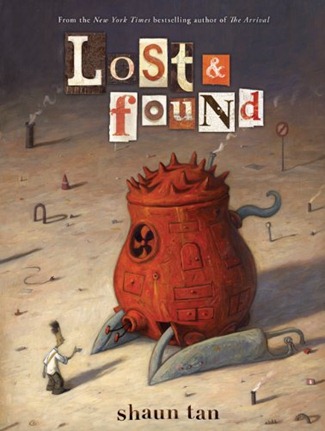
Lost & Found by Shaun Tan

This collection of three stories by Tan which were previously published in Australia as separate stories combine to create an incredible experience.  Tan wrote two of the stories himself and did the art for all three.  The three stories are unique and different, though they are all about loneliness, discovering what is right in front of us, and unexpected beauty. 

The Red Tree tells the story of a woman trapped in darkness, though if you look closely you will see a sign of hope that continues through the images.  The illustrations are filled with large urban buildings, strange mechanical beings, and empty curving landscapes.  Until finally, the red tree is found where you least expect it. 

The Lost Thing is the story of a man who discovers something strange on the beach.  It was something odd, unusual and completely out of place.  The man searches for where the lost thing belongs, eventually taking it home with him and figuring out what it eats.  But this is not a story of a lost and new pet.  It is a story of secret places, unusual beings, and discovering what you were once blind to.

The Rabbits is a story written by John Marsden, who is also from Australia.  The story takes a look at the colonization of Australia through the story of the rabbits entering and taking over the continent.  Marsden and Tan create a story that tells the tale of take over, theft and oppression through animals, at once making it a story that can be told clearly and coolly but also one that echoes with tragedy on a larger scale.  For me, this was the story in the book that resonated and continues to linger.

Tan pays close attention to details throughout the book.  The transitional pages between the stories create a unified feel to the book, tying the stories together as if they are hand-in-hand.  The effect of the three stories is one of uniqueness and universal themes. 

Beautifully created, these stories are a treasure for graphic novel fans who will find out that graphic novels can be artistic, deep, compassionate and amazing.  Appropriate for ages 12-15.

Reviewed from copy received from Scholastic.

Also reviewed by:

Booklist’s Top 10 Graphic Novels for Youth

Booklist has a list of their top picks for 2011 Graphic Novels for Youth selected from those reviewed in the past 12 months.


Crogan’s March by Chris Schweizer

The Little Prince by Antoine de Saint-Exupery and Joann Sfar

The Meeting by Brigitte Luciani

The Odyssey by Homer and Gareth Hinds


Return of the Dapper Men by Jim McCann

Scary Godmother by Jill Thompson

Set to Sea by Drew Weing


Trickster: Native American Tales ed. by Matt Dembicki

The Unsinkable Walker Bean by Aaron Renier

Yummy: The Last Days of a Southside Shorty by G. Neri, illustrated by Randy DuBurke

Owly & Wormy: Friends All Aflutter

owlyandwormy

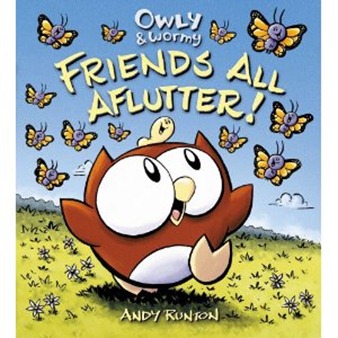
Owly & Wormy: Friends All Aflutter by Andy Runton

The popular Owly graphic novels make their picture book debut with this colorful new story.  Owly and his best friend Wormy want to make friends with some butterflies.  So they plant a milkweed plant, hoping to attract some.  All they manage to attract are some bugs that are definitely not butterflies and that are munching on the milkweed leaves.  Owly and Wormy make friends with the bugs instead until one day the bugs have to leave.  Now Owly and Wormy are left alone.  They wait and wait for their friends to return.  When they eventually do come back though, Owly and Wormy don’t recognize them!

Runton’s friendly and funny Owly graphic novels are some of my go-to graphic novels for younger children.  This new book makes the Owly stories available to even younger readers.  With the wordless format, this is a book that will appeal to children just about to become readers themselves. 

Add the bright colors to the illustrations and you have a very appealing book that is about friendship and metamorphosis.  The cartoon-like illustrations filled with smiling faces large and small are very friendly themselves.  The illustrations run from two-page spreads to smaller more graphic-novel-like images that read as panels.

This book takes graphic novels to the youngest readers and introduces them to a friend that they can share adventures with for years to come.  Appropriate for ages 4-6.

Reviewed from copy received from Simon & Schuster.

Zita the Spacegirl: A Girl-Powered Graphic Novel

zita_frontcover

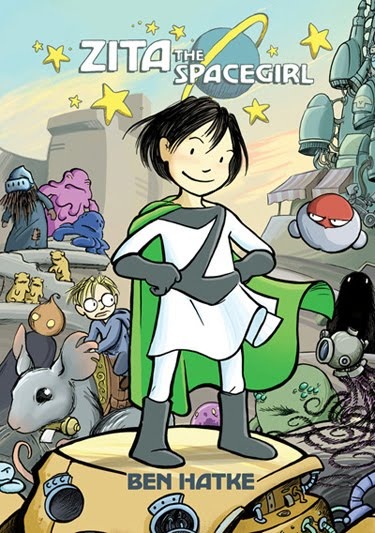
Zita the Spacegirl by Ben Hatke

This is a great graphic novel for elementary readers who will enjoy the action and the science fiction setting.  Zita and her friend Joseph see a meteoroid fall to earth.  When Zita looks closely, she sees that there is something embedded in the meteoroid.  It looks like a red button and despite her friend’s protests, she presses it.  Immediately, a rift opens and sucks Joseph through it.  After some moments of panic, Zita presses the button again and heads through the rift to rescue her friend.  On the other side of the rift, Joseph is being dragged away by a strange multi-armed alien who flies off with him in a space ship.  Now Zita is left alone in a strange world filled with amazing creatures.  Unfortunately, it’s a world about to be destroyed by a giant asteroid.   How is Zita going to be able to save her friend before the planet is demolished?

Hatke is a great storyteller.  Zita is a friendly, determined and strong girl character, who remains solidly the heroine of her story.  Through his friendly illustrations Hatke has created a world that makes one feel at home despite its strangeness.  The adventure here is thrilling, dangerous and great fun.  As Zita adventures through the world, readers will enjoy the humor of different characters.  Hatke embraces nuanced characters as well, which is a treat in a graphic novel for children.

The illustrations here have an anime appeal to them.  Young fans of Pokemon will feel right at home with the variety of creatures that Zita meets. 

This is one of those great graphic novels that belongs in every library collection.  Sure to check out and be very popular, just face this one out and watch it check out of the library.  Appropriate for ages 8-12.

To get a sense of the illustrations, you can view the video below:

Zita the Spacegirl Trailer

Reviewed from copy received from First Second.

Also reviewed by:

The Literate Mother

Little Lamb Books

Perpetual Learner

2011 Great Graphic Novels for Teens

Another fabulous list for collection building at libraries!  The 2011 Great Graphic Novels list has 63 titles on it.  Here are the Top Ten Titles.


Brain Camp by Susan Kim

Chew V.1. : Taster’s Choice by John Layman and Rob Guillory

Ghostopolis by Doug TenNapel


Green Monk by Brandon Dayton

Meanwhile: Pick Any Path by Jason Shiga (my review)

Saturn Apartments V. 1.  by Hisae Iwaoka


Set to Sea by Drew Weing

Smile by Raina Telgemeier (my review)

Yummy: the Last Days of a Southside Shorty by G. Neri and Randy Duburke (my review)

The Zabime Sisters by Aristophane and Matt Madden

Binky to the Rescue: A Second Silly Adventure

65507552

Binky to the Rescue by Ashley Spires

This sequel to Binky the Space Cat continues Binky’s adventures as a cat who believes he lives in outer space.  The graphic novel format is an ideal way to showcase the wry humor of the story.  In this latest adventure, Binky is busily battling his enemies, the insects that he considers aliens.  But when he pushes too hard on a window screen, he falls out the window and into the backyard, or outer space!  Luckily, Binky thinks quickly and finds a oxygen source (the garden hose) and ties himself down securely to keep from floating off (on a garden gnome.)  He takes notes on alien activity and as he is doing that notices that his co-pilot Ted has also fallen into outer space.  But before he can rescue Ted, he is attacked by wasps and then taken inside by his human.  Now Binky must launch a brave rescue of Ted by re-entering the vastness of outer space.

Spires’ illustrations are very funny, showing the truth of Binky’s situation clearly to the reader.  Much of the humor is physical and vaudevillian, playing out in the illustrations themselves.  The use of graphic novel format will make this series one that children, especially reluctant readers, will pick up and enjoy.  Even better, Spires is not afraid of using some fart humor every now and then.  Perfect for the target age.

The text is just as funny as the illustrations, taking a wonderful tone that will immediately have readers connecting it with science fiction films.  Nicely, the narration plays entirely into Binky’s fantasy, so readers themselves have to get the joke of the books.  And they definitely will.

A great sequel to the first book, this book should be added to elementary school graphic novel collections and children’s collections in public libraries.  Appropriate for ages 6-9.

Reviewed from copy received from Kids Can Press.

Also reviewed by:

Yummy

Yummy: the Last Days of a Southside Shorty by G. Neri, illustrated by Randy DuBurke

This graphic novel tells the true story of Robert “Yummy” Sandifer.  In 1994, Yummy, called that because of his sweet tooth, fired a gun into a crowd of rival gang members.  He ended up killing a bystander, a teen girl.  Yummy was just 11 years old when this happened.   The story is told from the point of view of Roger, another boy who knew Yummy from school and the neighborhood.  Roger tries to make sense of Yummy and how he became a gang member and killer.  This is made even more tangible to Roger because his own brother is in the same gang as Yummy.  Throughout this book, deep questions are asked and explored.

Neri’s text creates a great platform to understand the gang wars of the 1990s and the dynamic of southside Chicago.  Though the bulk of the book is from Roger’s point of view, the reader also gets to see what Yummy is going through as he hides from police and is eventually killed by his own gang.  There is a real restraint in the writing that allows the drama of the tale itself to take center stage. 

DuBurke’s illustrations done in black and white are a study in light and dark.  Faces change as the light changes on them, becoming sinister and strange.  The images are dynamic and underline the youth of Yummy and the transition from bully to killer. 

A beautifully crafted graphic novel dealing in brutal subjects, this book is an important exploration of gang warfare.  It is also an even more important look at childhood.  Appropriate for ages 12-14.

Reviewed from copy received from Lee & Low Books.

Also reviewed by:

How I Made It to Eighteen

How I Made It to Eighteen: a mostly true story by Tracy White

Based on the author’s experiences, this book takes a straight-on look at depression and self-destruction.  Seventeen-year-old Stacy Black checked herself into a mental hospital to help deal with her anger and depression.  She had just put her fist through a glass window.  Stacy hated the hospital but knew that she had to be there to survive, so she stayed.  As she spent time there, she developed new friends who helped her in her recovery and in being honest with herself.  Told in graphic novel format that is more like a journal than manga, this book is honest, blunt and intelligent.  Teen readers will easily see themselves in Stacy whether they are struggling with similar issues or not.

This book appears to be a regular novel until you open it and see all of the illustrations.  Done in line drawings, the illustrations are quirky and have the unedited feel of a real journal.  Readers get to know Stacy as well as her friends both in the hospital and from outside.  This perspective shift, done at the end of each chapter is a welcome view of how outsiders view a teen who enters a hospital.  While they express confusion and concern, all of them realize that it was a necessary step.  It is a brilliant and subtle way to tell teens that they will not be vilified if they get the help they need.

Though heavily illustrated, White’s writing is also a large part of the story.  Stacy is a sarcastic and caustic character.  Readers will realize immediately that she is putting on a front, but it takes time for readers and Stacy to acknowledge what exactly has brought her to the hospital and to this place in her life.  The slow unveiling of the basis of her problems mirrors the steps in her counseling.  This makes the entire book feel organic and honest.

A book that teens will enjoy and relate to, this graphic novel will appeal to a much broader audience than graphic novel readers.  Appropriate for ages 14-17.

Reviewed from copy received from Roaring Brook Press.

Also reviewed by:

Lunch Lady and the Summer Camp Shakedown

Lunch Lady and the Summer Camp Shakedown by Jarrett J. Krosoczka

A fourth book in the spectacularly funny Lunch Lady series, this book returns with the same formula of humor and action.  In this book, Lunch Lady is working at a summer camp that the Breakfast Bunch kids just happen to be attending.  This is not going to be the relaxing summer they all expected!  A swamp monster is on the loose at camp, coming out only at night.  Now Lunch Lady and the kids have to once again join forces to find out who is behind the attacks.

The puns here are just as funny as in all of the previous books.  They are guaranteed to have readers groaning and then sharing them aloud with friends.  The art is just as simple and fun too, sticking to the limited color palette that marks this clearly as a Lunch Lady book. 

A winning addition to a very popular series, every library should have this series for young graphic novel fans.  Appropriate for ages 7-10.