What Lane? by Torrey Maldonado

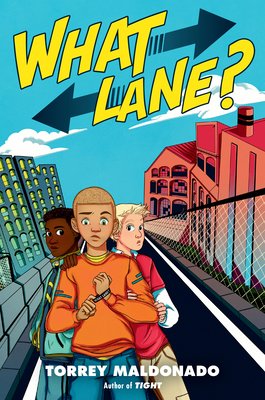
What Lane? (cover image)

What Lane? by Torrey Maldonado (9780525518433)

Stephen loves his Brooklyn neighborhood and spending time with his best friend Dan. Most of the time he doesn’t even notice that he’s Black and Dan is white. But when Dan’s cousin Chad moves nearby, he starts taunting Stephen for being a coward. As Chad dares him to enter an abandoned building, Stephen realizes that he’s the only Black kid in the group. Lately people have been reacting differently to him, now that he’s in sixth grade. People in the neighborhood suspect him first, assume he’s doing something wrong, and watch him in ways that they don’t Dan and Chad. Stephen begins to learn more about being Black in America, the Black Lives Matter movement, and the fact that there are different rules for Black children and teens. But Stephen doesn’t want to be assigned to a lane and stuck there. Is there a way for him to make his own lane with all of his friends, Black and white, included?

Maldonado has written a powerful story that unflinchingly shows the racism inherent in our society, the differences between the ways that white children and Black children are treated, and the dangers faced by Black teens in particular. The inclusion of Black Lives Matter and the focus on the many Black young people who have been killed by police is powerful, strongly tying this fictional story to reality. The realization of Stephen as becomes treated differently by others is shone with empathy and a call for social justice.

The characters here are well drawn. Maldonado shows how being a white ally looks in practice through Dan, how being a non-ally looks in Chad, and the power of friendship across races. But this is not shown as a solution for the systemic racism that he also shows with clarity. It’s a book that will inspire conversation that is necessary.

Powerful and thought-provoking, this look at identity and race belongs in all libraries. Appropriate for ages 9-12.

Reviewed from library copy.

Everything Comes Next by Naomi Shihab Nye

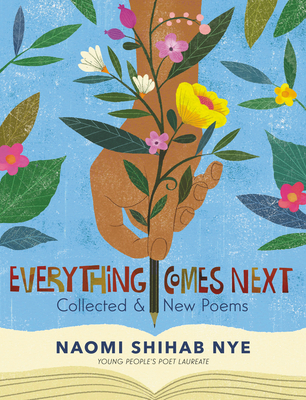
Cover image for Everything Comes Next

Everything Comes Next by Naomi Shihab Nye (9780063013452)

The current Young People’s Poet Laureate has compiled a collection of over 100 of her poems. It is a mixture of both previous published poems and new ones that have not been published before. Though some date back to the beginning of her stellar career and others are newer, there is a strong consistency across the collection with their eye towards hope combined with a strong sense of truth and honesty. Nye also has a way of focusing on the small and mundane in our lives and bringing out the wonder, including flour sifters, toddler comments, and cat food.

I bookmarked far too many of the poems, looking forward to returning to them again. While I had my distinct favorites (and lots of them) there were no poems in this collection that disappointed. The entire collection work both as a whole and as its separate parts. It provides a great introduction to Nye’s poetry.

Perhaps Nye’s greatest quality is her refusal to speak down to children or to simplify her poetry for them. She asks them to stretch to understand them, but not in confusing ways or using esoteric language. The concepts are fascinating, the poems leading the reader but not in a straight line, her poems more of a journey.

A gorgeous collection of poetry from one of the best. Appropriate for ages 12-15.

Reviewed from e-galley provided by Greenwillow Books.

Ikenga by Nnedi Okorafor

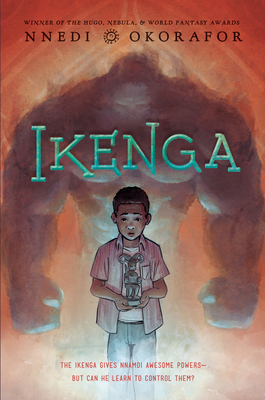
Cover image for Ikenga

Ikenga by Nnedi Okorafor (9780593113523)

Nnamdi’s father was chief of police in Kalaria, constantly rooting out illegal activity. After his murder, the criminals got more and more bold. Nnamdi had to witness one of the worst criminals, the Chief of Chiefs, attend his father’s funeral. When his father appears to him in a vision, he gives Nnamdi an ikenga, a magical statue. The statue imbues Nnamdi with super powers, transforming him into a fighter for justice, huge like the Incredible Hulk with a deep voice and superhuman strength and speed. Now Nnamdi has the power to continue his father’s work and find who murdered him. But the powers are difficult to control, feeding off of Nnamdi’s growing rage at his father’s death and his family’s poverty and loss. He knows he can use them to do good, sometimes though the powers take control and he ends up hurting people. It’s up to Nnamdi to discover a way to use his powers and solve the murder without losing himself along the way.

Okorafor is the author of the Akata series for teens. This is her first middle grade novel. She does it so well that I hope that she does more. Set in modern Nigeria, the novel gives young readers a glimpse of a country rarely shown in American children’s books. Okorafor crafts a rich setting for readers, really integrating the setting deeply into the story itself. Her plotting and pacing are marvelous too, creating moments of wild rage and action alongside more mundane day-to-day life which is then turned upside down by the magic of the criminals.

Nnamdi is a complex hero. Interested in comics himself, it’s great to see him become his own hero through a thoroughly Nigerian process. While he compares closely to the Hulk when he is transformed, he is also his own being, struggling with control. One of the best parts of the book is that the villainous criminals have layers too, which will surprise readers as they are revealed.

Super heroes, Nigeria, magic and adventure make for a unique and splendid read. Appropriate for ages 9-12.

Reviewed from library copy.

Twins by Varian Johnson

Cover image of Twins

Twins by Varian Johnson, illustrated by Shannon Wright (9781338236132)

Maureen and Francine are twins who have always been in the same classes, participated in the same activities and had the same group of friends. But sixth grade is different. The girls are in different classes and don’t even spend a lot of time together after school any more. Maureen finds herself hanging out with their friends at the mall but not with Francine, who’d rather be called Fran now. Maureen is struggling with marching for the cadet troop she is part of, so in order get extra credit for her grade, she is encouraged to run for a class office. Fran too is planning to run for president. So the battle grounds are set when Maureen decides to run for president too to prove that she can be just as brave and outgoing as Fran. The problem is that she might not be after all!

In this graphic novel, Johnson, himself a twin, captures the dynamics of close siblings perfectly. The two sisters go back and forth between adoration, supportiveness, strife and anger. It makes for a dynamic book that really looks at the differences between twins, the way feelings get hurt and how that can play out in larger decisions. That difference between the two girls is explored throughout the book, giving it layers and eventually showing how differences can make them both stronger for each other too.

I reviewed this from an unfinished galley, so my copy did not have full-color images throughout. The art throughout the graphic novel shows the relationship between the two girls and their emotions clearly. The pages are filled with diverse characters.

Sure to be popular, this graphic novel appears light but has lots of depth to explore about sisterhood. Appropriate for ages 9-12.

Reviewed from ARC provided by Scholastic.

Spindlefish and Stars by Christiane M. Andrews

Cover image of Spindlefish and Stars

Spindlefish and Stars by Christiane M. Andrews (9780316496018)

Clo has grown up on the road with her father. They move from village to village, taking small things every time but also repairing and fixing paintings too. When her father doesn’t return one morning, Clo puts their regular leaving plan in action, waiting for him in the woods. But her father doesn’t come, instead sending a boy with a strange ticket and a garbled written message to head to the harbor. There Clo finds she has a half passage aboard a strange ship. They take her to a strange gray island where there are no seasons, no day or night. Clo must wait there for her father to join her. She makes one friend, Cary, on the island where she can’t understand what anyone else is saying except for him. Her grandmother has taken her in, trying to force her to eat a strangely cold and fishy stew that Clo refuses to even try. Her grandmother wants Clo to work, but Clo is busy trying to watch for her father and to figure out the mysteries of the island itself. Clo steadily figures out the mysteries of the island, but it may not be enough to save herself and her father.

Based on Greek mythology, this children’s novel is a marvel of a book. It steadily reveals itself, a puzzle started by an ink-blotched note, a strange transport via ship, and then an even more odd island. One knows there is more going on, but the book holds it back, revealing it to the reader just before Clo herself begins to figure things out. The ties to mythology are dazzling, offering the Fates and Icarus as major characters, though not obvious at first. The pacing here is just right, never losing itself in the grayness of the island nor moving too quickly to resolution.

Clo is a great heroine, braver than many would be in her situation. She is opinionated and stubborn, two qualities that serve her well as she figures out the mysteries of the island and does not bow down to the pressure to conform. Her connection with others serves as a beacon for her to find a way forward, even as it threatens her own existence.

Tantalizing, puzzling and very satisfying, this Greek myth fantasy dazzles. Appropriate for ages 9-12.

Reviewed from e-galley provided by Little, Brown Books for Young Readers.

The Magic Fish by Trung Le Nguyen

The Magic Fish cover image

The Magic Fish by Trung Le Nguyen (9780593125298)

Tiến loves to spend the evening together with his mother reading from a book of fairy tales. He reads while his mother continues her work as a seamstress, sometimes fixing Tiến’s clothing too. They don’t have much money, so Tiến’s jacket is full of patches. Happily, his friends don’t mind, not even the boy who Tiến has a crush on. As they share the tales, Tiến is searching for a way to share with his parents that he is gay, but they don’t speak English well, and he can’t find the right word in Vietnamese. When his grandmother dies in Vietnam, his mother leaves to prepare her funeral. Tiến is left behind to navigate his first school dance, where his teacher becomes concerned and he is sent for church counseling. What will his mother say when she finds out?

It is remarkable that this is a debut graphic novel. It is done with such finesse, weaving the fairy tales and the modern world together into a place full of possibility and transformation. The stories shared include versions of Cinderella and The Little Mermaid, versions that grow and change themselves with endings that will surprise those who know the better-known stories. In this way, the author creates real hope on the page, that things will change, that love will prevail and that understanding will flourish, both through tales and in real life.

The art here is unique and exquisitely done. Using color to tell readers whether they are seeing the real world in the present, a flashback or a fairy tale, the effect is both dramatic and clarifies the borders between the various stories. The fine-line work here is beautiful, from each hair on the character’s heads to gorgeous dresses that swirl across the pages to dramatic landscapes and undersea worlds.

A great graphic novel that is about diversity, acceptance and the power of stories to bring us together. Appropriate for ages 9-12.

Reviewed from e-galley provided by Random House Graphic.

Displacement by Kiku Hughes

Displacement cover image

Displacement by Kiku Hughes (9781250193544)

This historical graphic novel takes a modern-day teen and puts her back in time. Kiku is vacationing with her mother in San Francisco, when she first travels through time back to World War II. As the mists form around her, she finds herself watching her grandmother play her violin as a teen. It happens again the next morning, when Kiku finds herself joining the line of Japanese-American people heading for the internment camps. Those experiences were shorter. But then Kiku finds herself back in time for a longer period as she experiences the internment camps herself. She lives near her grandmother, but can’t bring herself to actually meet her face to face. As Kiku witnesses and actually lives the experiences of Japanese-Americans in the internment camps, seeing how they suffered, the restrictions, the injustice but also the communities that were formed in the camps.

Hughes uses a dynamic mix of modern and historical in this graphic novel. She takes the sensibilities of a modern teen and allows readers to see the world through Kiku’s eyes. When Kiku is stuck in time, readers get to experience the full horror of the internment camps and what our country did to Japanese-Americans. Hughes ties our current political world directly to that of the camps, showing how racist policies make “solutions” like internment camps more likely to happen. She also keep hope alive as well, showing Kiku making friends and also developing a romantic relationship with a girl she meets.

The art is done in full color throughout. The color palette does change between modern day and the internment camps, moving from brighter colors to more grim browns, grays and tans. Hughes uses speech bubbles as well as narrative spaces that let Kiku share her thoughts. There are no firm frames here, letting colors dictate the edges of the panels.

Timely and important, this is a look at what we can learn from history and stop from happening now. Appropriate for ages 12-15.

Reviewed from copy provided by First Second.

The Sisters of Straygarden Place by Hayley Chewins

The Sisters of Straygarden Place cover image

The Sisters of Straygarden Place by Hayley Chewins (9781536212273)

Mayhap lives with her two sisters in Straygarden Place, a magical mansion that caters to all of their needs. The house feeds them, tucks them into bed at night, and gives them anything they wish for. But the house can’t bring back their parents, who disappeared into the tall silver grass that surrounds the house seven years ago. Now Winnow, the oldest of the sisters, has entered the grass herself. When she returns, she is different: her eyes are turning silver and she is unable to speak. Mayhap in particular seems to upset Winnow, so Pavonine, the youngest cares for her. Meanwhile, Mayhap is determined to figure out how to save her sister. She encounters a mysterious other girl in the house, one who claims to have been there a long time and who is connected with the house. As Mayhap begins to unravel the mystery of the house, she must face the truth about herself and her sisters and what has been stolen from them all.

Chewins has created a delicious mystery here. It’s a marvelously constricted mystery, set in a house that no one dares leave, surrounded by sentient grass, and filled with strange contraptions, rules and delights. It’s the ideal book for a pandemic lockdown, sharing much of the qualities of our lives over the past few months. Chewins has created a truly eerie setting, the grass whispering at the windows and the house revealing spaces that the girls never knew existed. The clues are glimpses into their own past as well as that of the house itself.

The entire book is filled with marvelous details. There are the dogs who climb into the girls’ heads so that they can sleep. There are the carpets that thicken to provide padding or move to carry Mayhap to a new part of the house. There are delightful meals provided by the house, that can be clues as well. And a coffee-scented library that makes one want to linger with the living card catalog. Mayhap herself is a grand heroine, willing to sacrifice herself for her sisters and determined to understand what is actually happening to them all.

A genre-breaking book that is a fantasy-mystery with Victorian delights and horrors that will enter your dreams. Appropriate for ages 9-12.

Reviewed from e-galley provided by Candlewick.

All He Knew by Helen Frost

All He Knew cover image

All He Knew by Helen Frost (9780374312992)

Henry started out life talking and able to hear, until a fever took his hearing as a small child. By the time Henry is six, he is labeled as “unteachable.” He is turned away from the school for the deaf after failing their test, refusing to blow out a candle when asked. His parents are encouraged to send him to an institution where he will be cared for. Given their lack of money during the years before World War II, they reluctantly agree. Henry is sent to Riverview, where his life becomes bleak, food is often scarce, children are beaten and restrained. He makes some dear friends there though, working to protect and care for them even as the system works to tear them down. When World War II starts, Victor arrives at Riverview. He’s a conscientious objector, sent to work as an attendant there. He quickly learns that Henry is far from unteachable, reaching out to Henry’s family, including Henry’s beloved sister who has always seen that Henry is smart and kind.

Frost is a master at the verse novel, creating entire worlds that spin by with her poetry. Here the verse draws readers into the darkness of Riverview. One could get caught in that dark, but Henry is there to show a way to see the squirrels outside the window, make friends with some of the other children, and find a way to live one day at a time. While he misses his family horribly and does not understand what happened to make them send him there, he understands much more than everyone thinks he does.

Frost keeps hope at the center of the book. She uses both Victor and Henry’s sister and family members in this way. They all love Henry, trying to figure out how best to deal with an impossible situation exacerbated by poverty and wartime. But hope really is an inherent part of Henry himself, who faces every day and its brutal challenges with a touch of humor, a courage to defend his friends, and a determination to survive.

An important look at how those with disabilities were treated in our country and how conscientious objectors made a difference in their lives. Appropriate for ages 9-12.

Reviewed from copy provided by Farrar, Straus & Giroux.