Some Kind of Happiness by Claire Legrand

Some Kind of Happiness by Claire Legrand

Some Kind of Happiness by Claire Legrand (InfoSoup)

Finley’s parents are having trouble, so they decide that it is best that she spend the summer with her grandparents even though Finley has never met them before. Something happened that made her father leave the family and not speak to his mother again. Finley struggles with “blue days” where she can barely get out of bed and doesn’t have any energy at all. Other days, she spends writing about Everwood, an imaginary land that has parallels to the real world. When she arrives at her grandparents’ home, she realizes that Everwood is a real place and it is right behind their house, complete with a half-destroyed house, villainous pirates, and a trustworthy knight to share her adventures. As Finley and her cousins go deeper into the fantasy world, the truth begins to surface about what happened years ago to their parents and grandparents.

Legrand has created an intensely gorgeous book here that is complex and multi-layered. Finley’s writing about Everwood is interspersed throughout the book so readers can see the detailed and wondrous world she has created. Readers will also clearly see the ties between Finley’s life and what is happening in Everwood. The whole book is a testament to writing that balances strength of vision with a delicacy of execution that allows those ideas to grow and come alive. The relationships of the adults in the book also supports this with various personalities stepping out at different times. There is a humanity to the adults here, a fragility that lets young readers glimpse the truth in pieces before it is revealed.

Finley’s depression and anxiety in particular are captured with sensitivity and grace. It is shown as a part of her personality, not the only characteristic and not one that overwhelms her constantly. Rather it is a factor in her life, one that doesn’t stop her from bonding with her cousins or being creative and imaginative. This is a book that shows that mental illness may impact your life but not destroy it and that there is power in honesty and getting help.

A deep book filled with the magic of imagination, new-found family and one large woods. Appropriate for ages 11-13.

Reviewed from copy received from Simon & Schuster.
 

As Brave As You by Jason Reynolds

As Brave As You by Jason Reynolds

As Brave As You by Jason Reynolds (InfoSoup)

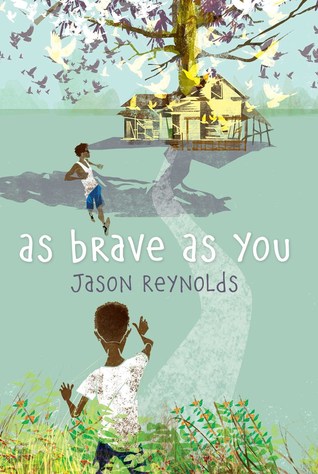
Genie and Ernie are heading to Virginia to stay with their paternal grandparents for the very first time. Though they have met their grandmother before, this is the first time that Genie has met him. The difference between their lives in Brooklyn and their grandparents’ home in rural Virginia are huge. But that’s not the only thing that surprises Genie. He is shocked to find out that his grandfather is blind. Genie is a kid who is full of questions to ask all of the time and so he immediately asks his grandfather questions about his blindness. Genie knows that his older brother Ernie is braver than he is, always taking up fights for Genie and protecting him. He also knows that his grandfather is immensely brave too. When something goes wrong though, Genie will have to rethink what it means to be brave.

Reynolds is so amazingly gifted as a writer. He astounded me with this departure from his more urban writing. He captures the rural world with a beautiful clarity, using the natural world around as symbols for what is happening to the humans who live there. It is done both subtly and overtly, creating a book that is multi-layered and gorgeous to read. Throughout Reynolds speaks to real issues such as guns and disabilities. They are dealt in their complexity with no clear point of view stated, giving young readers a chance to think things through on their own.

Reynolds has created a fabulous protagonist in Genie, a boy filled with so many questions to ask that he has to write them down to keep track of them. He is smart, verbose and caring. Yet at the same time, he agonizes over mistakes, trying to fix them on his own and thus creating a lot of the tension of the book. The depiction of the grandparents is also beautifully done, allowing them to be far more than elderly figures. They are often raw, sometimes wise, and also dealing with life.

A brilliant read for the middle grades, this book is filled with magnificent writing and great diverse characters. Appropriate for ages 9-12.

Reviewed from copy received from Atheneum.


Daughters of Ruin by K.D. Castner

Daughters of Ruin by KD Castner

Daughters of Ruin by K.D. Castner (InfoSoup)

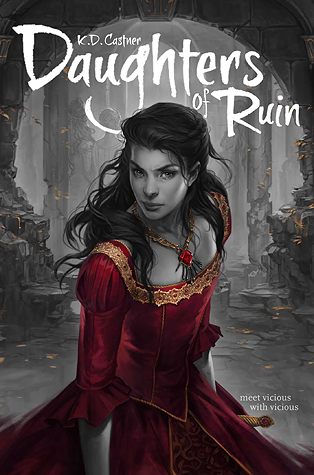
Four princesses have all lived together as sisters since they were small children. But they are far from being sisters, each heir to their own throne. After a war ravaged all of their kingdoms, the victor brought the daughters of his enemies together in peace to forge a new truce. Ten years later, the girls still live together but the peace between them is strained and fraying. There is Rhea, distrusted by the other princesses because her father is the king. Cadis is the beauty and the strongest fighter but there is some question about whether her democratic sea-faring society even lets her be royalty. Iren is the quiet and meek one, concentrating on long letters home to her mother. Finally there is Suki, the youngest of them and most volatile. When the peace of the palace is breached, the princesses have to choose alliances and take up arms.

Castner has created a very strong debut novel. She has not just one strong young woman but four, each of them different from the others. Castner gives them each a unique perspective and voice and yet also keeps them from becoming stereotypical in any way. These are all princesses of war, teens who have been raised to kill and damage, to defend their kingdoms and to win. While some of them are closer than others to being true sisters and friends, others are almost enemies. The dynamics of a four teenagers living closely together and isolated is intriguing and Castner captures the subtleties of it as well as the broader issues.

Castner focuses mostly on the girls themselves and the world comes into focus as the girls leave the palace and venture outside it. Because so much of the book is political intrigue, it makes for a book that truly is from the perspective of the main characters where what they are touched by is the thing that the reader knows most about. In this way, Castner also avoids lengthy exposition about the world made up by the kingdoms. There is just enough detail for it all to make sense and work and nothing more.

Strong female protagonists who wield weapons with panache combine with politics and plenty of twists and turns to create a debut worth exploring. Appropriate for ages 12-15.

Reviewed from copy received from Margaret K. McElderry Books.


Saving Montgomery Sole by Mariko Tamaki

Saving Montgomery Sole by Mariko Tamaki

Saving Montgomery Sole by Mariko Tamaki (InfoSoup)

Montgomery has two best friends who are the reason that she can make it through high school at all. They have a Mystery Club at school where they are the only members and they explore the mysteries of the universe. Thomas loves to talk about superheroes and Naoki focuses on crystals. With Monty’s two moms and Thomas being bullied for being gay, Monty knows there is hate in the world, something made even clearer when a preacher arrives in town putting up signs against people who are gay. When Monty buys The Eye of Know online, she doesn’t expect it to work any better than their other experiments, but soon the Eye seems to be channeling Monty’s personal anger and exacting revenge.

Tamaki captures the anger of a teenager with precision here. It all feels deeply organic, often not being logical at all, lashing out at those she loves, and withdrawing into her room. The issues that Monty is furious about are so tangible both in her life and in her friendships, yet she goes much farther than those who love her would want her to. There is a sense of her reaching a cliff of anger and having to make a choice of how she is going to be in the world. It’s a powerful place to set a YA novel and works well.

The magical realism in the book is done well too. It strikes a balance between being entirely believable but also allowing readers to see it as something that could be unrelated too. Readers will get to see what their own opinions of mysteries of the universe are in this well-written novel.

A novel about anger and its positive and negative sides, this book will speak to young teens navigating their own issues. Appropriate for ages 12-14.

Reviewed from copy received from Roaring Brook Press.


The Lie Tree by Frances Hardinge

The Lie Tree by Frances Hardinge

The Lie Tree by Frances Hardinge (InfoSoup)

Faith appears to be a very somber and dutiful daughter to her father who is a clergyman and a natural history scholar. When their family is forced to leave Kent for a small island, Faith discovers that her father’s entire body of work has been discovered to be based on lies and that their family is disgraced. Faith desperately wants to be seen as more than a burden to her father, so she helps him move a valuable specimen to a secret sea cave reached by boat. Soon afterwards, her father dies and people suspect it was suicide. Only Faith thinks that it could have been murder and may have something to do with the tree they moved to the cave. It’s a tree that only bears fruit when a lie is whispered to it and grows in strength as the lie grows too. Now Faith is the only one who knows where the tree is and that may be enough to have her become a target too.

Hardinge’s writing is breathtaking. She uses unique and unusual metaphors that are compelling and vivid, further building her world of lies, distrust and isolation. At times the writing is so beautiful that it stops the reader so that it can be reread again. At other times, the pace rockets forward, the reader clinging on and whooping along. Hardinge has created in the tree itself a beautiful metaphor for lies, the fruit they create and the power they can bring.

Throughout the strictness of Victorian society is at play, creating a world of rules that must not be altered or broken. In that world is Faith who must figure out how to solve a murder that only she believes has happened in a society where she is to be quiet and docile lest her reputation be forever ruined. As the book continues, readers will be carefully shown their own sexism about female characters to great effect. This is feminist writing at its finest.

Stunning writing, a compelling young heroine and a world filled with rules and lies, this is one amazing read that mixes fantasy, historical fiction and a big dash of horror. Appropriate for ages 10-13.

Reviewed from library copy.


Booked by Kwame Alexander

Booked by Kwame Alexander

Booked by Kwame Alexander (InfoSoup)

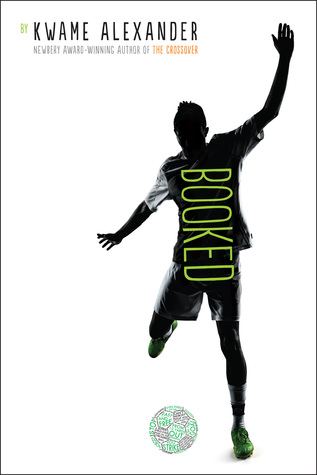
In his follow up to the Newbery-Award-winning The Crossover, Alexander once again blends sports and poetry. Nick loves soccer and is really good at it too. Nick and his best friend are on opposing teams in an upcoming soccer cup and Nick is also getting ready to ask out April, a girl he can’t stop thinking about. Everything is going well except for his father who insists that Nick read the dictionary of large words that he personally created. That’s when Nick finds out that his mother is moving away for a job working with horses, leaving Nick with his father, not a great combination. Nick will have to rely on soccer and his best friend to get him through this rough patch. Because there is more tough road to come.

Alexander is quite simply amazing. He writes verse that is both poetic and beautiful but also accessible and welcoming to young teens who may be far more interested in kicking a ball than reading a book, especially a book of poetry. Alexander also demonstrates throughout the book the power of words both in his poetry itself and through the story line, where Nick is clearly smart and uses words from his father’s collection without even thinking about it. Nicely, definitions are provided in footnotes.

Nick is a protagonist who is easy to relate to. He has several things on his mind: soccer, girls and gaming. It is life though that pulls him outside of those interests and broadens his scope. His father does this in a clumsy way, forcing Nick to learn words. A school librarian also helps, getting books that Nick will clearly love directly into his hands. So as much as this is a book about a smart young teen boy, it is also a book about the power of having adults who care in your life.

A worthy follow-up to his first verse novel, this book is just as beautifully written. Appropriate for ages 11-13.

Reviewed from library copy.


Wolf Hollow by Lauren Wolk

Wolf Hollow by Lauren Wolk

Wolf Hollow by Lauren Wolk (InfoSoup)

Growing up in rural Pennsylvania in 1943, Annabelle lives a quiet life where she hopes for adventure. She attends a one-room schoolhouse with her two younger brothers, walking there from their family farm each day. That quiet life changes when Betty Glengarry arrives at school. She immediately targets Annabelle, demanding payments in exchange for not hurting Annabelle and her brothers, killing a bird without remorse. Annabelle does not want to worry her family with her troubles, so she keeps them to herself. Soon though things escalate with her youngest brother running into a sharpened wire along the path. After that, Annabelle’s best friend is maimed with a rock that Annabelle knows was thrown by Betty. Betty though blames Toby, a reclusive man who walks the paths all day long with guns slung on his back. Toby has been nothing but kind to Annabelle and her family, but he is considered strange by many. When Betty disappears soon after making the allegation, Annabelle decides that she must rescue Toby from the new accusations being made.

Wolk has created a rich and beautiful world for Annabelle to live in. The hills and valleys of the Pennsylvanian countryside offer not only a rich farming world but also a place where secrets can hide and dangers lurk. The setting of Wolf Hollow itself with its history of trapping wolves in pits is a striking analogy for what happens in the novel. Annabelle herself is brave and clever, a girl who is bullied awfully and then has the power placed in her hands to make a difference for someone she cares about.

This book focuses on the courage it takes to stand up for what is right, for what one knows deep down to be true. It is a book that speaks to all of those who are strange among us and the way that rumors and accusations tend to target them. It is also about the power a child can have in an adult world, the difference one person can make. It is also a book that is dark and complicated: one where girls disappear, where Germans are not welcome, and where hate is fast to develop.

This is a complex and layered novel that is a deep and compelling read focusing on bullying and the impact of war. Appropriate for ages 10-13.

Reviewed from ARC received from Dutton Books for Young Readers

On the Edge of Gone by Corinne Duyvis

On the Edge of Gone by Corinne Duyvis

On the Edge of Gone by Corinne Duyvis (InfoSoup)

The author of Otherbound returns with a stunning science fiction novel for teens. Denise and her mother are ready to leave their apartment, but her mother won’t move fast enough. She is trying to wait for Denise’s sister, Iris. Now they are not going to reach the shelter in time and that means that they probably won’t survive the comet hitting Earth. As they drive the empty streets to their temporary shelter, desperately late, a chance encounter leads them on another path. Instead of a temporary shelter, they are offered shelter in a generation ship that will wait out the comet hit and then leave earth. Now it is up to Denise to figure out how to fix everything, to find her sister in destroyed and flooded Amsterdam, and even more importantly get them all a spot on the generation ship before it takes off. But who is going to take Denise who is autistic and her mother who struggles with drug addiction?

Duyvis set this book in her native Amsterdam and throughout the novel, one can see her love for her nation and her city. Yes, she destroys much of it, but the spirit of the people is clear on the page as is the beauty of the city even through its destruction. The science here is done just right, with a clear connection to today’s technology but also taking it leaps ahead, allowing readers to truly believe it is 2035. This book is not afraid of asking difficult questions about disabilities and addiction and whether only the perfect deserve to survive in this situation.

The book is beautifully written, with an impressive protagonist who shows that disabilities are no reason that you can’t be a survivor and even more so, a heroine. Denise is a beautiful mixture of autistic behaviors when she is pushed but also bravery and resilience. The book is an intelligent mix of adventure and survival with a compelling question of what could make Denise worthy enough to stay. There are additional ethical questions throughout, including how far one would go to save a loved one.

A brilliant science fiction novel that offers diversity and a powerful story. Appropriate for ages 12-15.

Reviewed from ARC received from Abrams.


The Nameless City by Faith Erin Hicks

The Nameless City by Faith Erin Hicks

The Nameless City by Faith Erin Hicks (InfoSoup)

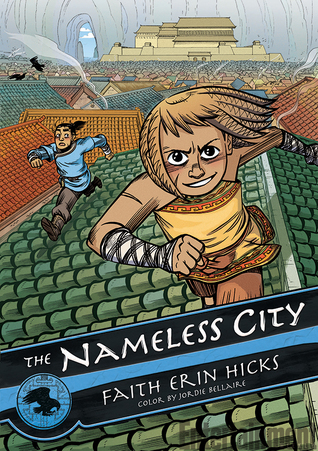
Kaidu has moved to the City, a city with no name because every time it is invaded it gets a new name. For those who are native to the city, they survive by not getting involved and living their lives despite those who rule them. Kaidu is one of the Dao, the current occupiers of the City. He is training to be a warrior, hoping to get to know the man who is his father. Kaidu loves the City and finds himself exploring its streets alone despite the rules forbidding it. It is in the City that Kaidu meets Rat, a girl who can dash along the rooftops of the city, make amazing leaps across space, and who lives on the streets. The two become friends slowly, first with Rat training Kaidu to run while Kaidu brings her food. Soon the two unlikely friends must decide whose side they are on as war and murder approach them and the City they love.

Hicks is the author of Friends with Boys and Nothing Can Possibly Go Wrong, both wonderful graphic novels. In this new book, she moves into historical fantasy where she has created a city at the center of warring nations. The world building here is exceptional, the entire city feels vibrant and alive as the characters move through it. Readers get to feel the same wonder as Kaidu as they explore the city and see the amazing Hole in the Sky that leads in. Hicks has a great sense of timing in the book, allowing moments to stretch and grow while others rush past in bursts of adventure and action.

The art is gorgeous as well. The two main characters play against each other visually, both of their races different but not clearly defined. This is a very important piece of the story, a decision that makes the book work on an entirely different level. It’s smart and sophisticated building of a society on a visual level.

The first book in a new series, I look forward to seeing where these dynamic characters take us next. Appropriate for ages 9-12.

Reviewed from copy received from First Second.