Review: My Basmati Bat Mitzvah by Paula J. Freedman

my basmati bat mitzvah

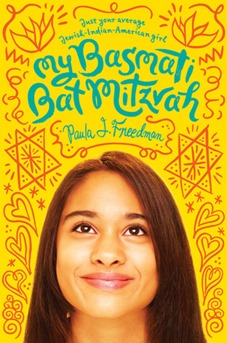
My Basmati Bat Mitzvah by Paula J. Freedman

Tara’s father is Jewish and her mother is East Indian, so Tara has mixed feelings about her upcoming bat mitzvah.  Some of the kids in her Hebrew class even wonder if she is actually Jewish at all.  Tara though is more concerned with whether she actually believes in God and if she doesn’t, does that mean that she can’t have a bat mitzvah?  She also worries about what celebrating this side of her family says to the other side.  So Tara decides to make sure that both sides of her family are represented by wearing a family sari that had been passed down for generations.  Unfortunately though, the sari is accidentally burned and Tara has to figure out how to tell her mother about it.  But that’s not the only complexity in Tara’s life.  Her best friend Rebecca seems to be spending more time with another girl, someone that Tara doesn’t get along with.  Her other best friend Ben-o seems interested in being more than friends sometimes but other times spends a lot of time with another girl.  It’s up to Tara to navigate all of the confusion and make her bat mitzvah her own.

Freedman very successfully tells the story of a young woman dealing with two distinct family heritages.  Happily, she doesn’t feel the need to build heightened angst about it, allowing Tara’s personal doubts to really drive this part of the story.  Her family around her does not have the same feelings, sharing holidays with one another and enjoying the same foods, most of the time. 

The book has a lightness of tone that makes the book very enjoyable.  Freedman explores bullying with a perfect touch, but less successfully explores the underlying issues.  Tara is a strong heroine who is far from perfect.  She has a temper, responds physically at times, and can be too self-absorbed to really see what is happening with her friends.

Hurrah for a book with a brown-skinned girl right on the cover that explores her multicultural heritage in such a straight-forward way!  Appropriate for ages 11-13.

Reviewed from ARC received from Amulet Books.

Review: March by John Lewis

march

March: Book One by John Lewis and Andrew Aydin, illustrated by Nate Powell

This is the first book in a planned series of graphic novels that follow the life of Congressman John Lewis and his work in the civil rights struggle.  This first book opens with President Obama’s inauguration day and then flashes back to critical points throughout Lewis’ life.  It tells the story of his connection to animals on the farm, particularly chickens.  It also shows him as a young minister and his determination to stay in school and then to attend college.  Readers get to witness the violence of the opposition to the Civil Rights Movement including many pivotal moments in history like the sit-ins at Nashville lunch counters. 

This is one powerful graphic novel.  The writing is sterling and strong.  It shines with an honest portrayal of historical events from someone who did not just witness them, but fought the battles personally.  The book clearly explains the world of the 1950s and 1960s, making sure that modern readers understand the dangers of the times and the differences.  It is both a historical book but also one that is important for modern teens to understand how far we have come and how far we have to go.

Powell’s art is stellar.  It is stirring art that evokes history with a fresh eye.  He creatively uses light and dark, playing with words across it at times, other times allowing the darkness to take control.  There is a sense of witnessing history throughout the book in both the words and the art. 

An impressive graphic novel for teens, this book shines light on the Civil Rights Movement.  Appropriate for ages 12-15.

Reviewed from library copy.

Review: Serafina’s Promise by Ann E. Burg

seraphinas promise

Serafina’s Promise by Ann E. Burg

The author of All the Broken Pieces returns with a new verse novel.  Serafina lives with her mother and father in Haiti.  She and her best friend dream of becoming doctors in order to help save people like her baby brother who died.  But Serafina’s family cannot afford for her to even attend school.  Instead she has to work hard to help her mother who is pregnant with another baby.  Serafina carries water for her family, empties chamber pots, sweeps the floor, and keeps the family fire burning.Her father is one of the lucky ones who has a steady job in the nearby city that he walks to every day.  There is no extra money for anything though, even with his work.  When a large storm comes, their small village is ruined and Serafina’s family moves to higher ground.  It is there that Serafina’s dreams start to come true with her new garden and the money it brings.  Then the earthquake strikes.

Burg tells a gripping story of  a young girl with huge dreams living in abject poverty.  Her family is strong and loving, just unable to lift themselves out of the poverty that surrounds them everywhere.  Burg shares small details of life in Haiti, nicely weaving them into the poetry so that it is revealed in a rich and natural way.  The Creole language is also used throughout the book, offering a rhythm and sound that enlivens the entire setting.

Serafina is a well-developed character.  Many of the poems show her own inner feelings in all of their complex beauty.  She is not a perfect character, sometimes showing stubbornness and jealousy, but that just makes her all the more compellingly human.  And the verse throughout the book is lovely, evocative and very effective.  Readers will know that the earthquake is coming and that also creates a tension that makes the book riveting.

This is a powerful look at the Haitian earthquake through the eyes of one extraordinary young woman.  Appropriate for ages 10-13.

Reviewed from ARC received from Scholastic.

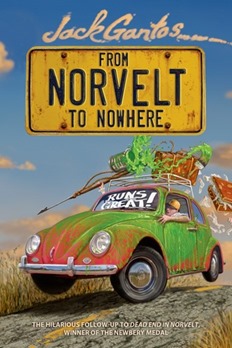
Review: From Norvelt to Nowhere by Jack Gantos

from norvelt to nowhere

From Norvelt to Nowhere by Jack Gantos

Halloween has come to Norvelt right at the height of the Cuban Missile Crisis.  Jack dresses up as the local serial killer to trick or treat, but no one finds him funny.  Even Jack loses his sense of humor when another old lady is killed right in front of him from a poisoned cookie.  Miss Volker, the last surviving original Norvelt woman, takes the murder very personally since the serial killer had been killing in order to marry her.  She is intent on revenge and takes Jack along with her on a cross-country journey to settle the issue once and for all.  But all may not be as simple as it seems as Jack finds himself with plenty of potential killers riding on the same train with them. 

Gantos won the Newbery Medal with the first Norvelt book and it was spectacular.  This book is more of a bumpy ride.  There are moments where Gantos reaches the same smart mix of serious heartfelt writing and humorous situations.  Then it can drag a bit as historical lessons are shared.  But the good thing is that those good parts outnumber the slowdowns and the humor still shines.

A large part of what makes the book work are the characters of Jack and Miss Volker.  This wonderful pairing adds to the fast pacing of the novel, move the story forward and are a pleasure to spend time with.  The book tends to slow when Miss Volker is more quiet and contained.  When she is unleashed, the story is exceptional. 

Fans of the first book will want to read the second and I’m happy to travel along with Jack and Miss Volker anytime.  Appropriate for ages 10-13.

Reviewed from copy received from Farrar, Straus & Giroux.

Review: The Real Boy by Anne Ursu

real boy

The Real Boy by Anne Ursu

The author of Breadcrumbs has returned with another beautiful fairy tale.  Oscar was taken in by the last known magician, Master Caleb, and in return works for him as his hand.  That means that Oscar manages the harvesting and preparation of the many herbs and plants Master Caleb uses in his magic.  Oscar is very happy with his life below the shop, accompanied only by the cats that live there too.  The only problem is Wolf, Master Caleb’s apprentice, who brutally teases Oscar any chance he gets.  But the world around Oscar is quickly changing.  The Barrow, the forest of ancient wizard wood trees that encircles the city, has also begun to be affected.  It may be that the very magic itself is changing too. 

Ursu weaves such beauty into her books.  She lingers over small things, taking the time to build a world in which her characters live.  One examples of this is her description of the Barrow early in the book:

The trees had magic in their leaves, their berries, and their bark.  Plants and shrubs and flowers grew everywhere; purplish-greenish moss crawled on the rocks; improbable mushrooms sprang from the soil in tiny little groves of their own.

The entire book is infused with a sense of rich detail and layering.  Oscar’s own small world below stairs is just as lovingly described and detailed until one longs to be the hand of a magician too and have cats for friends.

Oscar himself is an amazing character.  Because the book is told from his point of view, readers will understand him easily, but Oscar struggles with human beings, emotions and understanding what is meant.  When he is forced out from his snug workspace, the world becomes confusing.  He holds himself stiffly, hates looking people in the eye, and struggles to be social.  Clearly on the autism spectrum, Oscar has unique abilities too, allowing him to see what others do not by paying close attention. 

This amazing fantasy novel is one of the best reads for middle graders this year.  Get your hands on this one!  Appropriate for ages 11-13.

Reviewed from digital galley received from Edelweiss and Walden Pond Press.

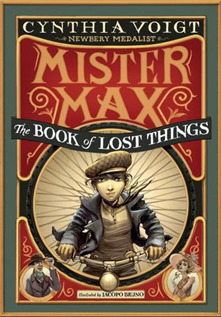
Review: The Book of Lost Things by Cynthia Voigt

book of lost things

The Book of Lost Things by Cynthia Voigt

  Max’s parents who were both well-known actors had been invited to Kashmir, India to start a theater troupe there.  They planned to take Max along with them but then they disappear.  The ship they were meant to take does not exist and they are simply gone.  That left Max with just his grandmother to care for him, but Max knew that if he was well-cared for, his grief would be too much to bear.  Instead he moved back to his family home, across the garden from his grandmother, and had to find a way to earn his keep.  It was through that that he stumbled upon a job at which he was exceptionally good:  being a detective or as Max preferred, a “solutioneer.” 

Set around the turn of the 20th century, this novel has a strong, brisk pace that is invigorating.  Max is a character who is bright, curious and always thinking.  Voigt populates his life with many other interesting characters, including is wonderful librarian grandmother, the various people he helps find solutions for, and even one demanding baby.  The entire book is a vibrant historical fiction that will have great appeal. 

One of my favorite aspects of the novel is the use of painting and creativity as a way to allow your brain space to think and figure things out.  Max is a painter, creating watercolors of the sky during different seasons.  It is this artistic outlet that is a big key to his success and creative thinking.  Voigt ties the two together clearly and also gives other characters creative outlets that make them even more well-rounded.

The first book in a new series, this book is a delight of mysteries, solutions, theater and historical fiction.  Appropriate for ages 10-12.

Reviewed from ARC received from Knopf Books for Young Readers.

Review: Rooftoppers by Katherine Rundell

rooftoppers

Rooftoppers by Katherine Rundell

Sophie was found floating in a cello case after a shipwreck, scooped out of the water by a fellow passenger, Charles, who became her guardian.  He was a single man and a scholar, and unlikely to be a suitable parent, but the two of them got along perfectly well.  The Welfare Agency did pursue the two of them and it finally got so bad that the two fled to Paris before Sophie could be sent to an orphanage.  Sophie knew that her mother was still alive although everyone else thought she was dead.  And her guardian always taught her to never ignore a possible.  So they searched Paris for her mother, following the clue she found in the cello case.  There she met Matteo, a boy who appeared in her skylight and led her to a world of the rooftops.  Together they search the roofs of Paris for the sound of her mother’s cello.  But how long can Sophie search before she is caught by the authorities?

Rundell writes so beautifully, it is impossible not to stop and linger over her phrases.  She uses unusual metaphors like “…he held her in his large hands – at arm’s length, as he would a leaky flowerpot…”  She also paints gorgeous images of her characters, “Think of nighttime with a speaking voice.  Or think how moonlight might talk, or think of ink, if ink had vocal chords.”  And she also vividly shows how characters think, “Mothers are a thing you need, like air, she thought, and water.  Even paper mothers were better than nothing – even imaginary ones.  Mothers were a place to put down your heart.  They were a resting stop to recover your breath.”  I could go on and on with quotes, since her entire novel is filled with moments like this.

Sophie and Charles are great characters, entirely unique and quirky.  At first they are living in a normal society where they don’t fit at all and the tension between them and normalcy is finely conveyed.  It is when she reaches the rooftops of Paris though that the book becomes pure quicksilver magic.  Impossible to put down, one wishes that they too could climb to the rooftops of Paris in the confident hands of Matteo, who is also a vivid and amazing character.

Profoundly original and filled with shining prose, this novel is a wondrous read.  Appropriate for ages 11-13.  Reviewed from digital galley received from Edelweiss and Simon & Schuster.

Review: Boxers & Saints by Gene Luen Yang

boxers saints

Boxers by Gene Luen Yang

Saints by Gene Luen Yang

These two incredible graphic novels tell the story of the Boxer Rebellion in China in 1898.  Boxers is told from the point of view of Little Bao, a young villager who has seen the foreign missionaries and soldiers take the ancient Chinese gods and beliefs and smash them apart.  Trained in kung fu by a wandering man and also introduced to a ritual to bring the ancient gods to life, Little Bao becomes the leader of a band of commoners who become instrumental in the rebellion.  Saints looks at the other side of the rebellion and is the story of Four-Girl, a daughter not even given a real name by her family.  She finds a place for herself in Christianity, at first only attending the teachings because of the cookies but eventually finding a new name and new identity as Vibiana.  Her faith makes her a target and both Vibiana and Little Bao have to find the extent of their beliefs and what they are willing to sacrifice for them.  There are no easy answers here, no right and wrong, there are only choices in the middle of violence.

Yang has created two books that must be read together to get a full picture of the history.  Both books are one-sided, showing only the point of view of the rebels or the Christians.  At the same time, they are both balanced against one another, showing the violence on both sides, the hubris, and the faith.  They also both capture a young individual caught up in history and questioning their own choices.

As always, Yang has written a compelling book.  His art is strong and his story arcs are well developed.  I found Boxers to be the more interesting of the two with the Chinese gods and the question of being in control of that amount of violence.  Saints to me is a necessary foil to Boxers but lacks its depth.  That said, Boxers is one of the more compelling graphic novels I have read for tweens, so Saints had a lot to live up to. 

Highly recommended, this graphic novel duo has a place in every library collection.  Its violence and questions about faith, duty and responsibility make it a good choice for teens and tweens.  Appropriate for ages 12-15.

Reviewed from digital galleys received from NetGalley and First Second.

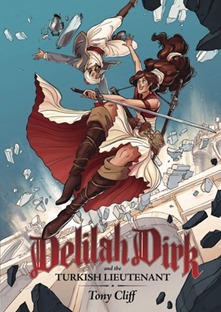
Review: Delilah Dirk and the Turkish Lieutenant by Tony Cliff

delilah dirk

Delilah Dirk and the Turkish Lieutenant by Tony Cliff

Released August 27, 2013.

Enter a new heroine who is funny, adept and can kick your butt.  Delilah Dirk comes crashing into the life of Selim, the Turkish Lieutenant and merrily takes over his world.  Delilah has adventured all around the world and is now looking to steal some valuable ancient scrolls from a Sultan in Constantinople.  With her flying boat, she saves Selim from certain death.  Then it is on to more adventures, including evading pirates, jumping off a disintegrating aqueduct, and fighting everyone who is after her, and everyone is.  Delilah loves the freedom and action of her life on the road, but Selim craves quiet times with friends.  Readers on the other hand will love Delilah and Selim both as well as the humor and adventure that make this one rollicking read.

Cliff has created a wonderful heroine.  She manages to be feminine and dashing at the same time.  Her outfit is skirted and flowing but not confining.  It reveals her beauty, but not her endowments.  She is great fun and the role reversal of the man who is the reluctant adventurer and the woman who adores it turns stereotypes on their heads.  The story both honors tradition with its setting in Turkey, but also adds a lot of new flavors like the flying boat.  It makes for a book that is filled with surprises.

A great pick for graphic novel fans and those just discovering the genre.  Delilah is a heroine who will take you on an amazing adventure.  Let’s hope there are many more to come!  Appropriate for ages 10-14.

Reviewed from copy received from First Second.