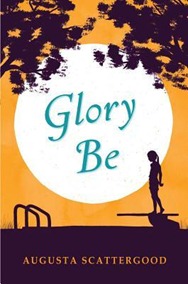
Review: Glory Be by Augusta Scattergood

glory be

Glory Be by Augusta Scattergood

In Hanging Moss, Mississippi, summer is filled with swimming at the pool, visits to the library, and just trying to stay cool.  But for Glory, the summer of 1964 when she turned 12, was a very different summer.  Now her older sister Jesslyn, doesn’t want anything to do with her.  She is interested in boys more than in playing games with Glory.  Her best friend Frankie has always been easy to get along with, but now things are strained.  Glory does have a new friend, a girl from the north whose mother is helping set up a clinic where everyone is welcome.  Desegregation has come to Hanging Moss, and the pool is closed rather than stop being segregated, tempers are high, and neighbors and families are torn.  In this setting, it is Glory who shines, growing into a young woman with passion and a voice to match.

Scattergood’s debut novel is a gem of a novel.  She manages to write with a distinct point out view without negating the fears of the time but still firmly standing against any racism.  It’s a difficult thing to do, but because she manages it, the book is much stronger.  While the book is about civil rights, it also explores the complicated relationship of sisters, who are by turns drawn together and then pushed away.  The book is intelligent, explores the complexity of the day fully, and remains very human.

Glory is a great heroine, one who is confused at times about what is happening around her, but also one who sees when a stand must be taken.  Her growing confidence along with the support of her father and sister, create a compelling story of a young woman finding her voice.  The growth of Glory throughout the book is clear and natural.

This is a book that could be shared in the classroom, but I think it would read best on a blazing hot day near a swimming pool to remind everyone of what human rights are.  This is one strong, dazzling debut.  Appropriate for ages 9-12.

Reviewed from ARC received from Scholastic.
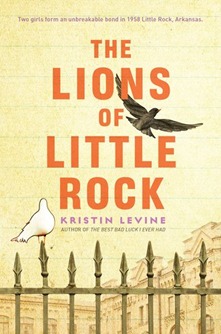
Review: The Lions of Little Rock by Kristin Levine

lions of little rock

The Lions of Little Rock by Kristin Levine

Little Rock in 1958 was a divided city at the forefront of the integration battles.  Marlee finds herself at the crossroads of that battle when the high schools in Little Rock are closed and her sister is sent away to go to school in another town.  Marlee is a quiet person, often unable to speak up even when she would most like to.  When she meets Liz, a new girl in her class, the two girls become fast friends with Liz helping Marlee find her voice.  The two girls work together on an oral project but before they can present it, Liz is discovered to be passing as a white girl to go to school there.   Marlee has to find a way to continue being friends with the best friend she has ever had, despite the dangers.  Otherwise she’s lost another person that she can actually talk to.  She has to find her voice and learn how to use it to make a difference.

Levine’s setting is one later than most books about Little Rock.  This book takes place a year after the Little Rock Nine enrolled at Little Rock Central High School.  It explores the effect of their courage on the community and also the way that the problems were not solved in that year alone.  The passions on both sides of of the segregation debate are shown clearly, as is the toll that it took on the Little Rock community.  The most important piece of the book is the courage of the ordinary citizen in taking on larger forces and winning for the good of everyone.  These are lessons that are vital for our children to learn.

The title of the book refers to the lions in the Little Rock Zoo.  Marlee lives close enough to the zoo to hear the lions roaring at night before she goes to bed.  The zoo is also the place that she sometimes meets with Liz.  This gives the book a strong level of symbolism that will give young readers something to relate to and discuss as the book progresses.

The character of Marlee is especially well drawn.  She is shy, nearly silent, and underneath that is brave, a good friend, and passionate.  She has trouble communicating with her own mother, rarely speaking, and yet she is inspiring and has a large impact on her mother and others.  There is a strength to her character that is more subtle than most, but also more steely.  She’s an incredible heroine and one that will inspire young readers.  The other characters are equally well done.  Liz, the best friend, is complex and interesting, battling her own problems with being too out-spoken.  Marlee’s parents are both teachers, watching their livelihood and professions being slowly destroyed in Little Rock. 

This powerful book is ideal for using in classrooms talking about civil rights and segregation.  It’s a book that will read aloud well and has plenty of action to keep listeners riveted.  An impressive and memorable book that should be in every public and school library.  Appropriate for ages 9-12.

Reviewed from ARC received from G. P. Putnam’s Sons.

Also reviewed by:

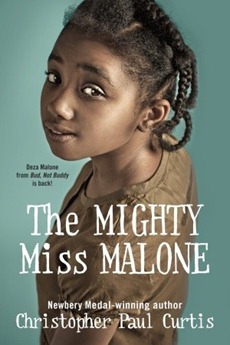
Review: The Mighty Miss Malone by Christopher Paul Curtis

mighty miss malone

The Mighty Miss Malone by Christopher Paul Curtis

Deza loves school, loves to read, and dreams of being a writer.  However, the Great Depression is raging in Gary, Indiana and her father has been unable to find work for some time.  Deza finds solace in her best friend and in her teacher, who has offered to tutor them both when school starts again.  When her father is almost killed in a boating accident, he doesn’t return as the same funny, smart man.  Instead he is withdrawn and almost silent, deciding soon after recovering to head up to Michigan to try to find work.  Deza’s mother refuses to let the family be separated and takes Deza and her brother on the road to follow him.  Unfortunately, the journey to becoming a complete family again is not that easy, taking them on a long road that will challenge them all.

Curtis’ writing is marvelous.  He renders the Great Depression with great detail, giving modern readers a way to not only understand the past but tie it directly to our present.  He also shows us the depth of poverty in the Depression, offering a view not only of the shanty town but of the kindness that could be found there too.  Nothing is simple in this book, the setting and time is complicated and the characters are complex.

Deza herself is a stellar protagonist, who loses much but keeps on moving and caring deeply.  She is luminous in the book, made fascinating by the small touches.  Her life is filled with challenges, including her rotting teeth, but they make her stronger and become coping mechanisms that make her all the more memorable. 

The depiction of this African American family that falls on hard times is one of deep caring, expansive love, and incredible strength.  While her father may leave to find a job, readers will know that his reasons for doing so are complicated and very human.  One feels the same thing for all of the characters in the book, no matter how minor.  They all seem to be carrying their own stories with them, even if they are just in a few pages.  This is a world populated with human beings with pasts and futures. 

This book cut right into my heart and lived there as I read it.  When I finished it, I wept because of the power, the people, and the story.  This is a wrenchingly honest, beautifully written, and noteworthy novel that I simply adored.  Appropriate for ages 9-12.

Reviewed from copy received from Random House Children’s Books.

Review: Promise the Night by Michaela MacColl

promise the night

Promise the Night by Michaela MacColl

Beryl Markham was the first person to fly solo from England to North America.  She also had a remarkable childhood, growing up in British East Africa.  Here the story of her childhood is interwoven with her perilous journey across the ocean to set the record.  Her younger years reveal the birth of her independent, rebellious spirit.  She could ride the fieriest stallion on her father’s horse farm in Africa, match wits with the boys of the local tribe, unsettle the most stern governess, and even survive attacks by lions.  This is a book about a girl who refused to become a lady and instead became a heroine.

MacColl’s work of historical fiction reads as such an adventure story, that readers will spend the entire book wondering what is true.  Happily after reading the author’s note at the end, all of the best parts of the story are real.  The astounding parts of the story are true!  The book is a result of detailed historical research and reveals much about this celebrated pilot who set her own pace. 

Beryl is a wonderful protagonist.  She could have been portrayed as a very harsh young girl, but instead we see her doubts, her resolve, and finally her ability to overcome any adversity.  It is a story of bravery but also one with lots of heart.  MacColl’s writing never gets in the way of the story she is telling.  Instead she writes evocatively of the African setting and this amazing girl.

If you are looking for an inspiring real-life heroine for children, look no further.  But best of all, it’s a rip-roaring tale too.  Appropriate for ages 9-12.

Reviewed from copy received from Chronicle Books.

Also reviewed by:

Review: Around the World by Matt Phelan

around the world

Around the World by Matt Phelan

In this graphic novel, Phelan tells the story of three adventurers at the end of the 19th century who attempt to travel around the world.  There is Thomas Stevens in 1884 who had been working in the mines but then started bicycling.  He first bicycled across the United States, and then attempted to cycle around the world on the difficult-to-ride old-fashioned bicycle with one larger wheel.  The next adventurer is Nellie Bly in 1889, who set herself the task of beating Jules Verne’s Around the World in 80 Days.  The men running the New York World newspaper did not like her idea, but eventually came around to having her attempt it.  Her race became a national obsession and sold many newspapers for them.  Finally, there is the story of Joshua Slocum in 1895.  He restored an old sailing vessel in a time when sailing was becoming outdated.  Then all on his own, he set off to sail around the world, becoming the first person to sail around the world alone.  These three adventurers all have their own reasons for circumnavigating the globe, but they are united in their attempts.  These are all stories of determination, courage and bold ideas.

United under the umbrella of Jules Verne’s novel, these three stories are beautifully connected and yet stand entirely on their own merits as well.  The three intrepid souls are also equally connected and yet uniquely themselves.  Their journeys are made for different reasons and received differently by the public, but they are all powerful stories of independence and resourcefulness.  All three stories show the power of taking charge of one’s life and following your dreams.

Phelan’s art suits each of the stories individually and also has a cohesive whole.  There are subtle changes from one story to the next, the colors shift from blues and greens to oranges and creams and then to deeper blues and grays.  The art style stays much the same but beyond the colors there are changes in mood that are amazingly deep yet subtly done.  Stevens’ story of bicycling has a merry joei de vive to it.  Bly’s adventure is filled with energy and zip.  Then there is the lonely sailing tale that has a deep grief embedded in it that almost aches.

Beautifully done, this is one of the top graphic novels for children, period.  It is honest, emotional, and a rousing adventure-filled read.  Appropriate for ages 8-12.

Reviewed from library copy.

Also reviewed by:

Check out the book trailer:

Review: Bluefish by Pat Schmatz

bluefish

Bluefish by Pat Schmatz

Travis misses his home after moving with his grandfather but even more, he misses his dog.  He used to have lots of room to roam in the country, but he’s stuck in a small house with his alcoholic grandfather.  At his new school, he is nearly silent but loud Velveeta will not allow him to withdraw far.  She joins him at lunch after seeing Travis help out a boy being bullied, firmly adopting him and filling his silence with all of her words.  The two unlikely friends are both hiding secrets.  As the story progresses, the secrets are shared with the reader first and then with each other.  This story explores the meaning of friendship and how we can all be friends that help one another in our own unique way.

Schmatz’s writing is clean and clear.  She doesn’t fill the story with flowery language, instead exploring the story alongside the reader.  The book is filled with characters who are struggling, including both Travis and Velveeta.  Another example is Travis’ grandfather who is battling his addiction and trying to be a parent to Travis.  There is nothing perfect here, and the message is clear that perfection is not something that is necessary or needed.  It is the striving, the doing that matters.

The two main characters are well drawn and intriguing.  They are very similar to one another in many ways and yet so different in others.  Their struggles may not be the same, but the two definitely need one another to get through.  There are also other adults who help, including one incredible teacher and a librarian.  It is a joy to see two adults helping children written free of any didacticism. 

This powerful read offers great characters, no easy answers, and no grand solution of an ending.  It’s a book that is about the journey.  Appropriate for ages 11-14.

Reviewed from copy received from Candlewick Press.

Also reviewed by:

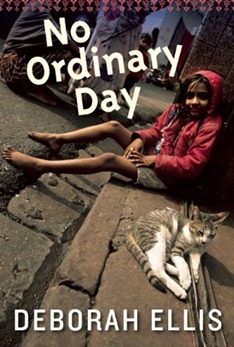
Review: No Ordinary Day by Deborah Ellis

no ordinary day

No Ordinary Day by Deborah Ellis

Valli picks up coal every day at her home town of Jharia, India.  But when she discovers that the family she is staying with is not her real family, she is free to leave their abuse and fend for herself.  She hops aboard a coal truck and ends up in Kolkata on the streets.  There she “borrows” items that she needs, giving them to others who need them more when she is finished with them.  She eats by begging for food and money or doesn’t eat much at all.  Valli has one super power, she has feet that feel no pain.  So she can stand on hot coals, run across glass, and never feel the wounds.  But this is not a real super power, it is leprosy.  A kind doctor discovers Valli and offers treatment, though it is some time before Valli is able to trust her.  This powerful read speaks to the horrors of poverty, the brutality of life on the streets, and one remarkable young girl who survives it all.

Ellis is known for her powerful writing and this book definitely has that.  The book could have become dark and depressing in less skilled hands, but Ellis through the spunky Valli keeps the book moving forward and keeps the viewpoint optimistic.  Yet Ellis does not shy away from harsh realities of life on the streets and being an unwanted child in a family.  It is Valli who makes this book work so well, her vitality shines on every page.

Ellis handles the subject of leprosy with a delicacy and honesty that is heartwarming.  Valli responds to the lepers she meets as “monsters,” but she and the reader learn that there is nothing to fear.  Valli sees the people behind their deformities and the reader will too. 

A powerful and outstanding book, this tough subject is written at a level that will invite young readers into a world they had never realized existed.  Appropriate for ages 9-12.

Reviewed from library copy.

Also reviewed by:

Review: Saint Louis Armstrong Beach by Brenda Woods

saint-louis-armstrong-beach

Saint Louis Armstrong Beach by Brenda Woods

Saint loves playing the clarinet.  He plays it for tourists in New Orleans to earn money for a new clarinet and for his future at Julliard.  Life isn’t all easy though, he has taken to a stray dog that his father will not allow him to adopt and his best friend has outgrown him, now spending her time partying with the cooler, older kids.  As Hurricane Katrina approaches, Saint and his family are not that concerned since it is expected to miss New Orleans, as the days progress, the tension builds and the warnings increase.  Though Saint’s family tries to send him to safety, things don’t go as planned and Saint is trapped by the weather and the flood waters.

Woods has written a book that captures the power of music in a young man’s life nicely, bridging the days before the storm, the time during the storm, and the time afterwards together with song.  The bulk of this book is the period before the storm hits, showing the loving family that Saint comes from, his close-knit neighborhood, friends, crushes, and his love of a dog.  While I know that this had a large part in establishing reader relationships with Saint, it is lengthy and could have been made more focused.  In particular, his friendship with Money is talked about at length, but the book never returns to her after the storm. 

The period during the storm is dramatic, with Woods leaving the drama of the storm to stand on its own.  More time could have been spent here with the reader, truly exploring the emotions and complexity of survival.  The same is true of the time after the storm, where only a few chapters are left for the aftermath.  My hope is that there is a sequel that will let us better understand the effect of the storm on Saint and his family, neighbors and friends.

There were also portions of the book that were too neat and tidy.  One such instance was when Shadow, the dog, brings Saint’s parents to him after the storm.  It was just too convenient and should have been foreshadowed more clearly to work better.

In the end, I have mixed feelings about this book.  A sequel may very well fix a lot of the dangling story lines, which would go a long way.  Saint is a strong male character and this is a book that children will find shows a close-up perspective on the storm.  Appropriate for ages 9-12.

Reviewed from ARC received from Penguin.

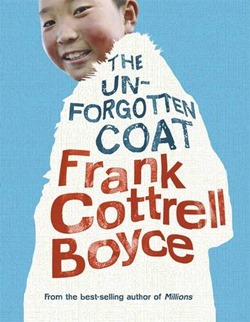
Review: The Unforgotten Coat by Frank Cottrell Boyce

unforgotten coat

The Unforgotten Coat by Frank Cottrell Boyce

Frank Cottrell Boyce has done it again, creating a book that surprises, amazes, and twists.  This is the story of what happens when two Mongolian boys join a class in England.  They appear out of nowhere, suddenly there in school.  The two brothers refuse to be separated, so the younger boy, Nergui, stays in his older brother’s class.  The two wear large coats and fur hats.  They immediately capture the imagination of Julie, one of their classmates, who is thrilled to be selected as their “Good Guide.”  She wonders where they live, trying for days to follow them home, but they elude her.  Chingis, the older boy, has photographs of Mongolia that he shares with everyone.  The entire class learns more about Mongolia than they had ever known.  But everything is not as it seems, and Julie discovers the truth too late to be of any help in the end.

The book is short, under 100 pages, with most of it being told in a flashback by an adult Julie.  The design of the book adds much to the story, with lined pages that resemble a notebook and Polaroid photographs that capture Mongolia and England, perhaps a mix of both.  The photographs in particular are cleverly done, hiding the truth and then revealing with equal success.

This is a powerful story that seems easy.  It reads as a simple story about two unusual children joining a classroom, and then twists and turns.  It speaks to community and acceptance throughout, showing a class that is eager and willing to embrace the new children, much to my delight.  Then the story takes on a more serious subject, about immigration, fear and deportation.  There is no didactic message here that is too heavy handed, instead it is kept serious but not message driven. 

The book also dances along an edge of imagination and reality where children who pay close attention will realize that even in the end there are questions about what has happened and what truly was.  This dance strengthens the novel even more, making it a powerful choice for discussion.

Highly recommended, this book may just be his best, and that is definitely saying something.  The short length, powerful subject and complex storyline all combine to make a package that is approachable for young readers, discussable by classes, and pure delight to experience.  Appropriate for ages 9-12.

Reviewed from library copy.

Also reviewed by: