The Books of Elsewhere: The Shadows

The Books of Elsewhere: The Shadows by Jacqueline West

Released June 2010.

A delightful romp of a book that combines mystery and fantasy, this book is filled with laughs, tension and plenty to discover.  After Old Ms. McMartin dies alone in her house, Olive and her mathematician parents move in.  The house is Victorian and filled with antiques and paintings.  Olive notices that the paintings are strange, but it isn’t until after she is warned of danger by a talking cat and finds some special spectacles that she learns the secret of the paintings.  By wearing the glasses, she can enter the world of the paintings.  But the mysteries go far deeper than that as does the pleasure of this read.  I will leave it to you to make your own discoveries in The Shadows.

Debut author, West, has written a book that is seasoned and tightly woven.  She has woven the tension of a good mystery with magical touches that make this book sparkle. West’s writing is something special.  She creates great images with her descriptions throughout the book.  One of my favorites is on page 20:

The basement of the old house was made mostly of stone, with some patches of packed dirt poking through, and other patches of crumbling cement trying to hide the dirt.  The effect was like an ancient, stale birthday cake frosted by a blindfolded five-year-old.

Sigh.  It captures so much not only about the basement it is describing, but also the atmosphere of the entire novel.  The above quote is from the advanced reader copy of the book.

Olive is a protagonist who is very human, often lonely, and at the same time clever, funny and just the type of person one would want for a friend.  The villains in the book are handsomely evil and thoroughly enjoy it.  The dangers are grippingly written, helping to add to pleasure of this light read that has wonderful dark moments too.  This is a book to be raced through and then read again to see all of the details and foreshadowing.

This book would work well as a classroom read aloud or a bedtime read with older children, but the best way to read it would be under the covers with a flashlight!  Get this into the hands of Coraline fans who will find a similar heroine to enjoy here.  Appropriate for ages 9-12.

Check out the trailer for the book:

Reviewed from ARC received from Penguin.

Reblog this post [with Zemanta]

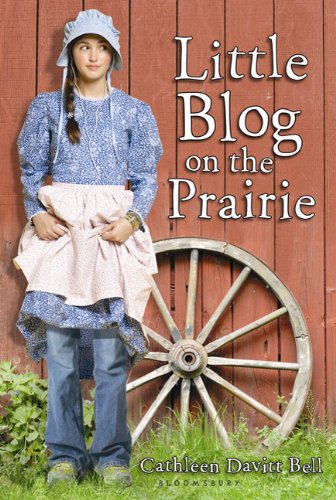
Little Blog on the Prairie

Little Blog on the Prairie by Cathleen Davitt Bell

When Gen’s mother signs the family up for Camp Frontier, they don’t know what they are getting into.  Now they must live like they are 1890s pioneers.  Which means wearing authentic clothing, cooking on a wood burning stove, milking cows, raising chickens, and living in a tiny cabin in the woods with an outhouse.  All of their electronics are confiscated when they enter camp, but Gen manages to sneak in her cell phone.  From there, she texts her best friends one of whom turns her texts into a blog for an assignment.  All is not dull work on the prairie, there is handsome Caleb who seems interested in Gen but might like Nora, the daughter of the owners better, and then there is the competition between the families and the drive to not keep being in last place.  Maybe this family bonding thing isn’t so bad after all.

Bell has created a book with a sharp wit and yet a homely warmth.  Gen is a great protagonist whose texts are fun to read.  Bell also has a feel for humor with the killer chickens and the cow milking scene.  Both are worth reading the novel for.  She writes best when dealing with modern teens juxtaposed with the world of 1890.  Bell’s writing is stilted in other scenes where there isn’t humor.  Her scenes with Nora and Caleb don’t flow with the same effortlessness as her humor.

Another issue is her characterization of the secondary characters.  Caleb, the love interest, is rather dull and quite normal though nice.  I don’t see why Gen who is bright, funny and complex would be entranced by this boy.  Nora, the homeschooled daughter of the proprietors, is also a disappointment.  Left to be rather cardboard and mean, she could have been a great example of a homeschooled kid.  Instead, she is envious and lonely.  What a missed opportunity she was a character!

One of the big successes of the book is that it never becomes a moral story about the dangers of modern technology and the isolation of modern family life.  Just as the book was approaching that, it veered into an unexpected direction that kept the novel fresh and interesting.

Despite the issues with the book, I could not put it down.  The humor and Gen kept me reading.  Recommended for readers who enjoyed Little House on the Prairie but also modern teens who wonder what would happen if their cell phones, iPods and computers were taken away.  Appropriate for ages 12-14.

Reviewed from ARC received from Bloomsbury.

Also reviewed by Semicolon.

Once

Once by Morris Gleitzman

This book looks at the Holocaust through the lens of one boy.  Felix is an extraordinary boy whose head is filled with stories that help explain the horrors he sees around himself.  His parents had left him in a Catholic orphanage to keep him safe as Poland was invaded.  But when he saw the books from the orphanage library being burned, he feared his parents were in danger since they were book sellers.  He isn’t sure why the Nazis hate books so much, but he certainly doesn’t want his parents to be hurt.  So Felix runs away from the orphanage and towards the big city, which means he is heading directly toward the Nazis.  As Felix travels, he tries to make sense of what he is seeing.  At first he naively explains much of it away, but as the book progresses he begins to understand what is happening to him and the people he loves.  Powerfully written, this book allows children to understand the horrors of the Holocaust without being overwhelmed.  It also shows children that they too can be heroes even when their world is falling apart.

In this book, Gleitzman has hit the balance perfectly between honestly depicting the atrocities of the Holocaust and yet making it accessible and appropriate for young readers.  He does this entirely through Felix who is an incredible protagonist, protectively telling himself untruths and stories about what he is witnessing.  It is a powerful device to use, as we see Felix almost killed time and again.  Because of Felix’s misunderstanding of the situation he is in, the book can be chilling and frightening.  Modern readers will understand more clearly than Felix what being a young Jew in Nazi-occupied Poland means. 

Gleitzman’s writing is wry and warm.  Told in Felix’s voice, the story is gripping, filled with action, and moves along at a brisk pace.  This brisk pace can be alarming as Felix is almost always moving closer and closer to more perilous areas and situations.  Gleitzman plays with our own understanding of history, creating our own lens to contrast with Felix’s. 

This is the sort of book that invites you in for carrot stew, shares stories whispered in the dark, and brings you to tears.  It is a story to savor, to linger with, to be amazed by.  I don’t hug every book I read, but this is one that I had to sit with my arms wrapped around for a bit.  I was holding Felix tightly to me because he had become so vivid and real to me as I read.

Beautifully done, this book should be shared with classes learning about the Holocaust.  It is a story of hope, a celebration of childhood, and a way to tell young people the truth of history.  Appropriate for ages 9-12.

Reviewed from copy received from Henry Holt.

One Crazy Summer

One Crazy Summer by Rita Williams-Garcia

Eleven-year-old Delphine has looked after her two younger sisters, Vonetta and Fern, ever since her mother left them soon after Fern’s birth seven years ago.  Now she and her sisters have traveled across the United States from Brooklyn to Oakland, California to see the mother they barely remember.  Once there, they discover a distant woman who won’t let them into her kitchen, feeds them only takeout, and insists that they are gone outside all day.  She sends the girls to a summer camp run by the Black Panthers where they are educated about revolution and black rights.  Set during in 1968, the girls see first hand the changing times.  Written with a depth of character, pitch-perfect dialogue, and a great deal of warmth, this book is an amazing work of children’s fiction.

Williams-Garcia has outdone herself with this novel.  Her portrayal of the girls, their mother and the Black Panthers is done even handedly and with appreciation for what was being done.  Cecile, the mother, is a complicated figure with a complex history and a fractured relationship with her children.  Williams-Garcia’s depiction of her is captivating in both good and bad ways.   This book reads as though it is about real people, with real personalities living during real times.  The characters grow convincingly throughout the story, with no one leaving behind their personality for sudden, simple change.  It is all deeper and more honest than that.

Highly recommended, I would expect this book to garner Newbery attention as well as Coretta Scott King Award interest.  This would work well in a classroom, since it is filled with moments worth discussing.  It would also make a fantastic summer read.  Appropriate for ages 9-13.

Reviewed from library copy.

Also reviewed by The Goddess of YA Literature, Bib-Laura-graphy, A Patchwork of Books, Muddy Puddle Musings, Fuse #8, A Chair, A Fireplace & a Tea Cozy, and Young Books.

Meanwhile

Meanwhile by Jason Shiga

Combine a Choose-Your-Own-Adventure book with a graphic novel and you have this book.  Open the book and you are immediately stopped and the format is explained.  Follow the tubes, they move in all directions, and you get the chance to make all sorts of choices.  The first choice you have is ice cream: chocolate or vanilla.  That small decision sets you off on an adventure that could involve a time machine, entropy or even immortality.  The choice is yours.  Chocolate or vanilla?

Shiga has taken the best of both formats and combined them into a stellar book.  Readers get to make decisions that have direct impact on the storyline, they get to try to figure out codes to reach new areas, and there is the joy of a book with thousands of potential stories inside it.  At the same time, it also has the appeal of a comic book.  It’s filled with humor as well as drama.  One never knows where the next turn in the tube or story will take you, making it virtually impossible to put down until you have tried story after story after story.

Highly recommended for all library graphic novel collections, this book will be adored be reluctant readers, embraced by comic lovers, and simply enjoyed by most.  Appropriate for ages 8-12.

Reviewed from library copy.

Also reviewed by 100 Scope Notes, Books4YourKids, and Comic Book Resources.

Mockingbird

Mockingbird by Kathryn Erskine

Released April 15, 2010.

In this small novel, Erskine has combined the tragedy of a school shooting with the unique voice of Asperger’s syndrome.  Caitlin’s older brother, Devon, has been killed in a school shooting along with others.  As Caitlin struggles to understand the emotions around her and the feelings she herself has, she has to do it for the first time without her brother helping her.  She tries to do it without flapping her hands, without burying herself in her father’s sweater, but she does retreat to her safe places like under the dresser in Devon’s room.  Her world is black and white, just like her award-winning drawings, color only confuses things.  But as the days go by, Caitlin begins to connect with other people in new ways and perhaps through her own literal understanding of things she just might find closure and help others find it too.

I don’t feel that I can encapsulate this book in a paragraph.  It is so much larger than I can describe, so much more profound and uplifting.  Erskine has taken two ideas that seem very divergent and created something amazing from them.  The two become more vital and important joined into a single book than they would have been separately.  Caitlin’s own grief is explored in such a literal and detached way that it becomes even more painful to witness.  Her inability to speak her emotions hands them over to the reader to feel for her.  We all become a part of her syndrome and feel it to our bones.

Through the lens of Caitlin readers also get to witness the grief of others.  Get to wince when Caitlin puts something too bluntly.  Cry when she is unable to understand.  Rejoice when connection is made, no matter how small.  Through Caitlin we get to see difference as a sliding scale that we too fit on somewhere.

This is a book about one family, one tragedy, one girl, but it reaches far beyond that.  It is a book about surviving, about scrambling for connections, about living life in color.  It is about fear, about being alone, and about reaching out despite how very hard it is.

I think we are going to hear a lot about this book with its large scope of ideas offered in a small package through the eyes of a brilliant girl.  I hope we do hear a lot about it.  It should be read in classrooms, discussed and embraced. 

Beautifully written, this book has the power to unite.  Appropriate for ages 10-13.

Reviewed from Advanced Reader Copy provided by Philomel.

Hex Hall

Hex Hall by Rachel Hawkins

When Sophie’s love charm goes horribly wrong at prom, she is sentenced to Hex Hall, a reform school for witches, shapeshifters, fairies and vampires.  Having been raised by a non-gifted mother, Sophie knows little about the magic world which gets her into trouble at Hex Hall.  In her first day, she is rooming with the controversial vampire, Jenna, she has angered three powerful dark witches, and she has a hopeless crush on one of the dark witch’s boyfriend.  Could it get any worse?  Throw in detention time spent cataloging garbage in a cellar, a strange spirit who won’t leave her alone, and family secrets and you have a wild ride of a book that is sure to please.

Hawkins has managed to write a story filled with witches, magic, vampires and other fantasy elements but also not to take herself too seriously.  The writing has a lot of humor, much of it pitched directly at current fantasy novel tropes.  Sophie herself is a character filled with sarcasm and a biting wit.  Without this writing style, the book could have suffered from the over dramatic and serious tones of many of these novels.  Here the lightness works well, creating a very funny and readable novel.

At the same time, the book is not just light.  There are dark themes here, real dangers and delightful diversions.  I quite enjoyed the mix of light and dark, humor and tension.  It kept the pages turning quickly.

Recommended for fans and non-fans of Twilight, both will find reasons to enjoy this novel and to look forward to the rest of the series.  Appropriate for ages 13-15.

Reviewed from library copy.

Also reviewed by Tempting Persephone, Whimsical Whamsical Whumsical, My Life Uncensored, Wondrous Reads, Frenetic Reader, The Compulsive Reader, Beyond Books, and many more.

The Firefly Letters

The Firefly Letters by Margarita Engle

I have adored Engle and her poetry since first reading her Poet Slave of Cuba.  This historical novel told in verse tells the story of early Swedish feminist Fredrika Bremer and her travels in Cuba.  While in Cuba she inspires and changes the lives of two women, a slave named Cecilia and a wealthy young woman named Elena.  At first amazed and shocked by the freedom Fredrika demonstrates, Elena warms to her as she begins to understand that the future could be different than just an arranged marriage.  Cecilia finds in Fredrika a woman who looks beyond her slave status and a role model for hope.  Told in Engle’s radiant verse, this is another novel by this splendid author that is to be treasured.

As with all of her novels, Engle writes about the duality of Cuba:  the dark side and the light, the beauty and the ugliness.  Once again she explores the horrific legacy of slavery without flinching from its truth.  Against that background of slavery, she has written a novel of freedom.  It is the story of a woman who refused to be defined by the limitations of her birth and her sex, instead deciding to travel and write rather than marry.  Fredrika is purely freedom, beautifully contrasted with the two women who are both captured in different ways and forced into lives beyond their control. 

Beautifully done, this book is an excellent example of the verse novel.  Each poem can stand on its own and still works to tell a cohesive story.  At times Engle’s words are so lovely that they give pause and must be reread.  This simply deepens the impact of the book.  Engle also uses strong images in her poems.  In this book, fireflies are an important image that work to reveal light and dark, as well as freedom and captivity.

Highly recommended, this author needs to be read by those who enjoy poetry, those who enjoy history, and those who simply are looking for great writing.  Appropriate for ages 11-14.

Reviewed from library copy.

Out of My Mind

Out of My Mind by Sharon M. Draper

Melody is eleven years old and has never said a single word.  She also has a photographic memory so she remembers being a baby, remembers every show she has ever seen on TV, remembers the commercials too, remembers songs, factoids, everything.  All those words are trapped in her head, unable to be released.  Her parents know she is bright, but how could anyone know just how smart Melody actually is with her cerebral palsy being all that they can see?  At school she is in the classroom for those with special needs where the quality of instruction varies from year to year. One year she was subjected to the alphabet over and over again along with a CD of nursery rhymes.  Pure torture!  So when Melody realizes that she needs a computer to help her talk, everyone had better be ready to hear what she has to say!

This in-depth character study is beautifully done.  Melody is a character with charisma, brilliance and a sassy attitude that is integral to her personality.  Despite being unable to speak, Melody will speak deeply to any reader who takes the time to meet her.  Draper does not sugarcoat Melody’s disability.  She does not make the people around Melody too perfect and good.  Instead everyone is human, especially Melody. 

Draper brought me to tears several times in the novel.  From spectacular moments of Melody speaking to the cruelty of other children, this book offers such highs and lows.  And through it all, living it all, we have Melody, a true heroine, an amazing person, and someone we all should get to know.

The cover is wonderful with its fish out of water theme and a direct tie to the storyline.  I love the contrast of the pale blue and bright orange, because Melody is such a flash of bright color in the novel.

This will make a brilliant read aloud for a classroom of 5th or 6th graders.  It will also be adored by single readers who will find Melody a person worth spending time with.  Appropriate for ages 9-13, this book is a real winner.

Reviewed from library copy.

Reblog this post [with Zemanta]