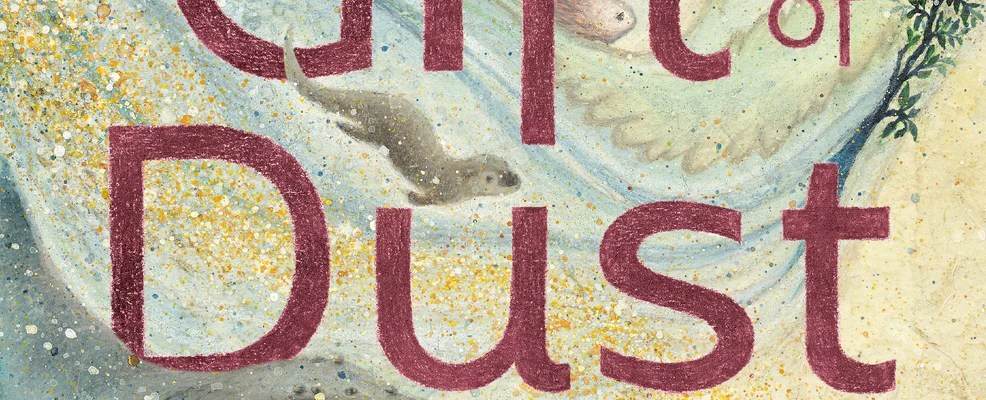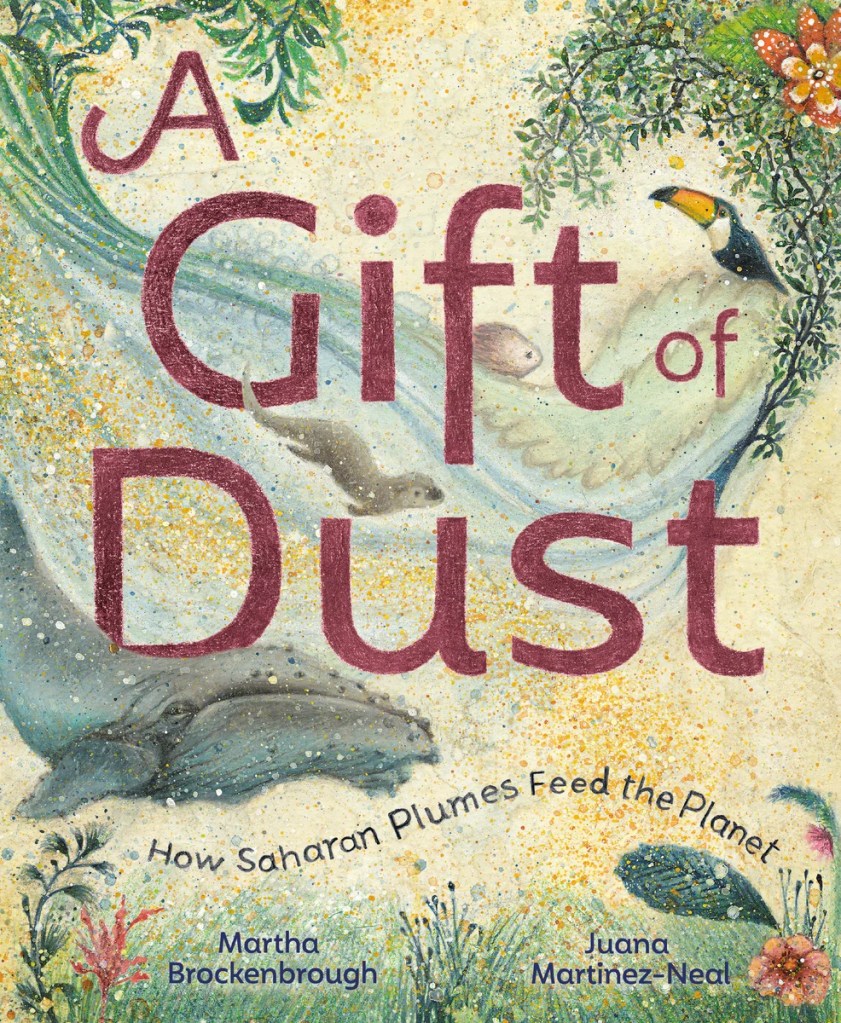
Beginning with dust motes in the sunlight, this book goes on to show the importance of dust for life on earth. Each speck in the dust was once something else and yet carries some of its value still. A trout dying long ago, becomes a fossil along with the plankton it ate. As the lake dries up, the wind lifts the fossils as they turn to dust. That dust falls into the water of the ocean feeding the plankton that live there and form the foundation of the food cycle. Dust also softens hurricanes and storms as they move from deserts to rainforests. Rain washes nutrients away, but dust helps replenish those too. It’s a cycle on earth much lesser known than those of water and food.
Beautifully told in poetic lines, this book truly celebrates simple dust and will have all readers looking at it differently in their own homes. It’s a very readable nonfiction picture book that could be shared aloud with classes or in programs. The book ends with additional dust information and online and print resources to learn more. The illustrations lean into the wonder of dust, speckling the pages with colors that show its movement and quality.
A dazzling dusty read. Appropriate for ages 5-9.
Reviewed from library copy.
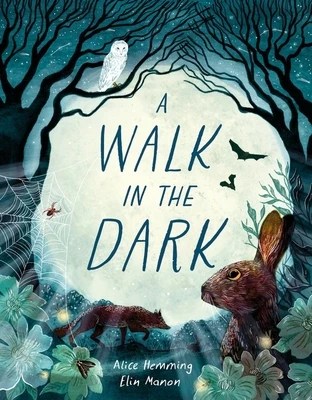
A Walk in the Dark by Alice Hemming, illustrated by Elin Manon (9781510231481)
Starting with twilight, the rabbits start to come out. They are active at dusk and dawn as they are crepuscular. Yet they disappear in the flash when the fox comes by. The fox misses a rabbit meal, so must scavenge to feed her cubs. A badger searches for worms, a mouse hides from the barn owls overhead. Bats, fireflies and moths share the sky. A roaming cat returns home as dawn breaks.
As the picture book moves naturally from one animal to the next using share habitats and locations, the nonfiction text shares information on the sort of animal they are, some of their nighttime habits, and how they interact with one another. This book truly shows the interconnected ecosystem in our own backyards as well as the wonder of the busy night. The illustrations are lush and rich, lighting specific areas like the fox den and allowing others to be covered with the blues of night. It’s very evocative and lovely.
This nonfiction picture book is dark and delightful. Appropriate for ages 5-8.
Reviewed from e-galley provided by Laurence King Publishing.
Starting with a regular orange, the book quickly moves to other sorts of fruit and citrus that are oranges, or are they? The history of orange and when it became a recognized color in the English language is explored. The book moves on to elements that are orange, how to make orange paint, and famous art pieces that embrace the color. Children get to explore monarchs, Buddhist monk robes, flags, marigolds and much more.
This picture book takes the exploration of a single color to a new level. I loved looking at the language development around the color that coincided with the fruit. The various animals, foods, and uses of the color from bridges to astronaut suits is a delight. There is no speaking down to children here, but elevating them to a level of understanding for this unique color. The illustrations are simple and approachable, matching the approach of the book. They are also filled with a wide variety of oranges, of course.
Orange you glad for this picture book? Appropriate for ages 3-6.
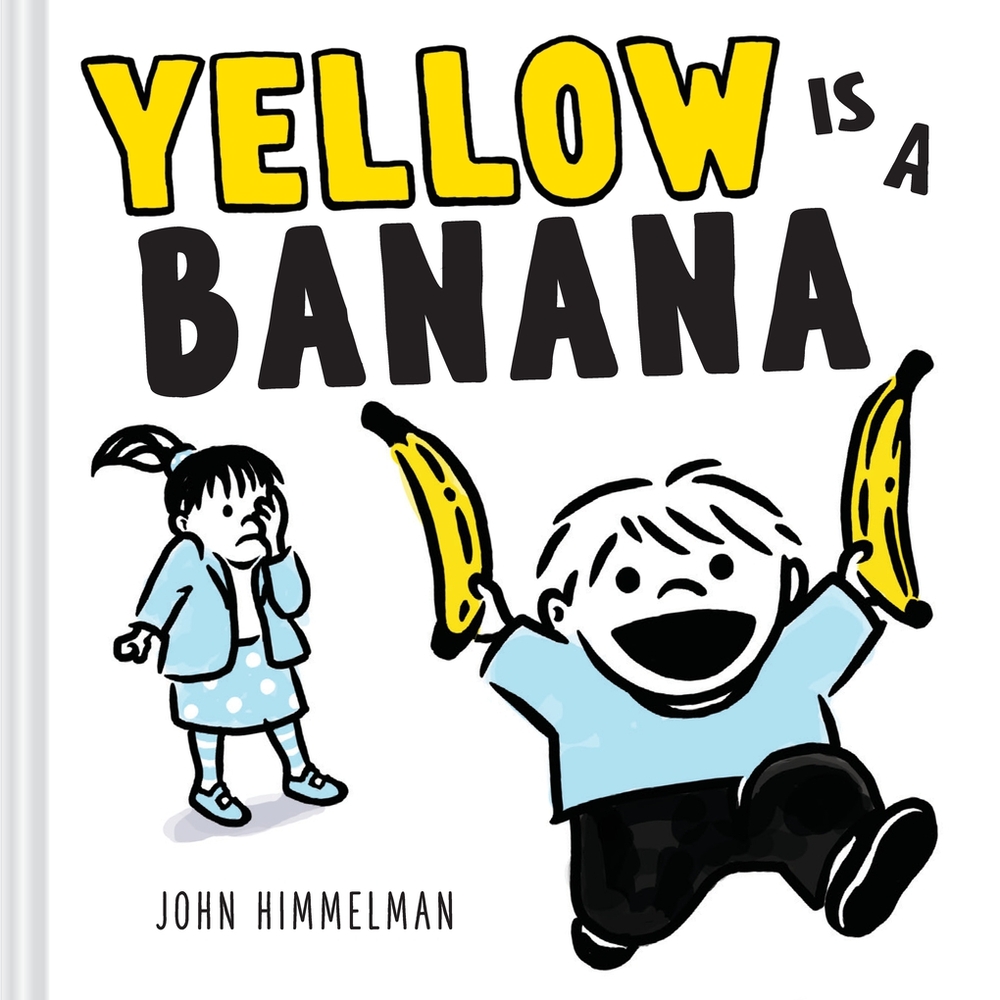
A little boy annoys his older sister by saying his sentences backwards. “This yellow is a banana!” She corrects him time and again as he points out red apples, purples grapes and a lime is green. He does it all with the great joy of a toddler discovering things, but his sister gets more and more frustrated and frazzled. Soon she too is accidentally saying things backwards. Finally, they agree that “This orange is orange” plus it’s delicious.
Told entirely in the dialogue between the two siblings, this picture book is the epitome of toddler joy at discovery. It also cleverly uses wordplay to show the importance of colors as well as creating a lot of giggles along the way. The illustrations are done with white backgrounds and simple lines that allow the specific colors to shine as the little boy presents them.
A colorful read-aloud sure to get laughs alongside learning. Appropriate for ages 1-4.
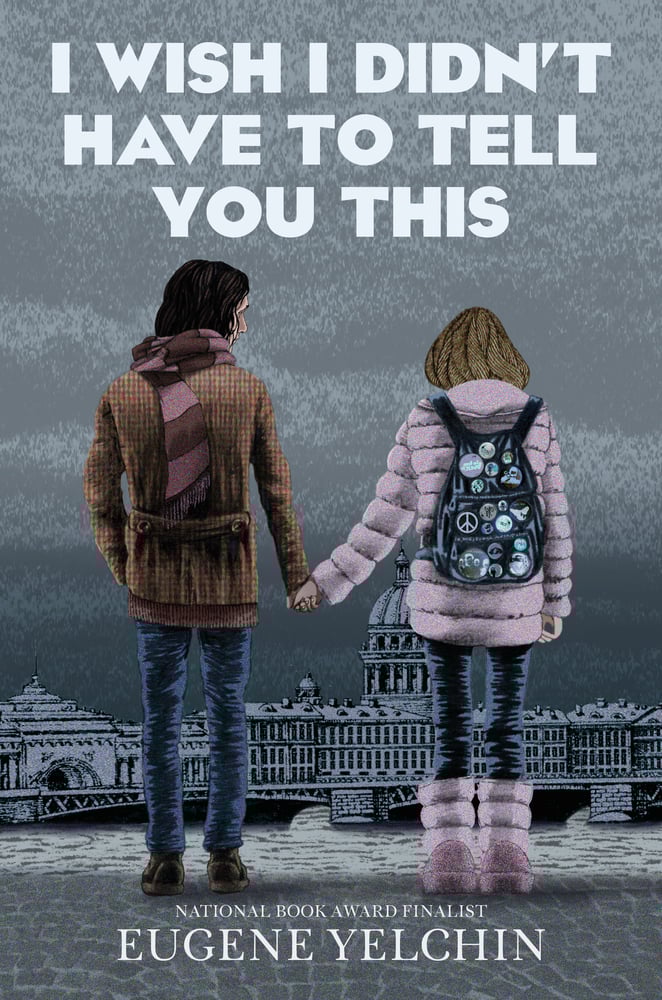
This incredible sequel to The Genius Under the Table continues Yelchin’s biographical story in graphic format. Yevgeny is living in Leningrad with his mother and grandmother in the same tiny apartment. He is now older, working on his art and doing scenery and design for theater. At an illegal art show, he first meets Lizzy, an American college student working on social justice issues. As the war in Afghanistan begins, Yevgeny is threatened with being drafted, escaping only by heading to Siberia to do theater design there. But there he finds himself institutionalized and abused.
A grim look at Soviet Russia with a first-hand account of the atrocities that happened at the hands of the KGB and in the name of Mother Russia. Yelchin’s black and white graphic format focuses on faces and characters while Russia forms an often blurred background. It gives the feeling of an old TV with a tightly focused camera. The effect is incredibly personal and offers no way for readers to look away.
One of the best graphic memoirs for teens, this is a must read and can be read as a stand alone. Appropriate for ages 13-18.
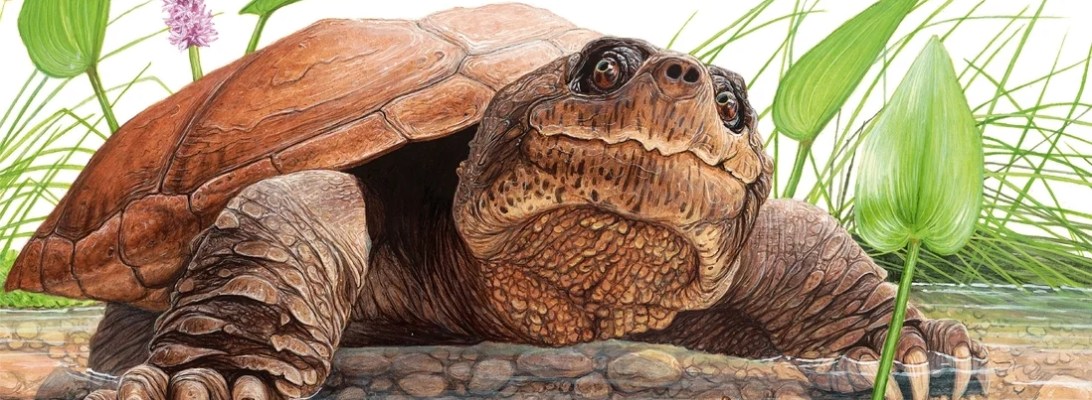
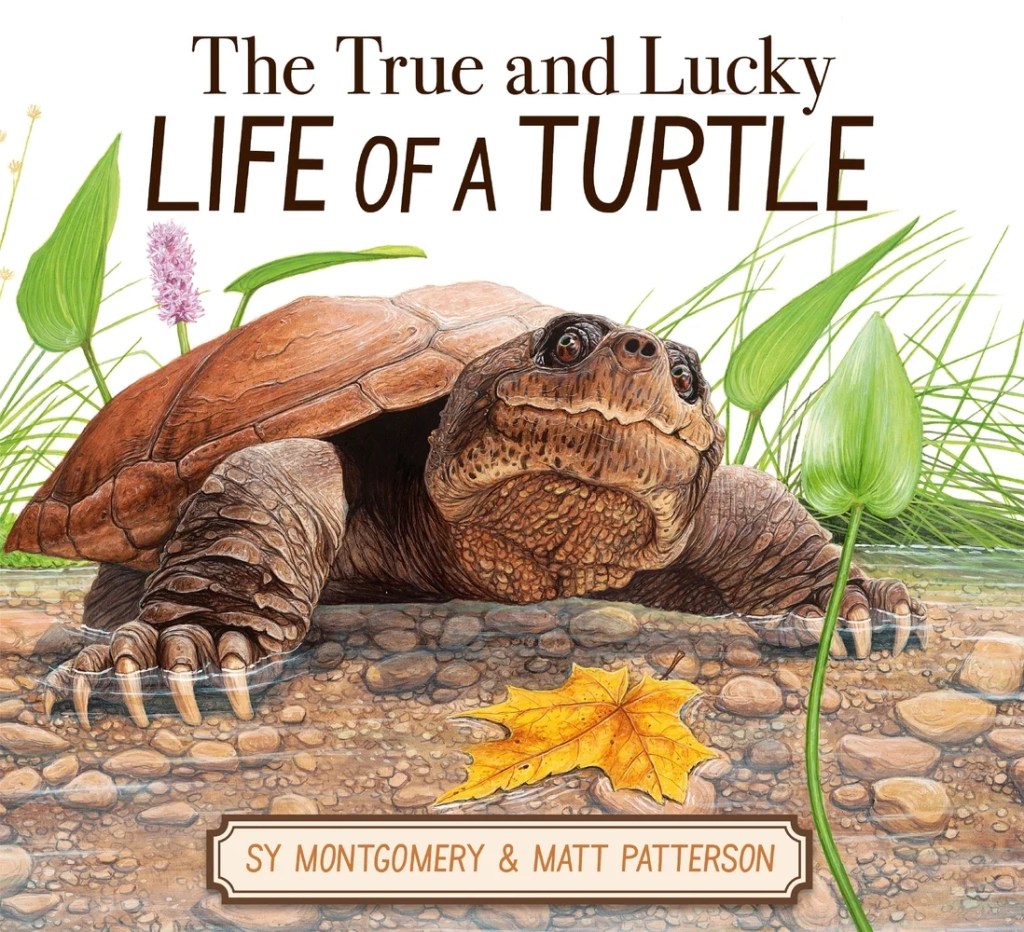
This nonfiction picture book shares the story of Fire Chief, a common snapping turtle. This turtle is currently over 60 years old and living in a pond near a fire station. Throughout his life, Fire Chief was lucky. He survived being so small that almost anything else could eat him. He found a safe pond to spend his summers and another one nearby to overwinter in. But as the town grew up around him, he was very unlucky one day as he moved to his winter pond and was hit by a car. That’s when the Turtle Rescue League came to help. They patched his shell and helped him regain the use of his back legs. When Fire Chief was ready to return to his pond, the humans there also decided to lend a hand to get him a space that would work for him all year long.
The author and illustrator of the award-winning The Book of Turtles return with another book celebrating these animals. The author and illustrator also help rescue turtles in their hometown and know Fire Chief personally. This connection to the animals and to this story really make this book special. The book wisely mixes turtle facts and information with Fire Chief’s own life and story. There is so much to enjoy here in its warm tone and clear delight in its subject matter. That is matched by the art which takes close-up looks at Fire Chief and his habitat, getting readers closer and more intimate than photography could.
A majestic look at one very lucky turtle. Appropriate for ages 4-7.
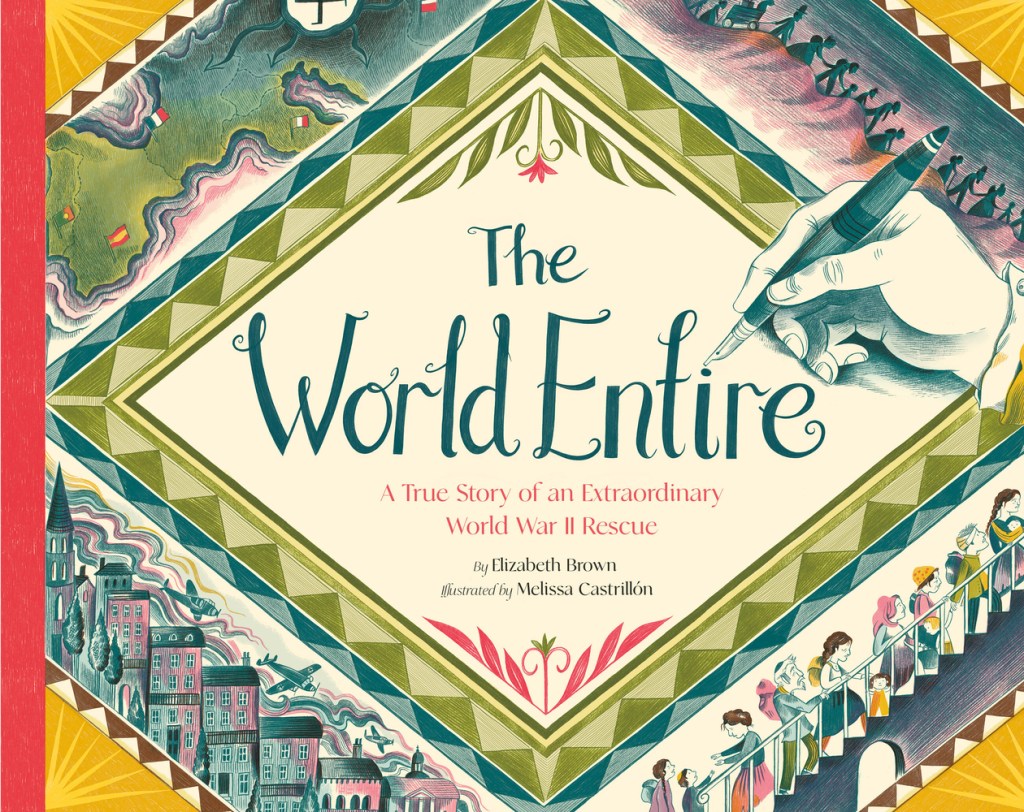
This is the true story of Aristides de Sousa Mendes, who was a Portuguese diplomat with the power to give or deny visas. As the Nazis approached, refugees started to flee France to Portugal since Spain was denying them refuge. Mendes thwarted his government’s guidance and rules on giving visas and in the course of 23 days in 1940 gave out thousands of visas to all sorts of people. He recognized that these people were the same as his own family experiencing it. Mendes saved thousands of people, even showing them a safe way to enter Portugal as the borders closed. He paid for it though, as he lost his position, his home and his family were forced onto the streets.
Such a timely title during the American immigration crisis, this picture book nonfiction shows everyone that whatever their role and what they are being told to do, there are choices that can save lives and make a difference. Brown’s writing takes a complex story and reworks it for children without losing any of its emotional impact. She takes time to explain how Mendes fretted over his decision to defy his government, showing that it was not simple and that afterwards he was impacted by the choices he made. The illustrations are done in pencil with digital coloring, offering fine lines that show life before the war, maps of the impact, and the suffering of refugees as they wait. They capture emotion clearly and support the story well.
A story that shows how civil disobedience is a powerful force. Appropriate for ages 6-10.
Reviewed from e-galley provided by Chronicle Books.
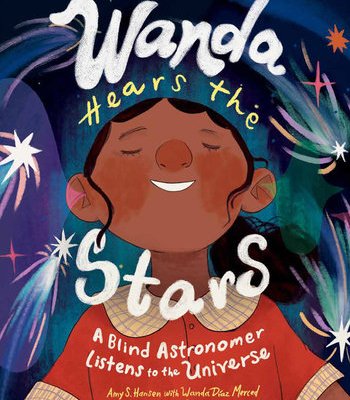
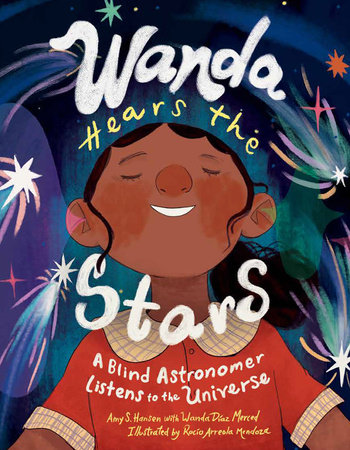
When Wanda was growing up in Puerto Rico’s rainforest, she couldn’t see the stars because of all the trees. She first truly saw the stars on a family fishing trip and she was entirely amazed by them. Wanda was a child who didn’t like school all that much and certainly didn’t like the shots she had to take for her diabetes. Eventually, she found out what she liked at school and decided to study physics in college. But at college, she started losing her eyesight due to her diabetes and eventually became blind. How could a blind person study the stars? Happily, she had friends around her to encourage her and one friend who was using sounds to study the stars. Now Wanda could listen to the stars and hear them. Wanda moved to the United States and continued to study the stars, making discoveries that only someone listening to the noises could have found.
An amazing story of overcoming a disability in a field where it seemed impossible to go on, this nonfiction picture book shows Wanda’s perseverance, skill and also her willingness to accept help in order to find her way forward. The story itself is wonderfully written for young readers and the ending where the star noises are shared on the page is amazing in an entirely additional way. The illustrations are friendly and invite readers to engage with the material.
A fascinating and inspiring true story. Appropriate for ages 6-9.
Deanne loved spending time in nature with her family as a young child. It was a love that continued throughout her life. When wildfires started spreading in California, Deanne applied for a job with the U.S. Forest Service. She was hired by them to fight fires. She had found exactly what she loved. It was a physical job with long hours and risks. But Deanne wanted to do more: she wanted to become a smokejumper. So, at age 26, she started taking the required physical tests. She passed them, but was found to be too small for their requirements. Deanne fought the decision, filing a formal complaint. Months later, she was allowed to take the tests and soon passed them to become the first female smokejumper in the nation.
Deanne is the epitome of resilience and determination. The book focuses on her willingness to take risks but also on her level-headed approach to gaining new skills as she pushes the envelope of society’s biases toward women. The writing here is approachable and evocative. It shares how Deanne was feeling as she hit each obstacle and overcame them. The illustrations are full of flame colors, smoke and fire. It brings the dangers and the drama directly to the reader.
Bravery, resilience and character are all on display in this great picture book biography. Appropriate for ages 4-8.
Reviewed from e-galley provided by Penguin Young Readers.
The Black Mambas are an anti-poaching unit that works in South Africa on the Olifants West Nature Reserve. The unit was started when animals in the reserve began to disappear, particularly rhinos and pangolins. The unit is the first all-women anti-poaching unit in the world and despite doubts from family members became very successful. The book explores how the unit was created, what sorts of training they go through, and what they do on a daily basis to protect the wildlife in the reserve. One particularly dramatic series of images shows the women tracking poachers and successfully stopping them. Told via photographs, the book celebrates the impact these women have had on their community and the success of the reserve.
A stirring tale of women successfully stepping out of traditional roles. Appropriate for ages 5-10.
Marjorie Rice grew up loving shapes, enchanted by the golden rectangle. She studied art and geometry, but her parents wanted her to be a secretary. Meanwhile, others were discovering five-sided shapes that could fit together, creating a seamless pattern. They each declared they had found them all. Majorie was raising children, doing art, helping with math, and discovered the question of five-sided shapes in her son’s Scientific American magazine. Marjorie started to work on the problem, despite it being declared as solved. Her first discovery was declared the tenth tiling pentagon, but she wasn’t done yet!
This picture book tells the story of an amateur mathematician who discovered tiling shapes that others couldn’t. These were questions from the beginning of math and design, solved by a mother of five working out of her home. It is an inspiring story of resilience, tenacity and patience. The illustrations in the book invite readers to look at five-sided shapes themselves, seeing them elongate and shrink and they fit together.
It’s a book that makes mathematics something tangible and beautiful. Appropriate for ages 5-9.
Ruth Asawa was raised on her family’s vegetable farm in California. She attended Japanese school on Saturdays and won an award in her regular school for a poster she made of the Statue of Liberty. Her life was divided in half, but soon that was to become even more clear. When Pearl Harbor was attacked, her father was taken away. Two months later the rest of the family entered imprisonment. Ruth started to draw her life in the camps. At age 20 after the end of the war, she started to create the wire sculptures that she would become known for. Eventually she was asked to create the memorial for those imprisoned in the Japanese internment camps.
Told in poetic language that uses the image of lines repeatedly, this nonfiction picture book pays a deep and respectful homage to this Japanese-American artist. Asawa rises again and again, despite the racism that impacted her childhood and teen years. The use of art to create conversation and connection is clear in this book. The illustrations are done in charcoal, watercolor and digital media. They capture the lines, the wire, the connectivity and the inhuman conditions of the camps.
A book that celebrates survival and the way art can carry a spirit through its darkest days. Appropriate for ages 5-9.
Reviewed from e-galley provided by Roaring Brook Press.
This nonfiction picture book explains to children that LGBTQIA people used to not be able to share openly about their sexuality. Instead, they used a code and asked one another if they were a friend of Dorothy. The book explores why it was unsafe to share sexuality openly with people losing their jobs, being arrested or placed in mental institutions. Then there are the people who hear the code who are working for the government. But they could never figure out who this mysterious Dorothy was. There are some ideas about why the name Dorothy was chosen. The ending returns to the present day and all the progress that has been made for LGBTQIA rights with the caveat about the continued dangers and threats to those who come out.
Lukoff tells the history of LGBTQ rights in America using a child-focused approach by focusing on the code phrase. It’s a clever way to share the information of past injustice, modern progress and all the way yet to go. Illustrations by Hastings are colorful at times and other times capture the bleakness of government surveillance.
All young friends of Dorothy will find a welcoming place in these pages. Appropriate for ages 5-9.
Reviewed from a copy provided by Simon & Schuster Books for Young Readers.
Part of the First Conversations series, this nonfiction picture book tackles speaking to young children about disabilities with a straight-forward approach. The book begins by explaining that everyone looks different from one another and that it is not what we can physically do that makes us matter. The book moves on to respecting how people describe themselves. It talks about access and ableism, defining both clearly and offering deeper explanations about disability justice and its importance.
It is powerful to find a picture book that offers information that is so informative and impactful. This book goes beyond the superficial nods at disability and truly looks at the damage of ableism and offers resources on what people can do to change access. There is no talking down to children here, just a frank, clear approach to the subject that centers each person with a disability as their own expert and voice.
Get this one into your library collections. Appropriate for ages 3-7.
Reviewed from e-galley provided by Penguin Workshop.