10 Great Picture Books on Civil Rights

The ACLU has just had its best fund raising month ever, so I know that others are concerned with civil rights being attacked just as much as I am. Happily, there are beautiful picture books on civil rights to share with the children in our lives:

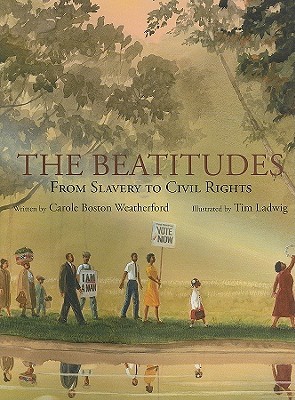
The Amazing Age of John Roy Lynch The Beatitudes: From Slavery to Civil Rights

The Amazing Age of John Roy Lynch by Chris Barton, illustrated by Don Tate

The Beatitudes: From Slavery to Civil Rights by Carole Boston Weatherford, illustrated by Tim Ladwig

The Case for Loving: The Fight for Interracial Marriage Lillian's Right to Vote: A Celebration of the Voting Rights Act of 1965

The Case for Loving: The Fight for Interracial Marriage by Selina Alko, illustrations by Sean Qualls and Selina Alko

Lillian’s Right to Vote by Jonah Winter, illustrated by Shane W. Evans
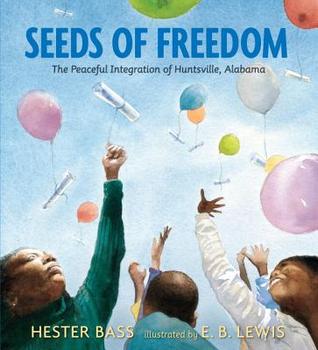
Seeds of Freedom: The Peaceful Integration of Huntsville, Alabama Separate Is Never Equal: Sylvia Mendez and Her Family's Fight for Desegregation

Seeds of Freedom: The Peaceful Integration of Huntsville, Alabama by Hester Bass, illustrated by E. B. Lewis

Separate Is Never Equal: Sylvia Mendez & Her Family’s Fight for Desegregation by Duncan Tonatiuh

Sit-In: How Four Friends Stood Up by Sitting Down 22747807

Sit-In: How Four Friends Stood Up by Sitting Down by Andrea Davis Pinkney, illlustrated by Brian Pinkney

Voice of Freedom: Fannie Lou Hamer:The Spirit of the Civil Rights Movement by Carole Bostone Weatherford, illustrated by Ekua Holmes
6519593 When Thunder Comes: Poems for Civil Rights Leaders

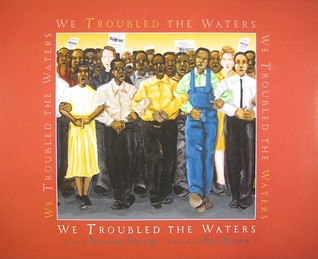
We Troubled the Waters by Ntozake Shange, illustrated by Rod Brown

When Thunder Comes: Poems for Civil Rights Leaders by J. Patrick Lewis, illustrated by Jim Burke, R. Gregory Christie, Tonya Engel, John Parra, and Meilo So

Six Dots by Jen Bryant

six-dots-by-jen-bryant

Six Dots: A Story of Young Louis Braille by Jen Bryant, illustrated by Boris Kulikov (InfoSoup)

Louis Braille lost his sight at age five from an accident and a resulting infection. His family helped him learn to cope, making him a cane that he could use to explore a little farther from home each day. His brothers taught him to whistle and his sisters made him letters out of straw. He could play dominoes, knew trees by touch, flowers by their smell and could listen to books being read aloud. But there were no books for blind children like him. Even when he got into a school for the blind in Paris he had to work very hard and become one of the best students to be able to access their books. When Louis achieved that though, he found that the books were done in large raised wax letters so thick books were actually quite short. Then there was news that a French army captain had created a way to send secret messages that was read by touch. Louis worked to make the system readable by the blind, creating his own alphabet system as a teenager!

Bryant writes in first person from Braille’s point of view. She explains how Louis lost his sight with just enough detail to make it understandable how tragic it was but doesn’t overly linger there. When Louis’ sight is gone, the text changes to become filled with noises and other senses than sight. Bryant moves the story forward using Braille’s desire to read for himself, that drives both the story and Braille’s own life. As each opportunity proves to be disappointing, Braille does not give up hope, instead developing throughout his life a tenacity to find a solution.

Kulikov’s illustrations play light against dark. When Braille loses his sight, the pages go black with shadowy furniture forms only. Color is gone entirely. The reader is not left there, but moves back into the world of color unless the story is speaking about Braille’s blindness specifically, so when Braille finally gets to try reading the wax lettering, the page goes dark again, also showing his disappointment in the solution.

Intelligently designed and depicted, this is a warm and inspiring look at the life and achievements of Louis Braille. Appropriate for ages 6-9.

Reviewed from copy received from Knopf Books for Young Readers.


Some Writer! by Melissa Sweet

some-writer-by-melissa-sweet

Some Writer!: The Story of E. B. White by Melissa Sweet (InfoSoup)

The life of E. B. White, author of several beloved children’s books, is shown here in a children’s biography from a two-time Caldecott Honor winner. White’s upbringing as a child with his summers spent on a lake in Maine shows the impact of childhood experiences. He won several writing awards as a teenager, knowing exactly what he wanted to do. His work for The New Yorker and other publications as a column author and poet is shown as well as Sweet spends much of the book on the author’s adult life. The strong connection he had with water, nature and Maine shines on the page just as it does in his work. Issues with Stuart Little being accepted in libraries and other moments of note are wonderfully portrayed in original wording of letters. A writer who lived away from the fame he was garnering, White continued to do farm work, sail his boats, and enjoy the simple life he adored.

Sweet has written a simply incredible biography. Her writing flows with that of White. Hers has a frankness and an honesty that is particularly important in biography. Sweet intersperses White’s writing throughout the book, sometimes in clippings from magazines or newspapers and other times clearly typed using a typewriter to get the right feel. Unlike many children’s biographies, Sweet depicts White’s childhood and then moves on to his work and his adult life. While his childhood informs his work, it is not the sole focus of the biography, which honors young readers will plenty of information on his full life.

Sweet’s illustrations are equally amazing. She uses physical items on the page, weathered wood, screws, rope, typewriter keys, and leaves. She incorporates photographs and then her own art as well, creating a world of found objects, drawn Wilburs and Templetons, photos and actual documents that is rich and wondrous. It is like opening a drawer and discovering a treasure trove, a book you want to curl up with and read just as you did those beloved childhood books.

In short, this is a masterpiece. A book with just the right tone, style and organic nature. Terrific! Appropriate for ages 8-12.

Reviewed from library copy.


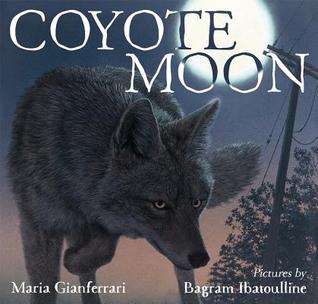
Coyote Moon by Maria Gianferrari

coyote-moon-by-maria-gianferrari

Coyote Moon by Maria Gianferrari, illustrated by Bagram Ibatoulline (InfoSoup)

Coyote wakes and heads out of her den to find food for her pups. She walks the roads past houses and fences. She finds a mouse but doesn’t manage to catch it. There are geese on the golf course, but Coyote can’t get close enough to steal an egg without the geese attacking her. There is a rabbit on a lawn, but the rabbit is faster than Coyote. Soon dawn arrives and Coyote still has not caught any food for her family. Then there are turkeys walking nearby and Coyote manages to capture one. She heads home but not before a child spies her from a window when Coyote stops to sing to the morning.

This book is a beautiful dance between illustrations and text. Gianferrari’s prose is extremely poetic, using phrasing that almost turns it into verse particularly when read aloud. The pacing of the book is dynamic and picks up with a sense of near desperation as one prey animal after another escapes. Sympathy for the coyotes, which may not have been high in the beginning of the book, is skillfully built throughout the story until readers will be near cheering when the turkey is caught. The book finishes with information on coyotes.

Ibatoulline’s illustrations are incredibly detailed. Dark and light play on the page, from the electric outdoor lights from human buildings to the moonlight shining on fur. The darkness has dimension, subtle colors, and textures. There is a sense of near hyper-realism as well as readers get closer to these animals in the illustrations than they ever could in life.

This picture book blends nonfiction with great writing to create a realistic view of urban coyotes. Appropriate for ages 5-7.

Reviewed from library copy.


Plants Can’t Sit Still by Rebecca E. Hirsch

Plants Can't Sit Still by Rebecca Hirsch

Plants Can’t Sit Still by Rebecca E. Hirsch, illustrated by Mia Posada (InfoSoup)

Plants can’t walk or run or even fly, but they don’t stay still either! This jaunty picture book captures the many ways that plants manage to move, even though they are rooted to the ground. They squirm out of the soil. They turn towards the sun. They creep underground and spring up in new places. They can climb walls and even eat bugs. Some fold shut at night while others open only in the moonlight. Then there are the seeds that use all sorts of tricks to move to new places to grow. That’s where they start to move all over again.

As a person with a native garden that overtakes the entire front of house this time of year, I am very aware of plants being able to move! I love the dynamic quality of this book as well as the surprise factor where children will wonder about how plants in their lives are moving since they don’t appear to be doing much at all. Hirsch selects plants that children will experience in their normal lives: milkweed, strawberries, tulips, morning glories, and maple trees. She uses simple language to explain how the plants move and grow, making this a science book that preschoolers will enjoy. Those looking for more detail can turn to a section in the back of the book.

Posada’s illustrations beautifully enhance this picture book and its fresh look at plants. The illustrations are done with cut paper collage and watercolor. They fill the pages with bursts of color, zings of green and plenty of earthiness too. The colors are perfectly chosen to evoke the real nature of the plants like the changing colors of the maple leaves and the burst of fuzz from a dandelion.

A great new book on plants and the surprising ways they move, this is a fascinating read. Appropriate for ages 3-5.

Reviewed from library copy.


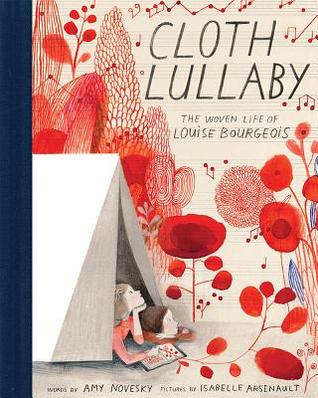
Cloth Lullaby by Amy Novesky

Cloth Lullaby by Amy Novesky

Cloth Lullaby: The Woven Life of Louise Bourgeois by Amy Novesky, illustrated by Isabelle Arsenault (InfoSoup)

Louise grew up alongside a river that wove through her life. Her mother restored tapestries and from age 12, Louise helped too by drawing in the missing bottom edges of tapestries. At her mother’s side, Louise learned about weaving and patterns. Louise eventually went to school in Paris and studied mathematics and cosmography at university. While at college, her mother died and Louise turned to art to express her feelings. She created enormous spiders out of metal and stone, naming them “Maman.” She took the fabrics of her life and cut them apart, working to put them back together in new ways. It was a tribute to her mother and her childhood expressed in art.

Novesky’s picture book biography keeps the magic of Bourgeois’ childhood intact. The book ends with an image of the artist and one of her spiders as well as a quote that speaks to her never having lost touch with the magic of her childhood. That quality weaves throughout the book where both the river and the restoration work create moments of inspiration and amazement. There is such beauty in the quiet work of restoration as well as the knitting activities of spiders. Readers will immediately understand the connection of wool and web in her art.

Arsenault’s illustrations are alight with that same magic and inspiration. In one image of Louise’s mother, there is a certain spider-ness there, subtle but also clear as she works with her black wool. All of the illustrations in the book celebrate pattern and weaving. There is a limited palette of reds, blues and grays that evoke the richness of tapestries and the excitement of art.

A top pick for picture book biographies, this book pays homage to a female artist that many may not know. Appropriate for ages 5-8.

Reviewed from library copy.

Circle by Jeannie Baker

Circle by Jeannie Baker

Circle by Jeannie Baker (InfoSoup)

As a young boy in a wheelchair dreams of flying, a godwit takes off from the beach. The bird embarks on a journey from Australia or New Zealand to the Arctic and then back again, performing the longest unbroken migration in the world. The reader gets to see the long and arduous flight with only one stop to eat along the way. The godwit reaches the Arctic where he attracts a mate and has chicks, but not all of them survive the predators. The chick who survives is left behind by his parents to make the journey separately as the godwit returns to the air to fly back south.

The bulk of the book is on the remarkable godwit and his story of grit and resilience on his journty. Framing that story though is the story of a boy and his recovery, allowing the bird to speak to the importance of endurance and spirit as anyone is facing difficulty. The text is poetic and lush, containing evocative phrasing like “they follow an ancient, invisible pathway” and “One chick hides, crouched and still, disappearing into the colors of the land.”

Baker’s art is simply awe-inspiring. Using collages, she creates entire worlds on the page. The tundra in the Arctic has individual blades of grass that fade into mosses and lichen while the godwit tries to defend his nest against a fox. Other pages capture landmarks like the Great Barrier Reef. There are northern mountain ranges, large cities and southern beaches. The illustrations are incredible.

A noteworthy picture book, this book is filled with information on a remarkable animal accompanied by exceptional illustrations. Appropriate for ages 4-7.

Reviewed from library copy.


Miss Mary Reporting by Sue Macy

Miss Mary Reporting by Sue Macy

Miss Mary Reporting: The True Story of Sportswriter Mary Garber by Sue Macy, illustrated by C. F. Payne (InfoSoup)

Mary Garber was one of the first female sports journalists in the United States. At a time when women were not newspaper reporters, Mary was a sports reporter. Her big break came during World War II when the men were sent to war. After the war, Mary was moved to a news desk but then a year later permanent came back to sports. She was there to witness Jackie Robinson join the Brooklyn Dodgers. Mary herself was barred from the press box and forced to sit with the coaches’ wives rather than the other reporters until her editor complained. Locker rooms were also a challenge. Mary continued writing about sports for more than 50 years, retiring in 2002. Along the way she garnered awards and honors and a reputation for being fair and unbiased.

Macy captures the story of this groundbreaking woman beautifully. The tone is playful and humble with Garber’s quotes often given credit and thanks to others rather than taking praise for herself. At the same time, one understands the courage it took for Mary to continue doing this job in such a male-dominated field. This story is inspirational in the best possible way.

Payne’s illustrations add to the playful feel of the title and the humor. Mary is shown as very petite, dwarfed by those around her. Yet she is clearly the center of attention on the page, her face lit from within by her big eyes and large glasses. Her short hair and can-do attitude mark her uniquely on the page as well.

A great picture book biography to share with children who enjoy sports or writing. Appropriate for ages 7-9.

Reviewed from copy received from Simon & Schuster.


I Am Pan! by Mordicai Gerstein

I Am Pan by Mordicai Gerstein

I Am Pan! by Mordicai Gerstein (InfoSoup)

From the minute he is born, Pan is filled with mischief. Born with his goat horns and hoofed feet, he is immediately silly and even gets the grumpy Zeus to smile. As Pan grows, he becomes bored with life on Olympus and gets into so much trouble that the Gods ask him to return to Arcadia where he was born. While there, he invents panic, falls in love with the moon, and helps battle the monster Typhon. He also falls in love and marries Echo and discovers his love of music and the pan pipes. Story after story shows the power of merriment, music and mischievousness.

Gerstein embraces the spirit of Pan on the page by telling the tales with a zany spirit and a wild feel. There is not attempt to contain Pan here, just a feeling of being along on a very rambunctious ride. This suits the subject beautifully, giving space to the large personality of Pan. The graphic novel format also works very nicely with retelling Greek myths, keeping them brief and showing rather than telling a lot of the action.

The illustrations of this picture book/graphic novel are done in loud colors with lots of action and movement. Pan almost flies off the page in some sections, particularly when creating panic personally. The illustrations match the subject, offering a loud and cheery look at this wild God.

I am hoping this is not the only Greek God book that Gerstein does, since this book works so well and offers a very approachable and funny look at Pan. Appropriate for ages 6-9.

Reviewed from copy received from Roaring Brook Press.