Review: In Mary’s Garden by Tina and Carson Kugler

In Marys Garden by Tina and Carson Kugler

In Mary’s Garden by Tina & Carson Kugler (InfoSoup)

This picture book biography of Mary Nohl, a Wisconsin artist, tells the story of her first creations of large art. When she was young, Mary discovered that she loved art and making things and drawing. It was when she started to collect odds and ends from the beach near her home that she started to create her statues in her garden. Cement was combed and crafted, dotted with stones and other objects. One after another, huge creatures filled her yard, drawing visitors to see what Mary was creating. Mary died in 2001 at the age of 87 and her home still serves as a gallery of her art.

The Kuglers focus primarily on the finding of objects and the process that Mary used to create the art. Then they turn to the gallery she created with her huge creatures who are friendly and welcoming and wild. One can immediately see the appeal of her art. Turning to the back of the book, readers can see the actual art and her garden gallery. The more detailed prose found there also explains how her works is still problematic for her neighbors and how people are working to preserve it.

The illustrations are great and completely capture the whimsical and decidedly friendly nature of Mary Nohl’s art work. From the finding of objects on the lake beach to the creation of the art itself, the illustrations invite young readers to try their own hand at found-object art and to make themselves happy too.

Ideal for Wisconsin libraries, art teachers will enjoy having a book about a woman modern sculptor. Appropriate for ages 4-6.

Reviewed from library copy.

Review: Trapped! by Robert Burleigh

Trapped by Robert Burleigh

Trapped!: A Whale’s Rescue by Robert Burleigh, illustrated by Wendell Minor (InfoSoup)

A wild whale is jumping, swimming and enjoying lots of krill to eat in the ocean waters. But then she runs into discarded netting from a crab fisherman floating in the water. The net catches her, cutting into her mouth and making swimming difficult. The a boat motor sound comes and along with it a group of humans who are hoping to rescue the huge animal. But it is so dangerous being near an animal of that size where even small motions can cause injuries to the rescuers. Still, they work close to the whale and begin to cut her free. They swim away if necessary and touch her with gentleness and care. Eventually the ropes and netting fall away and the whale is free to swim again. To say thanks, she gently touches each of her human rescuers before jumping for joy.

Burleigh’s text contains lots of information but it is presented through the lens of a story. This is a tale of one very fortunate whale, rescued in time from the netting. It is a story of wild freedom at first and then a desperate struggle and then impossible hope that she will survive after all. This is a real drama played out on the pages, from the danger to the whale to then the danger to her rescuers solely from her size. The final pages of the book offer resources about rescuing trapped whales and talk more about the dangers and about the whales themselves too.

Minor’s art is luscious on the page, taking readers under the water alongside the whale. There we float as the water changes colors and the light changes. Minor makes sure the show the size of the whale and of the humans on the same page, so that children will understand the size of the animal. It is beautifully and touchingly done.

An inspiring tale of the difference that even a small group of people can make in sustainability and saving animals, this picture book is a compelling mix of story and fact. Appropriate for ages 6-8.

Reviewed from copy received from Charlesbridge.

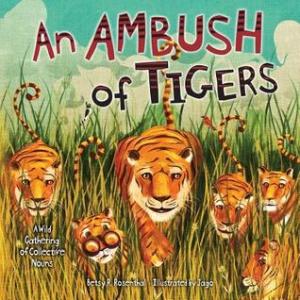
Review: An Ambush of Tigers by Betsy R. Rosenthal

Ambush of Tigers by Betsy Rosenthal

An Ambush of Tigers: A Wild Gathering of Collective Nouns by Betsy R. Rosenthal, illustrated by Jago (InfoSoup)

Using wordplay and clever illustrations, this book celebrates the unique and fascinating world of collective nouns used for groups of animals. From a leap of leopards jumping through the trees near a tower of giraffes to a labor of moles working alongside a business of flies, the animals and their respective collective nouns are matched up to maximize both understanding and humor. Children will enjoy exploring these words and will puzzle over why certain animals are referred to in specific ways.

Rosenthal has carefully chosen the collective nouns she highlights in her book. She also has managed to pair them with interesting imagery in her poetry, such as a troop of kangaroos selling cookies and collecting money in their pouches. She uses rhyming couplets to make the book even more fast-paced and jaunty. The result is a book that is both fascinating and educational but also great fun.

The art by Jago takes the imagery from Rosenthal’s rhymes and turns it into pictures which add to the inherent humor. The sleuth of bears is hot on the heels of the murder of crows. His paintings make the collective nouns tangible and real, creating scenarios that are memorable.

A nice addition to the Ruth Heller books that are in most libraries, this book has a fresh tone and lots of humor. Appropriate for ages 5-7.

Reviewed from library copy.

Review: Woodpecker Wham! by April Pulley Sayre

Woodpecker Wham by April Pulley Sayre

Woodpecker Wham! by April Pulley Sayre, illustrated by Steve Jenkins

In brief stanzas of rhyme, this nonfiction picture book looks at the habitats and lives of a variety of different species of woodpecker. Starting with finding food, the book explores woodpeckers eating insects and sap. Then woodpeckers bathe and preen. They create homes by digging holes in the bark of trees. They hide from hawks. They lay eggs and the chicks hatch, forcing the adult birds to scrounge for food for them. The fledglings start trying to fly and then fall comes and once again woodpeckers are searching for food and shelter to get them through the winter.

Sayre and Jenkins continue their partnership that started with Eat Like a Bear in this new book. Sayre writes with a light hand, creating a sense of exploration and wonder around these backyard birds. Children will learn some things from the brief poetic text and there is a lot more information to be found on the back pages where individual species are identified and all of the subjects are expanded upon.

Jenkins continues to create illustrations that amaze. With his cut paper collages, the illustrations pop on the page as the birds fly, hide, peck, eat and reproduce. I love that the color of the sky changes from one page to the next, creating moments in time rather than one continuous time period. The result are illustrations that stand on their own in terms of beauty and the incredible detail that they offer readers.

Beautiful and informative, this nonfiction picture book will have children gazing out of their windows to try to see the birds in their neighborhood. Appropriate for ages 4-7.

Reviewed from copy received from Henry Holt and Co.

Review: Tricky Vic by Greg Pizzoli

Tricky Vic by Greg Pizzoli

Tricky Vic: The Impossible True Story of the Man Who Sold the Eiffel Tower by Greg Pizzoli

This is a picture book version of the life of Robert Miller, known to law enforcement as Count Victor Lustig, who was one of the greatest con artists of all time. During the early 1900s, Lustig traveled the world doing one con after another. He sailed on ocean liners and befriended wealthy travelers beating them at cards just before they reached their destination. He even conned the legendary Al Capone, pretending to try to double his money while all the time just giving Capone his same money back to appear honest. It worked! His largest con of all time was trying to sell the Eiffel Tower for scrap metal. Amazingly, he did that twice! This incredible story makes for riveting reading and is filled with historical information so young readers will understand concepts like Prohibition.

Pizzoli writes the story of Lustig with great flourish, reveling in the amazing cons that this one man managed to pull off. Pizzoli is known for his simple and clever picture books for younger readers, and in this nonfiction picture book he shows his skills in writing for elementary-aged children. This biography is funny and fascinating, a combination that will have children enthusiastically turning the pages. His writing is filled with the details that make the cons more interesting and using sidebars, he makes sure that children understand the historical context of these cons and how Lustig got away with so much for so long.

Pizzoli’s illustrations add to the appeal. Lustig is shown with only a fingerprint for a head, keeping him a complete enigma throughout the book. At the same time, this bowler-hatted man stands out from the others. The illustrations are an intriguing mix of photographs and drawings, hearkening back to black-and-white photographs even while offering a modern look too.

An impressively compelling subject and cool illustrations combine into a book that is impossible to put down. Appropriate for ages 7-11.

Reviewed from copy received from Viking Books for Young Readers.

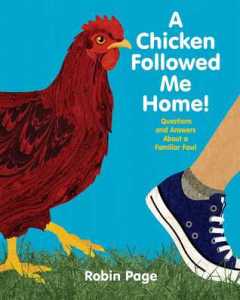
Review: A Chicken Followed Me Home by Robin Page

A Chicken Followed Me Home by Robin Page

A Chicken Followed Me Home!: Questions and Answers about a Familiar Fowl by Robin Page

What do you do when a chicken follows you home? All of the answers you need are in this nonfiction picture book that tells you facts about chickens. First, you will need to know what to feed your chicken. You may also want to know what kind of chicken you now have and whether it is a boy or a girl. You will need a chicken coop to keep your chicken safe from predators and give it somewhere to live. Then there is the question of eggs and if you want fertile eggs you will need both a hen and a rooster. Then the eggs have to hatch successfully. If they do, you will have lots of chickens instead of just two. Maybe they will follow someone else home!

Page is the author of several popular books about animals and she captures the joy of keeping chickens in this picture book. Using the framework of someone suddenly having to care for a chicken makes the book very approachable and readable. The facts are presented rather like a guidebook and offer matter-of-fact information for the new chicken owner or readers interested in chickens. This book will make a great addition to school and public libraries since it is information just at the right level for early report writers.

Page’s illustrations are spectacular. Done in collage and cut paper, she manages to create feathers out of patterned paper that look real and textured. Fuzzy baby chicks are almost touchable on the page as they struggled free from their eggs. The illustrations are large and bold, making this a book good for using with a class.

No need to be chicken, add this one to your library collection! Even children who haven’t found their own hens will delight in this book. Appropriate for ages 6-9.

Reviewed from copy received from Beach Lane Books.

Review: Small Wonders by Matthew Clark Smith

Small Wonders by Matthew Clark Smith

Small Wonders: Jean-Henri Fabre and His World of Insects by Matthew Clark Smith, illustrated by Giuliano Ferri (InfoSoup)

In a small French village lives a strange man who is interested in the smallest of creatures, the insects around us. He lures flies with dead animals that he pays the children in the village to find. His home is filled with specimens. No one realized that he was one of the greatest naturalists of his time. Jean-Henri Fabre grew up in the countryside where he was fascinated by the natural world around him. No one else seemed interested in the same things that he was, but that didn’t deter him from investigating them. Henri became a teacher and studied hard, but not about insects. It was not until a book rekindled his interest that he started to study them in a serious way as an adult. He discovered things about insects that no one else had ever seen and he documented them fully. So when scientists in France nominated one of their own for a tremendous national honor, they voted for Fabre.

Smith writes with a gentle tone throughout, documenting Fabre’s entire life from his childhood to the great honor he received from his peers and his nation. The story starts with the arrival of the president of France for the award and then shows how Fabre’s fascination with insects started as a boy. The period of time when insects were not a focus is clear but also brief and then the book grows almost merry as it documents the many accomplishments of this humble man who followed his own interests in science.

The illustrations are pastoral and lovely. They capture the beauty of the French countryside and also the wonder of the insects, showing them in great detail. There is a playfulness to the illustrations that also reflects the childlike joy that Fabre found in his wonder about insects.

A lovely book about a scientist who followed his own dreams and interests to great acclaim. Appropriate for ages 6-9.

Reviewed from library copy.

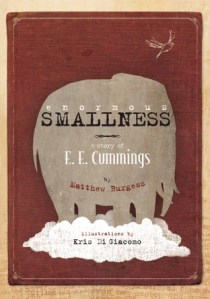
Review: Enormous Smallness by Matthew Burgess

Enormous Smallness by Matthew Burgess

Enormous Smallness: A Story of E.E. Cummings by Matthew Burgess, illustrated by Kris Di Giacomo (InfoSoup)

This picture book biography of the great poet E. E. Cummings is exceptional. Focusing on Cummings’ early years primarily, the book invites young readers to view their own world with wonder and to try to put it into words. As a young boy Cummings was already creating poetry, starting at age three. His mother wrote down his poems for him as he recited them aloud. His imagination extended to art as well, but his real love was words which he approached very playfully, often creating his own words or mashing ones together into new ones. The book emphasizes the hard work that Cummings put into his craft, including spending lots of quiet time observing the world around him for inspiration. After graduating from Harvard, Cummings headed to New York City where he found new inspiration all around him. He served in World War I and published his first books soon after the war ended. His poems were both loved and controversial as he toyed with form and words. Filled with Cummings’ poems as examples, this picture book is a joy to read.

Burgess does a great job with his prose which introduces the young Cummings and his early poems and then follows him as he grows older and his poems grow with him. I appreciate that the book was not attempted to be written using Cummings’ unique style. Rather it is a book that pays homage to the art, the inspiration and the man himself. Spending so much time on Cummings’ youth makes the book much more appealing to young readers who will find inspiration both in Cummings’ age when he began to write and in his poems simplicity.

The art by Di Giacomo is filled with textures and patterns. Words dance across the page, playful and light. They often break free of the lines of prose, merging to be part of the art itself. Words float up on breezes, lengthen with hot summer days, and zing with the style of New York City.

A fabulous biographical picture book, this book is a great introduction to E.E. Cummings and his work. Appropriate for ages 6-9.

Reviewed from copy received from Enchanted Lion Books.

Review: One Plastic Bag by Miranda Paul

one plastic bag

One Plastic Bag: Isatou Ceesay and the Recycling Women of the Gambia by Miranda Paul, illustrated by Elizabeth Zunon

Used to just dropping their baskets when they wore out, people in Njau, Gambia did the same thing with their plastic bags, but the plastic bags decayed like the baskets would. They also didn’t last nearly as long. Torn bags can’t be mended or used at all, so one by one, then ten by ten, and thousands by thousands they were thrown to the side of the road. They accumulated in heaps, poisoning the goats that tried to eat the garbage around them. Water pooled in them and brought more mosquitoes and diseases. Burying and burning them weren’t the solution either. Then Isatou Ceesay found a way to recycle the plastic bags and get jobs for her community by transforming them into something new.

This book speaks to the power that one person can have to change things, both for themselves and their entire community. The prose here is straight-forward but also has moments of poetry thrown in, showing the devastation the plastic bags were creating in the Gambia. The book also shows the way that an idea is born, comes to fruition, passes through being scorned and is finally embraced.

The illustrations by Zunon are remarkable. Using collage, they bring together the textures of the weaving and baskets as well as the plastic bags from photographs. The textiles of the Gambia are also incorporated and vibrate on the page. They are combined with painting and other more playful textures to create the natural setting and the people.

Strong writing and superb illustrations combine to tell the true story of how one woman transformed pollution. Appropriate for ages 6-9.

Reviewed from library copy.