The Great Stink by Colleen Paeff

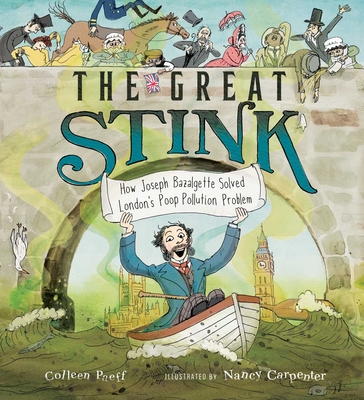
Cover image for The Great Stink.

The Great Stink: How Joseph Bazalgette Solved London’s Poop Pollution Problem by Colleen Paeff, illustrated by Nancy Carpenter (9781534449299)

It was 1858 and the Thames River in London smelled terrible. The problem was that the river was full of poop. The problem had started in 1500, when the sewers were emptied by men who shoveled them out at night. But the population kept on growing. By 1919, there were many more people in London and flush toilets are growing in popularity, but there is no way to get rid of all of the human feces, so some people connected their homes directly to the sewer, sending it all to the river. Cholera epidemics started killing thousands of people, but cholera is blamed on smelly air rather than polluted water, so they kept happening. In 1856, Bazalgette submits a plan to create large sewer pipes to take the sewage away from the river. His plan is finally approved in 1858 after a very hot summer causes the smell to get even worse.

Told with a merry tone, this book embraces the stink of history and shows how one man can change the lives of so many, rescuing them from disease and death. Paeff packs a lot of history into this picture book, making it all readable and fascinating through her use of historical quotes combined with a focused pared down version of what happened. Her writing is engaging and interesting, offering lots of information without ever overwhelming the story itself.

Carpenter’s art is just as stinky as can be. She captures the sewage entering the Thames, the miasma of stench coming off the river in the heat, and the grossness of dumped chamber pots. Against that unclean setting, a small baby is born and becomes an engineer who creates grand tunnels where the air is clear once again. Add in the macabre face of cholera and you have a book that is hard to look away from.

Fascinating, stinky and delightful. Appropriate for ages 6-9.

Reviewed from e-galley provided by Margaret K. McElderry Books.

The Shark Book by Steve Jenkins and Robin Page

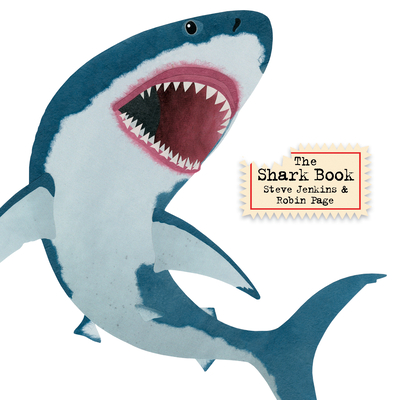
Cover image for The Shark Book.

The Shark Book by Steve Jenkins and Robin Page (9781328569493)

This gorgeous nonfiction picture book explores the diverse world of sharks that includes over 500 different species. The book defines what a shark is, exploring the various physical attributes that make sharks special including their rows of teeth, dorsal and other fins, and their countershading. The wide range of sizes that sharks come in is also featured. Size of shark is shown in comparison with a lone adult human swimmer, often dwarfed by the sharks around them. The book explores how sharks are born, what they eat, and then some of the more interesting species including hammerhead, great white, and whale sharks. Record holding sharks are shown and then shark attacks are discussed as well, while also stating the jeopardy that sharks are in themselves. This is a balanced, fascinating book that is sure to be popular.

From the Caldecott-Honor winning team, this nonfiction picture book features facts that have been chosen to draw readers into the subject. Readers may know something about one type of shark, but the huge diversity of sharks will likely surprise young readers who will find new sharks on every page. The writing is straight-forward and simple allowing the facts themselves to fascinate and awe.

As always, Jenkins’ illustrations are marvelous cut paper. He has a way of creating paper that creates watery ripples, dapples of light, or small waves across the sharks. The skilled use of humans as a way to show size is done at just the right moments in the book and not excessively.

Snap this one up! Appropriate for ages 4-7.

Reviewed from e-galley provided by Clarion Books.

Child of the Flower-Song People by Gloria Amescua

Cover image for Child of the Flower-Song People.

Child of the Flower-Song People by Gloria Amescua, illustrated by Duncan Tonatiuh (9781419740206)

Luz Jiménez was a child of the flower-song people, the Aztecs. She had listened intently to the stories told by the elders about their sacred mountains and streams and also about how the Spaniards had taken their lands away. Luz learned how to do the traditional work of her people, grinding corn on a metate, twisting yarn with her toes, weaving on a loom. She learned about the plants around her and what herbs were medicine. Luz longed to go to school, but it was forbidden for native children. Then the law changed and required schooling in the ways of the Spanish. Luz was a good student and learned much, still keeping the traditional tales alive as she shared them with the other students. At age 13, Luz was forced to flee the Mexican Revolution and live in Mexico City. There Luz became a model for artists, sharing her traditions in paintings and photographs. She longed to be a teacher, but was denied that opportunity. Instead she taught in a different way, through modeling, sharing her tales, and being a living link to the Aztecs.

This beautiful picture book pays homage to Luz Jiménez, a humble woman who became the face of her people. Amescua’s lovely Author’s Note shows the detailed research that went into this biographical picture book. That research is evident in the lovely prose she uses to share Luz’s story with a new generation. Her writing uses metaphors and evocative phrases to really show the impact that Luz’s presence has had as well as her strong connection to her heritage.

Tonatiuh’s art is always exquisite. Done in his own unique style, his illustrations mix modern materials with a folkloric feel. They work particularly well for this subject.

A stellar biographical picture book of a true teacher and heroine. Appropriate for ages 7-10.

Reviewed from e-galley provided by Abrams Books for Young Readers.

Fourteen Monkeys: A Rain Forest Rhyme by Melissa Stewart

Cover image for Fourteen Monkeys.

Fourteen Monkeys: A Rain Forest Rhyme by Melissa Stewart, illustrated by Steve Jenkins (9781534460393)

This picture book explores the fourteen species of monkey that all live together in Manu National Park in Peru. They all live in the rainforest together and survive successfully near one another thanks to their different diets, different heights for their habitats, and different body sizes. The day begins with the red howler monkeys who climb to the very tops of the trees to bellow. The spider monkeys live high up as well, searching for their favorite fruits. Down near the ground, sakis race and jump. Each monkey is shown with Jenkins’ detailed illustrations, their space in the rainforest documented, and their activities and diet explored. It’s a look at an entire community of monkeys all living happily as neighbors.

Stewart’s writing is clear and concise. She has a knack for sharing fascinating details about each monkey, such as how long the howlers rest each day (18 hours) and that capuchins will eat anything they can catch. The book offers layers of text, including basic text that could be shared aloud while the more detailed information is also there for those who want to explore it. Even more information is available at the end of the book along with additional resources.

As always, Jenkins’ illustrations done with paper art are phenomenal. He can make paper look furry, smooth, veined and fruity. He’s a master at the craft, creating animals that are realistic and artistic.

This book doesn’t monkey around, providing great information in a gorgeous format. Appropriate for ages 5-8.

Reviewed from copy provided by Beach Lane Books.

Make Meatballs Sing: The Life and Art of Sister Corita Kent by Matthew Burgess

Cover image for Make Meatballs Sing.

Make Meatballs Sing: The Life and Art of Sister Corita Kent by Matthew Burgess, illustrated by Kara Kramer (9781592703166)

Corita Kent was a remarkable pop-artist who was also a nun, a teacher and an activist. From a small child, Corita showed kindness and empathy for others and also a love of art and creativity. Her father wanted her to do something original, and Corita certainly did. She surprised her family by becoming a nun, discovering a love of teaching and training new teachers. She joined the art faculty at Immaculate Heart College, where she discovered a love of silkscreen printing. Soon her art was winning competitions. Corita continued to teach classes and make her own art, which spoke to social justice and against poverty and war. She transformed a rather formal celebration into one of bright colors and activity. Not everyone approved of what Corita was doing, and she surprised the people around her once again, asking to be released from her religious vows. She found places for her largest work, painted on a gigantic tank, and her smallest, a rainbow postage stamp.

While Kent may not be a household name, many of us have seen her work on the iconic postage stamp. This picture book embraces her unusual life, celebrating the decisions she made, the art she created and her voice for social change. The book cleverly pulls out elements of how Kent taught and created her art, offering unique perspectives gained by seeing the world in a fresh way. The writing here is engaging and offers a tone of delight as Kent continues to surprise and amaze.

The bright and vibrant art in the book shares elements of Kent’s own work. Her play with lettering and words appear throughout the illustrations of the book, filling tree trunks, coloring margins, and as posters on the walls. The entire book is a delight of collage, typography and riotous color.

A positive and affirming look at an artist who should be better known. Appropriate for ages 6-9.

Reviewed from copy provided by Enchanted Lion.

The Story of Bodri by Hédi Fried

Cover image for The Story of Bodri

The Story of Bodri by Hédi Fried, illustrated by Stina Wirsen (9780802855657)

Inspired by the author’s experiences during the Holocaust, this picture book takes a child’s view of the horrors of that time. Hédi grew up in Romania. She loved her dog Bodri, and he loved her most of all. She had a best friend who lived nearby. They had all sorts of things in common, except Hédi was Jewish and her friend went to church. When Adolf Hitler shouted on the radio, Hédi’s parents assured her that he would never come there. But his soldiers did come and Hédi was forbidden to play with her Christian friend. Soon the family was told to pack their belongings. They went to the train station, followed by Bodri, who had to be left behind. Hédi’s parents disappeared in the concentration camps but Hédi and her little sister survived. She went back home and found Bodri still waiting for her.

Fried survived several Nazi labor camps, including Auschwitz and Bergen-Belsen. She lives in Sweden and continues to be an expert voice for democracy and anti-racism. This book was inspired by a question she received at one of her presentations about what happened to her dog. The book translates the larger racism and hatred of the Nazis into a personal story of the impact of the Nazis. Fried writes through a child’s eyes, a child watching her parents to gauge what is happening. Using her dog as an anchor as time passes is very moving as he continued his vigil through the seasons.

Wirsen’s art is haunting. There is an ethereal nature to it throughout the book even as the girls play in the park full of pinks and greens. The colors change to more somber as the Nazis arrive. Wirsen uses watercolors and prints to create her images. The juxtaposition of the girls after they are liberated from the camp to before they went in is both startling and heartrending.

A powerful look at the Holocaust through the eyes of a survivor and her dog. Appropriate for ages 7-9.

Reviewed from copy provided by Eerdman’s Books for Young Readers.

Unbound: The Life & Art of Judith Scott by Joyce Scott

Cover image for Unbound.

Unbound: The Life & Art of Judith Scott by Joyce Scott with Brie Spangler and Melissa Sweet, illustrated by Melissa Sweet (9780525648116)

Told by Joyce Scott, the twin sister of Judith, this picture book explores the closeness of the sisters as small children until they are separated for years. The two sisters shared everything with one another, playing together all the time. Then Joyce is sent to kindergarten and Judith is left behind. Judith has Down syndrome and has never spoken. Then her parents send Judith to a special school where she will live and learn to talk. They don’t visit for a long time and when they do, the school isn’t like other schools. There is no playground, no desks, no books. As they grow older, Joyce gets married and has children. She continues to think of Judith as being at her side all the time. Eventually, she is able to bring Judith out of the institution and to live with her. Joyce finds Judith an art program to be part of. Judith attends but won’t participate at all. Months go by until her teachers give her some natural materials and fabric. Suddenly, Judith is creating unique pieces of sculpture and is celebrated as an artist.

Full of sorrow and loss, this picture book examines the destructive nature of the systematic institutionalization of people with special needs to both the person institutionalized and their loved ones. Having Joyce herself narrate the book is powerful. The beautiful connection the sisters have in their young childhood forms a foundation of connection that allows her to rescue her sister decades later. Even as the book moves to when Judith finds her artistic voice, there is a melancholy to the years lost and the muting of her voice for so long.

Sweet’s illustrations are incredible and moving. She incorporates collage and also builds sculptures to pay homage to Scott’s work. Built with string, textiles, wire and wood, there is a celebratory nature to them of an art newly found. In other moments, Sweet captures wistfulness, longing and connection with light, shadow and color.

An extraordinary look at an artist who was almost lost. Appropriate for ages 6-9.

Reviewed from e-galley provided by Alfred A. Knopf.

And I Paint It: Henriette Wyeth’s World by Beth Kephart

Cover image for And I Paint It.

And I Paint It: Henriette Wyeth’s World by Beth Kephart, illustrated by Amy June Bates (9781951836047)

This picture book biography looks at the country life of N.C. Wyeth and his family through the eyes of his artist daughter, Henriette. Henriette joins her father as he heads out into the countryside to paint. The two quietly go out, avoiding her talkative sister who is in the henhouse and her brother who is in his workshop building things. Her father greets the flowers along the way, finally stopping to paint the landscape before them. The two sense the world around them, draw the details they see, and smell the earth and plants, painting the sky. They paint together until it is time to head home, and even then Henriette stays behind to paint even more.

The author first discovered Henriette through N.C. Wyeth’s letters and then went on to learn more about her. The statements that the book has Wyeth say to his daughter are taken from his writing about art. The language in the book is poetic and rich, showing all of us how to look more deeply at the world around us and celebrate the small things we see and the large landscape and sky as well.

Bates was also taught art by her own father and notes in her Illustrator’s note that this book pays homage to the Wyeth’s and also to her own experience as she grew up. The illustrations are an engaging mix of watercolor landscapes and then also smaller drawings and paintings that Henriette would have made as they wandered from things she dreamt up and details she noticed.

A lovely look at the Wyeth family, the talented Henriette and how the artistic eye is taught. Appropriate for ages 6-9.

Reviewed from copy provided by Cameron Kids.

Mars Is by Suzanne Slade

Cover image for Mars Is.

Mars Is: Stark Slopes, Silvery Snow, and Startling Surprises by Suzanne Slade (9781682631881)

Taking photos from the HiRISE (High Resolution Imaging Science Experiment) that began orbiting Mars in 2006, this nonfiction picture book gives an intimate look at the planet. The large text in the book continues the Mars is… from the title while smaller text offers scientific details about what the image is revealing about Mars. While the images are all of the surface of Mars, they are unique and different from one another, each showing elements of wind, rock, dunes and craters that tell an even greater history of what has formed the planet.

Slade harnesses the incredible photographs from the HiRISE project with huge impact. The design of the book uses the images as the background for the entire page, allowing readers to get the most out of every image. The variety of images is remarkable too, from the paleness of the sand dunes to the dark drama of the slopes and craters.

Slade’s text allows readers to really understand what each image is showing about Mars and what it reveals about how the planet’s surface has formed and continues to evolve and change. She uses technical terms and explains them clearly, taking readers through the image and inviting them to look at it even more closely. At the end of the book, the HiRISE project is explained.

A fantastic science book that children will love to explore. Appropriate for ages 5-8.

Reviewed from ARC provided by Peachtree.