Review: See What a Seal Can Do by Chris Butterworth

see what a seal can do

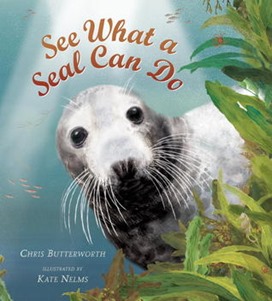
See What a Seal Can Do by Chris Butterworth, illustrated by Kate Nelms

This nonfiction picture book follows a gray seal through its day.  The seal starts off on shore where it is flumping along the sand, seeming slow and sleepy.  Then it enters the water and what seemed awkward on land makes it able to swim with incredible grace.  As the seal swims, readers learn about their different anatomy, including their ears, whiskers, fins and blubber.  At the bottom of the ocean, the seal eats fish and then eats more on its way up to the air again.  Returning to the beach, the seal is ready for another nap. 

Butterworth truly celebrates this animal in her book.  She writes with a mix of prose and poetry, making sure that readers understand how fascinating seals are.  Throughout, she uses metaphors to make sure that children relate to the animal.  Blubber is compared to a warm blanket.  The seaweed at the bottom is a forest.  The seal swims like a rocket in the water. 

There are many science picture books that use the format of larger text for the basic story and then smaller text for more details.  Perhaps best about this book is that Butterworth uses both sections of the book to share scientific information, too often the science is left mostly to the smaller text and younger readers miss out on the fascinating facts.

The artwork by Nelms is simply exquisite.  Just like the seal, the book really comes alive in its underwater scenes. Nelms manages to offer lots of small details to look at, but also to capture the wavering light and softness of water.  There are illustrations throughout that have a beautiful depth to them, inviting us to hidden places under the water.

A beauty of a science book, this celebration of seals gets my enthusiastic seal of approval.  Appropriate for ages 4-6.

Review: Locomotive by Brian Floca

locomotive

Locomotive by Brian Floca

This book thoroughly celebrates the days of steam trains when rails were just starting to bridge the nation.  It begins with the building of the railroad, coming from east and west and meeting in the middle.  Filled with the sounds of building and the sounds of trains, this book fairly sings with the noises of the railroad.  Your trip starts on a quiet platform waiting for a train.  Once aboard, readers learn about the way steam powers the engine and the jobs of different people aboard.  Readers ride aboard the train, visit the bathroom which is basically a hole in the floor, and sleep along the way.  On the way west, you can see the landscape change, cross fragile bridges and enter black tunnels.  This entire book is a stirring testament to steam engines and the people who worked them.

Floca offers so many details here.  One might think that would slow the book down, but it is really all about those details and the entire experience of travel by steam train.  He keeps the interest level high by being very selective of the facts he shares.  It makes the reading fascinating and even young train buffs should learn a thing or two. 

Floca’s illustrations are beautiful.  He lingers over details in his images as well as in the text.  Readers get to see mechanisms close up, feel the speed of the train as it moves forward, and see the light reflecting off of the tight tunnel walls.  He creates an experience here that speaks to the time period clearly with his choice of fonts and the design of the entire book.  His illustrations are sometimes front and center, other times serving more as diagrams of interesting facts. 

Gorgeous illustrations, fascinating facts and a clear love of the subject make this a riveting read whether you are a train buff or not.  Appropriate for ages 7-10.

Reviewed from library copy.

Review: Eat Like a Bear by April Pulley Sayre

eat like a bear

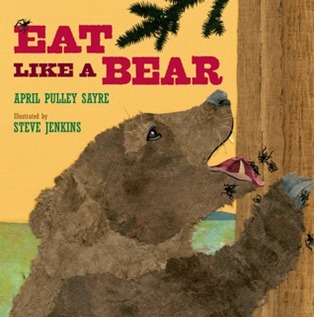
Eat Like a Bear by April Pulley Sayre, illustrated by Steve Jenkins

Released October 22, 2013.

Can you eat like a bear?  It means you will wake up very hungry in early spring and have to dine on sandy plants and frozen dead bison meat.  In May, you will have dandelions and cow parsnips to munch but you will still be hungry, so you eat some ants.  You will also eat clover and fish in icy streams for a meal of trout.  In July you will catch a squirrel you dig out of the dirt and in August you will have moths to munch.  September brings berries and October pinecones.  Then it is time to sleep for the winter, full with all of the various meals you have eaten for the rest of the year.

Sayre makes this book such fun to read.  She takes scientific information about what bears eat and makes it very accessible for a preschool audience.  She uses repetitive structures throughout the book, having the bear dig and pull to find food again and again.  This doesn’t just create a friendly structure for small children, it also underlines the fact that animals are in constant search for food.  Sayre also makes the book inviting by using the second person format, asking children if they can really eat like a bear.  I suspect many will stop saying yes when the ants, squirrels and dead bison appear in the diet.

The art of Jenkins is always beautiful, but he outdoes himself with the depiction of the bear.  I shared this book aloud with my son and we both spent time lingering over the first image of the bear.  Jenkins has managed to use the torn paper as fur, not only along the edges of the bear’s body but on its body too.  The result is fur so plush that you feel like your hand should sink into the page.

A glorious look at bears, this book is a fantastic introduction to a creature, its habitat and its diet.  Appropriate for ages 4-6.

Reviewed from copy received from Henry Holt & Co.

Review: Rotten Pumpkin by David M. Schwartz

rotten pumpkin

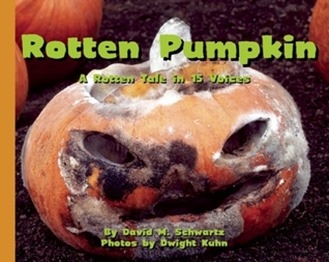
Rotten Pumpkin: A Rotten Tale in 15 Voices by David M. Schwartz, photos by Dwight Kuhn

A dynamic mix of story and nonfiction, this book follows the life of a pumpkin.  He has his shining moment as a jack-o-lantern lit for Halloween, but then is put into the compost.  That is where the story gets interesting.  First he is chewed on by mice, squirrels, slugs and vomited on by flies.  Now he looks a lot different and has fungi growing.  The various molds introduce themselves, explaining what they do, including the fascinating Penicillium.  Sow bugs, earthworms, slime mold and yeast work on the pumpkin too.  It is left as just a pile of seeds and little else.  Until spring arrives!

Schwartz shows readers just how fascinating science is with his in-depth descriptions of the decomposition process.  Children will adore the explanation of how flies taste and eat, the process of earthworm poop, and all of the molds seen up close.  But this book goes far beyond the gross and takes the reader right through the entire process, detailing it with interesting moments throughout. 

The photographs by Kuhn are particularly useful in a book like this.  Capturing the changing face of the pumpkin as it molds over adds real interest visually to the title.  At the same time, the close up images of yeasts and slime mold are grossly gripping.

Perfect for autumn and Halloween, this book will have kids looking at their slumping pumpkins with new eyes.  Appropriate for ages 6-9.

Reviewed from library copy.

Review: Volcano Rising by Elizabeth Rusch

volcano rising

Volcano Rising by Elizabeth Rusch, illustrated by Susan Swan

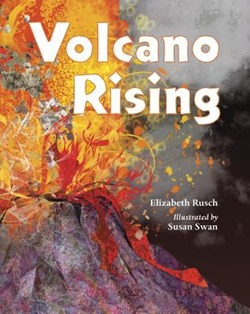
Volcanoes can seem destructive, but in this nonfiction picture book they are shown to be sources of creation as well.  The process of eruption and magma is described and the book looks at the fact that different volcanoes move at different speeds.  The book is written in two levels, one for more of a picture book audience and the other for elementary students ready for detailed information.  While the simpler part stays general, the more detailed information includes specific volcanoes and stories of their eruptions.  The book makes volcanoes interesting rather than frightening, looking at how ash restores fields and how most creative eruptions can be out-walked by people.

Rusch’s two levels of text really stand apart from one another.  The simpler version really reads as a playful picture book complete with sounds.  It does still offer facts and information, but the deeper text is filled with those.  That longer text loses the playfulness of the shorter but is a wealth of information on volcanoes that even young enthusiasts will find fascinating.

Swan’s illustrations are done in cut paper and have a vivid color that really makes the volcanoes pop.  She shows various volcanoes in her art, contrasting them with one another nicely.  It is the images of eruptions that really explode on the page and will delight readers.

A double-layered book that can be shared in a storytime or in a science classroom.  Appropriate for ages 3-8.

Reviewed from copy received from Charlesbridge.

Review: Electrical Wizard by Elizabeth Rusch

electrical wizard

Electrical Wizard: How Nikola Tesla Lit Up the World by Elizabeth Rusch, illustrated by Oliver Dominguez

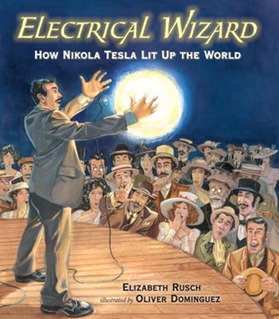
Nikola Tesla was born in Serbia during a lightning storm, something that would portend his future interest in electricity.  At a young age, Tesla became fascinated by the invisible energy everywhere around him, in the water, the wind and the insect that flew.  In college Tesla grew interested in alternating current though his professor thought it was impossible.  Tesla studied and invented and eventually figured out how to make alternating current work, but he needed help.  He headed to America to meet with Thomas Edison, someone he knew would be interested.  But Edison was not, insisting that direct current was the only electricity he would work with.  Soon Tesla and Edison were rivals in the “war of the currents.”  This first picture book biography will introduce young readers to one of the great scientific inventors of all time and his greatest rival too.

Rusch tells the compelling story of Tesla and his inventions.  She shows Tesla as a complicated person, eager to pursue his own ideas and willing to stand up for them in the face of great opposition.  She also tells the story of the rivalry of the two men in a very engaging way and Tesla’s ultimate victory and how he reached it.  Her writing is engaging, detailed and impressive.

Dominguez’s illustrations are filled with period details that help ground this picture book directly in the time in which it is set.  Scientific instruments are often in the forefront of the images, showing their structures in detail.  This is a true celebration of the science of invention.

An electric read, this book shines light on a great man.  Appropriate for ages 7-9.

Reviewed from copy received from Candlewick Press.

Review: Lifetime by Lola M. Schaefer

lifetime

Lifetime: The Amazing Numbers in Animal Lives by Lola M. Schaefer

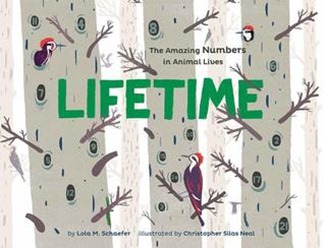
Take a unique look at what animals will do in a single lifetime in this book that combines counting, math and fascinating scientific facts.  The book focuses on how many times a single animal will do a behavior during their life.  The facts are based on estimations and opens with a description of how the numbers were figured out and explaining that each individual animal will be different than the estimate.  The book opens with one spider’s egg sac, the sole one she will create in a lifetime.  It then goes to the ten antlers that a caribou will grow and shed and moves on by tens.  The book ends with one thousand tiny baby seahorses, the number a single male seahorse will carry and birth. 

This is a spectacular way to introduce averages to children and estimation.  It is a celebration of the information that mathematics can provide to us about nature.  Schaefer has selected a wide variety of animals and intriguing facts about each of them.  Readers can find more in-depth information on the animals at the back of the book.  They will also find more information on averages and math there. 

Schaefer’s art adds to the appeal of this book.  Her illustrations have a boldness to them, a graphic quality that really works.  They are flat and vibrant, clearly laying items on the page for counting.  The book is a joy to page through since each page offers a new animal, a new habitat to see.

One of the most visually stimulating and smart concepts for a nonfiction picture book, this one is sure to beat the averages and be read more than once.  Appropriate for ages 4-6.

Reviewed from copy received from Chronicle Books.

Review: Jasper’s Story by Jill Robinson

jaspers story

Jasper’s Story: Saving Moon Bears by Jill Robinson and Marc Bekoff, illustrated by Gijsbert van Frankenhuyzen

Held captive for years by bear “farmers” who kept him in a too-small cage and harvested bile from his body, Jasper’s story is representative of many captive moon bears.   Now Jasper has been rescued by Animals Asia, an animal welfare organization.  He is taken to their Moon Bear Rescue Center where his medical needs are attended to and he is put into the sanctuary.  There, Jasper walks on grass for the first time in his life.  Caregivers work to teach Jasper how to find food on his own, hiding food in toys and places to dig.  In time, Jasper’s life starts to change.  He begins to play more, get stronger, and make friends.  Jasper is one success story among many, a testament to what rescue can do to save animals that might have been considered too damaged to rescue.

Robinson and Bekoff write in a very engaging way in this nonfiction picture book.  They invest time in telling the story of the abuse as well as painting a beautiful picture of moon bears in the wild: “Far away in the mist-covered mountains of China, the moon sends yellow arcs of light across the hills, softly painting the forests with a luminous glow.”  They describe the way that wild animals sleep with a sense of freedom.  The prose is beautiful, clearly painting the value of these animals and the importance of their rescue and rehabilitation.

The illustrations are equally evocative.  The paintings have a wonderful sense of place, showing the workers at the sanctuary and the horror of the small cages with equal attention.  I particularly like the way that the opening image relates to that at the end, showing that Jasper is once again more like the wild moon bears than the abused ones. 

A great book on the importance of animal rehabilitation and rescue, this book will speak volumes to every child who picks it up and meets Jasper.  Appropriate for ages 7-9.

Reviewed from library copy.

Review: No Monkeys, No Chocolate by Melissa Stewart

no monkeys no chocolate

No Monkeys, No Chocolate by Melissa Stewart and Allen Young, illustrated by Nicole Wong

A close-up look at the favorite sweet treat of chocolate, this nonfiction picture book explains exactly what it takes to get chocolate.  The book quickly moves to the tropical rain forests of Central and South America and the cocoa beans that grow there and how they are treated to get cocoa powder from them.  The book then moves to explaining cocoa pods, cocoa flowers, and cocoa leaves, but animals quickly come into the process from the midges that pollinate the cocoa flowers as they lay their eggs to the maggots of the coffin flies that take over the brains of the leaf-cutter ants.  Lizards and monkeys play a role too, but the monkeys are tantalizingly left to the end of the book.  Told in factual information, the book also offers asides by two funny bookworms who wonder along with the reader what in the world monkeys have to do with chocolate!

This is a fascinating look at the complexities of something that many of us take for granted.  Stewart, author of over 150 nonfiction books for children, worked with Allen Young, the world specialist on cocoa tree pollination and growth.  The result is a book that is enticing both in its premise and its execution.  Turning pages lets you learn more and the entire process is both odd and amazing.

The art by Wong has a wonderful lightness to it that fits the subject particularly well.  The clever little bookworms add a whimsical note to the entire book with their ballooned speech bubbles, ballcap, flower and skirt. 

A winner of a nonfiction picture book, this is one sweet addition to any library.  Appropriate for ages 6-8.

Reviewed from copy received from Charlesbridge.