Review: Bird Talk by Lita Judge

bird talk

Bird Talk: What Birds Are Saying and Why by Lita Judge

Incredible displays of feathers, bright-colors and complex songs are all ways that birds communicate and try to find a mate.  Some birds puff and strut, others have large wattles, and still others drum on a branch with a stick.  Once birds have found that mate, they communicate their pairing to others using dances, clattering bills, or by providing food for one another.  When eggs and baby birds arrive, the parents use flashing wing colors, trickery or pretending to be wounded to lead predators away from their young.  The parents teach their babies to eat, fly and more with clucks, demonstrations, and plenty of talk.  Celebrate the birds that live around your house as well as exotic birds that have amazing ways of communicating.

Judge has written a very detailed but also very readable book about birds.  It has a wide range of species that are all intriguing in the way they communicate with one another.  This makes the book engaging and great fun to read.  At the end of the book are even more facts about the birds, that share their habitat and range.   Judge’s illustrations have a wonderful playfulness to them, but also display the beauty of the birds with accuracy and skill. 

A great pick for children’s nonfiction collections, this is an inviting book about wildlife that will give new and intriguing information to young nature lovers.  Appropriate for ages 8-10.

Reviewed from copy received from Roaring Brook Press.

Review: Ocean Sunlight by Molly Bang

ocean sunlight

Ocean Sunlight: How Tiny Plants Feed the Seas by Molly Bang and Penny Chisholm

Following her Living Sunlight book, this continues the story of how the sun makes life on earth possible.  Here, the focus is on the ocean and the role that sunlight plays even in the darkest depths of the sea.  The story starts with photosynthesis and food chains on dry land, then moves to the water.  Bang asks where the green plants in the ocean are except for the seaweed.  Then she shows the tiny phytoplankton that make up the plants of the sea.  The food chain is shown and the book then turns to the darkness of the deep and how the food chain works even in blackness.  It is beautiful science. 

Bang successfully combines poetry and science in this enticing picture book. Her tone is inviting, inquisitive and filled with wonder at the amazing things that happen due to our sun.  The book is written from the point of view of the sun itself and how its energy reaches everywhere on earth.  It is a celebration of the sun and of the oceans themselves too.

Chisholm’s art ranges from the glow of the yellow sun to the black deep of the ocean.  Everywhere, even in the darkness, you can see the energy of the sun.  When the phytoplankton are displayed, Chisholm shows them up close in all of their wonderful detail.  Then the energy of the sun dances above the waves in yellow dots.  The entire book sings with energy and light.

This book is a tribute to science and nature.  It’s a readable and very understandable look at the complex systems that make our lives possible.  Appropriate for ages 5-8.

Reviewed from library copy.

Review: Georgia in Hawaii by Amy Novesky

georgia in hawaii

Georgia in Hawaii: When Georgia O’Keeffe Painted What She Pleased by Amy Novesky, illustrated by Yuyi Morales

In 1939, the Hawaiian Pineapple Company commissioned two painting by Georgia O’Keeffe.  This picture book is the story of her trip to Hawaii funded by the company.  O’Keeffe spent time on each of the Hawaiian islands.  Her first stop was Oahu where she saw pineapples in the fields.  She wanted to spend time close to the plants as they grew, but the company did not approve.  They gave her a pineapple that had been picked, but that was not the same for O’Keeffe.  She next went to Maui where she spent time near a rainforest and waterfalls.  She painted what she wanted, when she wanted.  On the island of Hawaii, she saw volcanoes, rare red coral and lots of flowers. Finally, she went to Kauai and visited with the local artists as the air was filled with the scent of burning sugar.  But when she returned to the mainland, she didn’t have a single picture of a pineapple.  The company was upset, and so was O’Keeffe, who hated being told what to paint.  So how could they resolve this?

Novesky brings the Hawaiian island to lush life in this picture book.  Her words tell of the beauty and diversity of the islands.  They also show how the islands impacted the work of Georgia O’Keeffe.  The story is told on a level that children will enjoy, giving examples of what inspired O’Keefe to paint and what did not.  It is a strong story about how creativity and inspiration work.

Morales’ art is so lovely.  As she says in her illustrator’s note at the end of the book, she took inspiration for the illustrations not only from the twenty paintings that O’Keeffe created in Hawaii, but also from works throughout O’Keeffe’s lifetime.  The illustrations have something that I can’t put into words.  It’s a kinship or a closeness with the original work. 

This is a gorgeous and striking picture book about a dynamic, one-of-a-kind artist.  Appropriate for ages 6-8.

Reviewed from library copy.

Review: Waiting for Ice by Sandra Markle

waiting for ice

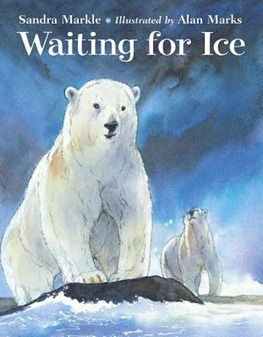
Waiting for Ice by Sandra Markle, illustrated by Alan Marks

This is the true story of an orphaned polar bear cub who has to survive the wait for the ice to return without the help of her mother, who would normally have cared for her for another year or two.  This cub lives on Wrangel Island, far north of Russia in the Arctic Ocean.  She lives there with many other polar bears, but she is alone.  She has to find dead things on the shore to eat, defend her finds from scavengers, negotiate other food from hunting bears, and manage to survive.  Many other cubs die from starvation, but this little cub survives.  She manages to live until the ice floes return.  Even then, she is one of the last to leave the island, unsure of how to live on the ice away from land.  Eventually, she spends more and more time on the ice, and then she is carried off into the ocean where she must learn to survive in a new way.

Markle captures the harrowing and desperate life of an orphaned cub in a very straight-forward way.  The reader knows of the danger that this cub is in and how difficult her life will be.  This white-furred heroine also captures the mind of readers, demonstrating time and again how brave and resourceful she is.  Markle takes care not to humanize the life of the bears, instead they are respected as animals with their own lives.  Few human emotions are spoken about, instead the drama comes directly from the situation and survival.

Marks’ illustrations recreate the cold of the Arctic on the page.  Done in whites, blues and browns, they are chilling, warmed only by the young bear at the center.  Marks draws the movement and feel of polar bears with a confidence and care.  These are solid illustrations that do much to support the book as a whole.

A stirring tale of survival set in the Arctic Circle, this book will be enjoyed by young nonfiction readers.  It is also a nonfiction book that would work well in a story time setting thanks to its inherent drama.  Appropriate for ages 6-8.

Reviewed from copy received from Charlesbridge.

Review: The Fairy Ring by Mary Losure

fairy ring

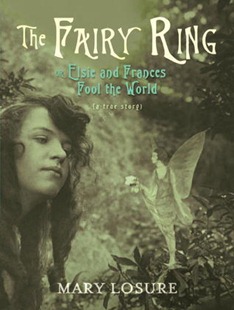
The Fairy Ring or Elsie and Frances Fool the World by Mary Losure

This is the true story of two young English girls who fooled everyone with the photographs they took.  Elsie and Frances were cousins who hadn’t met until Frances moved to England from South Africa.  When Frances, age 9, visited the beck behind their small house, she saw tiny little brown men in green clothes walking about.  But the grownups teased her about seeing fairies, and there was one thing that Elsie at age 15 wouldn’t tolerate and that was teasing.  So the girls set out to take a photograph of fairies that would stop the teasing entirely.  It was all meant to be a little joke, but quickly got out of hand as Sir Arthur Conan Doyle got involved along with international publicity.  It wasn’t until much later that the ruse was finally admitted to.  But in the end, there is still one magical photograph that wasn’t staged by the girls, and you can decide if there are really fairies in it.

This well-researched nonfiction book for children has the appeal of fairies and also the intriguing story of two young people who lied and got away with it for a very long time.  Losure manages to recreate the world that the children were growing up in, but not dwell on overly long descriptions.  It is a brief book, one that looks closely at the truth behind the photographs but also one that keeps one small part open to the wonder of fairies too. 

The girls could have been depicted in a quite different way than Losure handles them here.  They did deceive people and created more images that spread more lies.  But Losure does not show them as calculating at all, rather they are caught in the life that their small prank takes on, unable to admit the truth and unable to stop the insatiable curiosity about the images.  There is an exceptional dignity to the way their story is told here, one that pays homage to both the lie and to the belief.

A very readable nonfiction work that will be enjoyed by children reading the popular fairy series out right now and may lead those fiction readers to find more nonfiction to enjoy.  Appropriate for ages 8-11.

Reviewed from library copy.

Review: Here Come the Girl Scouts by Shana Corey

HERE COME THE GIRL SCOUTS!

Here Come the Girl Scouts! by Shana Corey, illustrated by Hadley Hooper

Juliette Gordon Low, or Daisy as her friends called her, was nothing like the other girls growing up in the Victorian Era.  While girls were meant to be prim and proper, Daisy instead loved the outdoors and adventure.  Daisy traveled the world, but eventually wanted to be more useful.  Then she found out about the Boy Scouts and Girl Guides in the United Kingdom and realized that America needed something that would get the girls there out in nature and exploring.  So Daisy started what would become the Girl Scouts with just 18 girls in Savannah, Georgia in 1912.  She taught them the rules, designed uniforms, planned excursions, and had them outside, active and learning.  This book is about the impact one person with a purpose can have and also the incredible impact the Girl Scouts themselves have had in our society.

Corey looks at Victorian life very briefly and then jumps right in to celebrating the life of Daisy and her Girl Scouts.  The tone here is one of delight in a life well-lived.  Daisy is shown as a person unfettered by her time, but definitely not un-criticized by those around her.  Daisy rose above the scorn and derision that her program faced, continuing her commitment to everything the Girl Scouts stand for.

Hooper’s illustrations have a wonderful playful quality to them.  Done using printmaking techniques, the images have a hand-made quality that suits the subject matter well.  Woven into the images are phrases from the Scouts that immediately incorporate their attitude towards life and service.

An impressive picture book biography of an incredible woman, this book will inspire young readers to dream big and work hard to achieve those dreams.  Appropriate for ages 6-8.

Reviewed from library copy.

Review: Kate & Pippin by Martin Springett

kate and pippin

Kate & Pippin: An Unlikely Love Story by Martin Springett, illustrated by Isobel Springett

When Pippin, a fawn, is abandoned by her mother, photographer Isobel Springett found her crying for help.  She took Pippin home and placed her by Kate their old Great Dane.  The two immediately bonded:  Pippin thought she had found a new mother and Kate started to mother her even though she had never raised any puppies of her own.  Pippin learned to drink from a bottle and when she got bigger started to adventure outside.  One evening, Pippin disappeared into the forest and didn’t return for bedtime.  Kate was very concerned, but the next morning Pippin came back just in time for breakfast.  Pippin returned to the woods every night after that, returning to the farm almost every morning to eat and play.  As she grew into an adult deer, she still continued to return to visit Kate and play.  She even still comes into the house once in awhile for a visit. 

This is one of the most lovely picture books about a relationship with a wild animal that I have seen.  I especially appreciate that Pippin was allowed to continue to be a wild deer, returning to the forest and being allowed to create a relationship on her own terms.  It’s definitely refreshing to see.  Here the human and dog were able to rescue, aid but also step back and not absorb this little creature.  The relationship that emerges is breathtakingly touching, seeped in fragility yet incredibly strong.

A large part of the success here are the photographs of this tiny deer bonding with the enormous dog.  By the end of the book, the animals are the same size.  It is clear that both of them adore one another on a deep level, and one that is delightfully separate from the humans. 

This nonfiction picture book reads like fiction, making it a great pick for a touch of nonfiction in a story time.  It’s a story that children will relate to easily and naturally.  Appropriate for ages 4-7.

Reviewed from copy received from Henry Holt and Company.

Review: Bambino and Mr. Twain by P. I. Maltbie

bambino and mr twain

Bambino and Mr. Twain by P. I. Maltbie, illustrated by Daniel Miyares

In 1904, after losing his beloved wife, Mark Twain shut his door on the public life he had led.  Instead, he stayed indoors spending much of his time alone except for his daughter’s cat, Bambino.  The two of them grew closer as they played billiards together, shared ice cream for his birthday, and stayed together in a bed crowded with books and papers.  One day, after spotting a squirrel outside the window, Bambino leapt out and disappeared.  Twain put an ad in the paper and many people came with cats and kittens just to meet the famous author.  But none of the cats were Bambino.  Three days later, Bambino appeared on the doorstep as if nothing had happened.  Mark Twain took inspiration from his small companion, and started being part of public life again. 

This book explores the powerful relationship between people and animals.  It is also an exploration of grief and could be used with children in elementary school to discuss death and grief.  Maltbie includes many small touches about Twain, including those white suits, details about his wife, and traditions of their family.  Those little points create a much more human story, even though we are talking about one of the most famous authors ever. 

The black cat and the figure of Twain in his trademark white suit make for a great pairing visually as well.  Miyares’ illustrations are filled with great textures and colors, with the palette changing as the mood of Twain lifts.  The shadows are stronger when the grief is at its worst, but lightens and even brightens as the book continues. 

A personal look at a great figure of American literature, this book about Twain offers the depth of grief and the joy of connection with a pet.  Appropriate for ages 6-8.

Reviewed from copy received from Charlesbridge.

Review: You Are a Lion by Taeeun Yoo

you are a lion

You Are a Lion and Other Fun Yoga Poses by Taeeun Yoo

This is a fun and gentle way for children to learn yoga poses.  The book opens with a Namaste to the morning.  Children then learn about the lion pose, with the pose simply explained and shown.  Readers turn the page to see the child in the pose and the jungle and lion around him.  Other poses follow with the butterfly, dog, snake, frog and cat.  The book ends with the Mountain pose and a group of children hold that pose up on top of the mountain range.  Finally, the children lie down and are still, relaxing in the morning light. 

The short text in the book has quick directions and then a few lines of poem to match that pose.  The rhymes are basic, offering a little more insight into why that pose is called by the name it is.  The entire book has a playful approach that matches the subject matter well.  That playful nature is matched by a gentle spirit and a quietness that work particularly well here.

Yoo’s illustrations were done using linoleum block prints, pencil drawings and Photoshop.  They have a wonderful texture to them, great lines, and a simplicity that is necessary when offering directions.  The children are all different races, making the book all the more inviting.

This is a great pick for introducing young children to some basic yoga moves.  The moves are simple, playful and presented in a fresh way.  Appropriate for ages 3-5.

Reviewed from copy received from Nancy Paulsen Books.