Shaped by Her Hands: Potter Maria Martinez by Anna Harber Freeman

Cover image for Shaped by Her Hands.

Shaped by Her Hands: Potter Maria Martinez by Anna Harber Freeman and Barbara Gonzales, illustrated by Aphelandra (9780807575994)

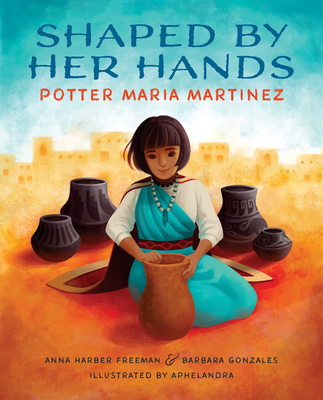
Maria played in the fields while her parents worked, making clay bowls. When all of them cracked in the sun, she sought help from her Aunt Nicolasa who showed her the ancient Tewa way of making pots using clay mixed with volcanic ash and thanking Mother Earth for sharing clay with them. Maria practiced making pots for months before she was ready to have one fired with her aunt’s. Some pots don’t survive firing, so Maria was pleased when hers came out perfectly from the blaze. Maria grew up, married and had children, never stopping working with clay and pots. In 1908 an archaeologist asked if she could create a pot based on an ancient shard of pottery. Though Maria had never seen such a polished and black pot, she decided to try. After many attempts, her pot came out shiny and black. Maria was able to sell her pottery for the first time and soon they were selling as many as they could create, employing her entire family.

This picture book biography tells the story of an important Native American artist who served as a vital ambassador for the Tewa people and the ancient ways of making pottery. The book is written by one of Maria’s great grandchildren and an art teacher author. Their deep knowledge of Maria and art are evident on the pages with the details shared and the homage to Maria’s dedication for learning and teaching.

The illustrations glow with the sun of New Mexico, combined with deep blue skies and green plants. The illustrations are a stirring combination of the characters and beautiful landscapes full of sunset pinks, purples and oranges.

A lovely tribute to an important Native woman artist. Appropriate for ages 5-9.

Reviewed from e-galley provided by Albert Whitman & Company.

13 Ways to Eat a Fly by Sue Heavenrich

Cover image

13 Ways to Eat a Fly by Sue Heavenrich, illustrated by David Clark (9781580898904)

In this hilarious reverse counting book, various creatures consume the thirteen flies. The various flies are given their specific species names as they are eaten. Facts are also shared about each of the predators. The book is inviting and offers a humorous take on the science of eating flies. There are frogs that eat them, spiders, other insects, fish, birds, bats, and even one human (who eats the last fly by mistake!) And remember, even as these 13 flies are eaten, more are emerging all the time.

Heavenrich takes clear glee in sharing strange and fascinating ways that flies can be eaten. She shares facts that will have children turning the pages to discover the next amazing piece of information. Even those who think they know all about insects, frogs and animals will be intrigued by some of the data. After all, who wouldn’t want to learn about a fungus that turns a fly into a zombie!

The art in this nonfiction picture book adds to the joy of the text. Clark creates dramatic moments with his humorous illustrations, depicting the last moments of each fly’s life just before they are eaten. The googly-eyed flies are full of gangly legs, beating wings and despair.

The ultimate in gross and cool nonfiction. Appropriate for ages 5-8.

Reviewed from e-galley provided by Charlesbridge.

The Power of Style by Christian Allaire

Cover image for The Power of Style.

The Power of Style by Christian Allaire (9781773214900)

This nonfiction book explores the importance of fashion as a way to pay homage to heritage, culture and identity. The book looks at the work of designers who are incorporating their own Indigenous heritage into their work, such as ribbon work. The book moves on to hair styles and the importance of embracing natural hair, keeping long hair as a connection to culture, and the art of braiding. Cosplay comes next focusing on size acceptance within the cosplay community and the people who are forcing more inclusivity. Modest fashion and hijabs and head scarves are explored next with a focus on style and individuality. Then the book moves on to talk about high heels for men and the importance of standing tall for LGBTQIA+ rights. The final section is about makeup, both as a way to express yourself and as a way to see yourself included as modern makeup embraces more skin tones.

Each turn of the page in this book shows people of color, different cultures and religions, various gender and sexual identities, a wide range of sizes, and it embraces all of them as valid and beautiful. Written by an Ojibwe author who is the Fashion and Style Writer for Vogue, this book represents so many movements in the fashion world to be seen and accepted. Allaire’s writing is friendly and fresh, inviting readers to explore the pages, showing what allyship looks like, and giving real space to these new ideas and designs.

The book is full of photographs, making it a visual delight to read. Allaire has clearly carefully selected the photographs to show the fashion and also the figures who make the fashion come alive. They are bright, beautiful and truly speak to the diversity he is highlighting.

A gorgeous and enticing book about fashion that will broaden definitions and embraces inclusion. Appropriate for ages 12-16.

Reviewed from ARC provided by Annick Press.

Strange Nature: The Insect Portraits of Levon Biss by Gregory Mone

Cover image for Strange Nature.

Strange Nature: The Insect Portraits of Levon Biss by Gregory Mone, illustrated by Levon Biss (9781419731662)

Levon Biss is a photographer who usually took pictures of celebrities and politicians. When his son brought him a regular garden beetle, the two of them looked at it under a microscope and were amazed at what they saw. Biss then selected 37 insects from the collection of the Oxford University Museum of Natural History to photograph. He used special lenses, cameras and lights to take thousands of pictures of each insect. Those many images were then combined to create the Microsculpture project. The images were enlarged and shown in museums around the world. This nonfiction picture book explores the images created from the Microsculpture project and offers information on each of the insects.

Mone’s text is limited to explaining how Biss got into photographing insects and then moves into sharing scientific information and fascinating facts about each insect. The book includes a glossary and an encouragement to head to the Microsculpture website to learn even more. Mone’s information is nicely selected offering enticing facts, measurements and also pointing out the most interesting parts of the photograph to the reader.

The portraits are incredibly detailed and beautiful. From the lighting that captures each insects iridescence to the incredible shapes of their bodies and armor. The book offers close ups of various parts of each insect, allowing readers to see eyes, legs, heads and more up close. These images are transformative, letting all of us know that we walk in a world of tiny amazing monsters.

Remarkable photographs that will have you leaning in close to see even more, if you dare! Appropriate for ages 4-8.

Reviewed from copy provided by Abrams.

The People’s Painter: How Ben Shahn Fought for Justice with Art by Cynthia Levinson

Cover image for The People’s Painter.

The People’s Painter: How Ben Shahn Fought for Justice with Art by Cynthia Levinson, illustrated by Evan Turk (9781419741302)

Ben Shahn was born in Lithuania and at age four saw his father taken banished for demanding workers’ rights. From a very young age, Ben drew, even though paper was scarce in Lithuania, so he drew in the margins. When his father ends up in America, he brings Ben, his mother and his brother to join him. Ben goes to school, learning a new alphabet instead of the Hebrew one that he learned in Lithuania. He is soon identified as a promising young artist at school, but his family must send him to work in order to survive. Ben works for a lithographer, hand-lettering signs while going to art school at night. But art school isn’t what he is looking for. They teach landscapes rather than the people and stories that Ben wants to paint. Inspired by stories of injustice, Ben painted about current events, creating series of paintings that while not pretty were inspiring. He went on to document the Great Depression using photography, hired by the government several times as an artist. Ben continued to paint the people who were invisible to others.

Levinson captures the story of Shahn’s life with a focus on what drove him to create art, linking it to tragedies in his homeland and his family. Her writing is full of admiration for his hard work and insistence that he paint what he wanted to rather than what he was being told to do. His belief in sharing the stories of those less fortunate shines in her words, revealed by her stellar writing that is both clear and also evocative.

Turk’s art pays homage to Shahn’s throughout the book. Made with gouache, acrylic, pencil, chalk and linoleum block prints, the illustrations are textured and layered. They include versions of some of Shahn’s most iconic works. Turk’s use of bold color, deep shadow and light create a marvelous background for Shahn’s life story.

A great picture book biography that speaks to the intersection of art and political statement. Appropriate for ages 6-9.

Reviewed from copy provided by Abrams.

Walking Toward Peace: The True Story of a Brave Woman Called Peace Pilgrim by Kathleen Krull

Cover image for Walking Toward Peace.

Walking Toward Peace: The True Story of a Brave Woman Called Peace Pilgrim by Kathleen Krull, illustrated by Annie Bowler (9781947888265)

In a world of war, Peace Pilgrim changed her name and decided to walk 25,000 in the name of peace. She gave up her possessions, her fancy dresses and shoes. She prepared for years, learning about foraging in the wild, practicing good deeds for neighbors, and volunteering for peace groups. She began her walk on New Year’s Day leaving Pasadena, California in simple sneakers and a blue shirt that said Peace Pilgrim. She carried only possessions that fit in her pockets. On her journey, she stopped and talked with everyone. Soon she was asked to speak with school groups and then with other organizations. She relied on strangers for food and would accept a place to sleep too, though she loved to sleep outside under the stars. She crossed from California to New York, but that was just her first pilgrimage. She kept on walking, heading for her 25,000 mile total. Even after she reached that milestone, she kept on walking for peace.

I am so pleased to have a picture book written about Peace Pilgrim. I was one of the lucky people who got to hear her speak at a tiny gathering in central Wisconsin. My family hosted her, driving her to our rural home and sharing time with her. It’s an experience I hold in my heart and continue to be inspired by. This picture book captures her spirit beautifully and shows how one person can make a difference simply by speaking out and walking forth.

The art is compelling, showing the long routes that Peace Pilgrim took, the signature blue apron she wore, and the connections she formed wherever she went. She is truly a national treasure, someone we can all look towards for inspiration on a life well spent in service to peace.

A book that shows that heroes come in all forms. Appropriate for ages 6-9.

Reviewed from e-galley provided by Flyaway Books.

The Elephants Come Home by Kim Tomsic

Cover image of The Elephants Come Home.

The Elephants Come Home by Kim Tomsic, illustrated by Hadley Hooper (9781452127835)

Based on a true story, this picture book shows the immense connection and love that can come from saving elephants. Lawrence Anthony and Francoise Malby owned an animal sanctuary, Thula Thula, in Africa. In 1999, they rescued a herd of wild elephants who were causing damage where they had been living. But it was not as simple as creating a space for the elephants and moving them in. The elephants were not sure they wanted to stay, and certainly didn’t want to be penned in. They made that clear after destroying their first enclosure and escaping. Lawrence and Francoise had to act quickly to avoid the elephants being slaughtered by hunters, so they called in the help of a helicopter, who found them and managed to move them back to Thula Thula. Lawrence decided to camp with the elephants, forming a bond with their matriarch, Nana. Once that happened, they were able to leave their enclosure and head into the full Thula Thula sanctuary with the other animals. They could visit the farmhouse whenever they wanted too. It was when tragedy struck though that the true connection to the elephants became clear.

This incredibly moving story shows the connection that can happened between human and animal, one that goes both directions through gentleness, protection and a deep understanding of one another’s value. The patience that Lawrence shows through the book is notable and is what allows him to bond with the herd. People who already love elephants will find new knowledge here about conservation, protection and how very intelligent they are.

The art feels like a series of prints, each created with watercolor, ink and printmaking. The colors are magnificent from the blues of late night to the dusty oranges of African day to the lush greens of Thula Thula itself. The elephants are drawn with real character, their hugeness and their emotions clear in each image.

A remarkable story worth enjoying with your own herd. Appropriate for ages 6-9.

Reviewed from copy provided by Chronicle Books.

The Highest Tribute: Thurgood Marshall’s Life, Leadership, and Legacy by Kekla Magoon

Cover image

The Highest Tribute: Thurgood Marshall’s Life, Leadership, and Legacy by Kekla Magoon, illustrated by Laura Freeman (9780062912510)

This picture book biography tells the life story of the first Black justice on the Supreme Court. It begins with Marshall changing his first name in second grade from Thoroughgood. From a child, Marshall knew that there were things that needed to change in the world around him, including segregation. Marshall discovered a love of the law and of debate in school, before heading to Lincoln University for college. He wanted to attend law school at the University of Maryland, but they did not admit Black students, so he attended Howard University, another Black college. As a young lawyer, Marshall won a case to allow a Black student to attend the University of Maryland. He worked on all sorts of civil rights cases with his most famous being arguing before the Supreme Court against school segregation and winning. He argued seven cases before the Supreme Court in his career, winning new rights for Black people along the way. Marshall was asked by JFK to become a judge and was himself sworn in as a member of the Supreme Court in 1967.

Magoon has created a focused and interesting biography for young readers in this nonfiction picture book. She takes a man of many accomplishments and highlights those of the most importance. By starting in his early years, she shows how a passion at a young age can become a career and a way to make a difference in our world. Her writing is insightful and fast moving, taking us through his career and personal life without her pace dragging at all.

Freeman’s illustrations focus on Marshall and the people around him. Even on the pages focused on his education, Marshall stays right in the center of the images rather than the university buildings. This focus on Marshall as a person centers the book visually, matching the text. The captures famous faces beyond Marshall’s in a recognizable yet simple way.

A resounding success of a biography. Appropriate for ages 6-9.

Reviewed from e-galley provided by HarperCollins.

Hello Earth!: Poems to Our Planet by Joyce Sidman

Cover image

Hello Earth!: Poems to Our Planet by Joyce Sidman, illustrated by Miren Asiain Lora (9780802855282)

In poems that speak directly to Earth, the planet, herself, this collection of poems explores a variety of scientific concepts. The poems speak to the wonder of walking on the earth’s surface, of trying to imagine its actual size. They look back in time to the dinosaurs, to volcanoes and earthquakes and the continents themselves. Poems explore the various ecosystems on earth from jungles to mountains to deserts. They look deep into the water of the planet and the creatures who dwell there. Then the text circles around to our own role as humans in caring for the earth and making sure it stays well for millennium to come.

As always, Sidman’s poems are both accessible for young readers but also expansive, asking us to look beyond the surface of the subject to the wonders within. In the poems in this book, her innate curiosity about the subject is infectious, giving space for young minds to dream and consider how they feel and think about the subjects Sidman writes about. The final pages of the book offer more information about the earth as well as resources to explore and ways to take action to save the planet.

The illustrations are mostly landscapes, sharing volcano eruptions, storms, wind and quiet moments on small islands. The horizons often line up as the pages turn, offering a feeling of continuity from one natural wonder to the next even if they are far apart on the planet. Beautifully painted, the images are joyous celebrations of our world.

A great poetry collection that invites exploration. Appropriate for ages 6-10.

Reviewed from copy provided by Eerdmans Books for Young Readers.