Review: Mrs. Harkness and the Panda by Alicia Potter

mrs harkness and the panda

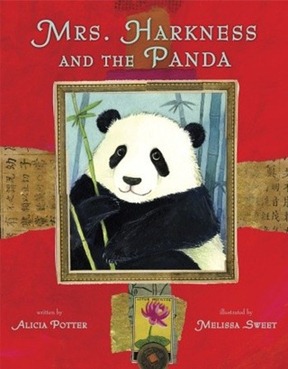
Mrs. Harkness and the Panda by Alicia Potter, illustrated by Melissa Sweet

In 1934, Mr. Harkness set out to China to bring the first live panda to the United States.  Unfortunately, he did not survive his journey.  So his young widow, Mrs. Harkness decided to set out and complete her husband’s dream.  Mrs. Harkness was not an adventurer; she designed tea gowns.  She knew that the journey would be hard, maybe even impossible.  But she set off for China and met up with Quentin Young, a man who had seen pandas and agreed to help her.  They packed carefully for the journey, even taking baby formula and bottles in case they found a baby panda.  They journeyed deep into China, until they finally found traces of panda activity, but no pandas.  Then they heard a small sound and followed it to a baby panda hidden in a rotten tree.  Mrs. Harkness had completed the mission!

This is a marvelous biographical picture book about an unlikely adventurer who took an amazing risk, especially after her husband’s death.  The story is told with a wonderful richness that helps bring the time period and this woman to life.  I particularly enjoyed all of the people telling her that it was a mistake and the amazing number of things she took along with her on the journey.  Potter takes the time to really create the world and this character, something that can be missing in picture book nonfiction.

Sweet’s illustrations are marvelous.  They incorporate cut paper art, maps, Chinese lettering, postcards, and lots of little touches that make them especially rich and meaningful.  At the same time, there is a sweetness to the illustrations that works particularly well with this story and the main character.  It also works well with the cuddly furry pandas too.

An inspirational story of adventure with an unlikely heroine at its center.  Appropriate for ages 5-7.

Reviewed from copy received from Alfred A. Knopf.

Review–Life in the Ocean: The Story of Oceanographer Sylvia Earle

life in the ocean

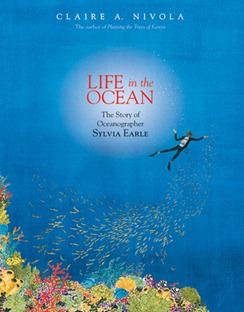
Life in the Ocean: The Story of Oceanographer Sylvia Earle by Claire A. Nivola

This picture book biography of biologist and oceanographer Sylvia Earle pays homage not only to her life’s work but to the incredible ecosystem of the oceans as well.  Sylvia was a biologist even as a child, sitting by the pond at their rural home in New Jersey and observing.  When Sylvia was 12, her family moved to Florida where their home was right near the Gulf of Mexico.  Sylvia started going to swims with her goggles on and watching these new creatures so different from the pond life in New Jersey.  As Sylvia grew older she ventured deeper and deeper into the ocean, meeting whales, spending 2 weeks in a deep-sea station, and walking the ocean floor in a Jim suit.  Sylvia Earle through her life and actions asks us to venture into the ocean too, spend time underwater, and explore beyond the 5% of the ocean humans have so far discovered.

Nivola’s text in this picture book can seem dense at first glance, but it is necessary to paint the picture of this ground-breaking (or ocean-breaking) woman.  The text reads aloud beautifully, flowing forward as it gives the small details that build to a life’s work.  It is a life spent outdoors, often alone, learning.  If you are looking for a picture book to inspire more exploration outside, this is definitely one. 

The illustrations in the book have a fine line to them, the pages filled with different blue hues as the water changes depth.  The ballet moves of the whales, the dazzle of bioluminescent creatures, and the colorful coral reefs all add to the range of the pictures.  Plenty of blue space is given to just water, allowing us to hold our collective breaths with hers and visit the depths too.

A brilliant picture book biography, this book is a winning nonfiction title for elementary students.  Appropriate for ages 7-9.

For more information on Sylvia Earle, you can watch her TEDPrize winning talk or visit Mission Blue, a gorgeous website for the Sylvia Earle Alliance.

Reviewed from copy received from Farrar Straus Giroux.

Review: Just Behave Pablo Picasso! by Jonah Winter

JUST BEHAVE, PABLO PICASSO!

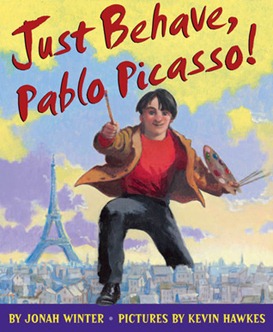
Just Behave, Pablo Picasso! by Jonah Winter, illustrated by Kevin Hawkes

Pablo Picasso started out painting just like everyone else, but when he started to paint his moods in colors, things started to change.  The gallery owners wanted more pictures in just the same style, and suddenly Picasso became wealthy and well know.  But Picasso was not interested in painting the same rose colored paintings again and again.  Instead, he becomes inspired by African masks and does a new painting that breaks all of the rules.  When it is unveiled, the reaction is strongly negative and it is called “ugly” by the critics.  When the entire world starts doubting him, Picasso works even harder, coming out with another painting that is the birth of modernism.  This book displays the strength needed to stay true to yourself all through the lens of the incredible Pablo Picasso.

Winter has not written a conventional picture book biography here.  Instead, he plays with the format.  He uses comic book techniques like BLAM! and has pages that range from just a sentence or two to ones that are lengthier and provide more information and insight into Picasso.  This biography is less about the details of his life and much more about his art and its inspiration and evolving style.  We learn nothing of his family, but much about his process and his drive.

Hawkes’ illustrations carry that same playful feeling forward.  He toys with perspective, enjoys depicting the close quarters in Paris with see-through walls.  It takes a certain amount of playfulness to take on a book about Picasso and not imitate his style in the illustrations.  Hawkes’ style remains true to himself, underlining the overall message of the book by doing so.

A creative and fun picture book biography about a vibrant and rebellious artist, this book should find a place in children’s nonfiction collections.  Appropriate for ages 6-8.

Reviewed from library copy.

Review: What We Wear by Maya Ajmera

what we wear

What We Wear: Dressing Up around the World by Maya Ajmera, Elise Hofer Derstine, and Cynthia Pon

This bright, colorful picture book shows cultural apparel from around the world.  The book revels in the unique colors, structure, beading and design.  Filled with images of children with smiling faces wearing their unique clothing, the book does contain some simple information on the clothes.  They are grouped in categories like dance and play, school clothing, and celebrating who we are.  The simple structure and basic information makes the book more appropriate for preschoolers than elementary students.

Because of the simplicity of the text, this book’s quality rests solely with the clarity of its images and the way they are presented.  Happily, the book has photographs of children of a variety of races, dressed in gorgeous colors and clothing.  They are shown on pages of equally bright colors that really add spice to the design. 

A very friendly look at costumes throughout the world, this book is a solid addition to preschool nonfiction collections.  It reminded me of looking through my mother’s Unicef calendars as a child.  Appropriate for ages 3-5.

Reviewed from copy received from Charlesbridge Publishing. 

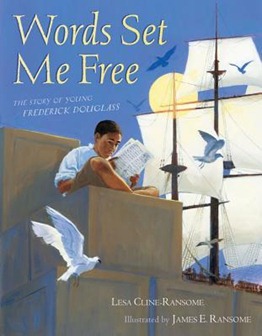
Review: Words Set Me Free by Lesa Cline-Ransome

words set me free

Words Set Me Free: The Story of Young Frederick Douglass by Lesa Cline-Ransome, illustrated by James E. Ransome

This picture book tells the story of Frederick Bailey, who would grow up to become the great Frederick Douglass.  His biography is also the story of the power of the written word and the ability to read.  Born a slave, Frederick was separated from his mother early in life and sent to live with his Grandmamma.  His mother would walk 12 miles at night to see him while he slept.  At age 8, Frederick was sent to work for another master in Baltimore.  It was there that he first learned his letters, until his mistress was told to stop teaching him as it would make him unfit to be a slave.  Daring white children to write better than him, Frederick continued to learn to read.  Returned to his home, Frederick taught the other slaves to read too, eventually writing his own way free from slavery.

A glimpse at an amazing mind and leader, this book takes us back to his childhood.  It is a testament to the damage and horrors of slavery, as readers see Frederick taken away from one person after another in his life.  It is also a celebration of the human spirit and the power of writing to change a life.  Cline-Ransome’s writing is exemplary.  She tells the story with wonderful detail, rich with meaning, and plenty of depth.  The book has more words than most picture books, but the story being told needs those words to shine best.

The illustrations are also rich.  There is such an aching feel to the image of the slave mother visiting Frederick that it is a portrait in heartbreak.  Other illustrations capture emotions beautifully as well.  The soaring nature of Frederick hidden up high and reading a newspaper rises against a purple-blue sky. 

The author and illustrator have created a wonderfully cohesive work with soaring prose and powerful illustrations.  Appropriate for ages 7-10.

Reviewed from library copy.

Review: Looking at Lincoln by Maira Kalman

looking at lincoln

Looking at Lincoln by Maira Kalman

Take a fresh and radiant look at our 16th president, Abraham Lincoln in this new picture book.  A young girl is motivated to find out more about President Lincoln after spotting someone in the park who reminded her of him.  She discovers many interesting facts, some of them well known like him being born in a small log cabin and other more obscure like his love of vanilla cake.  This is a personal look at a president, allowing us to see what his road to greatness was and how it ended in tragedy. 

Kalman takes a very modern look at history here.  A large part of its modern feel is the art in the book which is bright and blazing.  She uses color with abandon, with pinks, yellows, reds and greens adding color to simple illustrations.  Her paintings range from individual objects of importance to entire scenes from history.  The diversity of the images also adds a sense of playfulness to the work that is welcome.

Her writing carries through that same light touch, making the facts all the more interesting.  As she tells the story of Lincoln’s life, she is also telling the sad story of slavery and Civil War.  Somehow her illustrations and the tone she employs here keeps the book moving and never lets it bog down into too many words. 

A colorful, fascinating look at the life of our 16th President.  This book is appropriate for ages 7-9.

Reviewed from copy received from Nancy Paulsen Books.

Review: North: The Amazing Story of Arctic Migration by Nick Dowson

north

North: The Amazing Story of Arctic Migration by Nick Dowson, illustrated by Patrick Benson

This poetic look at the amazing Arctic starts with the deep winter and the few animals who survive there year round.  Then spring comes to the Arctic and the sun comes back along with some warmth.  Plants start to appear from under the snow.  Soon more animals will arrive.  The first to head out on their journey are the gray whales, that swim from Mexico to the Arctic Circle.  Birds head north too in flocks.  Herds of pregnant caribou journey north, followed closely by the gray wolves looking for weakness.  Walrus, narwhal, schools of fish, all of this life crowds the Arctic summer until the weather turns cold and brutal again, and once more they head back around the world.

Dowson’s words are poetry in this book.  Not only written in verse form, they also speak to the soul of the Arctic, the beauty of the place and the glory of the creatures who live there.  At the same time, the words are scientific and filled with information about the place and the animals.  It is an elegant combination of poem and fact.

Benson’s art is striking.  He created paintings that are both natural and accurate but also have a sense of artistry.  Much of the art is about the landscape, the place itself and the grand amount of space there.  The illustrations of bitter winter are cold and bleak with dim, gray light.  Then the reader turns the page and it is spring with its lemony light and sprigs of green.  The change is striking to the reader and beautifully captured.  There are moments like this throughout the book.

A striking mix of poetry, art and science, this book will speak to a range of different children looking to understand their world a little better.  Appropriate for ages 5-7.

Reviewed from library copy.

Review: The Boy Who Harnessed the Wind by William Kamkwamba

boy who harnessed the wind

The Boy Who Harnessed the Wind by William Kamkwamba and Bryan Mealer, illustrated by Elizabeth Zunon

This picture book version of the nonfiction book manages to translate the story of William Kamkwamba with clarity and inspiration.  When a drought hit his village in Malawi in 2001 and 2002, 14-year-old William and his family were in real danger of starving.  William had always through about machines and even after he was forced to leave school due to the drought, he kept reading books about them.  He thought about what could be done with a windmill in his village, bringing light and water.  So he hunted through the junk yard and found pieces to use.  Built entirely out of scraps, his first windmill and its electric wind brought electricity to the valley.   The afterword gives more details about William’s story and how it took him longer years to bring his dream of pumping water to fruition. This inspirational story speaks to the inventor, the doer, and the dreamer in all of us.

The writing here is lovely.  The imagery is impressive, such as comparing the windmill to a “clumsy giraffe” and giving William’s sorrow at having to leave school a physical sense: “alone with the monster in his belly and the lump in his throat.”  The book carefully captures what life in Malawi was like and what little could be done to make a difference before transforming into a book where dreams create change.  

Zunon’s illustrations are exquisite.  They are a captivating mix of painting and collage.  Filled with texture, the textiles of the clothing come to life and the objects have weight and feel.  The most impressive are the faces of the people, filled with light.  The faces become the place your eyes go first, making the message of the book just that much stronger in a subtle but powerful way.

A luminous picture book version of a compelling real-life story, this book should inspire others to not only dream but to make those dreams happen.  Appropriate for ages 7-10.

Reviewed from copy received from Dial Books for Young Readers.

Review: Secrets of the Garden by Kathleen Zoehfeld

secrets of the garden

Secrets of the Garden: Food Chains and the Food Web in Our Backyard by Kathleen Weidner Zoehfeld, illustrated by Priscilla Lamont

Alice loves it when spring arrives and they can start planting the garden.  Her dad gets the soil ready for planting and then she and her brother start putting the seeds in.  It seems like a long time before the seeds finally sprout.  Then other seedlings are transplanted from pots and potatoes are sown.  Lettuce and radishes are ready to eat first, and Alice spots a rabbit munching on them too.  She also thinks a mouse might be eating the fallen corn.  Hawks hunt in the garden and there are plenty of insects too.  Autumn nears and harvest begins, and the food cycle of the garden is complete for another year.  Throughout the book, the chickens offer commentary about the cycle itself with information about herbivores and carnivores, compost, worms and much more. 

This is an outstanding example an information book for children.  The chickens give the book a lighter tone, even though they are the ones offering the hard science.  The story celebrates gardening, the food cycle, and having a place connects one with nature.  Zoehfeld’s writing is breezy and cheerful, setting just the right tone of exploration, wonder and science.

Lamont’s illustrations add to the delight.  They have a similar feel to Michael Rosen’s with the friendly characters.  The colors tend towards the subtler side, inviting close inspection and learning.

This is a choice book for units on the food cycle or for children looking for information that they will enjoy learning.  Appropriate for ages 5-8.

Reviewed from copy received from Alfred A. Knopf.