Review: Around the World by Matt Phelan

around the world

Around the World by Matt Phelan

In this graphic novel, Phelan tells the story of three adventurers at the end of the 19th century who attempt to travel around the world.  There is Thomas Stevens in 1884 who had been working in the mines but then started bicycling.  He first bicycled across the United States, and then attempted to cycle around the world on the difficult-to-ride old-fashioned bicycle with one larger wheel.  The next adventurer is Nellie Bly in 1889, who set herself the task of beating Jules Verne’s Around the World in 80 Days.  The men running the New York World newspaper did not like her idea, but eventually came around to having her attempt it.  Her race became a national obsession and sold many newspapers for them.  Finally, there is the story of Joshua Slocum in 1895.  He restored an old sailing vessel in a time when sailing was becoming outdated.  Then all on his own, he set off to sail around the world, becoming the first person to sail around the world alone.  These three adventurers all have their own reasons for circumnavigating the globe, but they are united in their attempts.  These are all stories of determination, courage and bold ideas.

United under the umbrella of Jules Verne’s novel, these three stories are beautifully connected and yet stand entirely on their own merits as well.  The three intrepid souls are also equally connected and yet uniquely themselves.  Their journeys are made for different reasons and received differently by the public, but they are all powerful stories of independence and resourcefulness.  All three stories show the power of taking charge of one’s life and following your dreams.

Phelan’s art suits each of the stories individually and also has a cohesive whole.  There are subtle changes from one story to the next, the colors shift from blues and greens to oranges and creams and then to deeper blues and grays.  The art style stays much the same but beyond the colors there are changes in mood that are amazingly deep yet subtly done.  Stevens’ story of bicycling has a merry joei de vive to it.  Bly’s adventure is filled with energy and zip.  Then there is the lonely sailing tale that has a deep grief embedded in it that almost aches.

Beautifully done, this is one of the top graphic novels for children, period.  It is honest, emotional, and a rousing adventure-filled read.  Appropriate for ages 8-12.

Reviewed from library copy.

Also reviewed by:

Check out the book trailer:

Review: Born and Bred in the Great Depression by Jonah Winter

born bred great depression

Born and Bred in the Great Depression by Jonah Winter, illustrated by Kimberly Bulcken Root

Winter tells the story of his father’s childhood during the Great Depression in this historical picture book.  Through the life of his father, he shows the poverty of the time.  Grandpa Winter searched for work in the area, often unable to find any, which meant that there was no money to help support the family of 8 children.  When he did find work, it was dirty and back-breaking labor.  This is contrasted with the simple joys of childhood as Winter’s father spent time outside exploring the woods and walking the railroad tracks.  The family grew most of their own food, eating lots of produce from the garden and canning excess to eat during leaner times.  There was little ease in their lives, but what they could find they used.  There was time as a family for music, chess and reading books.  There was time to explore the natural world.  This glimpse of history opens our eyes to the way we live today as well.

Winter’s words are compelling, inviting readers into the world of the Great Depression.  He manages to tell the story of the poverty through a lens that children will be able to relate to.  Focusing on the family life, including many people in each bed, there are definite contrasts with today’s economic problems.  Winter does not romanticize the Great Depression, instead he brings it to life through the history of his own family.  There is a lovely simplicity to the story that makes it all the more readable.

Root’s illustrations are done in pencil, ink and watercolor.  They have a softness to them that evokes the past.  The colors are subdued with the focus on telling the story through the images as well as the words.  Root manages to show the Great Depression through images that are beautiful, quiet and rich.

This historical picture book celebrates strength of family and overcoming hardship.  Appropriate for ages 5-7.

Reviewed from copy received from Schwartz & Wade Books.

Review: Brother Sun, Sister Moon by Katherine Paterson

brother sun sister moon

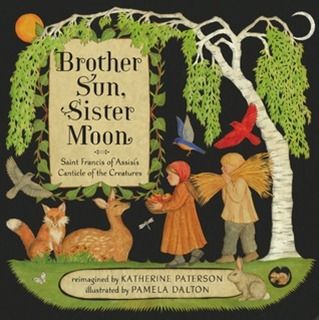
Brother Sun, Sister Moon: Saint Francis of Assisi’s Canticle of the Creatures by Katherine Paterson, illustrated by Pamela Dalton

Acclaimed author, Katherine Paterson has reworked a hymn of praise first said by Saint Francis of Assisi.  It praises God for our Brother Sun, Sister Moon, and Sister Stars.  Brother Wind and Brother Air are praised for being both harsh and mild.  Sister Water is thanked for being life-giving and Brother Fire is thanked for both warmth and playfulness.  The song of praise moves through Death as well, thanking God for the days we are given and the love that we are ushered into at death.  It is a universal prayer made joyous through Paterson’s changes to Saint Francis’ original version, which is included at the end of the book.

The delicacy of Paterson’s writing is not apparent until her words are compared with the original.  She has carefully teased deeper meaning from his words.  At the same times she has made them more appropriate for young readers and listeners.  The hymn of praise sings as she has written it, endowed with a new grace thanks to her skill.

Dalton’s illustrations are simply exquisite.  Using a cut paper technique that involves delicate knife work, watercolor painting, and then a process of being steeped in coffee, the result is luminous yet rustic.  It suits this subject matter perfectly, managing to be beautiful but not too lofty.

This is a magnificent selection for libraries’ religious shelves, one that will speak to people of many faiths and is phenomenally appealing and beautiful.  Appropriate for ages 4-6.

Reviewed from copy received from Chronicle Books.

Also reviewed by:

You can see Dalton create her art in the video below:

Review: If You Lived Here by Giles Laroche

if you lived here

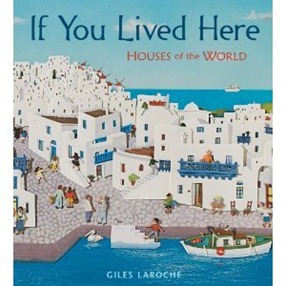
If You Lived Here: Houses of the World by Giles Laroche

This book invites readers to explore the different types of houses that are lived in throughout the world.  Beginning with the phrase, “If you lived here…” the book then describes some unique features of that particular type of home.  There are homes that you would have to go outside to get to the kitchen, others where you would not have to go out to even get to the barn, others are built around caves, still others are close to water or surrounded by it.  The book then defines the type of house, what materials it is made from, where this type of house is found, the date that this house first appeared, and a fact about them.  The tone is kept light and interesting, which will invite young readers to explore this subject in depth.

Laroche’s writing is welcoming and light.  He finds the most unique features of a home and describes them in simple and inviting ways.  Even the information on the materials and location are kept short and contain only the most interesting details. 

The illustrations, done in paper, have a three dimensional effect.  The homes are done in exacting detail that includes individual shingles, decorative features, and even the ability to peer closely and see into the windows to the rooms beyond.  There is a physical quality to this, creating almost a model effect where you lean in closer to see even more.  The illustrations are a delight and truly bring the structures to life.

When I first started reading this book, I wondered who would be the audience for it.  The entire book is so appealing that it will have no trouble being enjoyed by young readers interested in architecture, history, or travel.  Appropriate for ages 8-10.

Reviewed from library copy.

Review: After the Kill by Darrin Lunde

after the kill

After the Kill by Darrin Lunde, illustrated by Catherine Stock

Explore what happens after the lioness kills a zebra on the Serengeti Plain.  While the hunt and the kill are part of the story, they are only the beginning.  After the zebra is killed, the lion pride comes to eat and then other species start to gather.  There are the vultures who share with the lions.  Then the hyena clan that is able to drive the lions away and claim their share.  Jackals use trickery to grab some food for themselves.  The lions reclaim the carcass and continue to eat until they are sated.  Other vultures arrive.  The small scraps of flesh that remain are eaten by meat-eating beetles until the bones are white in the African sun. 

Lunde, a mammalogist at the Smithsonian Institute, creates a compelling story here.  There is no shying away from predator and prey, just a frank description of the food chain.  Nicely, Lunde injects his narrative with plenty of detail, noises, and an obvious love of his subject.  He paints a verbal picture of what is happening, helping young readers better understand what is actually happening.  The pieces of the book in the smaller font have additional scientific information that readers will find fascinating. 

Stock’s illustrations have a bright, hot quality to them thanks to the yellow tones throughout.  The heat of Africa is built into every page.  She also embraces the kill, the scavenging, and the story, creating a book filled with action-filled images.

An unflinching look at the battle for food on the Serengeti Plain, this book will be riveting for young readers.  Appropriate for ages 5-8, though this is a book that some children may find upsetting, so it is important to be aware of the sensitivity of the child you are sharing it with.

Reviewed from copy received from Charlesbridge.

Review: Big Wig by Kathleen Krull

big wig

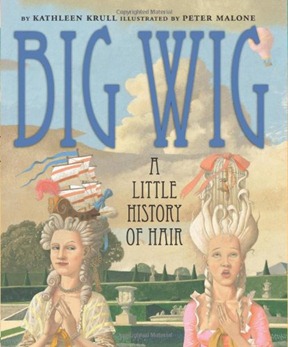
Big Wig: A Little History of Hair by Kathleen Krull, illlustrated by Peter Malone

I am a huge fan of Krull’s nonfiction books for children.  Just as her earlier books, this one has a wry sense of humor and contains fascinating facts.  Here the subject is the history of hairdos.  Krull starts with prehistory in Africa and then travels forward until 2007 where the most expensive haircut in history is purchased for $16,300.  In between, readers will learn about different trends in color, styles, lengths and curls.  The book takes an already interesting topic and through details and facts makes it even more compelling. 

Krull’s writing is skillful as always, bundling intriguing facts together into small stories that capture a moment in time.  Her tone of wonder and interest makes for an inviting read, encouraging readers to be excited about the information as well.  Make sure you head all the way to the end and read about the history of hair extensions too.

Malone’s illustrations are fine lined and work well to both depict historical figures and to place them in unique and hair-raising situations.   He changes his style of illustration to match the time period and culture at times, such as the Japanese samurai warrior page.  His colors are just as fine and carefully selected as his lines are.

No snarls in this book.  In fact, it goes to great lengths to avoid tangles.  One might say, this is a top-knot book.  Appropriate for ages 7-10.

Reviewed from copy received from Arthur A. Levine Books.

The Amazing Wangari Maathai

Sadly, Wangari Maathai, died at age 71.  She was the first African woman to receive the Nobel Peace Prize and was responsible for the Green Belt Movement in Kenya which planted millions of trees.  Happily, there are several great children’s picture books about her inspirational story.  What a great way to celebrate the life of this incredible woman.  Here are my three favorites with links to my reviews:

mama-miti

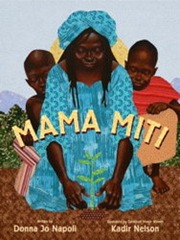
Mama Miti by Donna Jo Napoli, illustrated by Kaddir Nelson

planting_trees_of_kenya

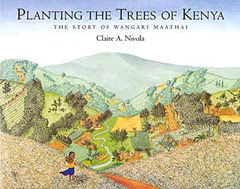
Planting the Trees of Kenya by Claire A. Nivola

Seeds of Change by Jen Cullerton Johnson, illustrated by Sonia Lynn Sadler

Review: The Quite Contrary Man by Patricia Rusch Hyatt

quite contrary man

The Quite Contrary Man: A True American Tale by Patricia Rusch Hyatt, illustrated by Kathryn Brown

In 19th-century New England when people lived and dressed plainly, Joseph Palmer most certainly did not.  It was his beard that made him different, since all the other men were clean shaven.  But Joseph did not just have a normal beard, his was huge, long and wide.  His neighbors were scandalized and tried to shame him into shaving, eventually trying to shave him by force.  His attackers headed to court before Joseph could get there and claimed that he had attacked them.  The judge fined him $10, but Joseph refused to pay it.  So he was jailed for a full year.  The rule in the jail was that prisoners had to be clean shaven, and you can guess how that went with Joseph.  As the tale twists and turns, readers will be in turns inspired by Joseph Palmer’s strength of conviction and appalled by the system that persecuted him.

Hyatt has found a true story that really speaks to what being an American means, down to the most basic rights of deciding how you appear.  While modern children may be shocked by the fact that beards were scandalous, this is a great book to start discussions about what sorts of things are taboo today that may also not make any sense.  Hyatt’s writing is engaging and rollicking.  The spirit of the book matches Palmer’s own strength and humor.

Brown’s illustrations are done in fine lines and soft colors.  They depict the glory of Palmer’s beard with enthusiasm.  On alternate pages, she creates a rustic frame from illustrations of branches tied together with vines, which adds to the feeling of the book being set in an earlier time.

An American hero, Joseph Palmer’s is an inspiring story of a regular man who stood up for his rights.  He would also make an intriguing hero to discuss in units.  Appropriate for ages 6-8.

Reviewed from library copy.

Also reviewed by

Review: Celebritrees by Margi Preus

celebritrees

Celebritrees: Historic and Famous Trees of the World by Margi Preus, illustrated by Rebecca Gibbon

This book carries readers through the stories of fourteen “celebritrees” which have made a name for themselves.  Many of the tress are very old, some are special in different ways, and all are fascinating.  Here you will visit Methuselah, the oldest known single living organism on earth, and General Sherman, the biggest living inhabitant of earth, and Hyperion, the tallest tree in the world.  There are trees famous for events around them, trees that have objects stuck in them, and even a tree that owns itself.  This is an inviting book of trees that is a pleasure to spend time in.

Preus paints pictures of moments in history to help tell the amazing stories of these trees.  From the events they witnessed to the events they were at the heart of, the trees are much more than simply largest, oldest, and tallest.  Here they have stories that bring them fully to life. 

Gibbon’s art has a simplicity that is almost that of folk art.  There is a richness to the color palette and a flatness to the perspective.  The trees are central to the art, as they should be, and the book celebrates them in browns and greens.

It is great fun to wander through this a veritable forest of famous trees.  Enjoy the journey, I certainly did!  Appropriate for ages 7-10.

Reviewed from library copy.