Out of Sight: Sophisticated Popup

OutofSight 

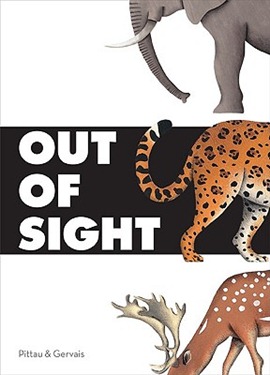
Out of Sight by Francesco Pittau and Gervais

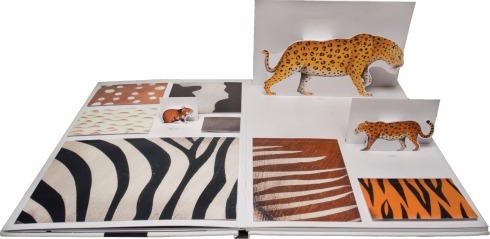
This intriguing lift-the-flap and pop up book is really a fun guessing game.  From one page to the next, the book changes.  First it is silhouettes of animals.  Lift the flap and you get the answer of what animal it is plus a fact about that animal.  There are also sections where you guess the animal from their tracks, their fur, and their tails.  The book is great fun for young science and animal lovers.

out-of-sight-interior

The large format of the book will make it challenging on library shelves, but I wouldn’t expect it to sit there for long anyway.  Nicely, the flaps and pop ups are sturdy enough to stand up to library use.  The concept is a very strong one with plenty of appeal thanks to the strong design elements.  Each page is visually attractive and well designed. 

At times, the illustrations can be a bit off, making guessing more frustrating.  The facts about the animals are random and unrelated to one another, so the occasionally book lacks cohesion.

A great book for reluctant readers, this is less of an informational book and more of an inviting and sophisticated introduction to animals and their variety.  Appropriate for ages 4-8.

Reviewed from library copy.

Also reviewed by Jean Little Library.

Family Pack: Poetic Nature

familypack

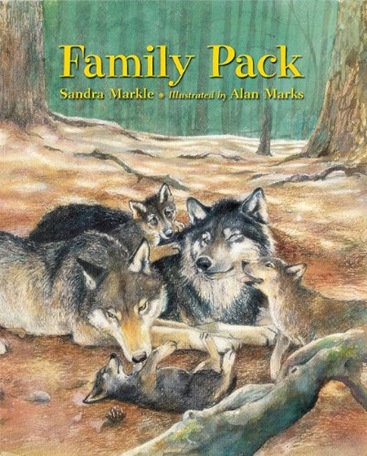
Family Pack by Sandra Markle, illustrated by Alan Marks

This book captures the real-life story of wolves being reintroduced to Yellowstone National Park.  The focus of the story is one young female wolf who finds herself suddenly separated from her pack and alone in a new place.  Her tracks are the only wolf tracks she sees, she is the only wolf she smells.  Without a pack, she cannot hunt the way she is used to, so she survives mostly on mice.  As she becomes an adult, she discovers another wolf, a male.  The two of them become a mated pair and eventually have a family in Yellowstone.  One lone wolf has created her own pack.

Markle’s verse in the book really shines, illuminating the loneliness of this young wolf’s new life, her troubles with hunting larger game, and her growth into an adult wolf.  The poetry is filled with imagery that enlivens the book, making the cold and loneliness tangible to readers. 

Marks’ illustrations are equally successful.  He captures the setting beautifully from the towering trees to the wide open spaces.  In his illustrations, Yellowstone becomes just as real as the wolf herself, almost another character in the story.  The vistas and close-ups he has created here give readers a very unique perspective on the life of this wolf.

Highly recommended, this book will work well for slightly older children because of the depth of the verse.  It will work well in units about preservation and ecology.  Appropriate for ages 6-8.

Reviewed from copy received from Charlesbridge.

I Feel Better with a Frog in My Throat: Gross, Gruesome and Great Fun

tumblr_lb070qPLi51qcx2yno1_500

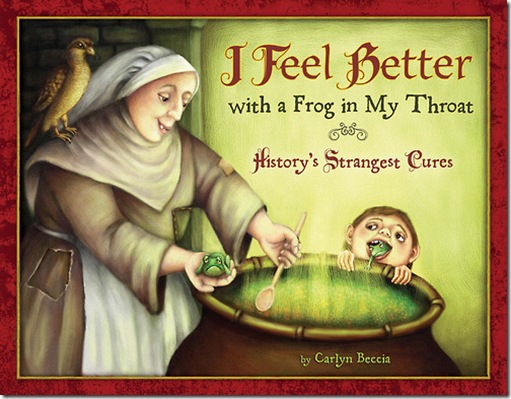
I Feel Better with a Frog in My Throat: History’s Strangest Cures by Carlyn Beccia

Have a symptom?  Look it up in this book, but beware!  Some of the cures listed just may not work.  It’s up to you to try to guess which ones would actually help and which might really hurt.   What would help a cough?  Caterpillar fungus used in ancient China?  Frog soup used in 16th century England?  Cherry bark used by ancient Native Americans?  Readers turn the page to discover which of the three would help.  The reasons behind the use of the cure and then the real results are offered, giving a readers a fascinating tour through medical history.  Happily, some of the cures are gross.  That and the way the information is presented as a guessing game make this book appealing to children, including reluctant readers.

Beccia has taken a cheerful approach to what could have been a very dark book.  Instead the tone stays rather merry, talking about the nutritional boost of frog soup, the healing power of spider webs, and much more.  Her illustrations add to the fun with images like maggots with smiling faces and stinky socks tied around the neck.  They have an interesting blend of macabre and silly.

There are some misses in the book.  At one point, a woman of the 19th century is shown in a short skirt, looking very modern except for her cap.  The book maintains a great pace and tone, but falls short at the end where the healing power of mother’s kisses takes on an overly sweet tone.  I also have concerns about the imagery of the mothers and children, because the only one with darker skin is prehistoric.  The only Asian faces are ancient.  It is a frustrating misstep in a book that is good overall.

Get this into the hands of reluctant readers who enjoy gross things and you too will get to talk about maggots at the dinner table!  Appropriate for ages 7-9.

Reviewed from library copy.

Tropical Rainforests: Beautiful Nonfiction

9780061142536

Tropical Rainforests by Seymour Simon

Veteran children’s nonfiction author, Seymour Simon, returns with this Smithsonian Institution book on rainforests. With full color images featuring interesting wildlife and grand expanses of forest, the book is an enticing introduction to tropical rainforests for children.  The importance of rainforests for the entire planet is woven into the particulars about the animals and plants that can be found there.  Making up just 2% of the earth’s surface, these forests are home to millions of insects, plants and animals.  Simon reveals their uniqueness and beauty as he writes with passion about their importance. 

Though he is writing nonfiction, Simon writes with an almost poetic voice.  He has a graceful sense of wonder in his prose, never allowing the rainforest to be reduced to a list of creatures that inhabit it.  Instead, Simon waters the book with plenty of facts, offers a sunshine of lovely little moments (like the way that you can hear the army ants hiss because there are so many of them) and brings out the beauty with the lush photography.  This is a science book for real science lovers, where the science is the loveliness of the world around us with so many details that make it amazing.

Unlike most science books, this one reads aloud very well.  Though you will find yourself stopping regularly to discuss an interesting point or take a closer look at an image.  A book that is sure to warm up wintry days, this is a scientific vacation to the rainforest.  Appropriate for ages 5-8.

Reviewed from copy received from HarperCollins.

Also reviewed by A Patchwork of Books

ZooBorns

73239963

ZooBorns! Zoo Babies from around the World by Andrew Bleiman and Chris Eastland

Even without the tie-in to a popular animal blog, this book will fly off your shelves.  Pair gorgeous close-ups of baby animals with clear, concise text and you get lots of appeal.  The book offers a glimpse of animals in a way that is very approachable.  Each pair of pages has five lines of text in a large font and one full-page image of the animals.  Adding to the appeal is the fact that each of the animals is named and offered as an individual.  The fennec fox image alone is worth picking up the book for:

The animals range from the cuddly like foxes and tigers to the strange like aardvarks, hippos and anteaters.  In the rear of the book is more information on each of the animals, though even that will most likely not satisfy a child whose interest is peaked by the book.  I see lots of fennec fox research in my future.

A charming and approachable book that is sure to be enjoyed by many children, this book is appropriate for children aged 4-7.

Reviewed from library copy.

Kubla Khan: The Emperor of Everything

kubla_0

Kubla Khan: The Emperor of Everything by Kathleen Krull, illustrated by Robert Byrd

Get a real sense of the great Khan who ruled over the largest empire in the world during the 13th century.  This picture book biography invites readers to be amazed by what Kubla Khan managed to create and build.  The emphasis is on the Khan’s achievements and the scope of his realm.  There are so many little facts shared that are fascinating and engaging.  They all demonstrate the largeness of his life and his achievements, from his one hundred children to the three million workers who extended the Grand Canal.  The feel of the book is rich and dramatic as well, thanks to the illustrations by Byrd.  Filled with small details, the illustrations and words work together to really bring this legendary leader to life.  While a boon for report writers, this is also a biography that reads aloud very well thanks to the engaging style.

Krull excels at making famous people from history more human.  With Kubla Khan, she humanizes him by sharing his youth in Mongolia.  Yet Krull allows Kubla Khan to remain larger than life, his power and success is so large that it would be wrong to minimize what he managed to accomplish.  Krull also emphasizes the fact that the Khan was very open to different opinions and new ideas.  His ability to remain open is what allowed him to become the leader he was. 

Byrd’s illustrations change as the Khan changes.  The youthful years in Mongolia have a freedom to the illustrations with racing horses, hunts, and smoky battlefields.  As Kubla Khan becomes more powerful and rules China, the illustrations reflect the Khan’s own changes and adoption of the Chinese style.  Beautifully depicted, the illustrations are detailed, rich and add to the deep texture of the book.

Highly recommended for all public library children’s nonfiction collections, this is a dazzling biography.  Appropriate for ages 8-11.

Reviewed from copy received from Viking.

Enhanced by Zemanta

Nic Bishop Lizards: A Beauty of a Science Book

lizards

Nic Bishop Lizards by Nic Bishop

Nic Bishop books combine fascinating science with exquisite photographs.  They are magnets for reluctant readers who love animals and nonfiction.   His latest book on lizards continues with the high quality standard he has set with previous books.  See a lizard hatching, so close that you can almost feel the rubbery egg.  Look right into the eyes of a bright-green baby chameleon.  Marvel at the skin of the thorny devil.  Run across water with a basilisk in a series of stunning shots.  Gawk at the geckos in all of their diversity.  Linger with lizards here in this book that makes science accessible, fascinating and beautiful.

Bishop excels at creating nonfiction for children.  His writing turns scientific facts into accessible and fascinating prose that points readers to reasons for wonder.  With his stunning photographs accompanying his prose, it is too easy to ignore the fact that his writing works so well.  And of course, you have his amazing gift for photography.  Photography that is crystal clear and brings readers so close to the subjects.  Make sure you read his author notes at the end for details about what it took to get the photographs you see in the book.

Highly recommended, this belongs in every school and public library along with Bishop’s other titles.  Get this in the hands of animal lovers, both reluctant readers and non.  But beware, bring it home and you too may be looking into a pet gecko for Christmas.  I hear his name is going to be Bob.

Reviewed from copy received from Scholastic.

Just One Bite: A Big Gulp of Fun Science

2010-10-28_1428

Just One Bite by Lola Schaefer, illustrated by Geoff Waring

Explore the world of eleven animals through how much they can eat in one bite.  Filled with fascinating facts, this book offers just enough information in the body of the book to entice readers to read the longer versions in the back.  Readers will marvel at the tiny amount of food a worm eats, the amazing tongue of the giraffe that eases around thorns, and the tremendous size of a whale’s meal.  This is a book that makes science friendly and great fun. 

Cleverly written, this book will appeal to a wide range of ages.  Thanks to the simple text and large bright illustrations, preschoolers will enjoy the book, and older children will also find plenty of depth to keep their interest in the final pages.  Schaefer’s simple text is welcoming and warm, inviting readers to wonder along with her about these creatures and their meals.  Waring’s illustrations are large, expansive and charmingly simple.  His use of bright colored backgrounds make the illustrations really pop.

With its large size, this book will shout to readers to pick it up and take a look.  It is a book that is sure to find its way easily into children’s hands, but it will also be welcome in story times as a great nonfiction pick for reading aloud.  Appropriate for ages 3-9.

Reviewed from copy received from Chronicle Books.

Ballet for Martha: Bravo! A Beautiful Performance

Ballet for Martha: Making Appalachian Spring by Jan Greenberg and Sandra Jordan, illustrated by Brian Floca

This is the story of how three great artists came together to create a classic American ballet.  Aaron Copland’s music inspired the original story and dance of Martha Graham and then in turn Isamu Noguchi created the minimalist sets.  All of these have become iconic so it is a pleasure to understand how the three collaborated on the creation, each drawing from the others ideas but also adding their own to make an ever more powerful ballet.  This picture book manages to capture the arc of creativity and also the ideas behind the ballet itself.

Greenberg and Jordan have somehow managed in so few words to tell two stories.  They reveal both the story of the collaboration between the creators of the ballet and also the story of that the ballet itself tells.  The text also gives insight into the design elements of the sets, the simple power of the music, the creative process of choreography.  This is truly a look at what it takes to be a master composer, choreographer and artist.  The text invites the reader in, explains the elements and leaves one in awe.

Floca’s watercolors are alive and vivid.  They offer a real look at the costumes and sets but also offer stirring glimpses behind the curtain and into the artistic process.  His use of color is subtle yet strong, really allowing the original creativity of the collaboration to shine.

Highly recommended, this book is a breathtaking look at a ballet.  Appropriate for ages 6-9.

Reviewed from copy received from Roaring Brook Press.

Enhanced by Zemanta