Things to Do by Elaine Magliaro

Things to Do by Elaine Magliaro

Things to Do by Elaine Magliaro, illustrated by Catia Chien (9781452111247, Amazon)

Follow the path of a day in this poetic picture book. Little things in life are captured on the page along with weather and seasons. The book begins with dawn and the things that dawn does, then moves to the outdoors with birds and acorns. Sun, sky and eventually moon appear and do their things as well. Rain arrives, boots come out. There are spiders, snails and crickets that appear too. Each given a poem about what they do and the small beauties they create in our world.

Magliaro’s poetry is exceptional. On the very first page, readers are drawn into viewing the world through her lens that looks at small things, captures them and then moves on to the next. Each poem is separate but linked, creating an entire universe of things to do and things to see. The poetry is sometimes rhymed, sometimes not, often ending in a rhyming couplet. It is the rhythm that ties it together, moving forward, lingering and then onward.

Chien’s illustrations are soft and ethereal. She creates dawn light then bright sun and finally a huge moon that fills the pages. Each time of day is unique and special, given space on the page to shine. There is a rough softness to the images, landscapes that blur rain that shimmers.

A top-notch poetic read for children, this book celebrates small moments made large. Appropriate for ages 4-6.

Reviewed from library copy.

Charlotte the Scientist Is Squished by Camille Andros

Charlotte the Scientist Is Squished by Camille Andros

Charlotte the Scientist Is Squished by Camille Andros, illustrated by Brianne Farley (9780544785830, Amazon)

Charlotte is a serious scientist with science instruments and protective goggles. She had one big problem, her family left her squished for room all the time. There was no space for her experiments where her siblings weren’t messing around with her equipment. So Charlotte started an experiment by asking a question, stating her hypothesis and then testing the hypothesis. Her hypothesis was that if her siblings disappeared, she’d have room to be a real scientist. Charlotte tried several ways to make her brothers and sisters disappear until she finally decided that she had to leave instead. She crafted a rocket and flew to the moon. She loved space, but as she drew her conclusions she realized that she was getting lonely. How would she find the perfect balance of space and family?

Andros has combined the scientific process with a picture book very successfully. It functions as a very strong structure for the story, using the book to both demonstrate the process but also to tell a good story about a girl scientist. The busy and crowded household will resonate with children reading the book and they will recognize their own wish for space at times, and maybe even outer space!

Farley’s illustrations are dynamic and busy. The crowded family and their interruptions to Charlotte’s experiments are clearly depicted. Charlotte’s carrot-shaped rocket is also lovely both on the moon and on earth. The images of Charlotte’s loneliness are suddenly filled with wide space despite the robot bunnies wrapped in toilet paper nearby.

An intelligent picture book with a strong scientific heroine just right for STEM units. Appropriate for ages 3-5.

Reviewed from library copy.

Little Pig Saves the Ship by David Hyde Costello

Little Pig Saves the Ship by David Hyde Costello

Little Pig Saves the Ship by David Hyde Costello (9781580897150, Amazon)

In this second Little Pig book, Little Pig isn’t big enough to join his older siblings at sailing camp. One of his brother’s gives him a rope to practice knot tying. That gets dull after a day. Happily, his grandparents come over and Poppy has been making a model ship. Little Pig helps him finish it and they sail it over and over again. Then on Saturday, the ship gets away from them and sails over a waterfall. Poppy and Little Pig try to catch it, but the current carries the ship away. Luckily, Little Pig has been practicing his knots and has the rope along in his pocket!

Costello demonstrates how little ones can be too small for some experiences but just the right size to save the day. Throughout the book there is a jolliness to the days spent with a grandfather who is happy to dabble in the water again and again. As the water runs faster after the rain, the adventure begins. Costello beautifully has Little Pig do the rescuing even as Poppy supports him in his endeavors. This is a story where the little one is the true hero.

The illustrations are immensely friendly. Costello combines sharp dark lines against flowing watercolors, making Little Pig and the other characters pop. Readers will notice that Little Pig has two grandfathers who visit, making this book a subtle LGBT-friendly read. As the days pass, Poppy’s shirts change color, marking the time in a floral way.

A second win for Little Pig! Appropriate for ages 2-4.

Reviewed from copy received from Charlesbridge.

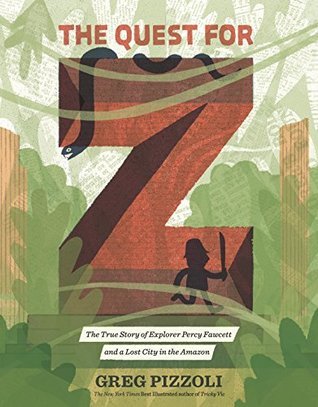
The Quest for Z by Greg Pizzoli

The Quest for Z by Greg Pizzoli

The Quest for Z: The True Story of Explorer Percy Fawcett and a Lost City in the Amazon by Greg Pizzoli (9780670016532, Amazon)

The author of Tricky Vic returns with another rip-roaring nonfiction picture book. It is the true story of Percy Fawcett, a British explorer who searched for an ancient city hidden in the Amazon rainforest. Fawcett had dreamed his entire life of being an explorer and as an adult took many treks into South America to map the region. They faced many dangers, such as huge snakes and natives with weapons. Many of the men he traveled with perished on the adventures but Fawcett survived. Others thought that the Amazon city was a myth while Fawcett insisted that it existed. If he found it, it would make him one of the most famous explorers of all time and one of the wealthiest too. This book tells his tale as he searched for the lost city.

Pizzoli has a knack for selecting real life stories that most people, adults and children, will not have heard of. This one is a fascinating story of belief and bravery, about a man who left family and country behind in his quest to discover the unknown. Pizzoli tells the story with lots of action and a sense of adventure in his prose. There are moments where Pizzoli allows the action to slow, the wonder of the moment to grow, and the dangers to almost overwhelm. It’s written with skill and knowledge, building to a conclusion that suits the life of Fawcett to a Z.

The book design and illustrations add so much to this nonfiction read. Done in a simple and clever style, just like Pizzoli’s picture books, the images add necessary humor to the book. The design of the book also allows additional information to be added on sidebars. Pizzoli uses his illustrations to also create moments of tension and drama, pausing the action for effect.

Smart, stylish and successful, this nonfiction picture book will take readers on quite an adventure. Appropriate for ages 5-9.

Reviewed from library copy.


Super Manny Stands Up by Kelly DiPucchio

Super Manny Stands Up by Kelly DiPucchio

Super Manny Stands Up by Kelly DiPucchio, illustrated by Stephanie Graegin (9781481459600, Amazon)

Manny has a collection of superhero capes that he wears to fight different foes. He wears his blue cape to fight sea creatures, his red cape to battle zombie bears, and his yellow cape to bring down cloud monsters. Manny always wore his top secret cape to school. It was invisible and he wore it on the playground to fight the monsters there. When a big kid starts to pick on a smaller child in the lunchroom though, Manny didn’t do anything at first. Then he remembered that he was wearing his invisible cape and stood up. It let all of the other children in the room also remember that they could be heroes too!

As always, DiPucchio writes with the ease of a master storyteller. Manny is a delightful new character whose imaginary world also bridges into the real world in tangible ways. His capes are an inventive way of showing this, including his invisible one for school. The scene with the bully is powerful as is the way that the other children stand up once Manny does. It is with one simple protest that bullies are stopped, something we all need to remember.

Graegin’s illustrations create a visible imaginary world for readers to share. The villains that Manny battles in his capes match color with each cape. Manny as a raccoon is a very friendly protagonist and one that children will relate to easily. Make sure to check out the end pages too for even more Manny (and friend).

A heroic new book that will fly off library shelves. Appropriate for ages 4-6.

Reviewed from copy received from Atheneum Books.


Blue Sky, White Stars by Sarvinder Naberhaus

Blue Sky, White Stars by Sarvinder Naberhaus

Blue Sky, White Stars by Sarvinder Naberhaus, illustrated by Kadir Nelson (9780803737006, Amazon)

Very simple patriotic text allows the illustrations by Nelson to shine on the page. The text moves from describing the nation and its flag to the various natural beauties of its land. The people of the nation come next. A well-worn face of Lincoln next to the well-worn flag that is tattered. People march on the streets, other attend a baseball game and still others are the face of America on its porches. Faces of all colors and creeds fill the pages until they return to the flag, our shared purpose and freedom itself.

This is one of the most patriotic picture books I have ever seen. The words are so simple and yet speak so profoundly of all that the United States holds dear. The illustrations for these words are truly exceptional. Each page is a wonder, and turning the pages is like visiting a gallery of Nelson’s work. They are filled with the faces of America, symbols of our nation, and the beauty of the land.

Awe inspiring, patriotic and grand, this picture book is superb. Appropriate for ages 3-7.

Reviewed from library copy.

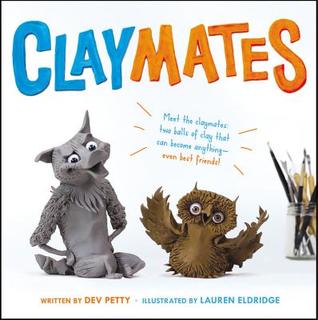
Claymates by Dev Petty

Claymates by Dev Petty

Claymates by Dev Petty, illustrated by Lauren Eldridge (9780316303118, Amazon)

Two balls of clay meet one another and then are formed by an artist into an owl and a wolf. The two are left alone and quickly discover that they are able to change their own shapes as they like. They rapidly change from one form to another, elephants and peanuts, things big, small, flat and sharp. As the artist returns, the two balls of clay try to remember what they had originally been shaped as but don’t quite get it right. So back they go into a wolf and an owl and then eventually into balls of clay. But they aren’t done playing yet!

The text of the book is entirely done in a dialogue between the two characters, so it is simple and easy. The result is a book done in photographs that reads much more like a comic with speech bubbles. There is a delight in the photos and the clay shapes, evoking claymation movies and the joy of childhood play with clay.

Throughout the book, there is lots of humor both in the dialogue and the shapes that the clay takes. The illustrations also incorporate the tools the artist uses to shape the clay, and the early pages of the book show an image of the set and photography equipment. The clay shapes are clever and funny, inviting readers to explore clay themselves and start to make friends through play.

A joyful look at friendship and creativity. Appropriate for ages 3-5.

Reviewed from library copy.


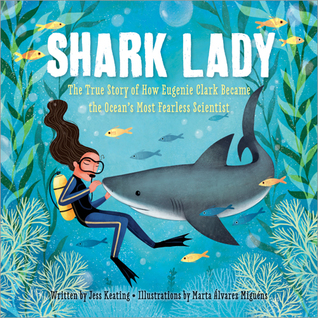
Shark Lady by Jess Keating

Shark Lady by Jess Keating

Shark Lady: The True Story of How Eugenie Clark Became the Ocean’s Most Fearless Scientist by Jess Keating, illustrated by Marta Álvarez Miguéns (9781492642046, Amazon)

Eugenie was a young girl when she first visited an aquarium and fell deeply in love with the creatures there, particularly with the sharks. But it was the 1920’s and girls were expected to become housewives or secretaries not scientists. Still, Eugenie never gave up on her dream and continued to study sharks at the library and join the local aquarium as a member. At the time, people thought that sharks were heartless and frightening killers, but Eugenie set out to prove them all wrong. Eugenie got her degree and earned a place on a scientific vessel to study marine life. That was just the beginning of a career that spanned many decades, led to several books and articles, and proved that women have a place in science.

Keating shows the growth of Eugenie’s scientific aspirations in this nonfiction picture book, moving from her childhood fantasies of swimming with sharks to the lack of support at school and finally to the discoveries that she made as her dreams became reality. The book has a tone of pure curiosity and joy where readers will cheer Eugenie as she overcomes the many obstacles standing in her way.

The illustrations are lighthearted and playful. Aquarium hallways are filled with floating sharks and fish as Eugenie dreams about them. They celebrate the beauty of the ocean and its lifeforms, showing sharks as graceful and amazing rather than dangerous.

A vibrant and celebratory nonfiction picture book that embraces women in STEM wholeheartedly. Appropriate for ages 5-8.

Reviewed from e-galley received from Edelweiss and Sourcebooks Jabberwocky.

Rodzilla by Rob Sanders

Rodzilla by Rob Sanders.jpg

Rodzilla by Rob Sanders, illustrated by Dan Santat (9781481457798, Amazon)

An enormous chubby monster is heading for the city! News crews are reporting on the disaster as the monster releases stink-ray farts. There are slime missiles of snot and even one big upset tummy effect. Hoses try to push him from the city, but it just ends in a belly flop. But the monster gets back up and continues his rampage. Until two brave people are willing to take on the disaster directly, by picking the terrible toddler up.

Sanders channels Japanese monster films in his text, offering just the right tone of awe and fear into the text. The book is great fun to share aloud, using an announcer voice that just makes the humor even funnier. Sanders offers just enough gross moments for children to be engaged and then moves on to other sources of humor. The switch from monster to toddler is also well handled and will not surprise readers who have been given clear hints about the end.

Santat uses his signature style here. The reactions of the people on the ground to Rodney’s gross emissions is particularly effective, as they run in fear or try to survive. Santat’s illustrations also offer clues to Rodney actually being a human toddler, ones that become more clear as the text progresses.

A funny look at the destructive nature of toddlers that will be appreciated by older siblings and parents alike. Appropriate for ages 4-6.

Reviewed from copy received from Margaret K. McElderry Books.