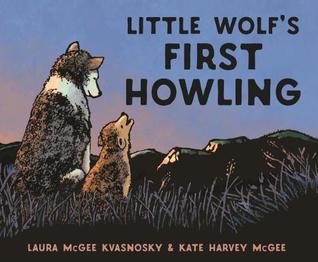
Little Wolf’s First Howling by Laura McGee Kvasnosky

Little Wolf's First Howling by Laura McGee Kvasnosky

Little Wolf’s First Howling by Laura McGee Kvasnosky, illustrated by Kate Harvey McGee (9780763689711, Amazon)

Little Wolf and his father head to the top of a hill for Little Wolf’s first try at howling at the moon. They watch as night falls and then Big Wolf demonstrates how it is done with a pure AAAAAAOOOOOOO. Little Wolf goes next, trying to imitate his father. But he can’t help but share his joy at it being his first howling as part of it with an “I’m hoooowling!” Big Wolf tells him that he started well but the ending was not proper form and demonstrates again. This time Little Wolf starts well again but soon adds his own interpretation. Once more Big Wolf demonstrates and again Little Wolf does his own things, this time getting his father’s paws to tap along. Soon the two of them are joining together in Little Wolf’s way of howling.

Kvasnosky’s text is simple and friendly. It will invite young listeners to howl along, so expect to fill your own space with lots of howling. As Little Wolf comes into his own in his personal way of howling, children will love the rhythms and jazzy nature of his voice. There is a great relationship between father and son in this book, a sense of patience emanates from Big Wolf while a wild playfulness exudes from Little Wolf.

McGee’s illustrations are done in gouache relief and capture the vibrancy of nature at dark. They are sprinkled with starlight and light from the moon. The medium also has lots of darkness and texture, creating its own shadows and organic qualities that add to the experience.

A howling good time, this picture book will be a pleasure to share aloud to your own group of little wolves. Appropriate for ages 3-5.

Reviewed from library copy.

Niko Draws a Feeling by Bob Raczka

Niko Draws a Feeling by Bob Raczka

Niko Draws a Feeling by Bob Raczka, illustrated by Simone Shin (9781467798433, Amazon)

Niko loves to draw. He carries paper and colored pencils with him all the time because he is always finding new inspiration. But he doesn’t draw like other people. If he draws the ice cream truck, he’s actually trying to capture the sound of its bell. Instead of drawing the sun, he draws the feeling of it on his face. The image he makes of the robin building her nest is of the hard work, not the robin or the nest. No one seems to understand his pictures at all. But then he meets Iris, a new girl, who can understand the feelings he is showing on the page.

In his text, Raczka really shows how the mind of young artist works and the different way in which Niko sees and experiences and depicts his world. There is a feeling of isolation when people can’t see what he is trying to convey in his art. That moment soon passes though when Iris can connect with the art that Niko has created. There is a real heart to this book, shown through Niko himself and his connection to the world.

Shin’s illustrations help readers understand Niko better and the art too. Children will want to discuss what they feel when they see the abstract swirls of Niko’s art. Shin also shows a vibrant and bustling urban community where Niko gets all of his inspiration. Done in mixed media, digital and acrylics, the illustrations have a solidity that supports the looser illustrations that are Niko’s.

A welcome look at artistic process and imagination, this picture book also is about finding kindred spirits. Appropriate for ages 4-6.

Reviewed from library copy.


Up! by Susan Hughes

Up! by Susan Hughes

Up!: How Families Around the World Carry Their Little Ones by Susan Hughes, illustrated by Ashley Barron (9781771471763, Amazon)

All around the world, families use different ways of carrying their children. This book travels the globe, showing widely diverse families and how they hold their babies close. There are babies being carried in arms, others in shawls, still others in parka hoods. Baby carriers can be used in different ways, whether you are father or brother and if you are differently abled. Baskets and shoulder rides are also shown. Up we go!

Hughes has chosen a wide range of baby carriers in her prose. She keeps it deliberately simple, making it a book that can be happily shared with little ones. The small format of the book also helps make it approachable. Only a little prose is given on each page, the brisk pace and changing scenes keeping the book very lively. It has a lovely bounce to the text, a sway like holding a baby on your hip or bouncing them merrily along.

Barron’s illustrations embrace the diversity and add to it. She has people of a wide range of races and religions on the page. The images are done in cut-paper collage and have a simplicity but also fully depict that part of the world. The crisp lines and bright colors add to the appeal for little ones.

A grand picture book that I hope gets made into a board book as well, this is a jolly journey through babies and how they are carried. Appropriate for ages 1-4.

Reviewed from library copy.


Life on Mars by Jon Agee

Life on Mars by Jon Agee

Life on Mars by Jon Agee (9780399538520, Amazon)

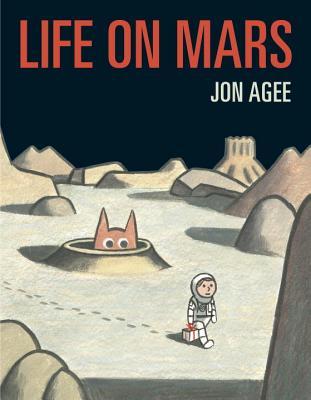
A child astronaut heads to Mars because he just knows that there is life there. He travels all alone, exploring the barren landscape of rocks and mountains. He even brings a wrapped gift of cupcakes with him for the creature he encounters. He does find a yellow flower blooming, proof that he was right all along. But along the way, he completely misses the huge martian following him around. That is until he gets ready to return to Earth and discovers the cupcakes have been eaten.

Agee is a master of riotous yet understated humor. Readers are in on the joke throughout the entire book, easily seeing the huge orange creature on the page. They will wonder if the astronaut will ever spot him. The use of the flower as proof of life on Mars is cleverly done, offering proof of life without the astronaut ever seeing the larger find right near him. As always, the illustrations by Agee are simple and friendly. His use of thick lines works well with the alien landscape of Mars, creating a dramatic feel.

A winner of a book that combines the joy of a mystery, a secret, aliens, space and cupcakes. Appropriate for ages 3-5.

Reviewed from library copy.


On Duck Pond by Jane Yolen

On Duck Pond by Jane Yolen

On Duck Pond by Jane Yolen, illustrated by Bob Marstall (9781943645220, Amazon)

This is the second book in the children’s picture book series by the award-winning duo of Yolen and Marstall that is done in conjunction with the Cornell Lab of Ornithology. A boy and his dog take a walk in a new setting. This time it is near a pond where everything is very quiet but soon the ducks arrive and break the silence with their splashing and quacking. The other creatures at the pond are startled and move away, including frogs, turtles, a heron and the tadpoles. Soon the pond goes back to being still and quiet and the other animals come out of hiding.

Yolen’s poetry is particularly effective. She pays such attention to small details not only in the animals as they react to the ducks but to the reflections in the water as they go from mirror-like to shattered to reflective once again. The water itself reacts similarly to the animals and the sounds, it’s a lovely connection that is clearly done and yet poetically presented allowing a sense of discovery for the reader.

Marstall’s illustrations are detailed and wonderfully natural. They embrace the greens of the surrounding land and also the colors of the animals themselves and the water. He uses plenty of detail on the animals themselves, showing them up close to the reader so that one can almost smell the pond water on the pages.

A grand look at a small pond and its vibrations throughout a boy’s day and life. Appropriate for ages 3-6.

Reviewed from library copy.


Carrot & Pea by Morag Hood

Carrot & Pea by Morag Hood

Carrot & Pea by Morag Hood (9780544868427, Amazon)

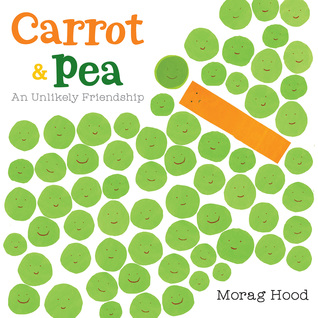
Lee is a pea and all of his friends are peas too. Except for Colin. Colin is a carrot. Colin is very different from the peas. He’s not the same green color. He doesn’t roll around like they do. He can’t really bounce and he can’t play hide-and-seek. But Colin is good at other things. He can be a slide for the peas to roll down. He can serve as a tower or a bridge. It’s because he is different that Lee loves him and so do all the other peas.

Hood takes a look at differences here in her very simple prose and while she points them out there is no sense at any time that Colin the carrot is misunderstood or left out. Instead the differences are pointed out and then embraced by the entire group. This ends up being a celebration of our differences and a look at how by being unique people provide new ideas for their community.

The illustrations are collaged out of plastic grocery bags. They have a wonderful texture to them that is very similar to crepe paper and their vibrant color adds to the appeal. The rows and rows of peas look out from the page, sometimes expressionless and other times very playful.

Great for even the littlest of children, this simple book on differences is as delicious as peas and carrots. Appropriate for ages 2-4.

Reviewed from library copy.


The Hawk of the Castle by Danna Smith

The Hawk of the Castle by Danna Smith

The Hawk of the Castle by Danna Smith, illustrated by Bagram Ibatoulline (9780763679927, Amazon)

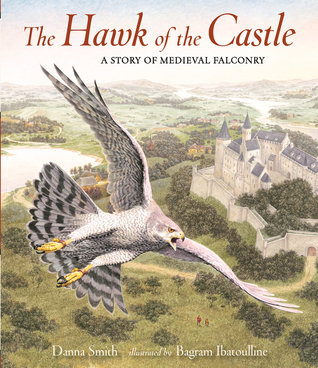
Journey back to medieval times in this nonfiction picture book about the skill of falconry. Told through the point of view of a young girl living in the castle, the text of the book is done in simple verse that hearkens back to traditional tales. Inset in each double-page spread is detailed information on falconry that shows the various parts of owning and caring for a hunting raptor. The book goes through all of the gear that is needed to own a falcon or hawk and then shows the hawk hunting for prey.

Smith has created a gorgeous two-layered book where her light hand with the verse and its traditional format clearly anchors the story in medieval times. That plays against the information shared about falconry which is clear and matter-of-fact. The text makes sure that readers never mistake the hawk for a traditional pet and never misunderstand that the hawk has emotions about their owner.

Ibatoulline’s illustrations are gorgeous. Bordered in a traditional black-and-white hawk theme, they have a lovely formality about them that suits the subject well. The paintings offer a feel of the majesty of the hawk. As the bird takes to the air so do the illustrations allowing a feel of freedom and joy.

This book truly soars, offering information for those wanting to know about falconry and a lovely poetic view as well. Appropriate for ages 6-8.

Reviewed from library copy.


My Pictures After the Storm by Éric Veillé

My Pictures After the Storm by Éric Veillé

My Pictures After the Storm by Éric Veillé (9781776571048, Amazon)

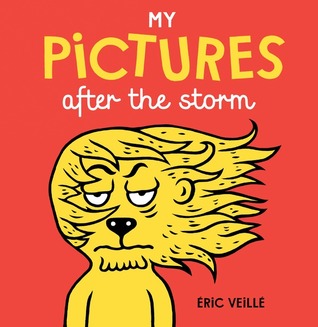
Before and after takes a humorous turn in this picture book. The first part of each pair of illustrations shows normalcy. Then something happens and everything changes. In the first pages, there are items from a beach and then after the storm things are tipped over, towels blow away, and ice cream falls. Lunch is shown and then after lunch everything is munched and changed. Other changes get more silly such as animals going to a hairdresser or mislabeled objects get relabeled or creatures eat too many potato chips.

Veillé has created a picture book that is a joy to share. The pictures are fun to explore and children will love spotting the differences. There is a zany nature to the illustrations, done in simple lines and bright, flat colors. The simplicity adds to the fun as the objects shift and change after an event.

Much more than a concept book, this is a funny and wry look at the chaos of life before and after. Appropriate for ages 3-5.

Reviewed from copy received from Gecko Press.

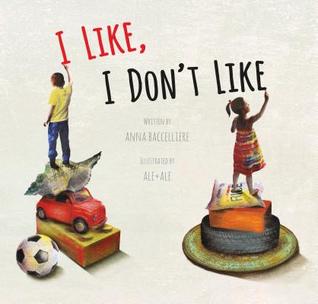
I Like, I Don’t Like by Anna Baccelliere

I Like, I Don't Like by Anna Baccelliere

I Like, I Don’t Like by Anna Baccelliere, illustrated by Ale + Ale (9780802854803, Amazon)

This spare and focused children’s picture book tackles the issue of child labor in a way that children will immediately understand. Looking at one object at a time, a child first says how much they like it, then the child responsible for making or gathering that object states that they don’t like it. So one child likes shoes, another doesn’t like shoes. One child likes music, another who plays on the street doesn’t like music. One child likes phones, another doesn’t like phones as they take them apart. The book ends with a heart-wrenching combination where one child likes playing and the other asks “What is playing?”

The book never loses sight of its purpose, pairing wealthy children with those living in poverty and doing child labor is a way to make sure that the message resonates with children and that they learn about their privilege in the world. The book ends with information on poverty and child labor as well as information on the United Nations’ Convention on the Rights of the Child and tips on how children can help.

The illustrations are stylised photographs that are painted and textured. They look straight into the faces of children from both sides of wealth and poverty, contrasting broad smiles with a deep weariness. Washes of similar colors further pair the contrasting dyads together into one image.

This is a very important picture book that is sure to inspire conversations and a desire to help. Appropriate for ages 6-8.

Reviewed from copy received from Eerdmans.