A Morning with Grandpa by Sylvia Liu

a-morning-with-grandpa-by-sylvia-liu

A Morning with Grandpa by Sylvia Liu, illustrated by Christina Forshay (InfoSoup)

Mei Mei’s grandfather, Gong Gong, is in the garden doing his tai chi forms. He sways his arms and explains that the form is called “White Crane Spreading Its Wings.” He also tells Mei Mei that tai chi is a martial art which makes Mei Mei start doing karate chops. Gong Gong continues to show Mei Mei about tai chi and its slow and smooth motions. Mei Mei does each motion with her own style. Then it is time for Mei Mei to teach Gong Gong about yoga. With stretching movements like Downward Dog and the Mermaid, Gong Gong is soon learning new poses of his own.

This book won Lee & Lows New Voices Award. It is a lovely look at the relationship of grandparent and grandchild through shared experiences and trying new things together. The incorporation of Tai Chi and Yoga is also done very well and there is a section in the back of the book that offers more information on the poses and forms demonstrated in the story. The way that Mei Mei is able to both learn from her grandfather and then teach him what she knows is a noteworthy element to the story, demonstrating that children can both be students and teachers.

The art by Forshay is bright and refreshing. She captures the various forms and poses with ease, showing the balance required for both Tai Chi and Yoga. She also demonstrates the energy of Mei Mei and the deep affection that the two of them have for one another. It is a book filled with movement and motion.

A joyful look at grandparents and grandchildren and the dynamic of learning from one another, this picture book is superb. Appropriate for ages 4-6.

Reviewed from library copy.


Six Dots by Jen Bryant

six-dots-by-jen-bryant

Six Dots: A Story of Young Louis Braille by Jen Bryant, illustrated by Boris Kulikov (InfoSoup)

Louis Braille lost his sight at age five from an accident and a resulting infection. His family helped him learn to cope, making him a cane that he could use to explore a little farther from home each day. His brothers taught him to whistle and his sisters made him letters out of straw. He could play dominoes, knew trees by touch, flowers by their smell and could listen to books being read aloud. But there were no books for blind children like him. Even when he got into a school for the blind in Paris he had to work very hard and become one of the best students to be able to access their books. When Louis achieved that though, he found that the books were done in large raised wax letters so thick books were actually quite short. Then there was news that a French army captain had created a way to send secret messages that was read by touch. Louis worked to make the system readable by the blind, creating his own alphabet system as a teenager!

Bryant writes in first person from Braille’s point of view. She explains how Louis lost his sight with just enough detail to make it understandable how tragic it was but doesn’t overly linger there. When Louis’ sight is gone, the text changes to become filled with noises and other senses than sight. Bryant moves the story forward using Braille’s desire to read for himself, that drives both the story and Braille’s own life. As each opportunity proves to be disappointing, Braille does not give up hope, instead developing throughout his life a tenacity to find a solution.

Kulikov’s illustrations play light against dark. When Braille loses his sight, the pages go black with shadowy furniture forms only. Color is gone entirely. The reader is not left there, but moves back into the world of color unless the story is speaking about Braille’s blindness specifically, so when Braille finally gets to try reading the wax lettering, the page goes dark again, also showing his disappointment in the solution.

Intelligently designed and depicted, this is a warm and inspiring look at the life and achievements of Louis Braille. Appropriate for ages 6-9.

Reviewed from copy received from Knopf Books for Young Readers.


Du Iz Tak? by Carson Ellis

du-iz-tak-by-carson-ellis

Du Iz Tak? by Carson Ellis (InfoSoup)

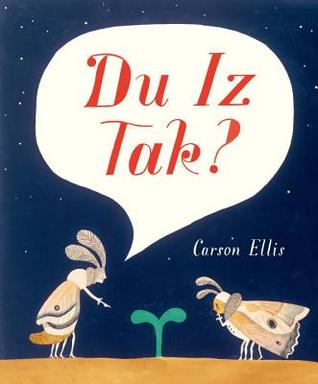
This inventive picture book takes a close-up look at a garden filled with insects. There is the caterpillar who enters his chrysalis, beetles and a ladybug who notice a sprout growing. They go to Icky, who lives in a log nearby and who has a ladder they can use. The sprout continues to grow and grow. At night other insects and bugs come out. Soon a fort is built in the growing plant but then, disaster! A spider comes and webs the entire plant. As nature continues to take its course, more insects arrive to see the plant flower. Slowly the plant tips over and the fort falls. Seeds drift to the ground. Fall arrives and the butterfly emerges from her cocoon. In spring, new sprouts appear.

The summary above does not capture what is truly amazing about this book. It is the language play, the word choices and the way that at first it seems like a foreign language but by the end of the book you are “speaking” and understanding bug. The language has phrases that are recognizable, allows for decoding of the language and then repeats in a way that allows readers to better understand. It’s very cleverly done and a book unlike any other I’ve experienced.

Ellis’ illustrations add to the otherworldly appeal of this book. Many of the insects are recognizable and still they are strange and wild. The illustrations beautifully focus on the same log and plant throughout, with seasons changing, the plant growing, and the insects coming and going. It is rather like an organic theatrical set and stage.

I have a deep affection for this zany picture book. Children who enjoy word play will love this and may find themselves speaking the bug language for awhile. Appropriate for ages 3-6.

Reviewed from copy received from Candlewick Press.


King Baby by Kate Beaton

king-baby-by-kate-beaton

King Baby by Kate Beaton (InfoSoup)

From the author of Hark! A Vagrant comes a second picture book. King Baby is born to loving and devoted subjects, his parents. People bring gifts and in return King Baby bestows blessings upon them. He smiles and coos, but a King can also be demanding. When he doesn’t get his toy fast enough, he can be cranky. And his subjects don’t understand his demands, so King Baby has to do something new and bold. He crawls! Then he starts to grow and grow into a Big Boy. But as he grows up, who will rule his subjects?

Beaton has created a picture book that fully embraces the experience of new parenthood and will also work to show children about to be siblings just how very demanding a tiny baby can be for attention and time. Still, there is also the fact that they grow up so fast, quickly leaving babyhood behind. The use of imperious and lordly demands makes the book very funny and may allow overwhelmed families a little laugh about their small bundles of joy.

Beaton’s signature art work is a delight. The baby as little more than an egg with a crown captures those first few weeks perfectly. The crown remains perched on his little head all the way through tantrums and royal demands. The chaos of a home with a baby is also fully depicted with exhausted parents in hoodies and sweatpants and the floor littered with bottles, toys and clothes.

If you have a new little king or queen of your own or are expecting one to move in soon, this is a book that will have you and your other children giggling and agreeing. Appropriate for ages 2-4.

Reviewed from library copy.


Pond by Jim LaMarche

pond-by-jim-lamarche

Pond by Jim LaMarche (InfoSoup)

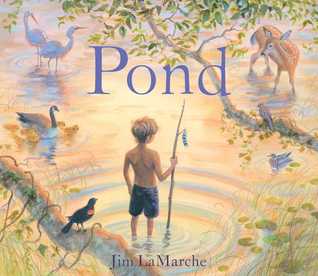
Out walking in the late winter, Matt realized the the place that they had always called “the Pit” used to be a pond. So he and his friends decided to recreate the pond that had been there. They cleaned up the junk and built a new dam. As they worked, Pablo discovered a blue stone shaped like a heart in the sand. Katie started to research the birds, insects and stones as the pond started to slowly fill. They found an old wooden boat and repaired it, naming it Dragonfly. Summer ended with them floating on the newly filled pond, camping nearby. In fall, the geese discovered the pond and flocked to it. Winter brought ice skating on the pond with lots of friends. In the spring, the three friends run to the top of a hill overlooking the pond and there they see how the heart stone is connected to the pond itself.

LaMarche offers a perspective on nature that shows children that they too can do things to restore natural areas. The amount of work that the children do is not minimized at all nor is the slow return to a pond from a pit. This focus on effort, hard work and a slow pay off is vital when working with nature. The book embraces a sort of natural time, a patience while birds and bugs return. Then it picks up, swooping with changes and demonstrating how an ecosystem changes throughout the seasons and serves different animals.

LaMarche grew up in Wisconsin and you can see Wisconsin on each page of this book. From the bombardment of mosquitoes in the summer to the spotted fawns to the woods and marshes. The illustrations are superb, showing the shimmering light of water and woods, the moon rising over a pond, and again that slow transformation into natural beauty.

A testament to the power of restoration for natural areas and how children can help, this picture book is a pleasure. Appropriate for ages 5-8.

Reviewed from copy received from Simon & Schuster.


Yellow Time by Lauren Stringer

yellow-time-by-lauren-stringer

Yellow Time by Lauren Stringer (InfoSoup)

The geese are flying south, the squirrels are busy and the crows are the only birds left in the trees. The air smells different and everyone knows that the trees must drop their leaves soon. Then the wind comes and the air fills with yellow leaves. Children run outside and play in the swirling yellow breezes. When the leaves have fallen, the yellow is in piles on the ground, covering everything. Children gather the leaves to press in books to remember the special time just before winter comes with its whiteness.

Stringer shares the drama of autumn in this picture book. She uses phrases like “a symphony of yellow” to capture the wonder of what is happening, mixing senses of sound and color together. When she describes the smell of autumn just before the leaves fall, she uses comparisons that children will understand: “Like wet mud and dry grass with a sprinkle of sugar.” It offers up the richness and deepness of the smell, the intangible dryness that is part of it and the sweetness as well. She skillfully creates autumn on the page with her words.

The illustrations celebrate the diversity of a small neighborhood filled with yellow trees and the children who wait for the falling leaves to start. There is a gorgeous overload of yellow on the pages, bright and cheerful, filled with motion and tumbling breezes and leaves. The pages are just as fresh and vibrant as the season she is depicting.

A joyous book that welcomes autumn with open arms. Appropriate for ages 3-5.

Reviewed from copy received from Beach Lane Books.

Is That Wise Pig? by Jan Thomas

is-that-wise-pig-by-jan-thomas

Is That Wise Pig? by Jan Thomas (InfoSoup)

Cow, Pig and Mouse are all making soup together. Mouse adds one onion, Cow adds two cabbages, but Pig tries to add three umbrellas! The other two ask Pig if that is wise. Then Mouse adds four tomatoes, Cow adds five potatoes, and Pig tries to add six galoshes. Is that wise? More ingredients go in and Pig even adds nine carrots! Then Pig reveals that she asked ten friends to join them, something that probably was not wise. Suddenly Pig’s galoshes and umbrellas make a lot of sense as the soup flies!

As always, Thomas completely understands the farcical humor that toddlers adore. Children will be so engaged in laughing at Pig’s ingredients that they won’t see the ending coming until the reveal. There is also a counting component to the book that is subtly done and the book feels much more like a story than one teaching numbers. Thomas’ illustrations will work well with a crowd, projecting easily even to those in the back thanks to their strong black lines and simple colors.

Expect lots of requests for seconds of this silly book. Appropriate for ages 2-4.

Reviewed from copy received from Beach Lane Books.


A Family Is a Family Is a Family by Sara O’Leary

a-family-is-a-family-is-a-family-by-sara-oleary

A Family Is a Family Is a Family by Sara O’Leary, illustrated by Qin Leng (InfoSoup)

A teacher in a classroom asks her class what they think make their families special. One little girl hesitates to answer, knowing that her family is not like everyone else’s. The children begin to share about their families. There are children being raised by two fathers and two mothers, another who is parented by a grandmother. Some have huge families with lots of siblings and others are only children. Some have a new baby and others have stepbrothers and sisters. Each family is different and special in its own way. By the end, the little girl knows that whatever structure her family has, all that matters is that there is lots of love.

O’Leary does not lecture about families here. Rather she shows the wide variety that there are in families and how each of those is based on love. There is no need to be didactic, as every child will see themselves in the pages of this book. It is a wise way to look at families, since each is just as special and marvelous as the one before. The emphasis here is on love itself, the care that is given to children in each of those families no matter their structure.

Leng’s illustrations add so much warmth to this picture book. The illustrations are full of details and invite readers to look closely. Each page zings with energy from the mothers singing under the night sky to the child who lives with both her father and mother, just at different times. There is a playfulness on the pages too, which makes each family come to life.

A strong picture book about diversity and families, this book is filled with warmth and love and not lectures. Appropriate for ages 3-5.

Reviewed from library copy.


How This Book Was Made by Mac Barnett

how-this-book-was-made-by-mac-barnett

How This Book Was Made by Mac Barnett, illustrated by Adam Rex (InfoSoup)

How is a book made? Well this book was made in the regular way with an author making many drafts, and editor offering firm advice, an illustrator taking a long time to create the art, and it being printed halfway around the world. But it is also an amazing story and one that will surprise when the tiger keeps reappearing, the pirates raid the slow boat full of books, and the news that there is one last important piece to the book really being A BOOK. You will just have to read this book to see what that is.

Any book by Barnett and Rex is going to be wonderfully surprising and funny. This book is no exception. Barnett immediately makes sure that this book is not taken too seriously by starting it with him arm wrestling a tiger. The tiger then returns at important moments in the book, sometimes to be scared off and other times with a posse. The editor’s role is also depicted in the book with a lot of tongue-in-cheek but also honesty too. Throughout there is real information on how books get made with plenty of imagination added as well. Just like any book.

Rex’s illustrations are done with pencil on paper combined with photography. Some of the illustrations have cotton clouds and others are 3-d objects or 2-d objects photographed. This gives a great sense of space and distance, shadows lengthening across the page. Throughout the art is as clever as the words, which is a compliment to both.

A funny and imaginative look at the making of this book, both unique to this book and universal to the process. Appropriate for ages 4-6.

Reviewed from library copy.