Home at Last by Vera B. Williams

home-at-last-by-vera-b-williams

Home at Last by Vera B. Williams and Chris Raschka (InfoSoup)

Lester is adopted by Daddy Rich and Daddy Albert, who pick him up with their dog Wincka once the adoption is formalized. They head home, put Lester’s new clothes away. But when Daddy Albert tries to put Lester’s suitcase in the attic, Lester shows them that it is full of his action figures and insists that they have to stay right in the suitcase in his room. Lester is happy during the day, playing with his toys and spending time with his new fathers. At night though, he packs up his suitcase and stands near his fathers’ bed. This happens night after night, despite cocoa and toast, singing songs, and explanations that Lester is safe. Finally, one of the fathers loses his temper with the situation and then Lester really opens up about what he is worried about. A solution to the problem is found by Wincka, the dog, who was listening to Lester’s story too.

This was the book that Williams was working on when she died. Raschka had been involved from the beginning with the book and completed the vision that Williams had shared with him. Williams captures the deep-seated fear that adopted children can have, the understanding at one level of newfound family love but also the change that comes at night where fears become larger. Williams also shows two loving gay men, both delighted to be fathers and each different from the other. The two of them together parent Lester with kindness and concern and deep love.

Raschka finished the book, basing his art on sketches by Williams. His large colorful illustrations have a loose feel that ranges across the page, capturing both the mayhem of a family short on sleep but also the warmth of that family too. His watercolors convey deep emotions from the frustrations of sleepless nights to the power of coming together afterwards. All is beautifully shown on the page.

A tribute to adoptive families, LGBT couples who adopt and the importance of love and patience, this picture book is a grand finale to the many books by Williams. Appropriate for ages 4-7.

Reviewed from copy received from HarperCollins.


What a Beautiful Morning by Arthur A. Levine

What a Beautiful Morning by Arthur A Levine.jpg

What a Beautiful Morning by Arthur A. Levine, illustrated by Katie Kath (InfoSoup)

When Noah visits his grandparents, Noah and his grandfather start the day with a song. They head outside with the dog even if its raining, singing all the way. At breakfast they made plans for the day. But lately, Grandpa has been forgetting to ask about making plans. Then one day when Noah woke him from a nap, Grandpa didn’t know who he was. His Grandma explained that sometimes Grandpa got confused and that it was better to focus on what he still had rather than what he lost. So Noah set out to do the things alone that he had done with his grandfather, until he discovered that Grandpa still responded to music and songs. It was a way to start once more having special mornings together.

This book is so beautifully done. It is about the very special relationship that children have with their grandparents, the delight of staying with them, and how each morning can be special just because someone cares for you and spends time with you. It is also about the power of music to connect people and experiences as well as its special quality with those suffering from Alzheimer’s or dementia. Throughout, the character of Grandma is there, at first secondary to the strong relationship between grandfather and grandson and then stepping up to fill some of the gaps left behind. She is warm and loving and very special.

Kath’s illustrations are bright colored and friendly. When Grandpa is confused or feeling separate, she uses a visual device to indicate the change by having his face lose color. If he is particularly confused, the colorlessness spreads on the page, taking up his entire body. In this way, children will see visually the change coming over Grandpa and understand that it is deeply affecting him and his personality.

It is rare that I tear up when reading a picture book, but this book is particularly moving. Have tissues ready. Appropriate for ages 3-5.

Reviewed from library copy.

A Child of Books by Oliver Jeffers

a-child-of-books-by-oliver-jeffers

A Child of Books by Oliver Jeffers and Sam Winston (InfoSoup)

This striking picture books tells the story of a young girl who loves to read, who is “a child of books.” She meets a boy who seems lonely, his father only reading the newspaper and ignoring the sea of words from fiction swirling around them. She leads the boy off on an adventure of stories. Down rabbit holes, up mountains, through dark tunnels, into fairy tale woods, past monsters in castles, into the clouds for bedtime stories, and much more. They return home, to a bright colored house on a gray street, and the boy leaves with a book under his arm trailing words behind him.

My description above doesn’t capture the beauty and wonder of this picture book. Jeffers’ poetry looks deeply into our relationship with fiction. Into the joy of discovering new adventures of heading down rabbit holes that other readers’ feet have merrily disappeared down before yours. He celebrates the shared language of story, the shared settings of tales, and the shared experiences that we have all had, separately but also together.

The illustrations are unique and very special. The merger of the painted characters with amazing typeface art is dynamic and original. It slows you down, naturally asking you to read the words that the mountains, clouds, and forest are made from. If you do, you discover old friends hiding there, beautiful words from classic children’s books. They invite you to read more, to rediscover those books of your childhood or introduce your favorites to your children. By the end of the book, I was slowly reading each word in the illustrations, lingering and sighing contentedly. My day slowed and enriched by memories.

Beautiful and luminous, this picture book is rich and unique. Appropriate for ages 3-5.

Reviewed from library copy.

Wonderfall by Michael Hall

wonderfall-by-michael-hall

Wonderfall by Michael Hall (InfoSoup)

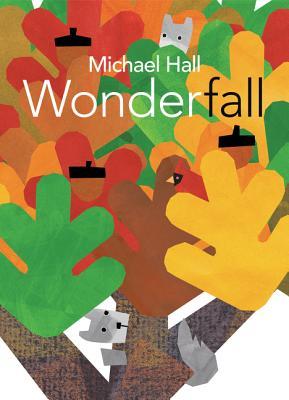
In a series of poems, this picture book celebrates the changing seasons through the experience of a tree. First in the greenness of summer, the acorns start to fall from the oak tree. The yellow school bus arrives and the tree’s leaves start to change. Harvest time arrives, parades march past, and Halloween comes.The leaves start to fall, Thanksgiving comes and children play in the piles of leaves. Wind arrives, taking most of the leaves off the tree and its time to rake. No leaves left, the tree stands bare until snow comes with the new winter season.

Hall celebrates the autumn season with this picture book that encompasses the very beginning signs of autumn all the way through to full winter. The focus on a single tree as the one experiencing the changes works well, particularly with the vivid changes that the tree goes through itself. It is also interesting to see trees as witnessing what humans do just as they watch the activities of the squirrels on the ground and in their branches. The book ends with information on animals seen in the book and how they prepare for winter.

The illustrations are signature Hall with bold shapes done in collage. The leaves are oversized and glorious, full of bold colors and the size of branches. They enliven the page no matter their color, making the winter pages when they are gone all the more cold and barren.

Simple and poetic, this is a great new pick for fall story times and units. Appropriate for ages 3-5.

Reviewed from copy received from Greenwillow Books.

The Journey by Francesca Sanna

The Journey by Francesca Sanna

The Journey by Francesca Sanna (InfoSoup)

The book begins with a family who enjoys going to the beach together often. But then things change and the war begins. Darkness invades and takes over the landscape, then the children’s father is taken by the war. Their mother hears of people leaving for a safer place, far away. She decides to leave as well. They leave at night, hide in different vehicles along the way. They reach the border but are turned back by a guard. They manage by paying for help to reach the sea, but their journey has not ended. As they continue to travel over dangerous seas and past many borders, the narrator notices that birds too are migrating along with them on their own long journey.

This picture book captures the current refugee crisis through a lens that is very appropriate for children. The impact of war is shown as a dark figure, destroying buildings and wreaking havoc. It envelopes them for awhile, particularly with the death of their father. There is a feeling of a constant state of upheaval and danger, the journey is one with its own dangers but is a way forward away from an even more violent situation. The focus here is on the devastation of war and the turmoil it brings, rather than a specific population. The message is that it could be any of us.

Sanna’s illustrations are so wrenching and evocative. War as a long-fingered destruction that envelopes and changes everything is beautifully shown. The book has a feeling of motion throughout, the long pages leading one on your own journey. The huge guard at the gate, stands horrifyingly large on the page, dwarfing the family. Then alone in the woods, the mother is their safe place and their home yet ever so human as well. The illustrations are artistic, beautiful and speak volumes about the emotions of refugee families.

An important and vital book, this book allows children to understand the plight of refugees in our world and will open hearts. Appropriate for ages 5-7.

Reviewed from digital galley received from Flying Eye Books and Edelweiss.


The Uncorker of Ocean Bottles by Michelle Cuevas

The Uncorker of Ocean Bottles by Michelle Cuevas

The Uncorker of Ocean Bottles by Michelle Cuevas, illustrated by Erin E. Stead (InfoSoup)

The Uncorker of Ocean Bottles lives in a small house on a hill near the sea where he watches for the glint of glass in the waves. It is his job to deliver any messages found in bottles to their rightful owner. Sometimes that means walking only a short distance and other times he must go on a long journey to deliver them. He wishes that one day he would find a message in a bottle that is meant for him, but he never does. One day though, he does find a message with no recipient mentioned. It is an invitation to a party on the beach. He heads into town and asks person after person if this is their message, but it doesn’t belong to any of them. He decides he must go to the party to apologize for not delivering the message to the right person. But what he finds there shows him that some messages are meant for him after all.

Cuevas writes with real poetry in this picture book. Her prose captures the essence of moments with gorgeous descriptions like, “Sometimes the messages were very old, crunchy like leaves in the fall.” The book celebrates the connection that letters bring each of us and takes readers back to a time when messages were written by hand, even if rarely placed in bottles. It is also a book that speaks to the importance of community and feeling like you belong, but also the vitality that can be found in taking the first step towards making that connection.

Stead’s illustrations are dreamy with their pastel colors and fine lined details. Some of them are almost like looking through a keyhole and watching while others encompass the page. There are pages filled with the water of the sea that show both the difficulty of the job and the loneliness of it too. Moments looking alone out of a window capture the isolation the Uncorker is feeling. The colors too add to the emotions of the images both during the isolation and later at the party.

A poetic and beautiful picture book that looks at letters, community and connections in a memorable way. Appropriate for ages 4-6.

Reviewed from ARC received from Dial Books.


Chirri and Chirra by Kaya Doi

Chirri and Chirra by Kaya Doi

Chirri and Chirra by Kaya Doi

Released September 6, 2016.

Chirri and Chirra are two little girls who wake up early and head out into the forest together on their bicycles. They arrive at the forest cafe where there are tables just right for creatures and people of any size. They order cups of acorn coffee and clover blossom tea. Then they are off again into the forest and they find a bakery with bread and jam of all kinds. A bear and rabbit are eating there too. The girls choose their sandwiches and eat them near a pond. They play in the water, nap under a tree. They bicycle farther on and as the sun is setting come to a forest hotel where they find a room and beds just the right size for them. The day ends with the girls joining in a forest concert as everyone sings together.

This is a translation from the Japanese original, and it works very well. The picture book is delightful and airy, inviting children into a world built just for them. The description may seem a bit too sweet and almost saccharine, but the book is not like that. Instead it has an exceptional childlike nature that fills it with wonder and the joy of exploration. There is a feeling that this is entirely imaginary yet that it may also be delightfully real.

Doi’s illustrations are a large part of the appeal of this book. The two girls are matching except for the buttons on their dresses. The illustrations celebrate the different sizes of creatures and also the food and drink that the girls have along the way. Just the acorn coffee and clover tea will have your mouth watering. Expect plenty of tea parties and sandwiches after reading this.

The first in a series, I am hopeful we will see more of them in translation soon. Appropriate for ages 2-4.

Reviewed from copy received from Enchanted Lion Books.


The Summer Nick Taught His Cats to Read by Curtis Manley

The Summer Nick Taught His Cats to Read by Curtis Manley

The Summer Nick Taught His Cats to Read by Curtis Manley, illustrated by Kate Berube (InfoSoup)

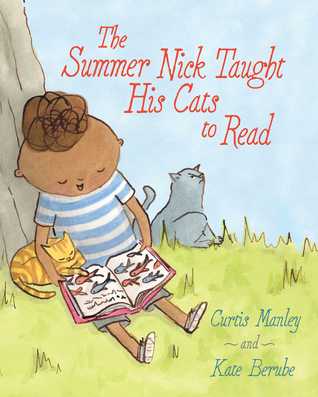
Nick has two pet cats, Verne and Stevenson. They love doing things together, but the cats don’t appreciate it when Nick sits down to read. So Nick decides to teach them to read too. He starts with easy words, but the cats aren’t interested. He moves on to flash cards and soon Verne is paying attention, particularly when the words and books have to do with fish. Verne sounds out words and starts reading books on his own, he even gets his own library card. Stevenson doesn’t seem interested at all though. Verne and Nick have lots of fun acting out the stories that they are reading, though it would be more fun with Stevenson playing too. Then one day Nick discovers pictures that Stevenson has drawn of a pirate story. Could it be that Stevenson is interested after all?

Manley cleverly shows the process of learning to read in this picture book. Moving from simple words to sounds of letters to looking at books on your own and then reading entirely on your own. Delightfully, he also has Stevenson who is a reluctant reader. Stevenson though just needs someone to notice what he is passionate about and suddenly he too is interested in reading. It’s a smart way to show that we are all readers, some of us just need to not read about fish but about pirates!

The illustrations by Berube are friendly and fun. I love that Nick is a child of color and that it is not an “issue” in the book or even mentioned. One special part of the book is Stevenson’s expressions which are pure grumpiness and then can be seen later in the book as purely piratical.

A summery book about reading that will move nicely into the school year. Appropriate for ages 4-6.

Reviewed from copy received from Simon & Schuster.


You Belong Here by M.H. Clark

You Belong Here by MH Clark

You Belong Here by M.H. Clark (InfoSoup)

This poetic picture book celebrates both nature and the child themselves. The book opens with the text talking right to the child, telling them that just as the moon and stars belong so do they belong right with the person reading the book. It then moves on to talk about different animals and how they belong too either deep in the sea, in the woods, or in a nest. Then the book returns to the child and it continues to move back and forth between nature and child, demonstrating how much that child simply belongs to the world as well.

Told in rhyme, this picture book’s poetry is very well done with none of the rhymes feeling forced. In fact, the text almost dances particularly as it moves between child and nature, each of those transitions feeling a little like a graceful twirl to bring to back around in a circle. There is attention throughout too to ecosystems and showing how each animal or plant has a place that is important and vital to that place. It’s a book that creates both warmth and the opportunity for conversation as well.

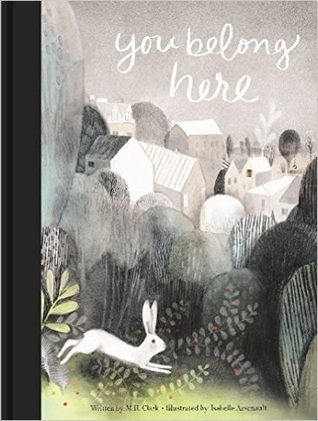
The illustrations by Arsenault are subtly colored and almost ethereal. They show the intertwining nature of the world with buildings and homes interspersed with natural scenes of animals and plants. The creatures on the page are almost lit from within, white against the watercolor backgrounds.

A beautiful celebration of home and the world that all sorts of families will find welcoming and heart warming. Appropriate for ages 2-4.

Reviewed from library copy.