Barnacle Is Bored by Jonathan Fenske

Barnacle Is Bored by Jonathan Fenske

Barnacle Is Bored by Jonathan Fenske (InfoSoup)

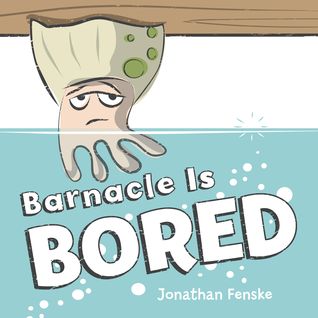
Hanging off of the bottom of a dock is not the most exciting life. Barnacle has times of day when he is cold and wet and other times when he is dry and hot. The tide comes in and out, the waves roll in, the sun goes up and goes down. Barnacle is particularly jealous of the merry life of a polka-dotted little fish nearby. He knows that the fish has to have a lot more fun than Barnacle does. He must go diving with dolphins and frolic with other fish. Just as Barnacle is completing his fantasies about how much better the little fish’s life is than his own, an eel comes along. Gulp!

Put this down as another rather dark picture book that I adore. I must admit to having a type and this one is particularly pleasing with Barnacle being entirely jealous of what another fish has that he does not. It’s an emotion that children will relate to readily. The text is very brief and fast-moving. Barnacle’s voice is a pleasure to read aloud, from his slow tones of boredom through to the joys of being a fish and all the way to the end when he realizes what he actually has going for him.

The illustrations are very appealing and have the feel of a cartoon. Done in flat colors, they play up the facial expressions of Barnacle and the other fish to good effect. The looks of boredom are particularly clear and take it so far that it’s humorous. The page turns are nicely done as well, adding to the theater of the book.

Perfect for the boredom of summer days, this seaside book will surely refresh or at any rate give everyone a good jump at the end. Appropriate for ages 4-6.

Reviewed from library copy.
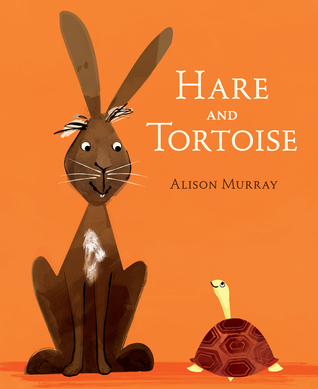
 

Hare and Tortoise by Alison Murray

Hare and Tortoise by Alison Murray

Hare and Tortoise by Alison Murray (InfoSoup)

This picture book is a retelling of the classic Aesop fable. The story is much the same with the added tantalizing feature of a carrot patch to get Hare to slow down and eat and then take a nap. As always, Tortoise simply walks along, not zipping at all. Hare awakens from his nap just that critical second too late and misses winning by a hair. The entire book is wonderfully accessible and readable with humorous touches added like diagrams of both Hare and Tortoise and their advantages and disadvantages. It reads aloud nicely, the pace happily more like Hare than Tortoise throughout.

Murray’s illustrations are large and will work well when shared with a group. Hare is a bounding and lean while Tortoise is rounded and with a determined set to his jaw. The illustrations show clearly that Tortoise is behind and the long walk he has to the finish line. While the snoozing Hare has the setting sun behind his full belly after leaving a trail of munched carrots.

Clever and jolly, this enduring tale is brightened by a fresh take. Appropriate for ages 3-6.

Reviewed from library copy.


Who Wants a Tortoise? by Dave Keane

Who Wants a Tortoise by Dave Keane

Who Wants a Tortoise? by Dave Keane, illustrated by KG Campbell (InfoSoup)

Released July 19, 2016.

A little girl has been longing for a puppy for her entire life. She has lists of dog names, read about training, and dreamed about life with a puppy. So when she opens the box with holes in the top on her birthday, she is dismayed to discover a tortoise inside. Her father had told her he was allergic to dogs, but she had still dreamed of having one. Now she has a cold-blooded reptile. She has no ideas for names for him, so she doesn’t name him anything. She figures out that he can’t play fetch, does not like rolling over, doesn’t do many tricks, and doesn’t get excited when she returns home. Slowly though, she does figure out things that she can do with a tortoise, including selling turns holding it and painting its nails. When she tries playing hide-and-seek though, she discovers that tortoises are far too good at it. Now she is the owner of a lost tortoise. How will she ever find him again?

Keane has written a witty story that shows the natural progression of falling in love with a different kind of pet. The protagonist tells the story in her own voice, filled with righteous indignation at being given a reptile and then turning to grudging respect for what it can do, and finally becoming an expert on tortoises. The characters throughout the book are thoroughly realistic and human, from the father who mentions his allergy to no avail to the little girl and her friends as they try to find the hiding tortoise. The reactions and emotions here are honest and true, creating a book that is funny and heartfelt.

Campbell’s illustrations add so much to this picture book. The little girl’s pigtails show her emotions just as much as her face. They are perky when hopeful, limp when lonely, and almost stiff when angry. Using plenty of white space, the illustrations show both a loving family and a warm community where people are willing to line up for lemonade and a tortoise.

A dynamite picture book that is ideal for pet-themed story times or to introduce a new pet to a classroom or family. Appropriate for ages 4-6.

Reviewed from e-galley received from Penguin Random House and Edelweiss.


Ferocious Fluffity by Erica S. Perl

Ferocious Fluffity by Erica S Perl

Ferocious Fluffity by Erica S. Perl, illustrated by Henry Cole

Released July 19, 2016.

The author and illustrator of Chicken Butt return with another uproariously funny picture book. Mr. Drake brings a new pet into his classroom. It’s a tiny hamster. They aren’t allowed to hold her, but one day when Mr. Drake is late, the children take her out of her cage. But Fluffity is not as sweet as she looks. She bites all of the children! Then she chases them down the hall and continues to bite them as they hide in the library. When Mr. Drake discovers them all, Fluffity bites him too and won’t let go. They finally get Fluffity back into her cage and figure out that she needs exercise and lots of things to chew on to be happiest. In fact, they do so well that Mr. Drake brings in a new pet for the classroom!

Now, I must admit that when I start a picture book and it is in rhyme I tend to worry and even shudder a bit. Here Perl handles her rhyme with panache, using it to up the frenzied action and to increase the humor as well. The rhyme adds a galloping pace to the book that is wonderful as well as making it a treat to read aloud. The humor is broad and never subtle, in other words perfect for small children to laugh right along with. It is also appreciated that in the end the students learn how to care for Fluffity rather than getting rid of the little nipper.

Cole’s illustrations add to the zany feel of the book. Just look into the eyes of Fluffity and you will know that something is about to go wrong. The ball of fur may be tiny, but her glare would have me hiding in a library too. Just like the writing, the illustrations are ideal for sharing out loud too with their bright colors, large format and action-filled images.

Sure to keep even the wiggliest preschooler listening, this picture book is a great finishing read for a story time welcoming children back to school. Appropriate for ages 4-6.

Reviewed from copy received from Abrams.


The Moon’s Almost Here by Patricia MacLachlan

The Moons Almost Here by Patricia MacLachlan

The Moon’s Almost Here by Patricia MacLachlan, illustrated by Tomie dePaola (InfoSoup)

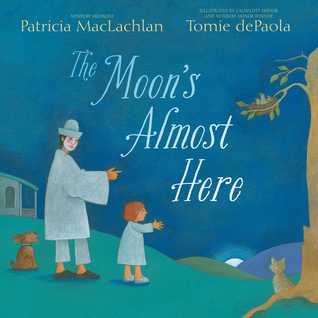
A collaboration between a Newbery medalist and Caldecott Honor and Newbery Honor winner, this picture book is a dreamy bedtime read. As two people get ready for the moon to arrive, the animals around them are also preparing for bed. A hen gathers her chicks close and safe in their pen. The ducks head to the shore. Horses and cows head inside. Fireflies blink in the meadow. The dog and cat fall asleep. Then the moon has arrived, big and bright in the sky, just as the child falls asleep in the adult’s arms.

MacLachlan’s text is a poem that leads readers around the farm, from one animal to another as they prepare for bed. The animals are not anthropomorphic at all, but nicely realistic. She adds in touches of butterflies as well as the fireflies that echo the stars above. The entire effect is of tranquility and a slowing down as the evening arrives. It feels entirely natural and organic as it gets sleepier.

The illustrations by dePaola are filled with teals and blues, but also lit with moonlight. The adult character wears white with a white clown face as well that evokes Pierrot. It creates a surreal and dreamlike effect in the picture book, but is not frightening at all. The deep colors add to the nighttime quiet and sleepiness.

A superb bedtime picture book that works because of the virtuoso blend of poetry and illustration. Appropriate for ages 2-4.

Reviewed from copy received from Margaret K. McElderry Books.

The Storm by Akiko Miyakoshi

The Storm by Akiko Miyakoshi

The Storm by Akiko Miyakoshi (InfoSoup)

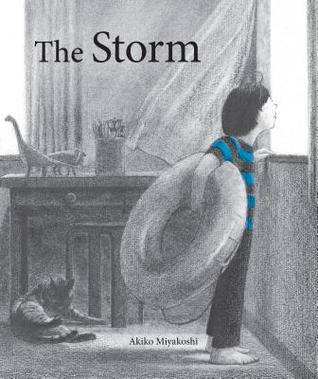
A little boy heads home after school, excited about a trip to the beach the next day with his family. His teacher did warn that a storm was coming and as the evening goes by, the sky gets darker. His parents prepare for a storm and reassure him that even if they can’t go to the beach the next day, they will go another weekend. Soon rain starts to fall and then the wind picks up and blows hard. When it gets too loud, the boy jumps into his bed and pulls his covers over his head. Soon he is dreaming about being on a ship with big propellers that help to drive the storm away. Finally the storm moves off and his ship can sail higher into the sky. When the boy wakes up the next morning, he discovers a lovely day. Just right for a visit to the beach!

Miyakoshi’s picture book is filled with tension. Not only of the storm itself but of the waiting for the storm to arrive and then the concern about how it will impact their plans for the next day. It is a tension that children will understand, whether about weather and storms or about big plans being disrupted. It is also a picture book that speaks to the power of nature and the way that children can have plans with little control over them.

The illustrations in the book are black and white with small touches of color like the blue sky after the storm. The charcoal style has a lovely texture throughout. Light and dark play on the page with one storm page filled with rain showing the falling water as bright zings of light in the darkness. There is both a feeling of drama and also one of safety throughout, particularly during dinner and at bedtime.

This stormy picture book is one that children will relate to on a variety of levels. Appropriate for ages 3-6.

Reviewed from e-galley received from Kids Can Press and Edelweiss.

Finding Wild by Megan Wagner Lloyd

Finding Wild by Megan Wagner Lloyd

Finding Wild by Megan Wagner Lloyd, illustrated by Abigail Halpin (InfoSoup)

Two children set off to discover the wild, leaving their urban world and heading into a nearby park filled with trees, ferns and birds. There are moments of wonder and some shivers too. Wild smells different from the city too and demands that you breathe it in deeply. Wild can be dangerous, prickly and poisonous, but it can also be filled with softness and soothing. It can be hot and cold. It is filled with secrets to explore and even discoveries to eat and savor. Even in large cities where there doesn’t seem to be room for wild to exist, you can see it if you follow the subtle clues.

Lloyd’s writing is a poem about wilderness and the importance of it in our lives. She doesn’t lecture about it in any way, allowing nature itself to invite readers in more deeply. She allows nature to sing on the page, showing its many sides. She does not shy away from showing that nature can be slightly frightening but balances that nicely with more positive sides of being outside and enjoying the outdoors.

Halpin’s illustrations are done in watercolor and colored pencil. She creates a wild that is filled with huge trees, large leaves, flowers and shadow. It is also full of water, places to swim and berries too. Her art covers the entire page at times, filling it to the brim with nature. Other times, the wild is surrounded by white space on the page, allowing young readers to both feel immersed in green wonder but also able to glimpse it from a distance at times too.

A lovely encouragement to find your own wild in your neighborhood, this picture book should be wildly successful. Appropriate for ages 3-6.

Reviewed from e-galley received from Penguin Random House and Edelweiss.


Painting Pepette by Linda Ravin Lodding

Painting Pepette by Linda Ravin Lodding

Painting Pepette by Linda Ravin Lodding, illustrated by Claire Fletcher (InfoSoup)

Josette lives in 1920s Paris with her toy rabbit, Pepette. At home, their great room’s walls were covered with paintings of the family, including Josette and her sisters as well as their dog. But there was no picture of Pepette! So the two of them set off to Montmartre where the best artists painted. Josette finds one famous painter after another to paint her toy bunny, but none of the paintings is quite right. Picasso gives the bunny too many ears and noses. Salvador Dali makes him too droopy. Chagall has Pepette flying in the clouds. Matisse painted him in the wrong colors. Finally, Josette heads home, realizing that it is up to her to create an appropriate portrait of her beloved rabbit.

Lodding’s glimpse of the wonder of Paris and the incredible artists at work all at once at Montmartre is very enticing. It will help for the adults reading the book to guide children through the artists afterwards, allowing them to understand who the artists were and how their signature styles are reflected in their portraits of Pepette. It is a lovely introduction to those painters for young children and may be ideal before a visit to a museum. Josette herself is a wonderful young character as well, showing real determination to get the right portrait of her toy and yet also showing respect to the artists and their unique vision.

The watercolor illustrations by Fletcher are a huge success. They have their own artistic quality and also capture the styles of the other artists as well. The watercolors have a vintage style that works particularly well in showing 1920s Paris, allowing the light to play across the colors of the city where Josette stands out with her red bow, polka dot dress and striped stockings.

A lovely historical picture book that invites readers to explore Paris and art. Appropriate for ages 4-6.

Reviewed from copy received from Little Bee Books.

Cloth Lullaby by Amy Novesky

Cloth Lullaby by Amy Novesky

Cloth Lullaby: The Woven Life of Louise Bourgeois by Amy Novesky, illustrated by Isabelle Arsenault (InfoSoup)

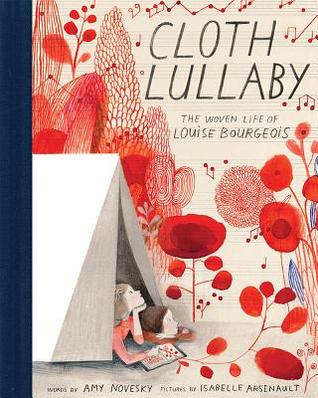
Louise grew up alongside a river that wove through her life. Her mother restored tapestries and from age 12, Louise helped too by drawing in the missing bottom edges of tapestries. At her mother’s side, Louise learned about weaving and patterns. Louise eventually went to school in Paris and studied mathematics and cosmography at university. While at college, her mother died and Louise turned to art to express her feelings. She created enormous spiders out of metal and stone, naming them “Maman.” She took the fabrics of her life and cut them apart, working to put them back together in new ways. It was a tribute to her mother and her childhood expressed in art.

Novesky’s picture book biography keeps the magic of Bourgeois’ childhood intact. The book ends with an image of the artist and one of her spiders as well as a quote that speaks to her never having lost touch with the magic of her childhood. That quality weaves throughout the book where both the river and the restoration work create moments of inspiration and amazement. There is such beauty in the quiet work of restoration as well as the knitting activities of spiders. Readers will immediately understand the connection of wool and web in her art.

Arsenault’s illustrations are alight with that same magic and inspiration. In one image of Louise’s mother, there is a certain spider-ness there, subtle but also clear as she works with her black wool. All of the illustrations in the book celebrate pattern and weaving. There is a limited palette of reds, blues and grays that evoke the richness of tapestries and the excitement of art.

A top pick for picture book biographies, this book pays homage to a female artist that many may not know. Appropriate for ages 5-8.

Reviewed from library copy.