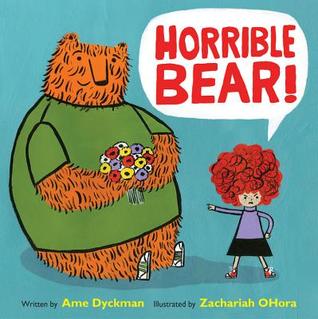
Horrible Bear! by Ame Dyckman

Horrible Bear by Ame Dyckman

Horrible Bear! by Ame Dyckman, illustrated by Zachariah OHora (InfoSoup)

A little girl is flying a kite when her string breaks and the kite lands in a cave. When she heads into the cave to get her kite, there is a big bear in there who rolls over in his sleep and breaks her kite. The little girl gets very angry and yells at the bear, “Horrible Bear!” She stomps away to her home. Bear was very upset too. After all, he isn’t a horrible bear at all. But then he had a horrible idea of his own. He practiced barging in, making lots of noise and waking someone out and then headed down to her house. Meanwhile though, the girl was figuring out exactly how rude she had been. Now an apologetic little girl is all set for a run in with a bear ready to be horrible!

Dyckman has created a book that simply must be shared aloud. From the refrain of “Horrible Bear!” as the girl storms off to the roaring bear as he is being horrible, the entire book is filled with ways for children to participate. This book is about the importance of apologizing for bad behavior and mistakes and the way that apologies can completely change a situation. I particularly enjoyed the clever interplay of a grumpy girl and a mellow bear that then switch roles. It also shows that each of us have different aspects to our personality and that we can decide to change our moods.

OHora’s illustrations are wonderfully large and bold, adding to the appeal of the book for group sharing. With a dynamic mix of panels and other images that span both pages, the book makes turning pages fun and interesting. The orange bear pops on the page as does the red-headed little girl. The two convey their emotions clearly which makes it easy for children to understand as their moods change.

A wonderful picture book that is just right for sharing aloud with a group. Expect lots of chants of Horrible Bear from preschool audiences. Appropriate for ages 3-5.

Reviewed from library copy.


Waiting for High Tide by Nikki McClure

Waiting for High Tide by Nikki McClure

Waiting for High Tide by Nikki McClure (InfoSoup)

On a summer day, a boy waits for high tide. He’d love to swim but he’d just get muddy or even stuck. The other animals on the seashore are waiting for high tide too, six long hours. But today is a special day, the boy and his family are going to build a raft. They found a big log and have cut it into three sections. The boy plays on the shore, finding treasures along the way including a pair of pink glasses with one eye covered in barnacles. They work hard on the raft as the water comes in closer and closer. When they stop for lunch, the boy sees birds eating too. The raft is finally ready but there is still time before high tide, so they eat cookies and wait. Finally the raft floats and there is time for jumping, swimming and enjoying the perfect summer day.

McClure proves here that she is as much a writer and poet as an artist. She writes with a depth that is lovely to see in a picture book, offering real insight into the natural world. She also writes with a childlike eye and attitude, drawing parallels between the human world and the natural one. There is an engaging mix of fonts in the text, some of the text large and capitalized in a way that conveys excitement and time passing. The passage of time is such a focus here as the tide slowly comes in. It is a book that celebrates slower times, lingering before enjoying the reward of your hard work.

As always McClure’s art is exceptional. Her cut paperwork is filled with details. The scene of the boy in the barnacle glasses as he explores the shoreline is filled with such tiny details that one can look for some time before you see the chipmunk peeking over the log or the five dollar bill. This is a book for spending some slow time of your own on.

Based on McClure’s own family, this picture book is a quiet look at nature and spending time outside. Appropriate for ages 6-8.

Reviewed from copy received from Abrams.

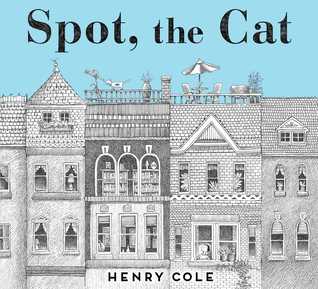
Spot, the Cat by Henry Cole

Spot the Cat by Henry Cole

Spot, the Cat by Henry Cole (InfoSoup)

In this wordless picture book, a cat named Spot heads out of an open window and into adventures in the city. The book is done in black and white illustrations with lots of fine details, perfect settings for a small spotted cat to get lost. It is up to the reader to find Spot on each page, something that can be challenging on some pages, even for adults. Spot visits areas throughout the city from a farmer’s market to a park filled with kites in the air. While he is adventuring though, his owner is looking for him, putting up lost cat posters around the neighborhood and missing him each time.

It is the art here that makes the book so enchanting. The details are so well done that as a reader I kept getting lost in what others on the page were doing. The world the cat and the boy explore on the page makes sense. It is all cohesive, filled with people going about their days in ways that read as natural and real. In other words, it’s a joy to read and explore the pages whether you are able to spot Spot or not.

A great seek-and-find book but also a great wordless picture book with a story too. Appropriate for ages 3-5.

Reviewed from copy received from Simon and Schuster.

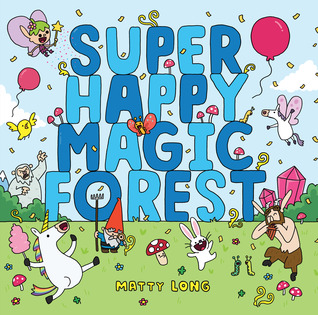
Super Happy Magic Forest by Matty Long

Super Happy Magic Forest by Matty Long

Super Happy Magic Forest by Matty Long (InfoSoup)

Everyone in the Super Happy Magic Forest loves picnics, fun and dancing. But that all changes when the Mystical Crystals of Life were stolen. Old Oak blames the goblins for stealing the crystals and sends a team of heroes to adventure to Goblin Tower to bring the crystals back. Five heroes set out and travel through one region to the next. They encounter frightening creatures like penguins. They must brave the dark dangers of the Super Creepy Haunted Forest. They survive dungeons and even bees. But is their quest doomed even though they are brave? It’s up to these five heroes to unravel who really stole the crystals.

This picture book is surprising and completely awesome. Opening it, I did not expect to find the rather sarcastic tone that makes this book work so very well. The main text of the book sets the larger scenes for the book but the real action takes place in the speech bubbles and the illustrations. The scenes are drawn large almost as maps and the various characters are scattered throughout, each having their own encounters along the way. It’s almost like a video game map, each scene a new level to explore.

Throughout the book, humor plays a large role. The book has more of a feel of a graphic novel or comic though it only has a few panels at times, usually it is one large image. Frightening tree stumps refer to guidebooks for their evil phrases. Walruses argue about sending out more penguins to the fray. Readers have to scan the page for the elusive dungeon key. It’s all busy, frenzied perfection.

Sure to appeal to video-game-playing children, this picture book will work best with slightly older children who will also enjoy the humor the most. Appropriate for ages 6-9.

Reviewed from copy received from Scholastic.

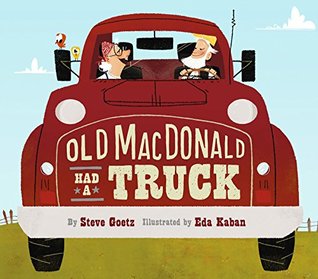
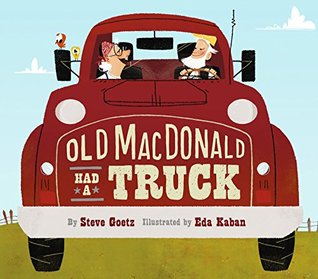
Old MacDonald Had a Truck by Steve Goetz

Old MacDonald Had a Truck by Steve Goetz

Old MacDonald Had a Truck by Steve Goetz, illustrated by Eda Kaban (InfoSoup)

This clever update to the beloved folk song has a focus on large machinery. The book follows the structure of the original song, filled with E-I-E-I-O’s and then inserts a different type of truck or machine in each verse. The Excavator arrives first with a “DIG DIG here and a DIG DIG there.” The front loader scoops, the bulldozer pushes, the motor grader scrapes, the dump truck does a satisfying “dump thump.” Throughout the book, it is clear that they are building something with all of these machines and all is revealed when Old MacDonald and his wife appear in their truck at the end.

This book is very engagingly designed with page turns right before the reveal of the next machine in the book: “And on that farm he had a…” There is a certain delight not only in the surprise of the equipment being shown but also in the noise that that machinery is going to make in the song.

Kaban’s jaunty and modern illustrations are great to see in a farm picture book. The animals on the farm are just as involved as the humans in doing the work, changing into hard hats and racing uniforms as appropriate for each scene. There is near mayhem on most pages, adding a zing of energy to each verse.

Smart, funny and engaging, this is just right for youngsters who enjoy big machines along with a little song. Appropriate for ages 2-4.

Reviewed from copy received from Chronicle Books.


Alan’s Big Scary Teeth by Jarvis

Alans Big Scary Teeth by Jarvis

Alan’s Big Scary Teeth by Jarvis (InfoSoup)

Alan is known for the way that he is able to scare the other animals with his big scary teeth. He spends time each day caring for his teeth and practicing his scary faces in the mirror. Then he heads into the jungle, snapping, growling and declaring how scary his teeth are. The other animals are terrified. Then Alan goes home, relaxes and takes out his false teeth. One day, Barry the beaver discovers Alan’s teeth in their hiding place. He takes them away and leaves Alan without his teeth. Alan tries to scare the other animals, but they just laugh at his toothless threats. Alan was terribly sad, though the other animals were relieved not to be scared anymore. Maybe Alan can learn some skills beyond scaring others?

Jarvis writes in a very engaging way that is perfect for sharing aloud. The entire book gallops along at a fast pace with plenty of action and humor. The reveal of Alan having false teeth is nicely timed, so that the listening audience will be just as surprised as the animals are. The playful tone of the book is helped by the humor throughout with surprises adding to the fun.

Jarvis’ illustrations are childlike and bold. The backgrounds on the illustrations show jungle lushness without being overwhelming or dark. The illustrations have just as much charm as the story itself, creating funny moments and showing products like “Snap Snap Toothpaste.” The entire book works as a seamless package with the illustrations skillfully supporting the story.

This picture book is sure to get toothy grins from any audience you share it with. Appropriate for ages 3-5.

Reviewed from library copy.


Little One by Jo Weaver

Little One by Jo Weaver

Little One by Jo Weaver (InfoSoup)

As Big Bear leaves her den in the spring, she has a tiny baby cub along with her. The two explore their world together as the baby bear learns to survive in the landscape. They swim together, eat berries, catch fish and play. The baby bear grows and thrives alongside Big Bear. The seasons keep changing from spring to summer to the blustery weather of autumn and the geese flying overhead. Big Bear leads her Little One back to their den, but not before they take a long last look at their world, sitting on a high hill and seeing the water, the forest and their domain below.

The text of this picture book is gentle and lovely. The tone is pure warmth and care, a mother bear who is not going to leave her little one’s side and one who is dedicated to the safety and growth of her little cub. The text celebrates the connection between the two bears and then their connection to the natural world around them. It’s a touching look at a family and then at their world too.

The illustrations are simply stunning. Done in charcoal, they are filled with light, with flowers that seem to bob on the page. Often there are sprigs of leaves and grass done in white in the foreground, caught in a sunbeam coming from off the page. This luminous effect is particularly effective and breathtaking.

A simple and gorgeous book about mothers and children and the incredible beauty of nature. Appropriate for ages 2-4.

Reviewed from library copy.

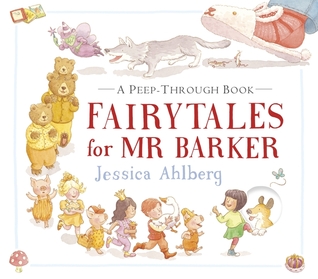
Fairy Tales for Mr. Barker by Jessica Ahlberg

Fairy Tales for Mr Barker by Jessica Ahlberg

Fairy Tales for Mr. Barker by Jessica Ahlberg (InfoSoup)

When Lucy tries to share a story with her dog, Mr. Barker, he follows a butterfly right out the window. As Lucy follows him through the window, they end up in the house of the Three Bears with Goldilocks eating porridge at the table. Then the three bears come home and it’s time for the two girls to follow the dog into the next story. They head right into the Three Little Pigs where a wolf is on his way to the house. One-by-one Lucy has different protagonists join her from several fairy tales and they get chased by all sorts of characters as well. Just as they are almost caught though, they return to Lucy’s room where she tucks them all in bed with a story.

Ahlberg has a great touch for the dramatic in this picture book. She cleverly offers just enough information for the reader to recognize the story that Lucy and Mr. Barker have entered. Then she gives the reveal on the next page, so parents and adult readers will know that children should be given a chance to guess the story. In that way, it is also an invitation to read stories that small children may not know yet, like Jack and the Beanstalk.

Ahlberg uses cutouts in this picture book, having each switch to a new story as a cut out through which the characters climb. There are windows, doorways and then even holes in cheese that make great escape routes to another tale. The illustrations have Ahlberg’s signature softness and fine lines where watercolors have an appealing mix of bright colors and gentleness.

A winning mix of cut outs to jump through, fairy tales to explore and a guessing game too, this picture book is a great choice for children who love fairy tales. Appropriate for ages 3-5.

Reviewed from library copy.


Tree by Britta Teckentrup

Tree by Britta Teckentrup

Tree by Britta Teckentrup (InfoSoup)

The seasons pass as an owl looks out of a hole in a tree in this engaging picture book. Beginning in winter, owl is alone in the cold landscape. When spring comes, the snow melts and buds form on the tree. Baby bears play and climb the tree’s trunk. Leaves and blossoms form and squirrels, birds and fox cubs arrive. With summer, the apples start to form on the tree and the tree spends long warm nights swaying in the breeze. Autumn comes with colder temperatures and the animals start to leave. Apples fall to the ground and the tree’s leaves turn red and fold. Snow comes and winter arrives. Soon everyone is gone, even the owl. But he is peeking out again soon as spring comes once again.

Teckentrup uses simple rhymes to tell the story of one large tree and the ways that it supports the ecosystem around it. The seasons are clearly noted in the rhymes, the changes explained and each one is celebrated for how unique it is. The various animals too change what they are doing as the weather shifts. This is a dynamic book about weather and seasons.

It is the illustrations that make this book so noteworthy. Teckentrup’s cut out designs allow each page turn to show the owl for most of the book but also to add the other animals as they appear in the story. Then as the story reverses and the animals leave, the cut outs play out that way too.

A clever and striking look at one tree, one ecosystem and many seasons. Appropriate for ages 2-4.

Reviewed from copy received from Random House.