When Spring Comes by Kevin Henkes

When Spring Comes by Kevin Henkes

When Spring Comes by Kevin Henkes, illustrated by Laura Dronzek (InfoSoup)

So I admit that I waited for spring to actually come to Wisconsin before I reviewed this and that means that even now I am being optimistic that it has finally arrived even though it was in the 30s here overnight. But even if you are almost headed into summer, this is a great book to share in early, mid and late spring. Written at a level just right for toddlers, this book shares the transformation that spring bring us. Bare trees become covered in blossoms and leaves. Snowmen disappear. Puddles appear. Grass turns from brown to green (with flowers). Gardens grow and soon there is green everywhere, breezes, robins and worms.

Henkes’ writing is made to share aloud with small children. His verse doesn’t rhyme but it has a great natural rhythm to it that makes the book almost sing. The joy here is in the exploration of the changing season, one that brings a certain beauty with it, a freshness. Henkes captures the turning of the season, the aspects of early spring all the way through to almost-summer and he does it in a way that shows small children what they can see and experience themselves.

Dronzek’s illustrations are big and bright and simple. She moves from the lighter colors of early spring through to the bold robustness of near summer. The images change too, moving from small images surrounded by white to double-page spreads that run right to the edge of the pages and seem to spill over with the bounty of late spring.

A gorgeous book for the smallest of children, this is a triumphant toddler look at spring. Appropriate for ages 1-3.

Reviewed from copy received from HarperCollins Publishers.
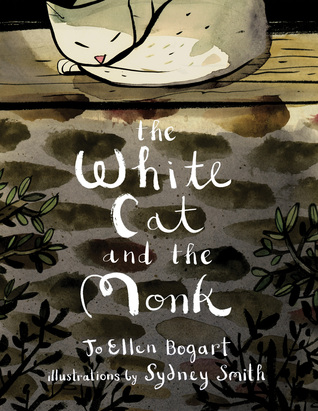
 

The White Cat and the Monk by Jo Ellen Bogart

Groundwood Logos Spine

The White Cat and the Monk by Jo Ellen Bogart, illustrated by Sydney Smith (InfoSoup)

A white cat named Pangur and a monk live together. At night, by candlelight the two work side by side. The monk quietly studies his books. The cat hunts mice along the walls, examining a mouse hole. The two do not disturb one another. At the end of the night, as day comes, they have both found what they were seeking. One searching for the joy of an answer to a puzzle and the other for the satisfaction of a successful hunt.

This picture book is a retelling of a classic Old Irish poem “Pangur Bán.” It is a tale that is contemplative and quiet. It offers space to simply be, a world of solitude and study, and also one that is filled with richness of the most simple forms. Bogart captures the power of a man’s simple monastic life accompanied by an animal companion. In particular, it is the interplay of their evening activities that demonstrate the impact of the natural world on even the quietest of evenings.

Smith’s illustrations evoke a period of time that is filled with illuminated texts, thick stone monastery walls and the light of several candles. They are done with rich blacks and subtle colors, the light playing across the page as the cat seeks dark corners.

A beautiful look at the power of contemplation, mindfulness and cats. Appropriate for ages 5-7.

Reviewed from library copy.

I Am Pan! by Mordicai Gerstein

I Am Pan by Mordicai Gerstein

I Am Pan! by Mordicai Gerstein (InfoSoup)

From the minute he is born, Pan is filled with mischief. Born with his goat horns and hoofed feet, he is immediately silly and even gets the grumpy Zeus to smile. As Pan grows, he becomes bored with life on Olympus and gets into so much trouble that the Gods ask him to return to Arcadia where he was born. While there, he invents panic, falls in love with the moon, and helps battle the monster Typhon. He also falls in love and marries Echo and discovers his love of music and the pan pipes. Story after story shows the power of merriment, music and mischievousness.

Gerstein embraces the spirit of Pan on the page by telling the tales with a zany spirit and a wild feel. There is not attempt to contain Pan here, just a feeling of being along on a very rambunctious ride. This suits the subject beautifully, giving space to the large personality of Pan. The graphic novel format also works very nicely with retelling Greek myths, keeping them brief and showing rather than telling a lot of the action.

The illustrations of this picture book/graphic novel are done in loud colors with lots of action and movement. Pan almost flies off the page in some sections, particularly when creating panic personally. The illustrations match the subject, offering a loud and cheery look at this wild God.

I am hoping this is not the only Greek God book that Gerstein does, since this book works so well and offers a very approachable and funny look at Pan. Appropriate for ages 6-9.

Reviewed from copy received from Roaring Brook Press.


Bloom by Doreen Cronin

Bloom by Doreen Cronin

Bloom by Doreen Cronin and David Small (InfoSoup)

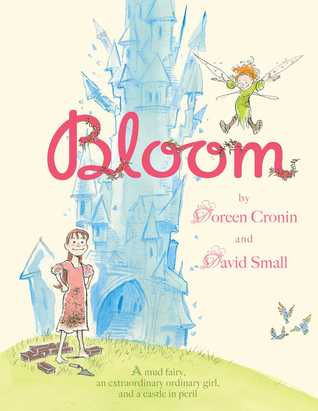
Bloom was a fairy who dealt in dirt and plants. She could spin sand into glass and turn small amounts of water into rivers. She lived in a glass kingdom and as the years passed, the kingdom’s inhabitants only saw the mess that Bloom left behind with her mud and not the way that she helped. Bloom finally left and went to live in the forest. More years passed and the glass kingdom started to fall into disrepair. The king remembered the powerful fairy and went to seek her help, because such a creature could only be asked by a monarch. But when Bloom offered the king to save his kingdom with mud, the king stormed off. The queen tried too with similar effect. Finally, they decided that they must send someone ordinary to ask Bloom for help and so Genevieve was selected. It will take a girl working with a fairy to save the kingdom, but even more it will take getting dirty along the way.

Cronin has created a story that is surprising and delightful. This is a fairy tale where girls save the day rather than being rescued by princes. It reads like a traditional fairy tale but with a feminist viewpoint that is not overplayed at all. There is also a beautiful attitude about getting your hands dirty and the fact that hard work is the way to solve problems along with working together.

Small’s illustrations are playful with delicate lines that swoop on the page. They are alive with action, particularly when Bloom is on the page. Small captures the delight of mud and getting dirty, the connection of the two girls, and the efforts that it takes to rebuild a kingdom even with magic. I must also mention the text design, which makes the book a joy to read aloud, creating real feeling around words like MUD and DIRT.

A feminist and intelligent fairy tale just right for modern children. Appropriate for ages 4-6.

Reviewed from copy received from Atheneum.


A Hungry Lion by Lucy Ruth Cummins

A Hungry Lion by Lucy Ruth Cummins

A Hungry Lion, or A Dwindling Assortment of Animals by Lucy Ruth Cummins (InfoSoup)

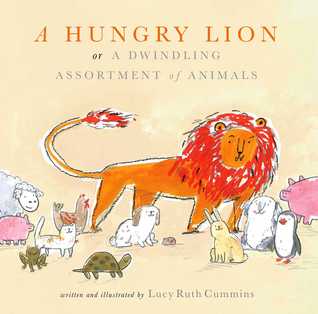
There was once a hungry lion in a room in a large number of small animals like a penguin, a pig, a could of bunnies, a mouse, a frog, a bat and many more, including a turtle. But as you turn the pages, more and more animals no longer appear on the page. Soon there is only the pig, a bunny and the turtle. Then only the turtle. Then just the lion and then after looking right at the reader, the lion leaves too and everything goes dark. What do you think happens next?!

Reminiscent of Jon Klassen’s classic I Want My Hat Back, this picture book has a delightful darkness about it. Even better, it toys with that darkness, allowing readers to think all is well right before plunging them right back into it again. It’s rather like a picture book roller coaster ride that will have readers demanding to ride again immediately. Cummins paces the book cleverly, filling it with a sense of impending doom.

The art adds to the emotional twists and turns. Readers can watch the lion’s face for clues, since at times he is far too innocent to actually not have done something wrong. Other times, he appears completely villainous with arched brows and big teeth. Yet all along, things may not be as they seem adding to the delicious tickles of dread.

Dark and delightful, this picture book is one wild ride worth sharing. Appropriate for ages 4-6.

Reviewed from copy received from Atheneum Books for Young Readers.


Their Great Gift by John Coy

Their Great Gift by John Coy

Their Great Gift: Courage, Sacrifice and Hope in a New Land by John Coy, photographs by Wing Young Huie

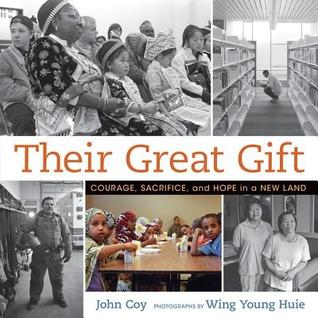
This picture book is filled with gorgeous photographs of diverse people who live in the United States. The book speaks about the way that families came to our country. It talks of the dreams that they had and how difficult it was to make the journey and learn a different language. It is about the hard work that it takes to be an immigrant, the mistakes that are made, the way money is sent back home. At it’s heart this is a book about determination, grit and resilience, qualities that make our country great and that exemplify the immigrants who add so much.

Coy’s words are simple and yet very powerful. He states each fact in a way that makes it easy to understand but also in a tone that rings with truth. His focus is on humanizing immigrants, showing that they are just like all of us who may have been born here, no matter how they worship, dress or what language they speak. Don’t miss the final pages of the book where the author and the illustrator speak to the ways both their families arrived here.

The photographs in this book are what make it so lovely. Done in a mix of black and white and color, the photographs capture people of various backgrounds and cultures. There are children, adults and the elderly and each page opens to reveal faces that form a tapestry of diversity on the page.

A very timely and important picture book, this book will open discussions for elementary-aged children about the larger topic of immigration in a way they can understand. Appropriate for ages 5-7.

Reviewed from library copy.


Elliot by Julie Pearson

Elliot by Julie Pearson

Elliot by Julie Pearson, illustrated by Manon Gauthier (InfoSoup)

Elliot was a little boy whose parents loved him very much. But there was a problem, when Elliot cried his parents did not understand why and when he yelled they did not know what to do. So one day a social worked named Thomas came and Elliot was taken to a new family with a new mother and father. It was different there and Elliot’s new family understood when he was hungry, when he was upset and when he needed attention. Elliot still got to see his parents sometimes too and they had a lot of fun together. His parents did try to care for him once again, but they still did not understand what he needed so he got moved to another family who could respond to his needs. Finally, Elliot came to a family where they wanted him to stay forever. They understood his needs even more deeply than any other family had and said things like “I love you forever, forever.”

This book is so very important. It is a book about the foster care system and one that is so intensely honest that it can be hard to read at times. Pearson manages to not make Elliot’s parents bad at all, keeping their neglect of Elliot vague enough to fit the experiences of many children. That also keeps the book appropriate for the youngest listeners. At the same time, Pearson shows the way children are moved from home to home, the way that they can go back to their parents, and the ability to finally find a permanent home where they are loved and cared for. The moment where parents finally use the word “love” with Elliot is so powerful because readers until that moment will not have realized that he had not been told it before. It’s a moment of realization that stings the heart.

Gauthier’s illustrations are done in cut paper collage. The colors are muted and quiet, creams and tans with lines on them. The background colors change slightly with the various families that Elliot lives with, but they are always muted. I appreciated this subtlety in the colors that supports the quiet and undramatic feel of the entire book.

Honest and vital, this picture book fills a huge gap in children’s books with its depiction of the foster system for small children. Appropriate for ages 3-5.

Reviewed from copy received from Pajama Press and Myrick Marketing & Media.


Horrible Bear! by Ame Dyckman

Horrible Bear by Ame Dyckman

Horrible Bear! by Ame Dyckman, illustrated by Zachariah OHora (InfoSoup)

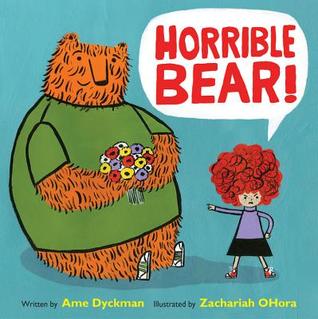
A little girl is flying a kite when her string breaks and the kite lands in a cave. When she heads into the cave to get her kite, there is a big bear in there who rolls over in his sleep and breaks her kite. The little girl gets very angry and yells at the bear, “Horrible Bear!” She stomps away to her home. Bear was very upset too. After all, he isn’t a horrible bear at all. But then he had a horrible idea of his own. He practiced barging in, making lots of noise and waking someone out and then headed down to her house. Meanwhile though, the girl was figuring out exactly how rude she had been. Now an apologetic little girl is all set for a run in with a bear ready to be horrible!

Dyckman has created a book that simply must be shared aloud. From the refrain of “Horrible Bear!” as the girl storms off to the roaring bear as he is being horrible, the entire book is filled with ways for children to participate. This book is about the importance of apologizing for bad behavior and mistakes and the way that apologies can completely change a situation. I particularly enjoyed the clever interplay of a grumpy girl and a mellow bear that then switch roles. It also shows that each of us have different aspects to our personality and that we can decide to change our moods.

OHora’s illustrations are wonderfully large and bold, adding to the appeal of the book for group sharing. With a dynamic mix of panels and other images that span both pages, the book makes turning pages fun and interesting. The orange bear pops on the page as does the red-headed little girl. The two convey their emotions clearly which makes it easy for children to understand as their moods change.

A wonderful picture book that is just right for sharing aloud with a group. Expect lots of chants of Horrible Bear from preschool audiences. Appropriate for ages 3-5.

Reviewed from library copy.


Waiting for High Tide by Nikki McClure

Waiting for High Tide by Nikki McClure

Waiting for High Tide by Nikki McClure (InfoSoup)

On a summer day, a boy waits for high tide. He’d love to swim but he’d just get muddy or even stuck. The other animals on the seashore are waiting for high tide too, six long hours. But today is a special day, the boy and his family are going to build a raft. They found a big log and have cut it into three sections. The boy plays on the shore, finding treasures along the way including a pair of pink glasses with one eye covered in barnacles. They work hard on the raft as the water comes in closer and closer. When they stop for lunch, the boy sees birds eating too. The raft is finally ready but there is still time before high tide, so they eat cookies and wait. Finally the raft floats and there is time for jumping, swimming and enjoying the perfect summer day.

McClure proves here that she is as much a writer and poet as an artist. She writes with a depth that is lovely to see in a picture book, offering real insight into the natural world. She also writes with a childlike eye and attitude, drawing parallels between the human world and the natural one. There is an engaging mix of fonts in the text, some of the text large and capitalized in a way that conveys excitement and time passing. The passage of time is such a focus here as the tide slowly comes in. It is a book that celebrates slower times, lingering before enjoying the reward of your hard work.

As always McClure’s art is exceptional. Her cut paperwork is filled with details. The scene of the boy in the barnacle glasses as he explores the shoreline is filled with such tiny details that one can look for some time before you see the chipmunk peeking over the log or the five dollar bill. This is a book for spending some slow time of your own on.

Based on McClure’s own family, this picture book is a quiet look at nature and spending time outside. Appropriate for ages 6-8.

Reviewed from copy received from Abrams.