Review: Goodnight, Grizzle Grump! by Aaron Blecha

Goodnight Grizzle Grump by Aaron Blecha

Goodnight, Grizzle Grump! by Aaron Blecha

Grizzle Grump is a huge bear who is ready to hibernate for the winter, but he has to find the right quiet place to do that. He’s so big that even his yawns can blow the other animals around. He tries to sleep in the trees first, going through an elaborate ritual of scratches, wiggles and flopping. Then he is asleep and snoring until the noises of the woodpeckers wake him up. He heads off to find another spot. But when he sleeps near the stream, the beavers are too loud. The gloomy swamp seems like a good choice until the frogs start to croak. He finally finds a snowy cave, far from everyone else. Then it is his turn to make huge snoring noises that drive everyone else away.

Blecha has created a great book to share aloud with a group. The humor is flawlessly presented in a way that makes it effortless to share. The ritual that Grizzle Grump goes through each time will have children giggling and is also something that you can get the audience to participate in. Inventive story time librarians will have children help make the noises of the woods and swamp with hands and feet.

The illustrations add to the humor from the bucktoothed squirrel who watches it all to the frenzied reaction of the bear every time he is woken once again. The wild energy of the story line is reflected in the illustrations with the noises themselves part of the art. Even the proportions of the huge bear and his little blanket and pillow add to the humor.

A glorious read aloud for autumn months or any bedtime, this picture book is a silly and cheery delight. Appropriate for ages 3-5.

Reviewed from copy received from HarperCollins.

Review: The Turnip by Jan Brett

The Turnip by Jan Brett

The Turnip by Jan Brett (InfoSoup)

Badger girl was weeding the garden when she noticed something odd. It was a huge turnip! She tried to pull it out, but it would not budge. Soon their whole family of badgers were trying to pull the turnip out with no success. Hedgie tried to use his prickles to get it out, Mr. Ram tried using his horns, and Vanya the horse hitched up and pulled too. Nothing worked. Then Rooster strutted up and insisted that he try all by himself. Meanwhile, down in the cave below a family of bears had also discovered the turnip and pushed hard to get it out of their bedroom. The turnip sailed into the air with a triumphant Rooster flying along too. Then it was turnip pancakes for everyone!

Brett excels at retelling folktales, enlivening them with her animal characters. This is a traditional cumulative tale that sticks very close to the original. The family of bears living under the turnip is a great addition that allows strutting Rooster to claim victory over the stubborn turnip. The pacing of the tale works well, each new attempt has a longer and longer line of animals trying to help and also dreaming of what delicious things could be made out of the turnip.

As always, Brett’s illustrations are filled with fine details. She again uses her framing on each double-page spread, showing the next animal to arrive before they come in. Readers will notice the bear family on these panels too, a subtle introduction prior to them taking center stage. The illustrations show that this is Russia where the badgers and bears live. They wear traditional Russian clothing and the frames on the illustrations show a similar influence.

Another winner from Brett, this picture book will make a crowd pleaser of a read aloud, but with Brett’s detailed illustrations it’s also a winner of a lap read. Appropriate for ages 2-4.

Reviewed from copy received from G. P. Putnam’s Sons Books for Young Readers.

Review: How to Share with a Bear by Eric Pinder

How to Share with a Bear by Eric Pinder

How to Share with a Bear by Eric Pinder, illustrated by Stephanie Graegin

Thomas made a pillow cave on a cold day. But when he went to get a flashlight to read by, he noticed that something big had taken over the cave. Something with two brown eyes looked back at him when he looked inside. It was a bear! To get the bear out of his cave, Thomas laid a trail of blueberries down the stairs and sure enough, the bear followed eating them up. Thomas ran to get books to read in his cave, but he was too late and the bear had already returned. He tricked the bear with a back-scratching stick and then got inside the cave, but stray bear fuzz had him sneezing and running for a tissue. In the meantime, the bear returned. Thomas tricked the bear again and again into leaving the cave, but when the bear returned finally and Thomas was already in the cave, something happened. The bear started to cry, revealing himself to be Thomas’ younger brother. There was only one thing to do!

Pinder has created a book sparkling with creativity. His young protagonist who is battling the invasive brother bear comes up with clever ways again and again to trick the bear into leaving the cave. Pinder keeps each of the tricks appropriate for both a bear and a little boy, keeping the audience entirely fooled until his reveal. I was completely convinced of this being a little bear and expected the book to end with a teddy bear of some kind. It was a delight to discover a different twist that speaks to how to be a good older sibling.

The illustrations from Graegin are key to keeping the audience convinced of the bear being real. She subtle makes sure that the face is not shown until that moment of reveal. The book glows with a yellow warmth that invites curling up under a blanket or in your own pillow cave to read it.

A great pick for bear story times, this picture book shows how hard sharing can be. Appropriate for ages 3-5.

Reviewed from copy received from Farrar, Straus & Giroux.

Review: North Woods Girl by Aimee Bissonette

North Woods Girl by Aimee Bissonette

North Woods Girl by Aimee Bissonette, illustrated by Claudia McGehee (InfoSoup)

A girl tells about her grandmother who is not like other grandmas. She dresses in Grandpa’s old flannel shirts and she’s bony. She doesn’t bake cookies or pies, but she does take long walks out in nature. With her trusty walking stick, the two of them explore the little paths near Grandma’s house. Every season there are new things to see, things in the garden to do. The two love winter best of all, especially winter nights with a full moon when they explore the snowy woods. Grandma may not be like other grandma’s but she’s pretty special and a north woods girl to the quick.

Bissonette captures the spirit of a north woods woman beautifully in her picture book. From the no-fuss long grey braid, the flannel shirts, the stout boots to the way that nature speaks to her and that she knows it so well. This book is a celebration of the north woods too, the ways that the woods changes in different seasons, the animals that fill it, and the glory of a winter woods.

McGehee’s scratchboard illustrations have a rustic beauty. The colors are deep and lovely, and they capture the spirit of the woods. In fact, there are moments when you can almost smell the pines and the grass. There is a subtle multiculturalism here too with the little girl’s darker skin tone and curly hair. The pages are crowded with details of the woods, filled with animals and insects.

A lovely look at the northern woods, this picture book celebrates unique grandmothers living in a unique place. Appropriate for ages 3-5.

Reviewed from copy received from Minnesota Historical Society Press.

Review: Two White Rabbits by Jairo Buitrago

Two White Rabbits by Jairo Buitrago

Two White Rabbits by Jairo Buitrago, illustrated by Rafael Yockteng, translated by Elisa Amado (InfoSoup)

A little girl and her father travel together. As they go, the little girl counts different things like chickens and the people who live by the train tracks. They are accompanied by a coyote, shown as an animal here but clearly meant to represent the person they pay to get them to safety eventually. The two board a train, riding on the roof where the little girl counts clouds and falls asleep when it gets dark. They and their coyote avoid soldiers, wait on the side of a highway, and even make new friends along the way. Her new friend gives her two white rabbits to take with them, rabbits that they eventually release into the wild near a border wall.

Filled with a powerful blend of the naive understanding of the young child and the harshness of trying to escape to a new country with a coyote, this picture book captures the risk and harrowing nature of that journey. The book ends with a statement by the President of IBBY Foundation about the millions of people who make journeys like this every year, including the hundreds of thousands of children from Central America traveling north. The author uses symbolism in a powerful way, showing the coyote as an animal and also the two white rabbits who are clearly both a present and the father and daughter themselves. The ending is ambiguous and will invite discussion about what happens to the rabbits and to the people.

The art by Yockteng is filled with delicate lines. He takes what could have been thoroughly grim moments and enlivens them with the eyes of the child. So the crossing of a muddy river becomes an adventure, the ride aboard the train is time to spend close together, and the wait by a highway is a chance to bond with another child. At the same time, readers will also see the truth, the danger and the exhaustion of the journey. It is a delicate balance that is beautifully achieved.

A book to inspire discussion, this picture book speaks the truth about desperate families looking for a better life and the risks they will take to reach it. Appropriate for ages 7-9.

Reviewed from library copy.

Review: Job Wanted by Teresa Bateman

Job Wanted by Teresa Bateman

Job Wanted by Teresa Bateman, illustrated by Chris Sheban

When an old farm dog walks up to a farm looking for work, the farmer refuses. He sees dogs as a waste of food since they don’t give anything back like chickens or cows do. The dog then offers to be a cow instead of a dog. He gets all of the cows into the barn and lined up ready for milking before the farmer gets there, but the farmer isn’t interested in this dog-cow. The next thing the dog tries is to be a horse. He couldn’t fit in the harness for the plow, but he could run ahead of the horse with treats to get the horse to plow faster. Still, the farmer was not interested in hiring the dog. The dog next tries to be a chicken and tidies up the chicken coop before settling down in a nest of hay himself. It’s there that he finally proves the value of a dog on a farm to the reluctant farmer.

Bateman nicely incorporates a rhythm and repetition into her story. The pattern of the conversation between the dog and the farmer carries through the entire book, creating a framework that functions very nicely. On each job, the dog manages to be useful in his own way, something that is a nice surprise in the book rather than him trying to give milk or eggs himself. One immediately roots for the success of this hard-working dog.

Sheban’s illustrations are done in watercolor, graphite, and colored pencil. The result is a picture book that glows with sunlight. There is a wonderful softness to the illustrations, gauzy light that plays across the farm and the characters.

A shining picture book about resilience and being yourself. Appropriate for ages 3-5.

Reviewed from copy received from Holiday House.

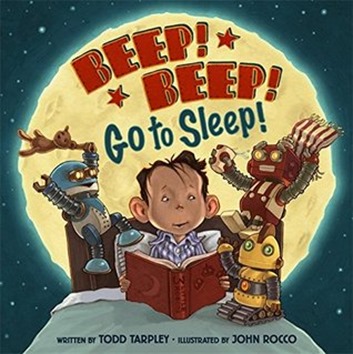
Review: Beep! Beep! Go to Sleep! by Todd Tarpley

Beep Beep Go to Sleep by Todd Tarpley

Beep! Beep! Go to Sleep! by Todd Tarpley, illustrated by John Rocco (InfoSoup)

A little boy helps his robots get ready for bed. First, they are herded into the bathroom where they brush their rotors and clean their shields. One robot even tries out the toilet. Then down the hall and into the bedroom they go, each one on a shelf with a blanket. It is quiet until Beep! Beep! The robots all want things like drinks. Then back to their beds and quiet again. It goes on and on, quiet and then beeping until finally the boy loses his temper. In the end though, one bedtime book is all it takes to get the boy off to sleep.

Tarpley has created a modern twist on the normal bedtime ritual. Here a boy takes the place of the parent, keeping his robots in line and moving towards bed. The complaints of the robots are lovely, each a riff on a classic bedtime request for more water, more light, and finally a story. The book is told in rhyme, one that is quiet at times and then other times filled with zing and snap. The most snap comes when the boy loses his temper.

Rocco’s illustrations are gorgeous. The three robots, each a primary color, all have distinct personalities and the ability to show some emotions on their metal faces. The boy is a throwback to an earlier age in his classic striped pajamas, evoking the fifties along with the classic robots. The entire house too has a vintage feeling to it, providing a clever backdrop to the very modern robot theme.

A perfect bedtime tale for robot fans, this picture book is sure to have even the sleepiest robot or child giggling. Appropriate for ages 3-5.

Reviewed from library copy.

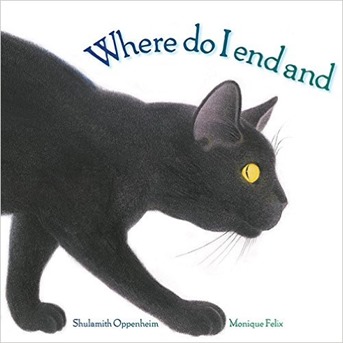
Review: Where Do I End and You Begin? by Shulamith Oppenheim

Where Do I End and You Begin by Shulamith Oppenheim

Where Do I End and You Begin? by Shulamith Oppenheim, illustrated by Monique Felix (InfoSoup)

This poetic book asks deep questions about the interconnectedness of life and nature. It begins with a cat asking where it ends and its tail begins. How about a shell and a snail? Or a branch and a tree? Perhaps the sky and the sea? Each pairing gets readers thinking about whether they can tell where one stops and the other begins. Some of them are arguably doable, like the sky and sea where a boundary is evident, others though are real questions whether emotional like a hug or physical like the snail and its shell. This is a book filled with unanswerable questions that will get readers thinking about the importance of all types of connections in our lives.

The poem at the heart of this picture book is particularly beautifully written. It uses items that are familiar to children and then guides them to think about them in a new and surprising way, examining the connections. While the poem could be read very literally at times, other pairings in the book make sure that the questions are larger than the objects themselves, lifting it up to include the interconnectedness of all of us on the planet. This grand book is sure to start interesting discussions in classrooms and families.

The illustrations by Felix are delicate and luminous. They shine on the white background, interconnect with one another and play together too. The cat is found on the next page, walking the stair within the snail’s shell. A boy and girl are present on many of the pages too, exploring the way that humans fit into the world as well.

A superb picture book that asks profound questions and then celebrates the world and our connections with it. Appropriate for ages 4-6.

Reviewed from library copy.

Review: Happy in Our Skin by Fran Manushkin

Happy in Our Skin by Fran Manushkin

Happy in Our Skin by Fran Manushkin, illustrated by Lauren Tobia (InfoSoup)

A picture book all about skin and how important it is to our bodies, this book also celebrates the different colors of skin we all come in. The book begins with the joy of baby skin in all of its sweet colors of cocoa, cinnamon, honey and ginger. It then talks about how skin forms a protective barrier for you, forming scabs when you hurt yourself and growing along with you. The way skin reacts to sun and to cold is also talked about and then the book talks again about how your skin is unique and so is everyone else’s too.

Written in rhyming couplets, this picture book has a jolly galloping feel to it with they rhymes propelling the text along. The book is a wonderful mix of scientific information about skin that is appropriate for very small children and praise for the beautiful variety of skin colors that you see. This is a wonderful book to start discussing diversity with very small children. The urban setting is a delight with people of differing abilities, Muslim families, and children and adults of all races. The book does focus on one family in particular where one of the parents could be any gender, making this book all the more welcoming.

The illustrations by Tobia go a long way to making this book inclusive and diverse. From henna on hands to families of mixed races, these illustrations are celebratory of the vast diversity we have. At the same time, there is a universal nature to all of them, with all of the families loving their children, adoring their infants, and spending the day outside together as a community.

A fresh and lovely look at diversity for the smallest of children, this book will serve as both a mirror and a window for all. Appropriate for ages 2-4.

Reviewed from library copy.