Review: Rufus the Writer by Elizabeth Bram

Rufus the Writer by Elizabeth Bram

Rufus the Writer by Elizabeth Bram, illustrated by Chuck Groenink (InfoSoup)

Released July 14, 2015.

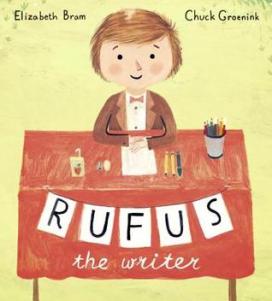
One summer Rufus decides not to have his regular lemonade stand. Instead he will do a story stand! So he gets all set up wtih plenty of paper, pencils, pens and markers. When Millie and her little brother Walter stop at the stand, Rufus agrees to write them a story in exchange for a special shell from the beach. The story is about Walter’s favorite color. Sandy stops by with a box of kittens and even though they are free, Rufus writes a story in exchange for the black kitten, a story about cats. Rufus is reminded that his little sister’s birthday is tomorrow and he knows that a story will be the best present. Sara stops by and asks for a story about buttons, so Rufus agrees in exchange for whatever Sara thinks it should be worth. All of his customers pick up their stories at the same time and sit right down to read and enjoy them.

This smart blend of lemonade stand and creativity makes for a book premise that is very engaging and fun. Particularly pleasant is the lack of focus on money as payment and instead allowing a warm and friendly bartering system in exchange for Rufus’ stories. The values make sense, paid in kittens, shells and flowers. Also great is the way that Rufus’ stories are each designed specifically for that reader, with their favorite color or via the subject matter. The stories are engaging and fun, just brief enough to give a flavor and not slow the main storyline down.

Groenink’s illustrations are done in gouache, acrylics and pencils with Adobe Photoshop. They are warm and bright, showing a friendly neighborhood with plenty of ethnic diversity in Rufus’ customers. They have a playful feel with the trees around Rufus’ stand done in a whimsical way and various woods animals peeking at what is going on. The illustrations in Rufus’ stories are drawn with fine details and show the coloring lines. They have the same quality and feel of the other pictures but also have a distinct style of their own.

A celebration of creativity and writing, this book may inspire children to find their own variations on lemonade stands or even try their hand at writing and illustrating their own stories. Appropriate for ages 4-6.

Reviewed from digital galley received from Schwartz & Wade and Edelweiss.
Review: Lillian’s Right to Vote by Jonah Winter

Lillians Right to Vote by Jonah Winter

Lillian’s Right to Vote by Jonah Winter, illustrated by Shane W. Evans (InfoSoup)

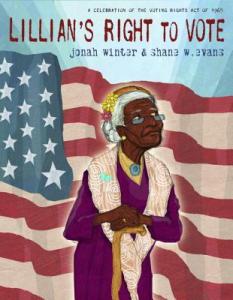
This picture book celebrates the 50th anniversary of the Voting Rights Act of 1965. Lillian is a 100-year-old African-American woman who has lived through all of the problems with African Americans voting in the United States. As she climbs the steep hill to her polling place, she remembers all of the steps that led from slavery to being able to openly vote today. She thinks about her great-grandfather who labored as a slave but also lived to see the Civil War come and allow him to vote for the first time.  She remembers her grandfather being charged a poll tax and her uncle being asked unanswerable questions before would be allowed to vote. She remembers running from an angry mob of neighbors who didn’t want women voting. She will never forget the cross burning in their yard. She remembers the people who fought for civil rights, who died for civil rights, who marched for everyone’s rights. She climbs that hill, slowly and steadily, until she reaches her polling place where she can vote without fear of being attacked or turned away.

Winter’s prose is musical and passionate. He draws us all close together and then speaks to us of history and voting and America. He tells us of shameful things that must not be forgotten, of heroes who fell and those who were able to keep marching. He tells us all of our duty in subtle ways that are stirring and moving; that we must vote each and every time, even when it is difficult or there is a steep hill to climb. Winter tells a personal story of voting history in the United States, giving us rich robust story telling rather than dry facts. It is a stirring and noteworthy tale.

Evans’ illustrations are superb. His fine lined illustrations show the determination of Lillian, the horrors of slavery, the dangers of voting, and the courage of many to make changes for the better. His pages swirl with color and texture, fill with sunlight, and dazzle with blue sky. The golden page of the cross burning is disturbing in its vividness, the wash of gold not allowing anywhere to hide.

A gorgeous story accompanied by equally lovely illustrations, this historical picture book is one that should be embraced by elementary teachers during any national election. Appropriate for ages 7-10.

Reviewed from digital galley received from Schwartz & Wade and Edelweiss.
Review: Trombone Shorty by Troy Andrews

Trombone Shorty by Troy Andrews

Trombone Shorty by Troy Andrews, illustrated by Bryan Collier

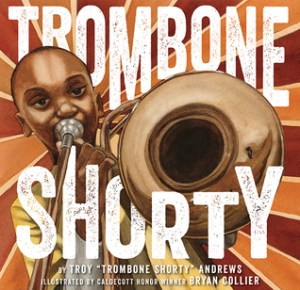
This autobiographical picture book is about a young boy growing up in the Tremé neighborhood in New Orleans where music was a simple part of everyday life and was always in the air. Tony particularly loved the music and energy of Mardi Gras where he could see brass bands play every day. Troy first played an imaginary instrument and then found a broken trombone that didn’t sound perfect but at least it was something he could play. Troy started to teach himself to play the trombone, an instrument that was almost as tall as he was, which is how he got the nickname of Trombone Shorty. He even slept with his horn in his hands. When Troy gains the attention of Bo Diddley for his playing in the crowd at his concert, Trombone Shorty knows it’s time to form his own band. And he still has his own band today!

Andrews is a Grammy-nominated trombone player and runs the Trombone Shorty Foundation committed to preserving the musical heritage of New Orleans. Andrews writes like a master on these pages which read like music is in the air between them too, just like the air in New Orleans. He shows children how an inspiration to play an instrument can become a lifelong calling. He also shows exactly how music empowers people in a place, gives them strength, creates a united culture, and unifies them. It’s a narrative about the power of music.

Collier’s illustrations are strong and dynamic. He creates motion on the page with his collage illustrations with patterns and textures that weave together. His paintings are a zingy mix of softly rendered closeups filled with detail and personality and then images of people farther away that are rougher but add even more energy to the art.

An inspiring picture book filled with music and vivaciousness, this autobiography celebrates New Orleans and the music in its veins and in one boy specifically. Appropriate for ages 7-10.

Reviewed from copy received from Abrams.

Review: Welcome Home, Bear by Il Sung Na

Welcome Home Bear by Il Sung Na

Welcome Home, Bear: A Book of Animal Habitats by Il Sung Na (InfoSoup)

Bear has been waking up to the same old forest and blue sky day after day, so he decides that he may need to find a new home. He sets off first to climb up a tree to see Bird’s home, but it was too high. Mole’s underground tunnels were stuffy and full of dirt. Goat’s cliff was too dizzying. Octopus’ underwater home was too deep. Polar Bear’s icy home was too cold. Camel’s desert was too hot on his paws. There were more that were too wet and too muddy. Bear was very sad. Where could he live that was just right for him?

Told in humorous and short lines, this picture book explore animal habitats in a lighthearted way. Bear’s exploration shows the differences in the needs of the animals in a subtle way, focusing more on Bear’s reaction to the places in the world. Bear is a great protagonist for this, since readers know from the very first page where he should be living and how different it is from the many places he visits.

Bear’s discomfort with each new habitat is delightfully illustrated to create humorous moments. From being squirted by a surprised octopus to Bear’s evident hatred of deep mud, the book is fast-paced and funny. The illustrations though are far from just being silly. They are lovely too. The habitats are beautifully depicted from the golden desert sand to the lushness of the rain forest. Each page and the animals themselves are textured and have a depth of color that is gorgeous. The final page of the dejected Bear heading back home with his shadow long on the ground is particularly lovely.

A lighthearted and richly illustrated look at animals and their habitats all through the eyes of one adventurous bear. Appropriate for ages 3-5.

Reviewed from digital galley received from Knopf Books for Young Readers and Edelweiss.

Review: Lucy and Henry Are Twins by Elizabeth Winthrop

Lucy and Henry Are Twins by Elizabeth Winthrop

Lucy and Henry Are Twins by Elizabeth Winthrop, illustrated by Jane Massey (InfoSoup)

Lucy and Henry are toddler twins who spend a merry day together. From waking up where Lucy is wide awake and Henry is slower to move to the way they come downstairs, the personalities of the two children are completely individual. Riding in strollers, the two go to the park where they both explore the different slides, swings and other equipment. Then the two play with a ball. Finally, they head back home again. Their busy day is filled with activity, play and the two of them exploring the world together.

Winthrop keeps this book at just the right level for busy toddlers. The book moves at a brisk pace, showing the different things the children are doing and moving quickly on to the next thing. The text rhymes, which adds to the jaunty feel of the book. The two children are shown equally, sometimes having fun and other times not. Nicely, Winthrop makes sure that each child is brave at times and more skittish at others and happy at times and grumpy at others. Both children are well rounded and believable.

Massey’s illustrations are bright and bold. The children are featured very closely with only the legs and arms of the parents ever in view. This keeps the children at the heart of the story. Interestingly, because the parents are never named or fully seen, this book will work well for gay and lesbian parents and grandparents to share aloud with their little ones.

A particularly strong book for toddlers, this one is not overly sweet and feels like a real outing with toddlers to the park. Appropriate for ages 1-3.

Reviewed from library copy.

Review: High Tide for Horseshoe Crabs by Lisa Kahn Schnell

High Tide for Horseshoe Crabs by Lisa Kahn Schnell

High Tide for Horseshoe Crabs by Lisa Kahn Schnell, illustrated by Alan Marks (InfoSoup)

The annual spawning of the horseshoe crabs serves as a way to speak about the life cycle of this fascinating creature. As the crabs come to the shore, they ride the high tide to get far enough up on the beach for their eggs to be safest. Following the crabs are the shorebirds who are looking for a feast. Humans are coming too, scientists who study both the crabs and the birds. The horseshoe crabs begin laying their eggs, their bodies piled high at the edge of the shore, all trying to reach the sand to deposit their eggs. The scientists tag the crabs, allowing them a better way to study how these creatures live and where they travel. The eggs that survive the birds feasting start to grow and the adult crabs return to the sea. A few weeks later, the baby crabs hatch and make their way down the sand to the sea too.

Schnell has created a book that celebrates the horseshoe crabs and highlights not only their life cycle but their impact on the larger habitat as well. Tying the human scientific element into the book as well informs young readers that there are interesting natural studies happening all around them. The final pages of the book offer many additional details on the horseshoe crab and how they function in the food system. Readers will also find more resources on the crabs including websites and books to explore.

Marks’ illustrations are beautiful and functional. He shows the wonder of life under the water as well as the gorgeous moonlit night that the crabs come to shore. The mix of underwater, sea and sky create a palette of blue that celebrates life.

A strong nonfiction picture book that highlights a fascinating and unique creature. Appropriate for ages 5-7.

Reviewed from library copy.

Review: Mesmerized by Mara Rockliff

Mesmerized by Mara Rockliff

Mesmerized: How Ben Franklin Solved a Mystery that Baffled All of France by Mara Rockliff, illustrated by Iacopo Bruno (InfoSoup)

When Benjamin Franklin went to France to ask them for their help in gaining freedom for the American colonies, he discovered that they were fascinated by science. Particularly, they were abuzz about Dr. Mesmer, a man who staged shows and used an unseen force that he claimed was similar to electricity to cure people of their health issues and control their thoughts. Even Marie Antoinette was taken with Dr. Mesmer and in awe of his powers. The King of France asked Ben Franklin to explore what the force was. So Franklin started the very first blind test, literally, by blindfolding people and experimenting to see if they could tell if Dr. Mesmer was using the force or not. In the end, several things were discovered like the placebo effect and the amazing power of the human mind itself.

Rockliff writes a rollicking book where science is what everyone wants to know more about but also where science is in its infancy. This look at a specific moment in history is dynamic and great fun, particularly due to the personalities involved and also the fact that it demonstrated scientific ideas that are still in use today. Rockliff relishes the fun of the entire story along with the reader, allowing this story to carry forward on its own wild pace which will delight teachers looking for a book on science that is fun to share aloud.

Bruno’s illustrations add to that wild feel with their fancy flounces when talking of Dr. Mesmer and the straight-forward but period touches when Franklin takes the page. There are full color double-page spreads mixed with other pages with more white space. The illustrations have a broad sense of humor that ties in well with the text.

A fabulous nonfiction book that is sure to surprise and enthrall history and science buffs. Appropriate for ages 6-9.

Reviewed from library copy.

Review: Dreams of Freedom

Dreams of Freedom

Dreams of Freedom: in words and pictures (InfoSoup)

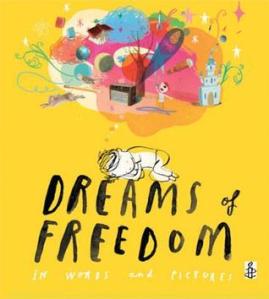
An incredible picture book that follows its sister book, We Are All Born Free. In association with Amnesty International, this book celebrates freedom around the world in a variety of ways. With quotations about freedom, the book’s text flies and builds an expectation that no one should live in the different forms of slavery or abridged freedom. The freedoms are large and expansive: the freedom to be a child, the freedom to learn, freedom from fear and freedom from slavery. This book embraces them all, creating a place where conversation can leap from.

The quotes from various luminaries from around the world were carefully selected so that children will be able to understand them. Sources range from the Dalai Lama to Harriet Tubman to Anne Frank. The illustrations are also rich and varied. They are done by various master children’s book illustrators including Mordicai Gerstein, Birgitta Sif and Chris Riddell. Each page of the book creates a singular moment to explore that type of freedom and to create hope and peace.

A strong book about freedom that invites conversation, this book belongs in both public and school libraries. Appropriate for ages 7-10.

Reviewed from library copy.

Review: Elvis by Bonnie Christensen

Elvis by Bonnie Christensen

Elvis: The Story of the Rock and Roll King by Bonnie Christensen (InfoSoup)

This picture book biography offers a glimpse into the journey of Elvis Presley from poverty to becoming a rock and roll legend. The book begins in segregated Mississippi with the birth of Elvis in 1935. Elvis’ father went to jail and even after he returned to the family, they lived a hard life of poverty. But through it all flowed music from their Sundays in church to listening to the radio at home. Elvis was shy and quiet, but he could sing and at age 10 he entered his first contest and then at 11 got his first guitar. His family moved to Memphis when he was 13 and Elvis found a new kind of music. He graduated from high school and eventually worked up the courage to enter a recording studio and offer his singing services. After a disastrous first session, Elvis was filled with nerves and picked up a guitar, singing That’s All Right. It got onto the radio and suddenly everyone wanted to hear more!

Christensen makes sure that readers understand that Elvis came from a difficult background, one where there was no money and no opportunities. His shyness was another thing that Elvis had to overcome, turning his shaking on stage into his signature moves. Christensen also keeps it clear that this was a different time, a time when these sorts of music did not mix together and that Elvis was uniquely situated to be the one who created the new sound. In all, this is a testament to the power of dreams and talent.

Christensen’s illustrations gleam with hope and the future even as Elvis is being moved to yet another house and another school. She makes sure that the light shines on the little boy and that readers see that there are possibilities to come.

A strong introduction to Elvis, make sure to play some of his music when reading it to children so that they can feel that beat too. Appropriate for ages 6-9.

Reviewed from library copy.