Review: The Specific Ocean by Kyo Maclear

Specific Ocean by Kyo Maclear

The Specific Ocean by Kyo Maclear, illustrated by Katty Maurey

Released on August 1, 2015.

A girl does not want to leaver her friends behind in the city and head off for summer vacation. There’s nothing to do in the little house near the ocean that she used to call The Specific Ocean instead of the Pacific. She starts out with a moping schedule and refuses to head to the water. The next day though, she does go down with her family and the water is cold but it also has warm spots. The next day, she races her brother down to the beach. They spend time floating in the waves, walking along the shoreline, and sitting on the rocks to watch the waves. The girl decides that she wants to have some of the ocean to call her own and to bring home, but that won’t work. So she has to figure out how to take the feeling of it home with her, deep inside.

Maclear has written a book about the process of change and the time that it takes to allow new experiences in. Time in the book moves slowly forward, allowing the girl the chance to change her mind in a natural way. Then the connection with nature becomes a delight, a way to spend the long days of vacation. The ocean becomes not just a source of activity for her, but a source of personal peace and joy. That process is honored here, that feeling of being connected to the world as a whole and wanting to keep that feeling with you every day. The prose in this book is exceptional. Maclear writes in first person and allows the girl’s voice to be poetic but still childlike and simple.

Maurey’s illustrations are filled with an inner glow that is helped by the pastel palette that is used. The sun shines on the page, the water beckons. The book has that dreamlike quality that many good vacations do, especially those filled with salt water and sand.

This quiet picture book speaks to those who don’t like change but is ultimately about nature and its power in our lives. Appropriate for ages 4-6.

Reviewed from copy received from Kids Can Press.

Review: I’m Trying to Love Spiders by Bethany Barton

Im Trying to Love Spiders by Bethany Barton

I’m Trying to Love Spiders by Bethany Barton (InfoSoup)

Using a great premise, this nonfiction picture book offers up lots of information on spiders. Told in first person, the narrator says that they are working to love spiders, but it just doesn’t seem to be working. They try looking more closely at them, but that doesn’t work and ends up with a spider squished on the page with the reader’s help. The next attempt goes a little better, focusing on the spiders’ eyes, webs and how they are able to walk up walls. Even the attempt to gently pet a spider ends up squished. But when a cloud of bugs invades the book, there’s only one thing that can help! Spiders to the rescue!

Barton takes the subject of arachnophobia and turns it into a clever look at spiders. The premise of the book is very engaging and gets even more so when the reader is called upon to use their own hand to squish or pet the spiders on the page. The facts shared are engaging and fascinating. They are selected to be interesting even to those struggling to love spiders. Even better, the book encourages children to take a closer look at things that scare them and shows how to approach changing your attitude.

Barton’s art has a wonderful loose quality to it that works particularly well with the zany interactions here. Her spiders are rather cute, fuzzy and googly eyed and very easy to love. Her humor is great, integrated into both her text and her illustrations. I particularly enjoyed what a human spider web made from our hair would look like as a house.

Inventive, funny and engaging, this nonfiction picture book will have you petting spiders in no time. Just be really careful not to smash them! Appropriate for ages 4-6.

Reviewed from library copy.

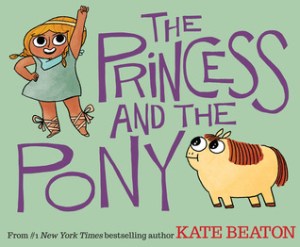
Review: The Princess and the Pony by Kate Beaton

Princess and the Pony by Kate Beaton

The Princess and the Pony by Kate Beaton (InfoSoup)

Princess Pinecone is the smallest warrior in a kingdom of warriors. For her birthday, she wanted something other than the cozy sweaters that she usually got. After all, warriors want something that make them feel like champions, not cozy sweaters. So Princess Pinecone asked for a real warrior horse, a grand steed. Unfortunately, what she got was a round little pony who ate what it shouldn’t and then farted too much. The day of a great warrior battle was approaching and Princess Pinecone just asked her pony to do its best. Everyone was fighting with one another and Princess Pinecone stayed at the edge waiting for her opportunity to join in. When Otto, a huge warrior, charged right at her, he was stopped by the cuteness of her pony. One by one all of the fierce warriors stopped to look at her pony, to pet it and hug it. Otto admitted that warriors rarely get to show their cuddly side. And that’s how Princess Pinecone found a use for all of her cozy sweaters and appreciation for her cutest of ponies.

The author of the online comic Hark! A Vagrant has released her first picture book and it’s stellar. First, let’s just applaud a picture book that has a tough heroine at its center, one who uses spitballs, wants to battle, and is looking for a real steed to ride. Second, the book also has other strong female characters, women warriors on the page who are already living the life that the princess seeks. Third, they are also different races. It’s lovely and done without fanfare. Then you also have the fact that the princess is feminine and cute herself. She does not have to reject that part of her to be a warrior. And finally of course you have the cute pony that manages to win a battle in its own way. This book is all about being yourself, whoever you are and the magic that happens when you do just that.

Beaton’s illustrations add so much to the appeal of this book. I love that the pony is a zany cute with eyes that sometimes don’t look in the same direction and a penchant for farting. Round and sturdy, it is impossibly cute. The warriors are also wonderful in their own ways, wearing different types of armor with missing teeth and green hair, they are individuals to the core. And yes, there’s even ice cream at the battle, adding the sense of merriment throughout.

Funny and intelligent, this picture book will have any warrior princess clamoring for more. Appropriate for ages 4-6.

Reviewed from library copy.

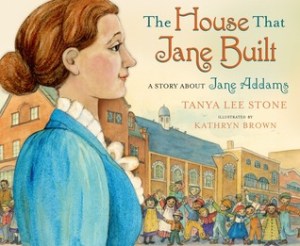
Review: The House That Jane Built by Tanya Lee Stone

House That Jane Built by Tanya Lee Stone

The House That Jane Built: A Story about Jane Addams by Tanya Lee Stone, illustrated by Kathryn Brown

Jane Addams was a girl born into comfort and wealth, but even as a child she noticed that not everyone lived like that. In a time when most women were not educated, Addams went to Seminary. When traveling with her friends in Europe she saw real poverty and then also saw a unique solution in London that she brought home with her. In Chicago, she started the first settlement house, a huge house that worked to help the poor right in the most destitute part of town. Hull House helped the poor find jobs and offered them resources. Addams also created a public bath which helped convince the city that more public baths were needed. She also found a way to have children play safely by creating the first public playground. Children were often home alone as their parents worked long hours, so she created before and after school programs for them to attend and even had evening classes for older students who had to work during the day. By the 1920s, Hull House as serving 9000 people a week! It had grown to several buildings and was the precursor to community centers.

Jane Addams was a remarkable woman. While this picture book biography looks specifically at Hull House, she also was active in the peace movement and labeled by the FBI as “the most dangerous woman in America.” In 1931, she became the first American woman to win the Nobel Peace Prize. She wrote hundreds of articles and eleven books, she worked for women’s suffrage, and was a founding member of both the ACLU and the NAACP. At the turn of the century she was one of the most famous women in the world. The beauty of her story is that she saw a need and met it with her own tenacity and resources. She asked others to contribute, but did not step back and just fund the efforts, instead keeping on working and living right in that part of Chicago. Her story is a message of hope and a tale of a life well lived in service to others.

Brown’s illustrations depict the neighborhood around Hull House in all of its gritty color. Laundry flies in the breeze, litter fills the alleys, and children are in patched clothes and often barefoot. Through both the illustrations and the text, readers will see the kindness of Jane Addams shining on the page. Her gentleness shows as does her determination to make a difference.

This biography is a glimpse of an incredible woman whose legacy lives on in the United States and will serve as inspiration for those children looking to make a difference in the world around them. Appropriate for ages 6-9.

Reviewed from copy received from Henry Holt and Co.

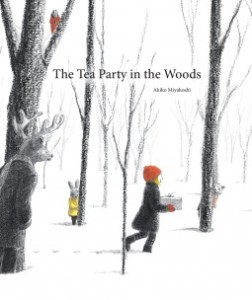
Review: The Tea Party in the Woods by Akiko Miyakoshi

Tea Party in the Woods by Akiko Miyakoshi

The Tea Party in the Woods by Akiko Miyakoshi

Released August 1, 2015.

Snow has fallen and Kikko wants to help her father clear her grandmother’s walk. He has already left but forgot to take the pie for her grandmother, so Kikko follows his footprints through the snow. She can see him ahead of her when she falls and crushes the pie. Still, she picks it all back up and continues on her way. But her father is heading into a huge building that Kikko has never seen before. As she approaches, she looks in the window and sees that the man she has been following is actually a bear in a coat. A little lamb comes up to her and asks her inside to join the tea party. Kikko is the only human there in a room filled with forest creatures. She quickly is welcomed to their tea party and spends a splendid time with them. When the time comes to continue on her way to her grandmother’s house, the animals replace the crushed pie with one made from different pieces of their own pies. Kikko is soon at her grandmother’s house where they are clearly delighted with the unusual pie.

Miyakoshi has created a story that is pure magic. She takes the traditional Little Riding Hood story of a girl heading through the woods to her grandmother’s house and turns it upside down in a most pleasant and unusual way. Once readers see that she is with wild animals, they will expect the story to take a darker turn. Instead they will discover a book that gets ever friendlier and more welcoming, a book filled with the warmth of new-found friends.

The illustrations are done with touches of color brightening the charcoal and pencil illustrations. Kikko is set apart immediately with her bright yellow hair and red hat and mittens. She is a burst of color against the white and the darkness. The illustrations of the animals are particularly effective. They are realistic and yet the animals are dressed in human attire, making it a lovely and whimsical book.

Gentle and friendly, this twist on Little Red Riding Hood is enchanting. Appropriate for ages 4-6.

Reviewed from copy received from Kids Can Press.
Review: The Wren and the Sparrow by J Patrick Lewis

Wren and the Sparrow by J Patrick Lewis

The Wren and the Sparrow by J. Patrick Lewis, illustrated by Yevgenia Nayberg (InfoSoup)

This Holocaust story tells of an old man who weaved carpets on a loom and spent his evening singing to a hurdy-gurdy. His student, the Sparrow, learned at his side. The town in Poland was dark and dismal, all of its trees harvested for kindling. Food and clothes were rationed and even the music was starting to disappear. One day music was removed from the village as soldiers arrived to gather all of the musical instruments and take them away. Everyone had to give up their instruments, but the old man sang one final song before he put his hurdy-gurdy on the pile. And he would not stop singing, even as he was dragged away. That night, the Sparrow returned and took the hurdy-gurdy from the pile and hid it away. Then she too disappeared. It was found years later with a note that spoke of the bravery of both the Wren and the Sparrow and the importance of music in keeping spirits alive in dark times.

Based on the musicians who played in the Lodz Ghetto, a place that housed 230,000 Jewish people in 1940. Only 1000 survived the Holocaust that followed. Music was a part of their life and that celebration of music as a way of expressing feelings that could not be voiced is very clear in this picture book. Lewis writes with intense beauty in this book, the strong feelings showing in his sentences such as “The town shriveled up like a rose without rain.” And the image of “the gift of music soon dwindled to a sigh.” The entire book sings with prose like this, adding its own music to the story.

The illustrations by Nayberg, a native of Ukraine, show the darkness of the times. The illustrations swim with the colors of war, khaki ground and the gray of despair. When the instrument and music are present though, there is a glow and a warmth that shines in the illustration visually capturing the impact of the music on people around.

This allegorical tale captures the impact of the Nazi regime in Poland and elsewhere, offering a lesson about the power of music to carry hope in the darkest of times. Appropriate for ages 5-7.

Reviewed from copy received from Kar-Ben.

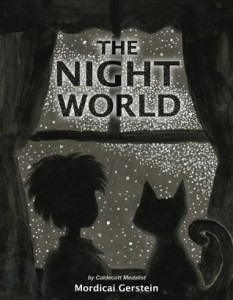
Review: The Night World by Mordicai Gerstein

Night World by Mordicai Gerstein

The Night World by Mordicai Gerstein (InfoSoup)

In the middle of the night darkness, a boy is woken by his cat who clearly wants to go outside. She leads him out of his room, through the dark house where everyone is asleep, even the fish. Then the cat speaks, saying that it is coming and it’s almost here. The two go outside where the grass is dewy, the air is warm, and the sky is filled stars. He can only see shadows everywhere. Some seem to be flowers and others seem to be animals who are also out at night, a deer, an owl, a porcupine and more. The birds start to call about it almost being here and slowly through the trees comes a glow. Dawn arrives. The animals depart off to sleep. And color floods away the shadows as the day shines into a glorious morning.

Gerstein has written a radiant picture book. He combines a mystery of what the cat is talking about that lengthens and deepens as the story unfolds. As the boy stands outside in the summer moments before dawn, there is a feeling of safety thanks to the animals gathered around him to witness the dawn too. There is immense pleasure is seeing the sun rise and that is captured vividly on these pages. From the hush and quiet splendor of the darkness to the dazzle of the day, this picture book is a perfect way to celebrate nature and each new start.

The illustrations are paramount here and they are immensely lovely. The dark pages in particular which are lit by the barest of lights, the deep blacks and greys of night are allowed to show their richness. The eyes of boy and cat light the darkness alone until outside where the stars in the sky join them as well, shining high above them. And the dawn that breaks so slowly over the horizon, first a glow and then becoming a full day with clouds, pastel colors and light.

A celebration of dawn, this picture book may just have early birds waking up to see the light break over their own dewy yards. Appropriate for ages 3-5.

Reviewed from library copy.

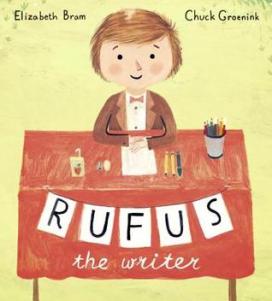
Review: Rufus the Writer by Elizabeth Bram

Rufus the Writer by Elizabeth Bram

Rufus the Writer by Elizabeth Bram, illustrated by Chuck Groenink (InfoSoup)

Released July 14, 2015.

One summer Rufus decides not to have his regular lemonade stand. Instead he will do a story stand! So he gets all set up wtih plenty of paper, pencils, pens and markers. When Millie and her little brother Walter stop at the stand, Rufus agrees to write them a story in exchange for a special shell from the beach. The story is about Walter’s favorite color. Sandy stops by with a box of kittens and even though they are free, Rufus writes a story in exchange for the black kitten, a story about cats. Rufus is reminded that his little sister’s birthday is tomorrow and he knows that a story will be the best present. Sara stops by and asks for a story about buttons, so Rufus agrees in exchange for whatever Sara thinks it should be worth. All of his customers pick up their stories at the same time and sit right down to read and enjoy them.

This smart blend of lemonade stand and creativity makes for a book premise that is very engaging and fun. Particularly pleasant is the lack of focus on money as payment and instead allowing a warm and friendly bartering system in exchange for Rufus’ stories. The values make sense, paid in kittens, shells and flowers. Also great is the way that Rufus’ stories are each designed specifically for that reader, with their favorite color or via the subject matter. The stories are engaging and fun, just brief enough to give a flavor and not slow the main storyline down.

Groenink’s illustrations are done in gouache, acrylics and pencils with Adobe Photoshop. They are warm and bright, showing a friendly neighborhood with plenty of ethnic diversity in Rufus’ customers. They have a playful feel with the trees around Rufus’ stand done in a whimsical way and various woods animals peeking at what is going on. The illustrations in Rufus’ stories are drawn with fine details and show the coloring lines. They have the same quality and feel of the other pictures but also have a distinct style of their own.

A celebration of creativity and writing, this book may inspire children to find their own variations on lemonade stands or even try their hand at writing and illustrating their own stories. Appropriate for ages 4-6.

Reviewed from digital galley received from Schwartz & Wade and Edelweiss.

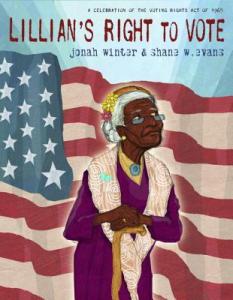
Review: Lillian’s Right to Vote by Jonah Winter

Lillians Right to Vote by Jonah Winter

Lillian’s Right to Vote by Jonah Winter, illustrated by Shane W. Evans (InfoSoup)

This picture book celebrates the 50th anniversary of the Voting Rights Act of 1965. Lillian is a 100-year-old African-American woman who has lived through all of the problems with African Americans voting in the United States. As she climbs the steep hill to her polling place, she remembers all of the steps that led from slavery to being able to openly vote today. She thinks about her great-grandfather who labored as a slave but also lived to see the Civil War come and allow him to vote for the first time.  She remembers her grandfather being charged a poll tax and her uncle being asked unanswerable questions before would be allowed to vote. She remembers running from an angry mob of neighbors who didn’t want women voting. She will never forget the cross burning in their yard. She remembers the people who fought for civil rights, who died for civil rights, who marched for everyone’s rights. She climbs that hill, slowly and steadily, until she reaches her polling place where she can vote without fear of being attacked or turned away.

Winter’s prose is musical and passionate. He draws us all close together and then speaks to us of history and voting and America. He tells us of shameful things that must not be forgotten, of heroes who fell and those who were able to keep marching. He tells us all of our duty in subtle ways that are stirring and moving; that we must vote each and every time, even when it is difficult or there is a steep hill to climb. Winter tells a personal story of voting history in the United States, giving us rich robust story telling rather than dry facts. It is a stirring and noteworthy tale.

Evans’ illustrations are superb. His fine lined illustrations show the determination of Lillian, the horrors of slavery, the dangers of voting, and the courage of many to make changes for the better. His pages swirl with color and texture, fill with sunlight, and dazzle with blue sky. The golden page of the cross burning is disturbing in its vividness, the wash of gold not allowing anywhere to hide.

A gorgeous story accompanied by equally lovely illustrations, this historical picture book is one that should be embraced by elementary teachers during any national election. Appropriate for ages 7-10.

Reviewed from digital galley received from Schwartz & Wade and Edelweiss.