Review: One Family by George Shannon

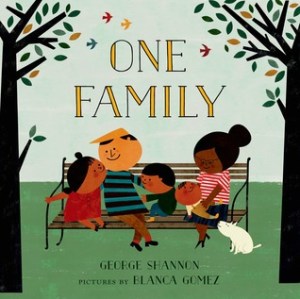
One Family by George Shannon

One Family by George Shannon, illustrated by Blanca Gomez (InfoSoup)

A joyous look at how different families can be and how very happy people can be in small and large families. The book is a cheery mix of counting book and family size, moving from one person happily sharing her book with her cat to a very large family of ten with grandparents mixed in. The book celebrates diversity in families as well with people of different ethnic backgrounds and gay parents. This picture book will have every child seeing themselves on the page and able to relate, which is definitely something to be celebrated!

Shannon writes a great little poem that carries this book forward at a brisk and jaunty pace. Each verse looks at a larger family but begins with “One is…” and then the number of people in that family. The verse then goes on to show other objects and items that are that number but still a solid unit, like a bunch of bananas or a flock of birds. The message is one of being loved and included no matter the size of your family or who is part of it.

Gomez’s illustrations are lovely. She creates diversity with a sense of ease, rather than it being forced at all. It is a joy to see the final page where all of the families are in the same neighborhood and mingling outside, one big rainbow of people together. Her paper collage illustrations are friendly and filled with small touches that are worth lingering over. It’s those touches that make the book feel even more warm and the families all the more loving.

A great pick to celebrate the diversity in every community, this is a great pick to share aloud thanks to the clever rhyme and lovely illustrations. Appropriate for ages 3-5.

Reviewed from copy received from Farrar, Straus and Giroux.

Review: Bulldozer’s Big Day by Candace Fleming

Bulldozers Big Day by Candace Fleming

Bulldozer’s Big Day by Candace Fleming, illustrated by Eric Rohmann (InfoSoup)

Bulldozer is very excited as he heads to the construction site one morning. It’s his special day and he wants to invite all of the other bigger trucks to his party. So he asks them to guess what day it is. Digger says that the day is a scooping day and keeps on scooping dirt. Dump Truck says it’s a sifting day. Cement Mixer knows that it’s a stirring day. One after another, the different trucks insist that it’s just a normal day and they are doing what they always do. Bulldozer gets more and more dejected as the other trucks talk to him and is about to leave the construction site entirely when happy whistles start to blow and the trucks reveal their birthday surprise for him.

Fleming charmingly combines two deep loves of small children: trucks and birthdays. She engages just enough with each of the trucks, allowing young vehicle lovers time to enjoy each truck and what they do on a construction site. Children will feel for Bulldozer as his attempts to talk about his party are foiled by each truck. The pacing is well done and leads up to a greatly satisfying ending.

Rohmann’s thick-lined illustrations work particularly well here. His Bulldozer character reads as young and jaunty as he flies over the construction area without touching the ground. The other trucks are solid and dependable. They come off as very friendly but also busy, rather like parents who are distracted but kind. Rohmann presents the birthday reveal on one double page spread that is very joyful and lots of fun. Expect a cheer of joy from your listening audience.

Get this into the hands of toddlers who like trucks and who may be approaching a birthday of their own. Appropriate for ages 2-4.

Reviewed from copy received from Atheneum Books for Young Readers.

Review: Ready Rabbit Gets Ready! by Brenna Maloney

Ready Rabbit Gets Ready by Brenna Maloney

Ready Rabbit Gets Ready! by Brenna Maloney (InfoSoup)

When Ready Rabbit wakes up in the morning, he doesn’t feel like getting right out of bed. But his mother keeps on calling him so he gets up. Then before he starts to get ready to go, he has to build a spaceship. His mother calls for him to pick up his toys and get ready to go. So Ready decides to get dressed. But what should he wear? He has all sorts of costumes to try on and consider until he remembers that rabbits don’t wear clothes! Breakfast is ready but Ready finds it quite boring to sit and eat. He’d rather be doing a daring rescue with an ambulance. Brushing teeth takes some concentration and before you know it, there’s toothpaste everywhere. Will Ready ever be ready for school?

Maloney creates the ultimate distracted child in Ready Rabbit, a rabbit who can’t concentrate on anything except his imagination. The voice of the mother only appears in voice bubbles and she never appears on the page. So the book is fully centered on the protagonist and his vivid imagination. The book works hard to make sure that the tone of the mother is encouraging and not angry and that Ready is actually slowly making progress towards getting ready even as he plays around.

The illustrations make this book particularly special. Ready Rabbit and all of his things are objects with Ready being a knit bunny with a face that is a piece of fabric with changing expressions drawn on it. One might not think it would work, but the result is charming and has a very different vibe than many picture books.

Families trying to get ready in the morning will recognize their own wish to play just a little bit longer. Appropriate for ages 3-5.

Reviewed from copy received from Penguin.

Review: In Mary’s Garden by Tina and Carson Kugler

In Marys Garden by Tina and Carson Kugler

In Mary’s Garden by Tina & Carson Kugler (InfoSoup)

This picture book biography of Mary Nohl, a Wisconsin artist, tells the story of her first creations of large art. When she was young, Mary discovered that she loved art and making things and drawing. It was when she started to collect odds and ends from the beach near her home that she started to create her statues in her garden. Cement was combed and crafted, dotted with stones and other objects. One after another, huge creatures filled her yard, drawing visitors to see what Mary was creating. Mary died in 2001 at the age of 87 and her home still serves as a gallery of her art.

The Kuglers focus primarily on the finding of objects and the process that Mary used to create the art. Then they turn to the gallery she created with her huge creatures who are friendly and welcoming and wild. One can immediately see the appeal of her art. Turning to the back of the book, readers can see the actual art and her garden gallery. The more detailed prose found there also explains how her works is still problematic for her neighbors and how people are working to preserve it.

The illustrations are great and completely capture the whimsical and decidedly friendly nature of Mary Nohl’s art work. From the finding of objects on the lake beach to the creation of the art itself, the illustrations invite young readers to try their own hand at found-object art and to make themselves happy too.

Ideal for Wisconsin libraries, art teachers will enjoy having a book about a woman modern sculptor. Appropriate for ages 4-6.

Reviewed from library copy.

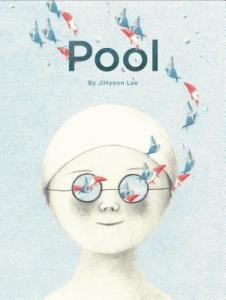
Review: Pool by JiHyeon Lee

Pool by JiHyeon Lee

Pool by JiHyeon Lee (InfoSoup)

A boy stands at the end of a swimming pool, ready to hop in. But just as he is about to, a crowd of people arrive and take over the pool. It is crammed full of them with their floating tubes and boats, leaving no area of water open. But the boy finds a sliver of water along the side of the pool and dives down underneath the crowd. A girl sees him dive down and heads down herself. The two meet underwater and head deeper together. Down at the bottom of the pool they discover a coral reef filled with wild fish that swim in large schools. There are also tubes large enough for a kid or a colorful eel to hide in. Large toothy fish swim by and then a gargantuan white whale too. The children head up to the surface again, as the rest of the crowd head out of the pool. The two of them are left to dry off side by side and wonder at what else could be underneath that water.

Lee captures the beauty of swimming and the wonder of imagination in this wordless picture book. The two children are distinct from the others floating on the surface, built in a more delicate way and almost matching except for their swimsuits. As they dream of reefs and fish, the water fills with animals. There is a playfulness to their imaginations, creating a world together that is filled with amazing things.

Delicate illustrations are filled with the blue of the pool. As the coral reef appears, there are animals of all sorts, even water spiders. The wonder of the huge white whale is a moment that is lengthened and filled with importance in this picture book. Throughout the pacing is masterfully done, allowing readers time to explore and dream themselves.

A book that encourages long looks and your own fish designs, this picture book is an inspiring and refreshing watery read. Appropriate for ages 3-5.

Reviewed from copy received from Chronicle Books.

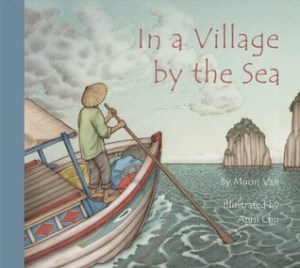
Review: In a Village by the Sea by Muon Van

In a Village by the Sea by Muon Van

In a Village by the Sea by Muon Van, illustrated by April Chu (InfoSoup)

In a fishing village near the sea, there is a small house high in the hills. In that house, there is a kitchen with a warm fire where a pot of noodle soup is simmering. A woman watches and waits, grinding spices in a mortar and pestle while a baby sleeps nearby. Their dog looks down into a hole in the floor and spots a cricket there. The cricket is painting on an easel, creating an image of a stormy sea with large waves. In that sea there is a small boat with a worried fisherman hoping to get out of the storm soon and dreaming of his family in a small house above the sea.

Both the author and illustrator are Vietnamese-Americans. The story was inspired by the author’s father and his ancestral village in Central Vietnam. It is the story of both the men who head onto the sea to fish and the families they leave behind. It is also a story of the cycle of life, of connections to one another. After all, the storm itself is both on the cricket’s easel but also part of the heart of the story too. It’s a book that twists a bit, so that one forgets the origin of the storm and the story, but knows that it echoes with history and truth.

The illustrations are dramatic and gorgeous. They evoke Vietnam with its stunning shoreline. They also capture the danger of the high waves and surging seas, conveying that tension clearly without making it too frightening or intense for young readers. The entire book celebrates the cozy home but also the wildness of nature, dancing from one to the other with ease and creating a strong dichotomy but also connection between the two.

Beautifully illustrated and told, this cyclical story is a journey to Vietnam and a celebration of their way of life. Appropriate for ages 4-6.

Reviewed from library copy.

Review: Trapped! by Robert Burleigh

Trapped by Robert Burleigh

Trapped!: A Whale’s Rescue by Robert Burleigh, illustrated by Wendell Minor (InfoSoup)

A wild whale is jumping, swimming and enjoying lots of krill to eat in the ocean waters. But then she runs into discarded netting from a crab fisherman floating in the water. The net catches her, cutting into her mouth and making swimming difficult. The a boat motor sound comes and along with it a group of humans who are hoping to rescue the huge animal. But it is so dangerous being near an animal of that size where even small motions can cause injuries to the rescuers. Still, they work close to the whale and begin to cut her free. They swim away if necessary and touch her with gentleness and care. Eventually the ropes and netting fall away and the whale is free to swim again. To say thanks, she gently touches each of her human rescuers before jumping for joy.

Burleigh’s text contains lots of information but it is presented through the lens of a story. This is a tale of one very fortunate whale, rescued in time from the netting. It is a story of wild freedom at first and then a desperate struggle and then impossible hope that she will survive after all. This is a real drama played out on the pages, from the danger to the whale to then the danger to her rescuers solely from her size. The final pages of the book offer resources about rescuing trapped whales and talk more about the dangers and about the whales themselves too.

Minor’s art is luscious on the page, taking readers under the water alongside the whale. There we float as the water changes colors and the light changes. Minor makes sure the show the size of the whale and of the humans on the same page, so that children will understand the size of the animal. It is beautifully and touchingly done.

An inspiring tale of the difference that even a small group of people can make in sustainability and saving animals, this picture book is a compelling mix of story and fact. Appropriate for ages 6-8.

Reviewed from copy received from Charlesbridge.

Review: The Baby Swap by Jan Ormerod

Baby Swap by Jan Ormerod

The Baby Swap by Jan Ormerod, illustrated by Andrew Joyner (InfoSoup)

Caroline is not happy to have a baby brother. Her mother adores him despite his dribbling mouth. She talks all of the time about his yellow eyes and green skin and how very cute he is. When her mother goes into town to exchange her hat for one that is just right, Caroline gets an idea and heads to the baby store to trade her baby brother in for one that is just right too. The baby panda with yellow eyes like her mother likes eats the bamboo furniture. The baby elephant is too squirty and ends up breaking a fountain. The two baby tigers are too active and too much of a handful for her. By the time she goes through all of the available babies, the store only has one left, her original baby brother. But after all of that, he looks pretty perfect to her!

Ormerod takes a humorous look at sibling rivalry in this picture book. Caroline is clearly jealous of the time that her mother spends with her little brother, but that is transferred to disliking his drool and activities. The idea of exchanging an infant for one who fits and suits you better is a clever one, and an idea that children will understand. The ending where Caroline takes her own brother back works very well and doesn’t feel forced or overplayed. Instead it feels like the natural extension of the experience that the character has had.

Joyner’s illustrations add to the humor of the book. Filling his pages with a community of different animals, Joyner makes sure that it is a modern world with cell phones, portable music, and cars. Yet it also has a distinct vintage feel in the way that the characters dress and touches like the price tags on the babies and their cloth diapers. It’s a distinctive mix of the two, one that is modern and yet warm.

A great addition to the crowded shelves of sibling rivalry books and one that takes a more lighthearted and humorous approach to the situation. Appropriate for ages 4-6.

Reviewed from copy received from Simon and Schuster.

Review: The Potato King by Christoph Niemann

Potato King by Christoph Niemann

The Potato King by Christoph Niemann (InfoSoup)

A Prussian king named Fritz loved the idea of the potato. It was easy to grow and healthy too and could just solve the hunger problems in his country. So he went to a nearby village and told them about the potato and its benefits and planted some potatoes for them. But people don’t like to be told what to eat, and the village rejected the potato entirely. Then King Fritz had an idea. He ordered his army to go to the village and guard the potato field, telling them to be very lax about it. Suddenly, the people were very interested in a food that they were being stopped from eating and that was valuable enough to guard with soldiers. They snuck into the field and stole the potatoes, planting them in their own gardens. It was a clever use of reverse psychology to create a crop that would end up being a staple of the area.

Translated from the original German, this picture book is told very simply. The book ends with a brief history of the potato and how it came to Europe from South America. It also admits that this tale may be a myth, but that’s part of what makes it all the more fun to tell. Niemann manages to take a moment in history and turn it into a rollicking tale that young children will enjoy immensely and will relate to immediately.

The illustrations in the book are done entirely in potato prints of different colors combined with actual potatoes too. The prints work particularly well when used to create larger scenes of hills of grass and crowds of soldiers. Somehow the crude images have their own personality too, particularly the king himself whose open mouth and bright red color mark his as unique right from the start.

Nominated for a German Youth Literature Prize, this picture book has a wonderful organic charm all its own. Appropriate for ages 4-6.

Reviewed from library copy.