Review: Little Red Henry by Linda Urban

Little Red Henry by Linda Urban

Little Red Henry by Linda Urban, illustrated by Madeline Valentine (InfoSoup)

Henry’s family does way too much for him. They dress him. They feed him. They bring him anything he needs. But they haven’t noticed that Henry is getting much more independent and wants to start doing things himself. So Henry starts to insist on doing things entirely on his own. Henry feeds himself. Henry brushes his own teeth. He gets himself dressed, refusing all of their suggestions for things to wear. Then he headed next door to his friend’s house to play. His worried family peers at him from behind trees and other objects, but Henry does just fine on his own. At first Henry’s family doesn’t know what to do with themselves with no Henry to take care of. Slowly though, they start to find their own way again. When bedtime comes, Henry gets himself ready for bed, but he just might still need some help going to sleep.

A perfect story for children in the age of helicopter parenting and a reminder for parents to give their children the space and opportunities they need, this picture book has a snappy tone that is great fun to read aloud. It plays homage of course to The Little Red Hen who asks for help and gets none. Nicely, this book is the reverse and echoes the flip at the end of the traditional story with one of their own as well. It’s a great riff on a beloved tale, modernizing it and changing it so that young readers may not even realize the connection.

Valentine’s illustrations add to the pizzazz of the book. The worried and overbearing family is filled with doting love. Henry is vividly independent, standing on chairs and being entirely himself. There are great moments of activity where Henry tries on different outfits and where the family tries out new activities. This echoing of each other adds to the pleasure of the read.

A modern riff on a classic tale, this picture book is sure to support independent kids and send helicopter parents spinning. Appropriate for ages 4-6.

Reviewed from library copy.

Review: Daylight Starlight Wildlife by Wendell Minor

Daylight Starlight Wildlife by Wendell Minor

Daylight Starlight Wildlife by Wendell Minor (InfoSoup)

Explore the world of animals in your own backyard that come out either in the day or at night. Shown in pairs, the various animals are awake at opposite ends of the day. Hawks fly the skies in the bright sunlight while owls glide the skies after dark. Rabbits and their babies are active in the fields and meadows in the day while opossum mothers and their babies come out and forage the same areas at night. Even the butterflies of day are replaced by the moths of night. The book moves from bright page to dark page, each equally lovely and equally celebrated. This is a nice beginning book that looks at animals of all sorts that can be spotted in backyards across the U.S.

Minor provides brief comments on each of the animals that he highlights. He smartly chooses not to make the pairings rhyme, creating instead a natural flow with his prose that makes the book easy to share aloud and a pleasure to explore. His use of only backyard animals makes for an accessible read for young children who will delight in recognizing many of the daylight animals and may be very surprised by some of the nighttime ones.

As always, Minor’s artwork is stunningly lovely. He captures both the sun yellow of the daylight pages but also the glowing blues of night. Both are presented with loving detail and care, each page as lovely as the next. Thanks to his art, this book reads as a celebration of these animals and of the different times of day. Minor’s skill with light and shadow are on full display in this book.

A beautiful look at everyday animals that are active either in the day or the night, this picture book will inspire visits to dark backyards and sunlit ones. Appropriate for ages 3-5.

Reviewed from copy received from Nancy Paulsen Books.

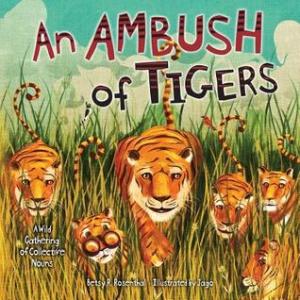
Review: An Ambush of Tigers by Betsy R. Rosenthal

Ambush of Tigers by Betsy Rosenthal

An Ambush of Tigers: A Wild Gathering of Collective Nouns by Betsy R. Rosenthal, illustrated by Jago (InfoSoup)

Using wordplay and clever illustrations, this book celebrates the unique and fascinating world of collective nouns used for groups of animals. From a leap of leopards jumping through the trees near a tower of giraffes to a labor of moles working alongside a business of flies, the animals and their respective collective nouns are matched up to maximize both understanding and humor. Children will enjoy exploring these words and will puzzle over why certain animals are referred to in specific ways.

Rosenthal has carefully chosen the collective nouns she highlights in her book. She also has managed to pair them with interesting imagery in her poetry, such as a troop of kangaroos selling cookies and collecting money in their pouches. She uses rhyming couplets to make the book even more fast-paced and jaunty. The result is a book that is both fascinating and educational but also great fun.

The art by Jago takes the imagery from Rosenthal’s rhymes and turns it into pictures which add to the inherent humor. The sleuth of bears is hot on the heels of the murder of crows. His paintings make the collective nouns tangible and real, creating scenarios that are memorable.

A nice addition to the Ruth Heller books that are in most libraries, this book has a fresh tone and lots of humor. Appropriate for ages 5-7.

Reviewed from library copy.

Review: Yard Sale by Eve Bunting

Yard Sale by Eve Bunting

Yard Sale by Eve Bunting, illustrated by Lauren Castillo (InfoSoup)

Callie’s family is moving from their house into a small apartment, so they are having a yard sale. It’s a bright sunny day but Callie is filled with mixed feelings as she sees all of the parts of their lives out in the front yard for sale. Callie has visited their new apartment and seen where she will sleep. It’s even a cool bed that pulls out of the wall. But she is going to miss her friends in the neighborhood and doesn’t really understand why they have to move except that it has to do with money. When Callie sees her red bicycle being purchased by someone she gets upset and then when a friendly woman asks if Callie herself is for sale, Callie gets alarmed. In the end after the sale in their almost-empty house, Callie and her family look forward to a fresh start together as a family.

Bunting beautifully and sensitively captures the mixed feelings of moving and the additional burden of being forced to downsize due to financial reasons. She shows from Callie’s point of view how upsetting it can be. At the same time, she shows supportive parents who work with Callie to discuss her feelings and validate her emotions. The yard sale is a strong image to have at the heart of the book, demonstrating the loss of so many items of property but at the same time strengthening the image of the family who is left strong and resilient.

Castillo has created a neighborhood of friendly people, bright balloons and lots of sunshine that works very nicely here. The deep feelings expressed by the protagonist play against the dazzling day and the contrast makes the emotions all the more real. The three members of the family are clearly a unit from their similar dark hair to the color palette that holds them together as well. It is subtly done, but very effective.

A powerful book about children caught in the impact of the economic downturn, this book is not bleak but rather filled with hope for the future. Appropriate for ages 4-6.

Reviewed from library copy.
Review: Woodpecker Wham! by April Pulley Sayre

Woodpecker Wham by April Pulley Sayre

Woodpecker Wham! by April Pulley Sayre, illustrated by Steve Jenkins

In brief stanzas of rhyme, this nonfiction picture book looks at the habitats and lives of a variety of different species of woodpecker. Starting with finding food, the book explores woodpeckers eating insects and sap. Then woodpeckers bathe and preen. They create homes by digging holes in the bark of trees. They hide from hawks. They lay eggs and the chicks hatch, forcing the adult birds to scrounge for food for them. The fledglings start trying to fly and then fall comes and once again woodpeckers are searching for food and shelter to get them through the winter.

Sayre and Jenkins continue their partnership that started with Eat Like a Bear in this new book. Sayre writes with a light hand, creating a sense of exploration and wonder around these backyard birds. Children will learn some things from the brief poetic text and there is a lot more information to be found on the back pages where individual species are identified and all of the subjects are expanded upon.

Jenkins continues to create illustrations that amaze. With his cut paper collages, the illustrations pop on the page as the birds fly, hide, peck, eat and reproduce. I love that the color of the sky changes from one page to the next, creating moments in time rather than one continuous time period. The result are illustrations that stand on their own in terms of beauty and the incredible detail that they offer readers.

Beautiful and informative, this nonfiction picture book will have children gazing out of their windows to try to see the birds in their neighborhood. Appropriate for ages 4-7.

Reviewed from copy received from Henry Holt and Co.

Review: Everybody Sleeps (But Not Fred) by Josh Schneider

Everybody Sleeps But Not Fred by Josh Schneider

Everybody Sleeps (But Not Fred) by Josh Schneider

Every type of animals has to sleep whether on the farm or in the jungle or underwater, but not Fred. Fred has far too much to do to sleep at all. Fred has to do his important jumping. He has to break the world shouting record. He has to test his horn collection. He has so much to do, much to the chagrin of the sleepy animals around him who keep getting startled from his activities. It isn’t until parents start to read poetry to get children to fall asleep that Fred too succumbs to slumber. Now it’s up to young readers to be quiet enough to keep from waking Fred up and starting it all over again.

Schneider writes in rhyme, jaunty and confident. He invites readers to see different habitats for the animals as they snore and snooze. The pacing is deftly done in this book, allowing a slow build up to each activity that then becomes zany and silly. It’s that dichotomy of pace that makes for a book that is a joy to share aloud and one that will make any bedtime a lot more fun.

Also adding to the fun are the impeccable illustrations. They are complete irreverent and silly, with sleeping pigs with tattooed bottoms, monsters who brush their teeth, monkeys in tutus, and a toucan who appears throughout in unexpected places. The illustrations are worth spending lots of time with since they are filled with small details. Many of the animals continue to subsequent pages along with Fred, joining in his adventures.

Smart, funny and a great bedtime story, this picture book will amuse even the most resistant sleepyhead. Appropriate for ages 4-6.

Reviewed from library copy.

Review: The Skunk by Mac Barnett

The Skunk by Mac Barnett

The Skunk by Mac Barnett, illustrations by Patrick McDonnell

When a man wearing a tuxedo leaves his home, a skunk is sitting on his doorstep. The man slowly backs away and heads off. But the skunk seems to follow him. Even when he hops into a taxi, the skunk hops into another one and follows him closely. The man escapes to the opera, sure that the skunk will not be able to get in, but suddenly the skunk is right next to him, sitting on a woman’s head. The skunk continues to pursue him across a cemetery and even around and around on a ferris wheel. Finally the man escapes down into the sewers. He finds himself a new house and leaves his old life behind. But even as he celebrates with his new friends, he starts to think about the skunk and why the skunk was following him. It’s up to him to figure it out. Maybe the skunk won’t even notice the man following him!

Barnett and McDonnell are an incredible pairing in this picture book. They feed off of one another, each lifting the other up. Barnett’s writing is just as quirky as ever, creating a zingy dynamic between the two characters of the man and skunk. Full of dry humor, the book has a deadpan quality that makes it ideal for sharing aloud with children. The twist at the end of the man searching for the skunk is really well done and sure to get hoots of laughter. Expect children to read this at different levels and see different things in the story, all the while with them having an equally great time.

McDonnell channels the feel of vintage comics in his illustrations. Done with limited colors of only black, white and red, the illustrations change to full color when the man creates his new and different life only to change back when he returns to his original place. Both the man and the skunk convey emotions and a sense of jaunty determination.

A great read aloud pick, this picture book is one of the best of the year. Appropriate for ages 4-7.

Reviewed from copy received from Roaring Brook Press.

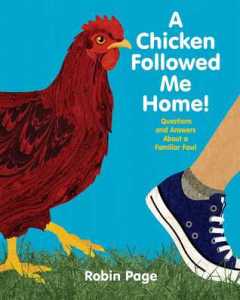
Review: A Chicken Followed Me Home by Robin Page

A Chicken Followed Me Home by Robin Page

A Chicken Followed Me Home!: Questions and Answers about a Familiar Fowl by Robin Page

What do you do when a chicken follows you home? All of the answers you need are in this nonfiction picture book that tells you facts about chickens. First, you will need to know what to feed your chicken. You may also want to know what kind of chicken you now have and whether it is a boy or a girl. You will need a chicken coop to keep your chicken safe from predators and give it somewhere to live. Then there is the question of eggs and if you want fertile eggs you will need both a hen and a rooster. Then the eggs have to hatch successfully. If they do, you will have lots of chickens instead of just two. Maybe they will follow someone else home!

Page is the author of several popular books about animals and she captures the joy of keeping chickens in this picture book. Using the framework of someone suddenly having to care for a chicken makes the book very approachable and readable. The facts are presented rather like a guidebook and offer matter-of-fact information for the new chicken owner or readers interested in chickens. This book will make a great addition to school and public libraries since it is information just at the right level for early report writers.

Page’s illustrations are spectacular. Done in collage and cut paper, she manages to create feathers out of patterned paper that look real and textured. Fuzzy baby chicks are almost touchable on the page as they struggled free from their eggs. The illustrations are large and bold, making this a book good for using with a class.

No need to be chicken, add this one to your library collection! Even children who haven’t found their own hens will delight in this book. Appropriate for ages 6-9.

Reviewed from copy received from Beach Lane Books.

Review: Luna & Me by Jenny Sue Kostecki-Shaw

Luna and Me by Jenny Sue Kostecki Shaw

Luna & Me: The True Story of a Girl Who Lived in a Tree to Save a Forest by Jenny Sue Kostecki-Shaw

This is a picture book version of the real-life heroism of Julia Butterfly Hill, a woman who lived for two years in the branches of Luna, a great redwood tree in order to save the grove from logging. In this picture book, Butterfly is shown as a girl rather than an adult. She spends many of her days exploring nature and then discovers Luna and climbs up into her branches. When she realizes that Luna is going to be chopped down, she stays in the branches. That starts her adventure high in the canopy where she has to withstand storms and cold. Butterfly stayed up in Luna for two years, figuring out how to make a home high in a tree and sharing Luna’s story with whomever she could. Until finally Luna and her entire grove her saved and made into The Luna Preserve.

As Kostecki-Shaw notes in her Author’s Note, she has simplified the political situation that the real Julia Butterfly Hill was dealing with as well as the initial response that included a group of environmental activists taking turns sleeping in Luna’s branches. This makes for a picture book that is easily understood by young readers and that hints at larger issues happening. It will serve to inspire young readers that they can individually make a difference in the world around them and protect what is invaluable to all of us.

The illustrations in this book are done in a variety of media including acrylics, watercolor and pencil. They capture the beauty of nature with dappled light through leaves, the texture of tree bark, and the dwarfed size of Butterfly against the world. They also delightfully show the other animals and creatures living in Luna with one magical page displaying a space inside her trunk.

A very special book about an environmental heroine, this picture book will be inspiring for young readers. Appropriate for ages 4-6.

Reviewed from copy received from Henry Holt & Co.