Review: It’s Only Stanley by Jon Agee

Its Only Stanley by Jon Agee

It’s Only Stanley by Jon Agee (InfoSoup)

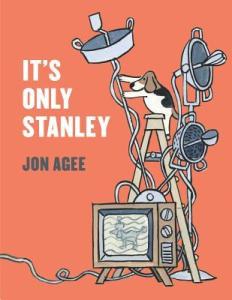
Something odd is happening tonight in the Wimbledon house. There are mysterious noises. The first noise is Stanley the dog howling at the moon. But then new noises start. The clanking noise is Stanley fixing the oil tank in the basement. A little later, the funky smell that makes the cat ill turns out to be Stanley cooking catfish stew in the kitchen. The buzzing noise is Stanley fixing the family’s old TV in the living room. Splashing noises are Stanley fixing the plumbing. Each noise wakes up the human family and the father has to head out to see what is happening. But just as everyone is starting to get very cranky from loss of sleep, something happens that shows exactly what Stanley has actually been up to all night.

Agee is a master at creating understated books that have a distinctive feel about them. Here he takes a strong matter-of-fact tone and uses it to add to the silliness of the entire book. Told in natural-feeling rhyme, the book has a buoyant tone that makes it great fun to share aloud. Throughout the book the father heads out each time without much emotion and returns to report that it is just Stanley and what the dog is up to. The oblivious family heads back to bed only to be awoken again and again. This builds wonderful tension until it’s released with a literal bang.

Agee’s art is done in his unique style with flat color and thick black lines. Throughout, readers will be able to watch for clues as to what Stanley is actually up to and readers who are paying close attention will figure it out before the family does. Even those children who don’t piece together the clues will want to re-read the story to notice them. Also keep an eye on the cat who seems to always get into the worst of it as the story progresses.

Not a bedtime story despite being set at night, this picture book is strikingly funny and has a grand warped feeling throughout. Appropriate for ages 4-6.

Reviewed from copy received from Dial Books.
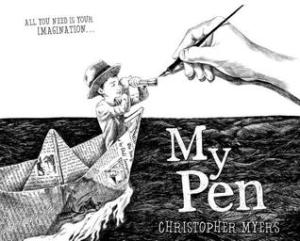
Review: My Pen by Christopher Myers

my pen

My Pen by Christopher Myers (InfoSoup)

A new picture book from an award-winning illustrator which shows the power of art in a child’s life. Using powerful sketches, the book talks about the freedom and self-esteem that comes from creating art. Myers also speaks to the importance of imagination and creativity, showing an elephant in a teacup and the protagonist riding a dinosaur. He plays with different perspectives and plays the simplicity of ink and pen art against the complexity of world problems that art also speaks to. Even mistakes and errors are embraced along the way, showing children that the goal is not perfection but the experience of creation.

Beautifully written and illustrated, this picture book is a compelling look at creativity and art. The words in the book demonstrate the various aspects of art, showing a playfulness throughout but also allowing moments of gravity and seriousness as well. The book ends with an encouragement to the reader to pick up a pen and see what worlds they discover inside it.

The real focus of this picture book is the art, which is incredibly beautiful. Done in pen, of course, the art is detailed and distinctive. The boy’s face is expressive throughout, as he takes imaginary travels and as he responds to making mistakes on the page. Thanks to the creative subject, one is never sure what is going to be revealed on the next page. With art of this quality, it’s a delight to turn the pages and discover each new image.

Share this with art teachers or in units that encourage creativity. Then have pens ready for children to create their own art on the page, blots and all. Appropriate for ages 4-6.

Reviewed from library copy.

Review: I Don’t Like Koala by Sean Ferrell

I Don't Like Koala by Sean Ferrell

I Don’t Like Koala by Sean Ferrell, illustrated by Charles Santoso

When Adam opens his gift and discovers Koala inside, he is not pleased. After all, Koala is “the most terrible terrible.” He has bright yellow eyes that follow Adam around the room. So Adam decides that he must get rid of Koala, but it’s not that easy. Every night Adam puts Koala away in different places all over the house and happily goes to be alone. But when he wakes up, Koala is right there on his pillow, every morning. His parents think that he loves Koala, even though Adam tells them that he hates Koala. Then comes the day that Koala seems to have eaten Adams snack! So Adam hikes up into the forest and leaves Koala there. But Koala is waiting for him at home when he returns. One night though, frightening things loom in the dark and Koala is right there to protect Adam and make him feel safe. But someone else might just be being freaked out by Koala too.

Ferrell captures the creepiness and the appeal of strange stuffed animals. He creates a horror vibe that is just right for young readers with the way that Koala appears in bed in the morning and can’t be left behind anywhere. It’s a funny riff on scary movies, something that some special stuffed animals can evoke with ease. The parents don’t understand or step in to protect their son in the story at all, adding to that eerie feeling throughout that makes the book such fun.

Santoso creates the ultimate creepy stuffed animal in Koala, a strange beast who readers will also grow to love as the book progresses. The expressions on Adam’s face are priceless as he tries to explain why he hates Koala so very much and when he discovers Koala’s return again and again. The use of dark colors for both Koala and Adam unite them as a pair in the book even as Adam struggles to be separate. Santoso’s illustrations continue the dark eerie feel of the story.

An exceptionally dark picture book, this book is great fun and reads aloud well. Share it with children ready for a little fright with their stuffed animals. Appropriate for ages 4-6.

Reviewed from copy received from Atheneum Books for Young Readers.

Review: Sidewalk Flowers by JonArno Lawson

sidewalk flowers

Sidewalk Flowers by JoArno Lawson, illustrated by Sydney Smith

As she heads home with her father who is distracted by his cell phone call, a little girl dressed in vibrant red picks wild flowers. Along the way, she takes a moment to smell each of them, creating a bouquet of bright colored blooms. The flowers grow unnoticed by the others on the street in this urban setting, but the little girl spots them all growing out of sidewalk cracks. When the girl and her father reach the park, she notices a dead bird on the sidewalk and leaves some of the flowers there with the bird. A man sleeping on a park bench is given a sprig too. Then she decorates the collar of a friendly dog with more flowers. As they reach home, the little girl gives each of her family members flowers, leaving a trail of them on their hair and heads. The final flower is used to decorate her own hair at the very end.

This wordless picture book is immensely lovely. The story arc really works well and has moments of sophistication that create a vibrant urban world for this girl to live within. As she gathers the flowers, other beautiful parts of the city that would have been overlooked too light up with color or are captured in small moments. From the display of bright fruits in the market to the pigeons on the street, each small piece adds together so that readers “see” the beauty of the city along with the young protagonist.

The art is expressive and lovely. The city is shown in black and white against which the red girl pops like a bright ruby. Portions of the city are done in color, like flowered dresses and the small flowers that the girl gathers too. Then when the girl starts sharing her flowers, the entire world becomes colorful and bright. It is a dynamic shift in the middle of the book, showing the power of generosity and community.

Subtle and powerful, this picture book celebrates seeing the beauty in everyday life and sharing it with others. Appropriate for ages 3-5.

Reviewed from library copy.

Review: P. Zonka Lays an Egg by Julie Paschkis

p zonka lays an egg

P. Zonka Lays an Egg by Julie Paschkis

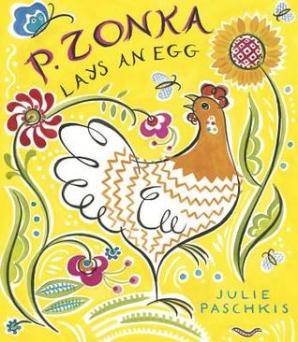
P. Zonka isn’t like the other chickens on the farm. The other chickens lay eggs each and every day, but P. Zonka never lays a single egg. She’s busy walking around the farm noticing nature and the beauty of flowers and moss. The other hens call her lazy, but she doesn’t pay them any mind. Finally, after they cluck at her for a long time, P. Zonka agrees to try laying an egg. After clucking and delays, she lays an egg that isn’t anything like the brown and white eggs the other hens lay. P. Zonka’s egg is spectacular and shows in colors and design all of the beautiful things she has been seeing in nature. P. Zonka’s eggs are art, pure and simple.

Paschkis takes her inspiration from Ukrainian eggs designed with bright colors and intricate designs. A Ukrainian decorated egg is called a pysanka, giving P. Zonka her unique name. The story is written with the rhythm and structure of a traditional folktale. The complaining hens and rooster create the chorus of the book, the repetitive feature. This more formal structure contrasts wonderfully with P. Zonka’s daydreaming and wandering. Those parts of the book are filled with her descriptive words and the pacing shifts and changes.

Paschkis carries her Ukrainian inspiration directly into the art in the book, filling it with the colors and shapes of traditional art. The bright yellows, deep reds, clear blues and crisp greens echo the traditional art as do the sweeping lines and free flowing plants. Yet this is distinctly modern too with the lines having a looser feel and the animals feeling more life like.

This book is a winning blend of traditional and modern, folktale and new story. Appropriate for ages 4-6.

Reviewed from library copy.

Review: Sweep Up the Sun by Helen Frost

sweep up the sun

Sweep Up the Sun by Helen Frost and Rick Lieder (InfoSoup)

The pair who created Step Gently Out return with another gorgeous book connecting young readers to nature. This picture book focuses on birds and flight, using the metaphor to encourage young people to “fly” themselves and spread their own wings in life. The poem at the heart of the book is simple and lovely, creating a sense of wonder and opportunity. The photographs dynamically capture eleven species of birds in flight and in their natural habitats. There are wide-mouthed babies in the nest and incredible pictures of birds in full flight, like the one on the cover. This is a book that inspires both in words and images.

Frost is a gifted poet who has written novels in verse for older readers as well as picture books for younger readers. Her words here create a positive feeling of strength for the reader, showing them what is possible. At the same time, her poem is also beautifully written, creating imagery that is tangible and that will make sense for children. One of my favorites is that wings are “stitching earth to sky with invisible thread.”

Lieder’s photographs are simply stunning. He has captured birds in poses that are dramatic and amazing, leaving plenty of dappled light and green on the page for the poetry to shine next to his images. I found myself leaning into the book to look even more closely at the structure of wing and feather on the page.

I hope there will be more collaboration between these two since their first two books are so noteworthy. This vibrant picture book will be at home equally in units on birds and poetry. Appropriate for ages 5-8.

Reviewed from library copy.

Review: The World in a Second by Isabel Minhos Martins

world in a second

The World in a Second by Isabel Minhos Martins, illustrated by Bernardo Carvalho (InfoSoup)

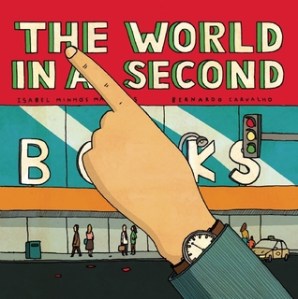
This picture book explores time and the way that things happen all at once across the world. Small moments are captured from various countries: an elevator stuck in New York City, a horn honks in traffic in Mexico, a volcano erupts, a boy learns to balance on his bike. One after another these snapshots of time are happening all at once and yet also form a lovely series of events that are all entirely human and show how interrelated our world actually is.

The concept is at once immensely simple and also incredibly complex, the understanding that your own life is just one of many being lived at the very same time. Martins embraces that duality in the book, capturing those universal moments but also showing the diversity around the world. A guide at the end of the book includes a map of where the various events take place all at the same time. There is a distinct wonder to the book, a feeling that the world is both larger and smaller than it had seemed to be a second before.

Carvalho’s illustrations are bold and graphic. He uses thick black lines to create scenes that are active and beautiful. One page contrasts with the next, showing diverse people and settings. The result is a feeling of moving clearly from one place to the next with each turn of the page, from lush jungles to concrete settings, from bright sunlight to clouded evening.

Perfect to start discussions about time and place and even time zones, this picture book allows children to think in a bigger way about their world, diversity and their own place. Appropriate for ages 4-7.

Reviewed from copy received from Enchanted Lion Books.

Review: Hoot Owl Master of Disguise by Sean Taylor

hoot owl master of disguise

Hoot Owl, Master of Disguise by Sean Taylor, illustrated by Jean Jullien

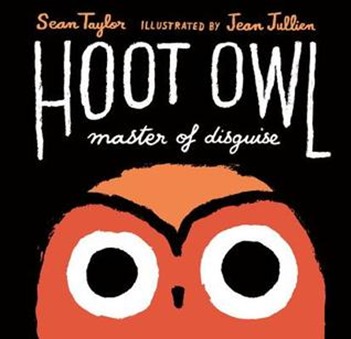
A very hungry owl uses a unique approach to find his dinner in this silly picture book. Hoot Owl is a master of disguise, so he as he hunts in the dark night, he switches into different costumes to trick his prey. First, he sees a rabbit and so he puts on his carrot disguise. It doesn’t work to tempt the rabbit, so he moves on to a lamb. Hoot Owl disguises himself as a mother sheep to lure the lamb closer, but that doesn’t work either. Maybe a pigeon will be fooled by his clever birdbath costume? Nope. Then finally, he finds something to eat that can’t move away – pepperoni pizza! But will his waiter costume work?

The voice of owl as the narrator for the story is so much fun to read aloud. He is brazen, confident and sure that eventually his unique approach to hunting will work out. Never daunted by disappointment, he moves on to the next meal quickly and eagerly. Throughout, Hoot Owl expresses himself in metaphors and playful language. The night is “black as burnt toast” and his eyes “glitter like sardines” when they see the pizza.

Jullien’s illustrations are bold and gorgeous. The colors are bright and fun, the orange of owl popping against that black night sky. Hoot Owl’s personality shines on the page, his head peeking out from various angles as he hunts his prey.

This playful picture book is a great read aloud, bright, funny and impressive. Appropriate for ages 3-5. 

Reviewed from library copy.

Review: Room for Bear by Ciara Gavin

room for bear

Room for Bear by Ciara Gavin (In InfoSoup)

Bear visited the Duck family one spring and then never left. He fit in perfectly in many ways, except for their house which was not designed for someone Bear’s size. So Bear set off in search of a perfect space for all of them. But it was hard to find a place that worked. Places that fit Bear perfectly did not work for the Ducks. Where the Ducks were happy, Bear was not. Then Bear thought that maybe it was because HE did not fit in with the Ducks after all, so he went away to find a home just for him. The Ducks missed Bear horribly, and Bear missed the Ducks. Finally, Bear found just the right huge cave for himself and then came up with a clever Duck-sized solution that would let them all live together happily.

This picture book is about families and what makes a family. Told from the point of view of animals, it speaks beyond cultures and skin color to a feeling where differences in general are embraced and honored. At the same time, the book honors the feeling a person can have of fitting in just fine sometimes and in other situations feeling that they are an outsider. These complex feelings are caught on the page without over dramatizing them. The result is a book the embraces adoptive and blended families of all sorts without making the picture too rosy and uncomplicated.

Gavin’s illustrations are done with a whimsical sense of humor. From Bear trying to fit into a tiny and tippy Duck boat as a home to the unhappy Ducks sitting around the table forlornly missing Bear, she captures emotions clearly on the page as well as the dilemmas of differences. The illustrations are softly painted with fine ink lines that allow both the big bear and small ducks to have personality galore.

A winning read that speaks to all families and particularly adoptive and blended families. Appropriate for ages 3-5.

Reviewed from library copy.