Review: Vegetables in Underwear by Jared Chapman

vegetables in underwear

Vegetables in Underwear by Jared Chapman

Released April 7, 2015.

All different sorts of vegetables demonstrate the joys of wearing big-kid underwear in all sorts of colors and styles. Never taking the subject too seriously, this book celebrates an often under-appreciated piece of clothing. One after another vegetables show the different sorts of underwear from dirty to clean, big to small, and serious to funny. But there is one sort of kid who doesn’t wear underwear, since babies wear diapers. Suitable giggle-worthy, these grinning vegetables invite young children to join the underwear ranks.

Chapman has written this book in an infectious rhyme that is jaunty and adds much to the fun of reading this book aloud. One never quite knows what is on the next page, except that it will be friendly and fun. The book ends with a silly reminder that you should have your clothes on top of your underwear before you leave the house, something that will have preschoolers laughing along.

Chapmas has created an entire garden of smiling vegetables here. Using whitespace very nicely, they pop on the page in all of their colorfulness. The vegetables are friendly, approachable and entirely silly. Children will immediately get the joke of vegetables being the ones to show humans how to wear undies.

Funny and friendly, this is a great pick for potty training giggles. Appropriate for ages 3-5.

Reviewed from copy received from Abrams.
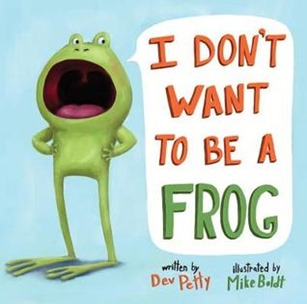
Review: I Don’t Want to Be a Frog by Dev Petty

i dont want to be a frog

I Don’t Want to Be a Frog by Dev Petty, illustrated by Mike Boldt

A little frog has decided that he doesn’t want to be a frog. He’d much rather be a… cat! Why? Because frogs are too wet. But a bigger frog explains that there is no way he can be a cat, because he’s a frog. Then he decides he wants to be a rabbit, since he can already jump and because frogs are too slimy. But he’s missing the long ears. Maybe a pig? But then you have to eat garbage. How about an owl? Nope, he can’t turn his head all the way around. Finally, a wolf comes along and gives the little frog a perfect reason to be happy to be a frog.

This debut picture book makes for a great read aloud. The two voices of the pair of frogs form the entire story, creating a great dynamic together. The story may be very silly, and it certainly is, but at the heart it is a child questioning if it might be better to be something entirely different, something furry or something that flies. It’s a classic case of identity crisis and one that children will relate to even while they giggle about it.

Boldt’s illustrations play up the humorous aspect of the story. The expressions on the frogs’ faces are well drawn and convey the emotions they are feeling very clearly. The use of speech bubbles and hand lettering makes for a book that has the feel of a comic book. Combined with the silly story, the illustrations make it even more funny.

Get this in the hands of Mo Willems fans who will completely fall for this loud little frog with big ideas. Appropriate for ages 3-5.

Reviewed from copy received from Doubleday Books for Young Readers.

Review: Little Baby Buttercup by Linda Ashman

little baby buttercup

Little Baby Buttercup by Linda Ashman, illustrated by You Byun

The life of a toddler is explored in this loving picture book that celebrates all of the small moments that make up a busy toddler day. Written in bouncy rhyme, the book matches the endless energy of a small child. From waking up to hugs and moving on through the day to bedtime, the day is filled with activity.  Some is as simple as eating and wearing some of the food. Others are visits to the park and meeting friends there. There is even a skinned knee on the playground and some rain to add a little drama, but all is patched up quickly and the rain is delightful when viewed from a coffee shop with a treat.

Moving from one activity to the next, the book bounces along filled with small moments that add up to one full day for a little one. Children will see their own activities in this urban setting, which is nicely multicultural. There is plenty of green space rather than concrete too, thanks to parks and the neighborhoods are depicted as friendly and welcoming to little children. Ashman shows the delight of new discoveries alongside the activities of a regular day and ends up with a rich wealth of time spent with loved ones.

Byun’s illustrations are lovely. With a bright color palette, the paint and ink illustrations are filled with sunlight and show the strong connection between mother and child. The illustrations are busy with details which will delight children, particularly when they head out into the neighborhood. Shining with friendliness, these illustrations are rich and warm.

Toddlers will see their own busy days on the page here with plenty to point at and name and talk about. Appropriate for ages 1-3.

Reviewed from copy received from Nancy Paulsen Books.

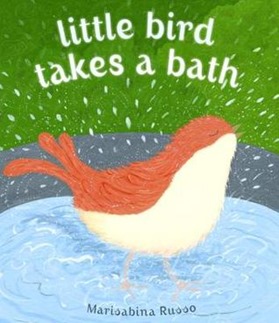
Review: Little Bird Takes a Bath by Marisabina Russo

little bird takes a bath 

Little Bird Takes a Bath by Marisabina Russo

Little Bird hates the rain and it was raining on his nest high above the city. The next morning though, the rain was gone and it was a lovely day. It was the perfect day for a bath! But the trouble was finding the right puddle. Some puddles were too big, some too small, and others were too crowded with other bathers. Then Little Bird found just the right puddle on a path in the park. But over and over again he got interrupted during his bathing. There was a bouncing ball, a little girl in flip flops, and a dog. By the time they had all gone through his puddle, it was far too small to bathe in. Little Bird flew up above the city, then spotted a fountain that looked like it was just the right size for a little bird.

Russo’s picture book is gentle and echoes traditional stories. She incorporates repetition and the mirroring of Goldilocks finding things that were “just right” adds much to the story. As the different things interrupt Little Bird’s bath, they are shown by the noise they make and then the reader turns the page to see what is making that noise. This little touch makes the book more dynamic and interactive for young listeners.

Russo’s art is just as inviting as the story she weaves. She makes sure that readers know that this is a city bird both in the text and the illustrations. Her images move from close ups of Little Bird to most distant images of the cityscape and how Little Bird flies across it. This change of scale makes the book interesting and children will enjoy seeing the path of Little Bird as he locates puddles and fountains in the city.

A great pick for rainy read alouds, this book will be welcome at toddler and preschool story times. Appropriate for ages 2-4.

Reviewed from digital galley received from Edelweiss and Schwartz & Wade.

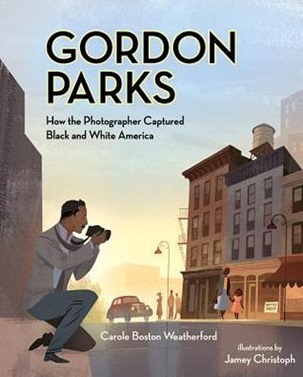
Review: Gordon Parks by Carole Boston Weatherford

gordon parks

Gordon Parks: How the Photographer Captured Black and White America by Carole Boston Weatherford, illustrated by Jamey Christoph

Gordon Parks had a rough beginning to his life from being born almost stillborn to losing his mother at age 14. He was told by his white teacher that he and the rest of his all-black class would end up as either porters or waiters. Parks did do those jobs, but then he purchased a used camera and everything changed. He started photographing models and then turned his camera towards the struggling families in Chicago and Washington DC. He is pointed towards one specific subject who will create his most famous image, American Gothic, the picture of an African-American cleaning woman standing in front of the American flag with her mop in hand. Parks managed to show racism with a clarity thanks to just picking up a camera at first.

Weatherford keeps this book very friendly with a minimal amount of text in the bulk of the book. She does include an author’s note at the end that fills in more of the extensive career of Parks as a film director and Renaissance man. The focus here in this picture book biography is Parks’ photographic work and the impact he had on exposing racism and poverty in the inner city, showing hard working people who were still in poverty. Make sure to turn to the end of the book to see his photographs and their intense message.

Christoph’s illustrations are stellar. Using a subtle color palette, the images echo the photographs that Park took, but not too closely. Instead they build upon them, showing Parks taking the images and embracing the dark beauty of the back streets of urban spaces. He also beautifully captures emotions and the humanity of Parks’ subjects that also shines in his photographs.

An important picture book biography, this book shows how one person can make a difference and have a voice. Appropriate for ages 7-9.

Reviewed from library copy.

Review: Fly! by Karl Newsom Edwards

fly

Fly! by Karl Newsom Edwards

Little Fly can’t do what the other bugs in the garden can do.  He tries to act just like them, but it doesn’t work out quite right. He can’t wiggle like a worm or jump like a grasshopper. He can’t march in formation like the ants or swing like a spider. He’s hopeless at digging and chewing leaves too. It’s not until some flying insects inspire him to try his wings that he figures out exactly what he’s meant to do – fly!

This very simple picture book works so well. The insect who is doing the movement or action states it with confidence and in their own unique font. Then Fly tries it too but always with a question mark wondering about it. So the book reads aloud well and offers plenty of options for tone and approach as a teacher or librarian. In other words, be just as silly as you would like and it will work well.

One of the huge strengths of this book is its illustrations. From the pop-eyed little fly to the other insects, they are all distinctive and brimming with personality. Sharp-eyed readers and listeners will hints of the next insect before you turn the page, creating a feeling of moving along a path of insects. Make sure to check out the Bug Facts at the end of the book for the names of the insects you meet in the story.

Simple and innately funny, this picture book has a zingy personality all its own. Appropriate for ages 2-4.

Reviewed from digital copy from Edelweiss and Knopf Books for Young Readers.

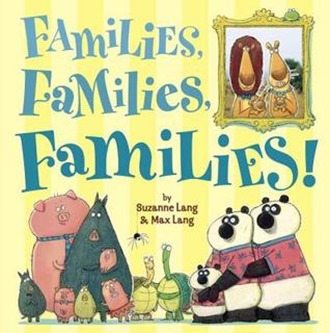
Review: Families, Families, Families! by Suzanne Lang

families families families

Families, Families, Families! by Suzanne Lang and Max Lang

Released March 24, 2015.

In rhythmic rhyme, this picture book celebrates each and every kind of family there is. Starting with families with lots of siblings, the book quickly moves to embrace only children, families with gay and lesbian parents, single parent families, and children who live with extended family. Then the book moves into other differences like step families, adoption, and parents who may or may not be married. Towards the end, the book gains momentum and speed and rushes merrily through silly types of differences in families, that underline how the most important thing in each of these different sorts of families is the love that is there.

The rhyming text has a friendly bounce to it and that ramping up of speed at the end of the book is a great twist and a grand way to reach the loving finale. The book maintains a great sense of humor throughout, both in its words and its illustrations.

The illustrations are done with cartoon cut outs placed on photographic backgrounds and then mounted as pictures in a photo album. The use of both cartoons and photographs gives this book a fresh approach. The illustrations also use animals instead of people, making it all the more friendly and approachable for small children who will enjoy finding their own kind of family on the page, probably more than once!

Funny, friendly and embracing everyone, this picture book is all about the love within families and acceptance for all. Appropriate for ages 3-5.

Reviewed from digital galley received from Edelweiss and Random House.

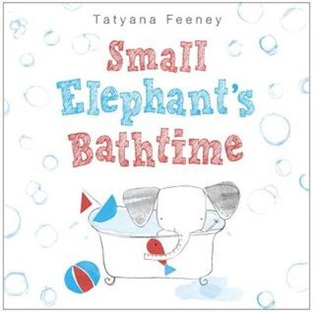
Review: Small Elephant’s Bathtime by Tatyana Feeney

small elephants bathtime

Small Elephant’s Bathtime by Tatyana Feeney

While Small Elephant is happy to play in water or drink it, he doesn’t like taking a bath at all. His mother tries all sorts of thing to entice him into the bathtub. She fills it with plenty of toys. She blows bubbles in the air. But nothing works. Small Elephant tries to be too busy to take a bath and gets very mad when his mother insists on a bath. He has a tantrum and then hides from the bath. Then his father gets involved and makes Small Elephant giggle enough to try out the bath after all. But who will be able to get him out when he discovers how much fun he is having?

The author of Small Bunny’s Blue Blanket and other picture books has a winner with this title. Just the right playful tone is set here for toddlers who are also reluctant to stop what they are doing to take baths. The gentle approach of both parents is great to see, offering options towards tantrums and reluctance that are inventive and filled with humor.

As always Feeney’s art has a refreshing looseness about it. Line drawings with splashes of watercolor color, the book has an aesthetic that will appeal to children and adults alike. It uses limited colors to great effect, creating a cohesive and playful feel.

Soapy, sudsy, bubbly fun for small children who will relate to the emotions Small Elephant feels.  Appropriate for ages 2-4.

Reviewed from digital galley received from Edelweiss and Knopf Books for Young Readers.

Review: Wolfie the Bunny by Ame Dyckman

wolfie the bunny

Wolfie the Bunny by Ame Dyckman, illustrated by Zachariah OHora

When the bunny family came home, they found a little bundle on their doorstep. It was a baby wolf! Mama and Papa were thrilled to take him in, but Dot knew that the wolf was going to eat them all. Still, the bunny family took Wolfie in. Dot kept an eye on him all night long, and tried again at breakfast to warn her family that they were going to be eaten. No one listened, again. Finally, Dot’s friends agreed that Dot was right and they went to play somewhere else. When she got back, Wolfie would not leave Dot alone. Days went by and Wolfie started to grow and grow. He also started to eat and eat, so Dot was sent to the store along with Wolfie. It was there that Wolfie finally showed his fangs, but it doesn’t turn out in the way that Dot was expecting!

Dyckman has created a very clever little book that shows adoption and new siblings in a fresh way. Dot is convinced from the very beginning that taking in Wolfie is a bad idea and that it will be catastrophic for her family. This feeling of doom is very much what human children feel when a new baby is announced. Wolfie goes through all of the steps of a new sibling, from getting all of the attention to being a pest. Yet through the entire book, Dyckman keeps the focus on wolves and bunnies and how it will all play out, creating a welcome added dynamic to the story.

OHora’s illustrations add to the humor on the page. Done in acrylic, the illustrations have a signature flat feeling to them that is very modern. They capture the cheerful bunny family, the worried Dot, and the adorable Wolfie. OHora also creates a dynamic neighborhood for the story to take place in that makes the entire book feel grounded and real. Or as real as a book about wolves and bunnies can be.

Clever, funny and bright, this picture book captures have a new sibling in a fresh way. Appropriate for ages 3-5.

Reviewed from library copy.