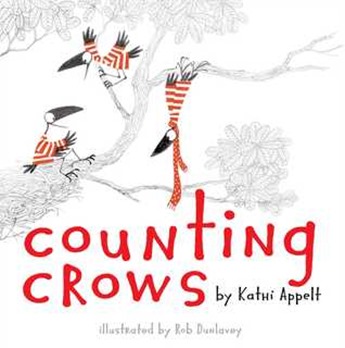
Review: Counting Crows by Kathi Appelt

counting crows

Counting Crows by Kathi Appelt, illustrated by Rob Dunlavey (InfoSoup)

This playful picture book comes from the author of The Underneath and other novels for older children. This counting book does not move from one to twelve, but instead starts at three and allows a merry amount of counting along the way. Throughout the action is led by the crows who climb around on trees, sit on lines and find all sorts of treats to eat, including spicy ants. The story moves forward with counting until there are twelve crows who then discover one cat!

Appelt proves that she can be a very successful writer for any age of child with her first picture book. Her rhyme reads aloud so well that it’s impossible to read it silently to yourself. It has a great rhythm and buoyancy to it, giving the book a really dynamic energy and feel. I also enjoy a book that has counting in it, but isn’t solely a counting book. This one tells a full story in a cheery way and allows you to share it either as a story book or a concept book.

The illustrations truly make the book unique. Using light drawings with touches of red, the book pops. Readers may notice the one scarf-wearing crow who appears in each scene and then they can see what happens to the scarf after the cat appears. It’s a nice touch that may have some readers turning back to trace the scarf from the beginning of the book.

Bouncy, rhyming, fun and jaunty, this picture book has its own unique tone and feel that readers will appreciate. Appropriate for ages 2-4.

Reviewed from copy received from Atheneum Books for Young Readers.
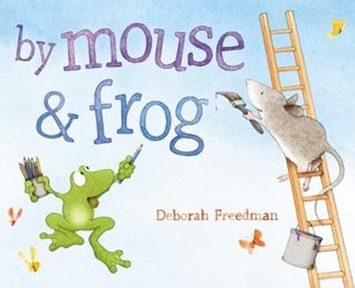
Review: By Mouse and Frog by Deborah Freedman

by mouse and frog

By Mouse and Frog by Deborah Freedman

Released April 14, 2015

Mouse wakes up early to start work on the new story she wants to write. It is a quiet story about a mouse who is setting the table. But before she can get any farther in her story, exuberant Frog hops in and starts adding new elements to the story, including cake, a king, and lots of ice cream. Meanwhile Mouse is trying to mop up all of the mess of the spilled tea, melting ice cream, while Frog gets completely out of control and takes over entirely. Finally Mouse has had enough and yells that Frog is not listening at all! They erase the entire mess of Frog’s story and start again with just Mouse’s ideas of morning tea. Frog is forlorn, unable to help until Mouse realizes that there is room in the story for her quiet ideas and Frog’s wild ones.

Freedman shows without any didactic tone that collaboration on stories and art is possible, as long as everyone listens, communicates and compromises. In fact, the end result is a lot more lovely! Showing that wild ideas are not the best way to come up with a story, but that also quiet thoughts have value, is a wonderful show of support for quieter thinkers. At the same time, that wild moment of Frog’s makes the entire book work, showing how out of control and wonderful some ideas can be. It’s a balanced look at creativity and collaboration that is welcoming and inclusive.

As always Freedman’s art is exceptional. Once again she does washes of watercolor that are gorgeously messy and free. The spilled tea and other elements of Frog’s story embrace all of that. Mouse’s story is shown in pencil drawings that are childlike and rough while also being very neat and structured. They show each characters personality clearly. At the end, it is a lovely marriage of the two styles, filled with bright colors and yet neat as a pin.

Creative and great fun to share aloud, this picture book demonstrates how teamwork and collaboration should work. Appropriate for ages 3-5.

Reviewed from ARC received from Viking Books for Young Readers.

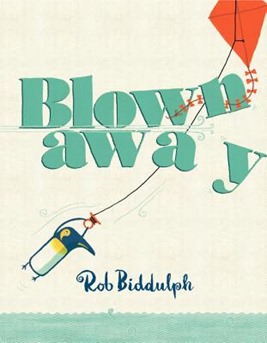
Review: Blown Away by Rob Biddulph

blown away

Blown Away by Rob Biddulph

Penguin Blue has a brand new kite but when he flies it, it lifts him right off the ice and up into the air. Two other penguins try to help and get swept along too. Wilbur the harp seal tries to catch them and joins the group flying along. Blue calls out for help from a polar bear and then Clive is riding along too, his boat and all. They are finally dropped on a lush warm jungle isle where they all agree it is way too hot. Blue has a great solution though, it will just take Clive’s boat, leaves and vines and one good gust of wind that is provided by the elephants on the island. Soon the group are back in their icy home, but there is one stowaway from the island who now needs to figure out how to get back to the warmth of the jungle.

This romp of a picture book is filled with a positive feel throughout. Each new challenge is playfully presented and merrily dealt with through clever solutions. The text rhymes and creates a jaunty cheer that makes this book great fun to share aloud. The rhyming story is written very strongly with a great story arc that solidly supports the humor. This is a book that is immensely satisfying to read.

The design of the book is stellar with playful word design and placement that enhances the strong illustrations. The book is beautifully illustrated with images filled with strong graphic elements, deep colors and also small playful touches. Children will enjoy lingering over the illustrations and spotting the penguins waiting for the bus on an ice floe and the bear losing his map immediately. The combination of strong vivid illustrations and small details make for a book that has its own unique vibe.

A great read-aloud for any penguin story time, this picture book will be enjoyed by preschoolers looking for a complete and playful story. Appropriate for ages 3-5.

Reviewed from copy received from HarperCollins.

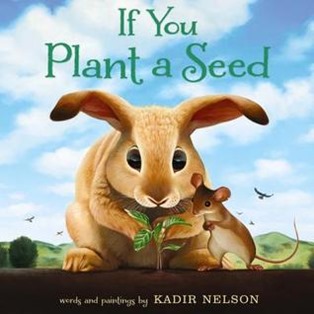
Review: If You Plant a Seed by Kadir Nelson

if you plant a seed

If You Plant a Seed by Kadir Nelson

Award-winning Nelson tells a story about the power of sharing in this simple and striking picture book. The story begins with a rabbit and a mouse planting a tomato seed, a carrot seed and a cabbage seed in their garden. Then the two wait through all kinds of weather for the seeds to sprout and grow. Until finally, they have three lovely plants and are able to feast on their bounty. Then the birds arrive and silently ask for the rabbit and mouse to share. But no sharing happens and instead there is a struggle and the plants are destroyed. One small red tomato survives and the mouse offers it to the birds. The birds in turn repay that kindness with seeds of their own which then sprout into a much larger and more diverse garden for them all to enjoy, along with even more animals.

Nelson’s writing here is simple but also to the point. He shows young readers what is happening in the story. Using the symbolism of the garden throughout, he explains the importance of sowing the seeds of kindness rather than selfishness and finally how beautiful it is in the end when you do that. There is little subtlety here and the symbolism is beautifully integrated into the story as a whole.

As always, Nelson’s illustrations are pure delight. His animals shine on the page, showing emotions clearly and beautifully both in their eyes and the positions of ears and tails. Other details bring the entire scene to life. Perhaps my favorite page is the birds silently watching the rabbit and mouse feast on the produce. It’s funny and yet the tension is clear too. The entire book is filled with small lovely moments like this told in images rather than words.

Community, sharing and kindness come together in this splendidly illustrated picture book that is sure to be enjoyed along with other spring gardening books. Appropriate for ages 3-5.

Reviewed from library copy.

Review: Good Night, Knight by Betsy Lewin

good night knight

Good Night, Knight by Betsy Lewin

When Horse and Knight are falling asleep, Knight has a dream about golden cookies. So he wakes up Horse and sets off on a quest to find the golden cookies. They search everywhere, in hollow tree trunks and under water and in the bushes, riding from one place to the next at a brisk trot. It isn’t until they return home and Knight has collapsed from exhaustion that Knight realizes that the cookies were right in their castle all along. The two have a golden cookie feast and then go to bed, but it’s not long before Horse has a golden dream of his own!

Written for emerging readers, this picture book is written with a limited vocabulary and words that repeat on the page and from one section of the story to another. The picture book format will invite reluctant readers to give reading a try. Lewin also wisely incorporates plenty of humor and galloping around, giving the reader reasons to turn the page to see what will happen next. It’s a good mix of action and silliness.

Lewin’s illustrations break the text into nice readable chunks appropriate for beginning readers. Plenty of attention is paid to the illustrations, offering humor beyond the text itself. For example, Knight never removes his armor, even to sleep! The art is simple, funny and inviting.

Head out on a quest with your beginning reader and this simple picture book. Appropriate for ages 3-5.

Reviewed from copy received from Holiday House.

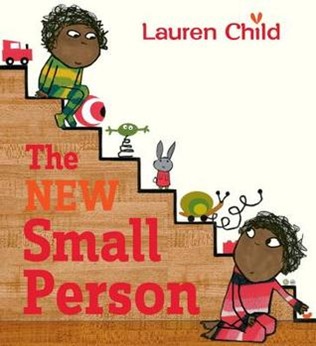
Review: The New Small Person by Lauren Child

new small person

The New Small Person by Lauren Child

The creator of Charlie and Lola returns with a new picture book sibling pair. Elmore Green has always been an only child. He has his own room, no one moves his toys around, and no one eats his jelly beans. But suddenly a new baby enters the picture and soon Elmore finds himself sharing a room, unable to leave any of his toys unattended, and no one pays him attention. Perhaps worst of all, his jelly bean collection is licked by his little brother! Just as all seems to be falling apart, Elmore discovers that there are some parts of having a new sibling that aren’t so bad after all like laughing at TV shows together, sharing toys, and even sharing jelly beans (maybe).

Child has a wonderful way of understanding what children are thinking. While other new sibling books have more focus on the loss of parental attention, Child shows exactly how a small sibling can bother an older one. She merrily skips quickly past the baby stage and directly to toddlerhood where the most disruption can take place. Young readers will enjoy a book that has plenty of humor but also is realistic too.

Child’s art is done in her signature style. Her collage work incorporates pieces of cloth and patterned paper. I appreciate that her new family are people of color and also that it is not a focus of the book but just a visual component, natural and not remarked upon.

Perfect for Charlie & Lola fans and also for older siblings experiencing their own toddlers at home. Appropriate for ages 3-5.

Reviewed from library copy.

Review: One Plastic Bag by Miranda Paul

one plastic bag

One Plastic Bag: Isatou Ceesay and the Recycling Women of the Gambia by Miranda Paul, illustrated by Elizabeth Zunon

Used to just dropping their baskets when they wore out, people in Njau, Gambia did the same thing with their plastic bags, but the plastic bags decayed like the baskets would. They also didn’t last nearly as long. Torn bags can’t be mended or used at all, so one by one, then ten by ten, and thousands by thousands they were thrown to the side of the road. They accumulated in heaps, poisoning the goats that tried to eat the garbage around them. Water pooled in them and brought more mosquitoes and diseases. Burying and burning them weren’t the solution either. Then Isatou Ceesay found a way to recycle the plastic bags and get jobs for her community by transforming them into something new.

This book speaks to the power that one person can have to change things, both for themselves and their entire community. The prose here is straight-forward but also has moments of poetry thrown in, showing the devastation the plastic bags were creating in the Gambia. The book also shows the way that an idea is born, comes to fruition, passes through being scorned and is finally embraced.

The illustrations by Zunon are remarkable. Using collage, they bring together the textures of the weaving and baskets as well as the plastic bags from photographs. The textiles of the Gambia are also incorporated and vibrate on the page. They are combined with painting and other more playful textures to create the natural setting and the people.

Strong writing and superb illustrations combine to tell the true story of how one woman transformed pollution. Appropriate for ages 6-9.

Reviewed from library copy.

Review: Vegetables in Underwear by Jared Chapman

vegetables in underwear

Vegetables in Underwear by Jared Chapman

Released April 7, 2015.

All different sorts of vegetables demonstrate the joys of wearing big-kid underwear in all sorts of colors and styles. Never taking the subject too seriously, this book celebrates an often under-appreciated piece of clothing. One after another vegetables show the different sorts of underwear from dirty to clean, big to small, and serious to funny. But there is one sort of kid who doesn’t wear underwear, since babies wear diapers. Suitable giggle-worthy, these grinning vegetables invite young children to join the underwear ranks.

Chapman has written this book in an infectious rhyme that is jaunty and adds much to the fun of reading this book aloud. One never quite knows what is on the next page, except that it will be friendly and fun. The book ends with a silly reminder that you should have your clothes on top of your underwear before you leave the house, something that will have preschoolers laughing along.

Chapmas has created an entire garden of smiling vegetables here. Using whitespace very nicely, they pop on the page in all of their colorfulness. The vegetables are friendly, approachable and entirely silly. Children will immediately get the joke of vegetables being the ones to show humans how to wear undies.

Funny and friendly, this is a great pick for potty training giggles. Appropriate for ages 3-5.

Reviewed from copy received from Abrams.

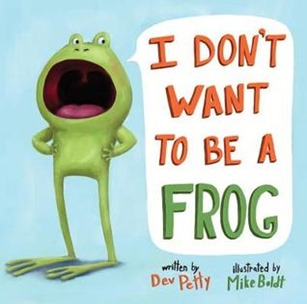
Review: I Don’t Want to Be a Frog by Dev Petty

i dont want to be a frog

I Don’t Want to Be a Frog by Dev Petty, illustrated by Mike Boldt

A little frog has decided that he doesn’t want to be a frog. He’d much rather be a… cat! Why? Because frogs are too wet. But a bigger frog explains that there is no way he can be a cat, because he’s a frog. Then he decides he wants to be a rabbit, since he can already jump and because frogs are too slimy. But he’s missing the long ears. Maybe a pig? But then you have to eat garbage. How about an owl? Nope, he can’t turn his head all the way around. Finally, a wolf comes along and gives the little frog a perfect reason to be happy to be a frog.

This debut picture book makes for a great read aloud. The two voices of the pair of frogs form the entire story, creating a great dynamic together. The story may be very silly, and it certainly is, but at the heart it is a child questioning if it might be better to be something entirely different, something furry or something that flies. It’s a classic case of identity crisis and one that children will relate to even while they giggle about it.

Boldt’s illustrations play up the humorous aspect of the story. The expressions on the frogs’ faces are well drawn and convey the emotions they are feeling very clearly. The use of speech bubbles and hand lettering makes for a book that has the feel of a comic book. Combined with the silly story, the illustrations make it even more funny.

Get this in the hands of Mo Willems fans who will completely fall for this loud little frog with big ideas. Appropriate for ages 3-5.

Reviewed from copy received from Doubleday Books for Young Readers.