Review: A Poem in Your Pocket by Margaret McNamara

poem in your pocket

A Poem in Your Pocket by Margaret McNamara, illustrated by G. Brian Karas

The third in the Mr. Tiffin’s Classroom series, this book focuses on Elinor, a girl who just wants everything to be perfect.  Unfortunately though, poetry and perfection really don’t work together no matter whether you are talking haikus, concrete poems or rhyming stanzas.  A poet is going to be visiting their school and Elinor desperately wants to impress her with her poetry.  But as the time goes by, the pressure builds and Elinor becomes less and less able to write poetry.  When she finally does start writing, she’s not happy with any of the poems she has written.  Can the kind teacher Mr. Tiffin find a way to let Elinor know that it’s OK to make mistakes?  Maybe this is a job for a poet!

This is a wonderful addition to an already strong series.  McNamara “perfectly” captures the trap of perfectionism for students and the pressure that it builds in a person.  Tying it to poetry was inspired, something that doesn’t work with tension or pressure but instead relies on inspiration and creativity.  Elementary students will see themselves in both Elinor and her classmates who are more relaxed about the entire thing.  Watch for the poem that ties to How Many Seeds in a Pumpkin? for fans of the series. 

Karas’ illustrations continue in his signature style that is playful and friendly.  His drawings add to the accessibility of the entire book and the series as a whole. 

A winning addition to a popular series, this third book will delight during poetry units and may inspire a more relaxed approach to writing too.  Appropriate for ages 6-9.

Reviewed from digital galley received from Schwartz & Wade and Edelweiss.

My Top 30 Children’s Nonfiction Books of 2014

Here are my picks for the best nonfiction titles for children from this past year.  The list includes books of poetry and nursery rhymes along with more factual forms of nonfiction.  Enjoy!

All Different Now: Juneteenth, the First Day of Freedom Beyond Magenta: Transgender Teens Speak Out

All Different Now: Juneteenth, the First Day of Freedom by Angela Johnson

Beyond Magenta: Transgender Teens Speak Out by Susan Kuklin

Born in the Wild: Baby Mammals and Their Parents 17320985

Born in the Wild: Baby Mammals and Their Parents by Lita Judge

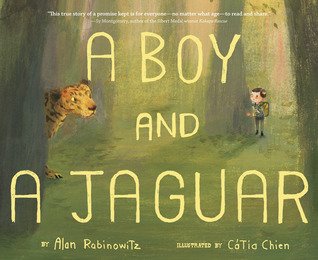
A Boy and a Jaguar by Alan Rabinowitz

Brown Girl Dreaming 21892530

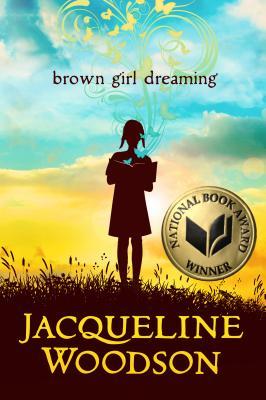
Brown Girl Dreaming by Jacqueline Woodson

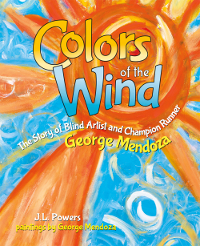
Colors of the Wind: The Story of Blind Artist and Champion Runner George Mendoza by J. L. Powers

The Cosmobiography of Sun Ra: The Sound of Joy Is Enlightening Dare the Wind: The Record-breaking Voyage of Eleanor Prentiss and the Flying Cloud

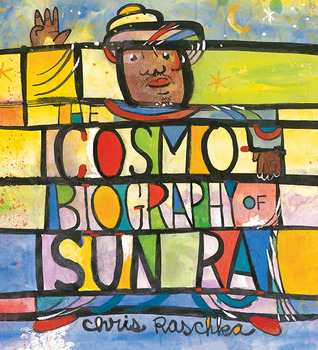
The Cosmobiography of Sun Ra: The Sounds of Joy Is Enlightening by Chris Raschka

Dare the Wind: The Record-breaking Voyage of Eleanor Prentiss and the Flying Cloud by Tracey E. Fern, illustrated by Emily Arnold McCully

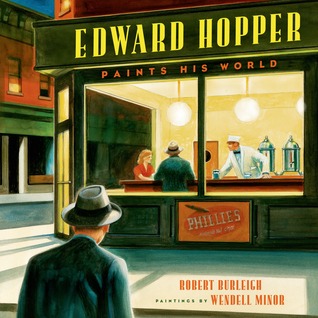
Edward Hopper Paints His World Eye to Eye: How Animals See The World

Edward Hopper Paints His World by Robert Burleigh

Eye to Eye: How Animals See the World by Steve Jenkins

17870871 Firefly July A Year of Very Short Poems

Feathers: Not Just for Flying by Melissa Stewart

Firefly July: A Year of Very Short Poems by Paul B. Janeczko

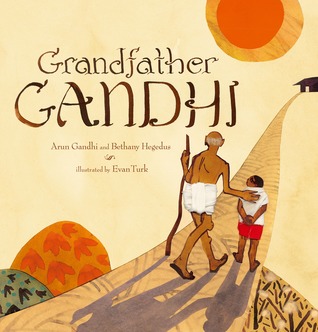
Goodnight Songs Grandfather Gandhi

Goodnight Songs by Margaret Wise Brown

Grandfather Gandhi by Arun Gandhi and Bethany Hegedus, illustrated by Evan Turk

Hi, Koo! A Home for Mr. Emerson

Hi, Koo!: A Year of Seasons By Jon J. Muth

A Home for Mr. Emerson by Barbara Kerley, illustrated by Edwin Fotheringham

How I Discovered Poetry The Iridescence of Birds: A Book About Henri Matisse

How I Discovered Poetry by Marilyn Nelson

The Iridescence of Birds: A Book about Henri Matisse by Patricia MacLachlan

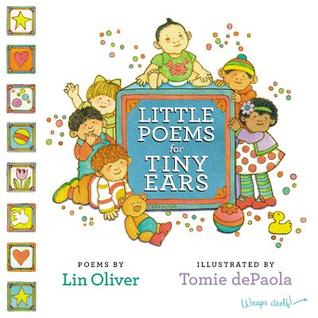
20388100 Little Poems for Tiny Ears

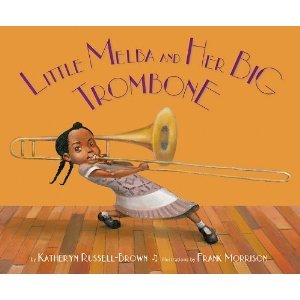
Little Melba and Her Big Trombone by Katheryn Russell-Brown, illustrated by Frank Morrison

Little Poems for Tiny Ears by Lin Oliver, illustrated by Tomie dePaola

Mr. Ferris and His Wheel The Noisy Paint Box: The Colors and Sounds of Kandinsky's Abstract Art

Mr. Ferris and His Wheel by Kathryn Gibbs Davis, illustrated by Gilbert Ford

The Noisy Paint Box: The Colors and Sounds of Kandinsky’s Abstract Art by Barb Rosenstock, illustrated by Mary GrandPre

Not My Girl Poem-Mobiles: Crazy Car Poems

Not My Girl by Christy Jordan-Fenton and Margaret Pokiak-Fenton, illustrated by Gabrielle Grimard

Poem-Mobiles: Crazy Car Poems by J. Patrick Lewis and Douglas Florian, illustrated by Jeremy Holmes

The Right Word: Roget and His Thesaurus The Scraps Book

The Right Word: Roget and His Thesaurus by Jennifer Fisher Bryant, illustrated by Melissa Sweet

The Scraps Book: Notes from a Colorful Life by Lois Ehlert

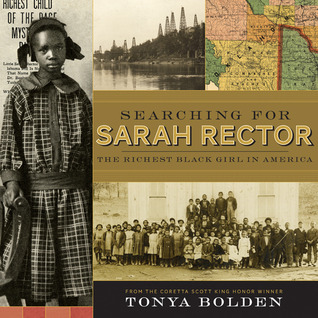
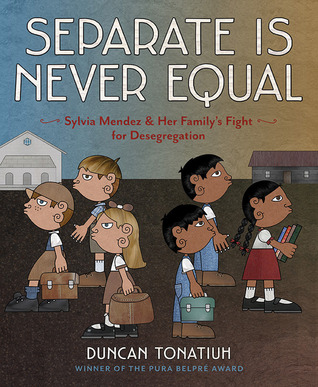
Searching for Sarah Rector: The Richest Black Girl in America Separate Is Never Equal: Sylvia Mendez and Her Family's Fight for Desegregation

Searching for Sarah Rector: The Richest Black Girl in America by Tonya Bolden

Separate Is Never Equal: Sylvia Mendez and Her Family’s Fight for Desegregation by Duncan Tonatiuh

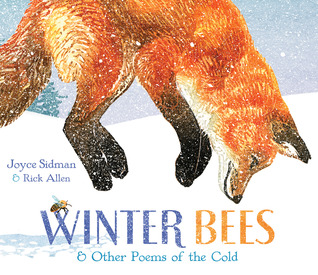
Thomas Jefferson: Life, Liberty and the Pursuit of Everything Winter Bees & Other Poems of the Cold

Thomas Jefferson: Life, Liberty and the Pursuit of Everything by Maira Kalman

Winter Bees and Other Poems of the Cold by Joyce Sidman and Rick Allen

Review: Malala, a Brave Girl from Pakistan/Iqbal, a Brave Boy from Pakistan by Jeanette Winter

malala iqbal

Malala, Brave Girl from Pakistan/Iqbal, a Brave Boy from Pakistan by Jeanette Winter

This nonfiction picture book celebrates the accomplishments of two young heroes from Pakistan.  Told side-by-side, in a book that flips over, the two young people both managed to make real changes in their country.  Malala Yousafzai is a very well-known heroine who fights for the rights of young women in Pakistan to have an education.  Iqbal Masih has also won human rights awards and fought for the end of child slavery in the carpet industry.  Both of them were shot as a result of their efforts to change their country.  Tragically, Iqbal was killed while Malala survived and continues to inspire people around the world.  These are examples of children who created the change their country was desperate for, changing the lives of other children through their efforts.  True heroes in every sense of the word!

Winter begins each of these nonfiction stories with an Author’s Note that explains in detail the life of the young person.  The story parts are told in spare text that shows on every page the ferocious pride that Winter has for their work.  There is an anger on the page, one that is exactly the right tone for what is happening in their stories.  While Iqbal may be lesser known to American children than Malala, their stories are so supportive of one another that the pairing strengthens both their stories.  Readers may pick up the book for Malala and along the way learn of this boy whose efforts were just as amazing.

Winter’s illustrations have the feeling of framed artwork on the page.  Done in strong colors, they have a beauty and straightforward nature that works well with the subject.  There is a directness here that you will also feel in the writing, the two combining to make a book that hits hard at what injustice there is in the world but also at how important children can be in realizing change.

A beautiful and inspiring picture book that adds diversity and true child heroism to your shelves.  Appropriate for ages 5-8.

Reviewed from copy received from Beach Lane Books.

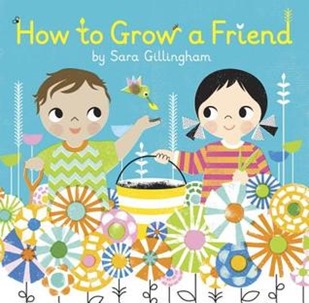
Review: How to Grow a Friend by Sara Gillingham

how to grow a friend

How to Grow a Friend by Sara Gillingham

Growing a friend is a lot like growing a flower as this picture book proves.  Just like flowers, friends need a seed and good soil.  You need space to bloom.  You need to be patient.  Sometimes your friend will bug you, but chase the bugs away together.  Don’t let your friend get stuck in the weeds.  Grow a whole garden of friends and know that there is always room for one more friend.  Along the way, the analogy of gardening strengthens the ties of the friendship, making this a very tight and strong picture book that shows that hard work, patience and time make for a great friendship.

Gillingham writes in a very earnest and straight forward tone here.  This is not a subtle analogy, but one that is presented straight to the reader.  The text of the book speaks about friendship while the illustrations show mostly the gardening aspect though at times it too is all about the human connection.  Young readers are shown clearly that friendship takes work and time.

Gillingham’s bright illustrations add greatly to the appeal of the book.  With an organic feel thanks to the texture of the prints, the illustrations have strong shapes, bright colors, and lots of patterns yet never get too busy or fussy.  They have a jaunty and frolicking feel to them that is very cheery.

Perfect for gardening and friendship story times, this picture book will have us thinking spring early this year.  Appropriate for ages 3-6.

Reviewed from digital galley received from Random House and Edelweiss.

Review: Little Red Riding Hood by Sybille Schenker

little red riding hood

Little Red Riding Hood by The Brothers Grimm, illustrated by Sybille Schenker, translated by Anthea Bell

This follow-up to the illustrator’s gorgeous rendition of Hansel and Gretel continues to show her amazing skills with cut paper illustrations.  The cover the book is pure black with cut outs that reveal a red and white pattern behind.  It’s rather like opening a door into another world.  The story is the traditional one, told in a simple way that highlights the more dramatic moments.  Be prepared for the traditional ending with the wolf killed, his body cut open and then refilled with stones so that he dies.  This is not a modernized and gentle version at all.  Yet that works particularly well with these incredible illustrations and the wonder they evoke. 

Schenker plays with her cut paper throughout.  There are times when the page is entirely cut through, into patterns.  Other times the illustrations are cut paper but the page is whole.  You will find yourself running your hands over the page to see if the cuts are actual or simply visual.  She shows such skill throughout creating moments that change as you turn the page and they become even more dazzling as you look back through the cuts.  My favorite page turn is when the wolf eats Little Red Riding Hood, it’s an astonishing change that works oh so well.

Wundergarden has some illustrations online from Schenker.  Here are ones from this book:

If you are looking for a version of Little Red Riding Hood to treasure, this is it.  It may not last for long on public library shelves, but it is a book that will be loved by those who discover it.  Appropriate for ages 4-6.

Reviewed from library copy.

Review: Creature Features by Steve Jenkins

creature features

Creature Features: 25 Animals Explain Why They Look the Way They Do by Steve Jenkins and Robin Page

Look right into the eyes of 25 animals as they answer a question about why they look the way that they do.  The animals range from sun bears to various birds to giraffes to frogs and fish.  With each turn of the page there is a new animal looking straight at you, ready to explain the feature that is their most unusual.  That explanation is filled with just enough scientific information to be fascinating and to inspire more exploration of the animal.  The paragraphs are short enough to be shared with even quite young children who are fascinated by animals.  This is a great addition to even the most crowded of animal shelves.

Filled with Jenkins’ trademark cut paper art, this is an exquisite look at each animal, some of which you may never have seen straight on from the front like the mole rat or the shoebill stork. The unique point of view makes for unusual images of these animals that make you look at them in a different way.  Wonderfully, Jenkins manages to make each meet your eyes in a distinct way that matches their species.  See how long you can lock gazes with the ferocious ones!

One that will be read again and again by young animal lovers, this book deserves a spot in every public library.  Appropriate for ages 6-9.

Reviewed from library copy.

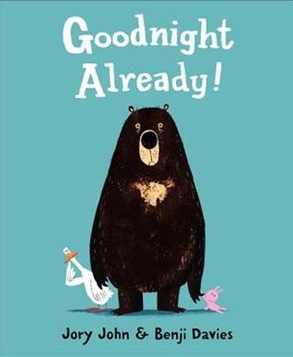
Review: Goodnight, Already! by Jory John

goodnight already

Goodnight, Already! by Jory John and Benji Davies

Bear is so very tired, all he wants to do is go to sleep.  But his next door neighbor, Duck, feels exactly the opposite and has never felt more awake as he reads a book on staying awake and drinks a pot of coffee.  As Bear climbs into bed and pulls up his blanket, ready to snooze, Duck comes over for a visit.  Duck offers all sorts of ideas of what they could do together, but all Bear wants to do is sleep.  Just when Bear is again about to fall asleep, Duck returns with a new idea to bake something.  But Bear once again sends him on his way.  When Duck comes in for a third time, Bear has had enough!   The evening though has time for one final ironic twist by the end of the book, one that will get readers giggling.

John captures both the very essence of being tired and wanting nothing more than to sleep and the zany energy that comes with insomnia.  It is that dynamic being thrust together in this picture book that leads to the hilarity.  It also helps that John has impeccable comic timing throughout the book, using repeating themes to really make the scenes pop.  The pace switches from one character to the next beautifully, the dozy slow of Bear and the yapping zing of Duck.

Davies’ illustrations capture the same shifts in energy and pace.  Duck’s entire home is bright yellow while Bear is surrounded by sleepy blues.  The silly additions of coffee and a book to stay awake make the situation even funnier.  The illustrations are deceptively simple, making this a very approachable book for children, one that conveys its humor right from the cover.

Perfect for kids who both love bedtime and hate it, as well as for their sleepy parents.  Appropriate for ages 3-5.

Reviewed from library copy.

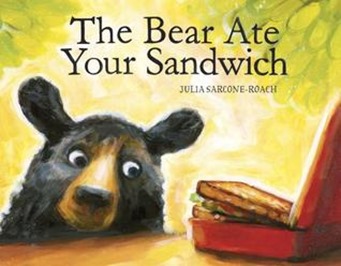
Review: The Bear Ate Your Sandwich by Julia Sarcone-Roach

bear ate your sandwich

The Bear Ate Your Sandwich by Julia Sarcone-Roach

Released January 6, 2015.

This picture book tells the story of exactly what happened to your sandwich.  See, it started with the bear.  He was having a great warm, bright morning when he smelled berries.  He found a pickup truck filled with berries, which he munched and then fell fast asleep in the back of the truck.  When he woke up, he was riding towards a huge city.  Now he was in a new forest, but a very different one.  He climbed, he scratched, he squished his toes in mud, he investigated.  He found a park and that is where he discovered your sandwich sitting on a park bench.  He then ran off, scared by the dogs around, climbed aboard a boat and returned to his own forest.  It’s all true you see, I saw it all.  Don’t you trust me?

The merriment in this picture book is pure joy to share.  And the voice that it is written in is so very earnest and honest, willing you with their very words to really believe them.  It’s so earnest that you immediately know that this is a voice not to be trusted.  But you won’t completely understand who is talking until the very end of the story.   The timing of the humor is impeccable, the writing is wonderfully strong and lovely, evoking a forest in an urban setting and letting the bear discover it. 

The illustrations have a richness to them.  The opening scenes of the bear in the forest play with light and shadows, greens and browns, dappling and shining.  It’s all lush and green and beautiful with the black bear anchoring the beauty around him.  Along the way there are other moments, particularly the ones where the bear investigates the city and then the lingering moments of him discovering the sandwich, approaching the sandwich, longing for it.  It’s all strikingly rendered.

Lush, strong and very funny, this picture book is a delight and just as satisfying as a sandwich for a hungry bear.  Appropriate for ages 3-5.

Reviewed from digital galley received from Random House and Edelweiss.

Review: Betty Goes Bananas by Steve Antony

betty goes bananas

Betty Goes Bananas by Steve Antony

Released December 23, 2014.

Betty is a gorilla and being a gorilla, she loves bananas.  So when she finds one on the ground, she wants to eat it so much.  But she can’t open it, even with her teeth, or her feet!  So what is a little gorilla to do?  Well, Betty throws a fit and cries and screams.  Then she calms down and Mr. Toucan tells her that there is no need to act like that, he will show her how to peel the banana.  And he does.  But Betty had wanted to peel it herself.  And she starts once again to cry and scream and kick.  Mr. Toucan stays and waits for her to calm down again, telling her that she can peel the next banana she finds.  Betty is happy and is about to finally eat the banana.  When it breaks.  And I bet you can guess what she does next!
This is a rather merry book about the strong emotions that come with being a toddler.  Betty is a jolly little gorilla until she is disappointed, something that children and adults alike will recognize immediately.  The addition of Mr. Toucan as an adult figure works well here, and I appreciate that he allows Betty to calm down before simply telling her that there is no need for her to act that way.  The entire book is filled with humor, from the splendid temper tantrums that have a rhythm and repetition all their own, to the believability of the various things that set Betty off.  It’s well paced and nicely timed with gorgeous pauses built in before the tantrums.

Antony’s art adds much to the appeal of the book.  The bulk of the book is done with sunshine yellow backgrounds, while the tantrum sections are a bright red.  Little Betty does actually throw herself on the ground, kick her feet and scream!  Her emotions are clear and young readers will enjoy seeing her throw her tantrums and recover too.

Dynamic, funny and oh so appropriate for toddlers, this picture book will be enjoyed by those who throw tantrums as well as those who don’t.  Appropriate for ages 1-3.

Reviewed from copy received from Schwartz & Wade.