Review: Little Elliot, Big City by Mike Curato

little eliot big city

Little Elliot, Big City by Mike Curato

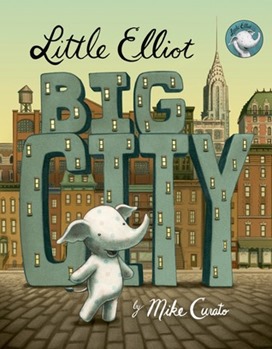
Eliot loved living in the big city, but sometimes it was hard being such a small elephant in such a huge place.  He had to watch out so he didn’t get stepped on, doorknobs could be too high, and he could never catch a cab.  Even at home, Eliot had to find a way to make everyday things work.  Eliot also loved cupcakes, though when he tried to buy  one in a shop he couldn’t get noticed by the person at the counter.  He felt very small and invisible then, but on the way home he discovered a mouse trying to reach some food and found that even though he may be small he can make a big difference.  Even better, he can make friends!

Curato uses only a few words to tell his story, making the most of the illustrations to show the ways that Eliot solves his height issues at home as well as how the new friends solve the cupcake buying problem.  Children will enjoy reading about this little polka-dotted elephant who faces the same issues that they do in life.  They will easily relate to the sadness of being ignored too. 

The illustrations in this book are filled with charm.  Eliot himself is a wonderfully unusual little fellow, shining on the page.  The images of the city are mostly done in a dark and subtle color palette.  The entire book has a fifties vibe to it and some of the images are pulled right out of an Edward Hopper painting.  It’s a courageous choice that works particularly well.

A charmer of a protagonist and an urban landscape make this one delicious cupcake of a picture book.  Appropriate for ages 3-5.

Reviewed from copy received from Henry Holt & Co.
Review: Blizzard by John Rocco

blizzard

Blizzard by John Rocco

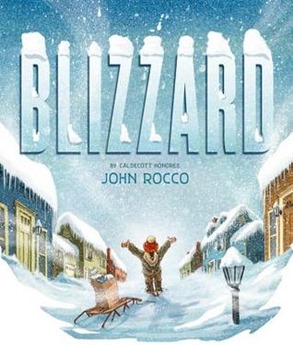
Rocco tells a story from his childhood of the blizzard of 1978 that dumped 53 inches of snow on his Rhode Island town.  The story begins with just a few flakes in the air and by the time school closes and the children make their way home, the snow is getting deeper and deeper.  The next morning, the drifts were so high that they had to leave the house through the window rather than the door.  The snowplows stopped running because the snow was too deep.  They were isolated and at first it was great fun with days of playing in the snow and drinking mugs of hot cocoa with milk.  Then after a few days, food got scarcer and the cocoa was being made with water.  It was up to a ten-year-old John to make his way to the grocery store pulling his sled with tennis rackets strapped to his feet. 

Rocco embraces the wonder of a huge snowfall in this picture book.  The delight of a landscape and world changed into something foreign and incredible.  The changes to routine, the cancelation of school, families stuck inside together, the futility of trying to dig out paths.  He celebrates it all on the page and then moves the story to an arctic exploration of one boy against the elements, complete with a map of his route to the store.  There is a rich humor throughout the narrative that reassures children that the family is not going to starve but also offers real reason to travel to the store, watery cocoa!

Rocco’s art cleverly incorporates the days of the week in the art, from snow on branches spelling out the word to a squirrels trail on the roof.  The cool white and blues of the outdoors are contrasted fully with the yellows of the indoor world of the family.  The disjointed attempts at clearing the snow are cleverly done, speaking to the power of intent but also the depth of the snow and the effort required to clear it. 

Perfect for folks in Buffalo, but also a great story to read when any snowstorm is drifting your way, preferably with mugs of milk hot cocoa.  Appropriate for ages 4-6.

Reviewed from library copy.

Review: Here Comes Santa Cat by Deborah Underwood

here comes santa cat

Here Comes Santa Cat by Deborah Underwood, illustrated by Claudia Rueda

Cat tries out a new disguise in this follow up to Here Comes the Easter Cat.  Cat is worried that he has not been nice enough to get a present from Santa.  So his solution is to become Santa so that he can give himself a present.  Of course, he has to learn how to climb down chimneys, which doesn’t go well.  He also has to figure out how to fly without Santa’s magic reindeer.  Perhaps a jet pack?  He tries giving gifts to children, but they don’t seem to appreciate the fish.  He even tries to decorate a tree, but it too ends in disaster.  What is one naughty cat to do?

Underwood has created a delightful sequel to her first Cat book.  Once again Cat uses signs to communicate with the reader.  The voice of the narrator is one of an adult, making this an ideal book to be read aloud by a teacher or parent.  The rather disapproving but still encouraging tone of the narrator sets up the humor perfectly and with Underwood’s clear sense of comedic timing, the results are hilarious. 

Rueda’s art adds to the zany humor, often serving as the final funny note to a gag.  She uses gentle colors and delicate lines, supporting the storyline clearly.  Her comedic timing too is wonderfully spot on.

A very funny addition to crowded Christmas picture book shelves, save this one to share aloud on Christmas Eve.  Appropriate for ages 3-5.

Reviewed from copy received from Dial.

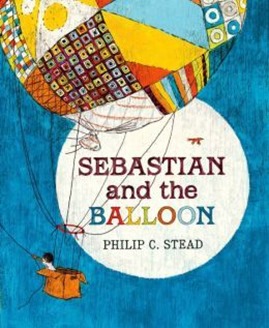
Review: Sebastian and the Balloon by Philip C. Stead

sebastian and the balloon

Sebastian and the Balloon by Philip C. Stead

A little boy named Sebastian is having a very boring day even though he is up on the top of the roof where he’s never supposed to be.  So he decides to head on a journey.  First, he packs everything he needs, then he heads for the hot air balloon he made from his grandmother’s afghans and quilts.  He sets off and meets a bear next to a leafless tree.  He offers the bear a pickle sandwich and the bear joins him on his journey.  Flying in the fog, they hear a loud pop and find that a bird has flown into the balloon.  They land atop a a colorful worn house where three sisters help them knit their balloon together again.  As the three elderly ladies work, they mention the time that they went over the mountain as children and found a rollercoaster.  You can guess where they all headed next!

Stead has created a quiet and lovely book here.  It is an adventure book, but somehow it is imbued with a gentleness and dreaminess.  Perhaps it is the balloon flight, the drifting and silence and quiet of that mode of transportation.  Or it could be the fog, the friendly bear, and the three grandmothers.  It all adds up to a wonderfully whimsical book that dances along dreamily.

Stead’s illustrations are always a treat.  I love that his protagonist is a little boy of color, someone who glows against the background, who is resourceful, smart and creative.  The three grandmothers, each with their own color that is also represented in their home, are drawn with a humor that is gentle and gorgeous.  The entire book sings of whimsy and imagination.

Ideal for bedtime reading, this book is sure to create dreams of hot air balloon rides and an array of friends.  Appropriate for ages 4-6.

Reviewed from copy received from Roaring Brook Press.

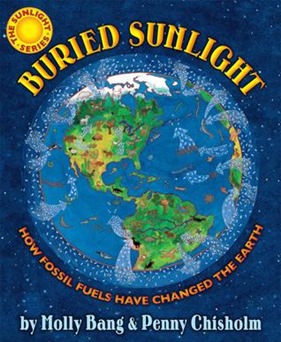
Review: Buried Sunlight by Molly Bang

buried sunlight

Buried Sunlight: How Fossil Fuels Have Changed the Earth by Molly Bang & Penny Chisholm

Everything needs energy in order to grow and we also need energy to run machines.  This energy comes from the sun though it may be stored as fossil fuels underground.  The fossil fuels have stored that energy inside them and it is released when they are burned.  This book looks at how sunlight energy is stored in fossil fuels, explaining photosynthesis and the balance of oxygen on the planet.  It speaks to the way that oxygen was first released to the atmosphere and the millions of years that it took to create fossil fuels.  The book then informs readers about the impact of carbon dioxide on the planet and the resulting climate change.  In the end, the book lets readers know that the choice for the future of the planet is theirs.

Bang worked with Chisholm, an award-winning MIT professor on the information in the book.  Told from the point of view of the sun, the book takes a clear and scientific tone throughout, enhanced by the more personal point of view.  The information is compellingly presented and interesting.  The final pages of the book offer even more details about the fossil fuel process for those looking for more in-depth information.

Bang’s illustrations capture the information of graphs along with an artistic feel.  She manages to keep it scientific but also speak to the wonder of the process and the beauty of the captured sunlight energy. 

This fourth book in their Sunlight series continues the combination of science, beauty and natural wonder.  Appropriate for ages 5-9.

Reviewed from library copy.

Review: Wall by Tom Clohosy Cole

wall

Wall by Tom Clohosy Cole

When the Berlin Wall was built, a boy was separated from his father who was on the other side.  His mother told him that his father was in a place where life was better.  They were not allowed to leave their side of Berlin.  The boy dreamed of his father coming and rescuing them, but he knew that was unlikely to happen.  So he started to plan ways to get past the wall himself.  Other people tried to get past the wall, many of them died in their attempts.  But it was worth the risk to see his father once again, so the boy started digging out in the woods near the wall.  When the tunnel was ready, the boy led his family to it, but along the way they were stopped by a soldier.  Would this be the end of their brave journey to reunite their family?

Cole captures the separation and division caused by the Berlin Wall.  He also clearly shows the fierce drive of a family to reunite and be together once again.  Told in very simple sentences, the book relies on its fine artwork to carry the story.  It is the art that conveys the danger, the deaths and the risks that people took to see loved ones again or to attain freedom. 

The art here is exceptional.  Cole uses lighting on his pages to show the hope of the West versus the darkness and gray of the other side of the wall.  The illustrations are atmospheric and dramatic.  They convey the feeling of isolation and the fear. 

A strong picture book about the Berlin Wall and the power of family and hope.  Appropriate for ages 4-6.

Reviewed from library copy.

Review: Fox’s Garden by Princesse Camcam

foxs garden

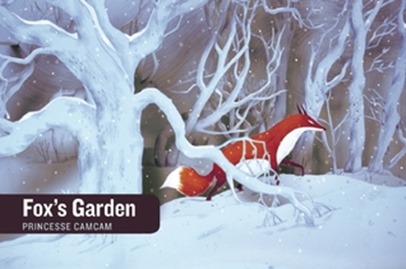
Fox’s Garden by Princesse Camcam

Gorgeously illustrated, this wordless picture book invites readers into a snowy world.  A fox finds her way into a village, warm lit against the cold snow that is falling.  She is shooed away by several people but discovers an open greenhouse.  A little boy sees her enter and brings her a basket of food.  Now there is a fox with four baby foxes nursing.  Soon after, the mother fox leads her kits to the boy’s room where they plant flowers from the greenhouse into his rug which he discovers in the morning.  The five foxes disappear back into the woods.

Done in cut-paper illustrations, the images have a beautiful 3-D quality to them.  You want to stroke the page and think that you will be able to lift flaps, so strong are the images. Against the white and gray snow and woods, the characters pop.  The fox gloriously orange in the snow and the little boy wearing red. 

Camcam lights her paper work beautifully as well, almost as if it were a stage.  She conveys the welcoming warmth of the light in the village, the yellow of the windows lit against the storm.  More subtly, she plays with shadows and underlighting in specific scenes, showing the cold and the night clearly.

This is a haunting picture book, done with an immense delicacy and skill.  Simply beautiful.  Appropriate for ages 3-5.

Reviewed from copy received from Enchanted Lion Books.

Review: Iridescence of Birds by Patricia MacLachlan

iridescence of birds

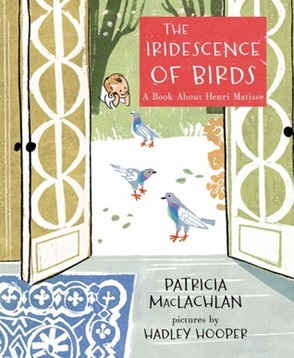
The Iridescence of Birds: A Book about Henri Matisse by Patricia MacLachlan, illustrations by Hadley Hooper

Henri Matisse grew up in a town in northern France that was cold, gray and dreary.  But his mother filled their world with color with the plates that she painted with nature scenes.  She also let Henri mix the paint colors.  He was also the person who arranged the fruit and flowers that they bought in the market, on the blue and white tablecloth.  Red rugs adorned the walls of their house, filling it with color too and making the whole world turn red.  Henri also raised pigeons with their iridescent feathers.  And all of these elements of his childhood came together in his work as an adult, reflecting the color that one can see in the dreariest of towns.

MacLachlan has written this picture book in an unusual second person, inviting the reader to feel the environment just as Matisse himself did as a child.  The slow reveal of the richness of his childhood at home plays beautifully against the original gray and dullness of the outside.  It is as if he was given another world to grow up in, one of colors and delight.  Though when readers really look at it, it is about small things, tiny touches, being surrounded by paint, and of course the brilliance of pigeons too.

The illustrations by Hooper are rich and saturated with color.  Done in a combination of relief printmaking and digital formats, the book has a grounding in the solidity of printmaking that gives it texture and a feeling of tradition.  Playing against that is the modern lightness of the little boy, surrounded by the color and delight of his home.  It’s an exquisite pairing.

Rich, detailed and delightful, this picture book biography of the inspiration that Matisse found in his childhood home is sure to invite young readers to find their own sources of inspiration around them.  Appropriate for ages 4-6.

Reviewed from copy received from Roaring Brook Press.

Review: Give and Take by Chris Raschka

give and take

Give and Take by Chris Raschka

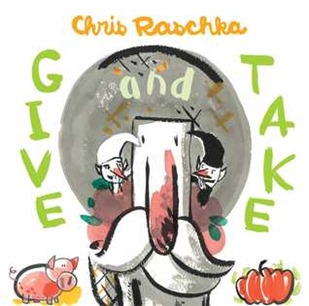
A farmer who grows apples discovers a strange little man out in his orchard just as his apples are ready to pick.  The little man is named Take and he encourages the farmer to listen to him so that he can have a fine life.  Though the farmer already has a fine life, Take promises to make it better.  So the farmer goes through his day taking everything.  He takes all of his neighbors pumpkins when she offers him some.  He takes her advice to make pumpkin soup, and he takes a long hike.  Left wishing he had some apples to eat, he kicks out Take the next morning.  Then when he visits his orchard that morning, he meets another little man named Give.  Give promises to make his life sweeter, so once again the farmer tries.  He gives everything away, including his apples and all of his opinions.  He is left hungry another night and kicks Give out.  But in the morning, he discovers the two little men fighting with one another.  Can a farmer outwit these two battling forces?

Raschka has written this picture book with the tone of a fable.  Readers will immediately see Take as a selfish force and then think that Give is the angelic voice.  But Raschka’s take is more nuanced than that, showing the harm in being too giving with everything in your life and how it can turn toxic and harmful too.  He then goes about having his farmer propose a balance of giving and taking in life.  The result is a book that has balance, a folkloric rhythm and tone, and is a great read aloud and opportunity for discussion.

Raschka’s illustrations are his trademark flowing and free style.  He uses watercolors contained with thick black lines.  The bright red of the farmer’s nose and the apples pop on the page along with the pink pig and the orange pumpkins.  As always, his book is art, changing with each turn of the page as the story is told.

Perfect for discussions about balance, generosity and greed, this picture book is a great balance of art and folklore itself.  Appropriate for ages 4-6.

Reviewed from copy received from Atheneum.