Review: Three Bears in a Boat by David Soman

three bears in a boat

Three Bears in a Boat by David Soman

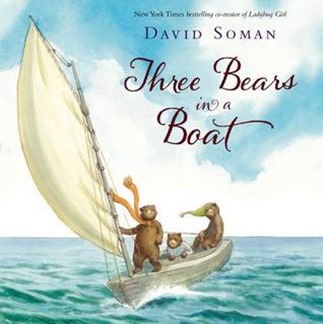
The co-creator of the Ladybug Girl series returns with a completely different type of book.  It is the story of three little bears who accidentally break their mother’s favorite blue seashell, so they set off to find her a new one.  Along the way they meet other bears on boats but only one can give them any advice about finding a blue seashell, they need to look for a hat-shaped island and then look in the right place.  As they travel, the bears look and look for a blue seashell, but don’t find one.  Once they give up hope, they start to argue and as they fight a storm blows up around them.  They may be forced to return home to Mama empty handed, and after all, their mother is a bear!

Soman has created an exceptional picture book.  It hearkens back to many classic picture books, particularly ones by Maurice Sendak like Where the Wild Things Are and the Little Bear series.  It also has ties to the three bears, Beatrix Potter and even Melville.  But best of all, it reads like it is a classic already, one that will be shared with children for years, and very rightly so.  The story arc is brilliantly crafted, moving the story forward and also coming full circle, returning the bears in time for a warm supper with Mama.  It is so strongly built that there is a sense of coming home when reading the story, but also one of surprise and delight at discovering it.

Soman’s art is extraordinary:  from the faces of the little bears that show every emotion clearly despite the fur to the landscapes that are like opening a window to the ocean.  There are page turns where you simply sit for a moment and linger, looking at the new vista before you until you are ready to read the words on the page. 

A top Caldecott contender, this picture book feels like returning home to Mama after a long trip at sea.  Appropriate for ages 3-5.

Reviewed from copy received from Dial Books.
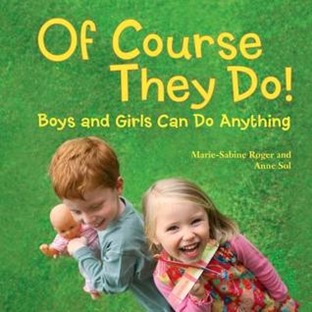
Review: Of Course They Do! by Marie-Sabine Roger

of course they do

Of Course They Do!: Boys and Girls Can Do Anything by Marie-Sabine Roger and Anne Sol

This very simple book filled with crisp photographs takes on gender stereotypes and proves them quickly wrong.  The book starts with things that boys don’t do, like “Boys don’t cook.”  Turn the page and the counter to the stereotype is given with a photograph of a chef and the words “Are you sure?”  The book then moves on to stereotypes about girls, like them not playing sports. 

The format is engaging and fresh.  Having the more traditional gender role on one page and then the correction on next works particularly well, since it gives children a chance to realize that they themselves may think some of these things.  I also like that the format asks questions on the pages where the stereotype is being disputed.  This too lets children have the ability to change their mind rather than be defensive about what they had been thinking. 

The illustrations are all photographs and are bright and clear.  Many of them are close ups of faces that prove the point that girls and boys can do so many things.  Throughout the book there is clear diversity as well.

Clear and intelligently designed, this book will be welcome for units about gender.  Appropriate for ages 3-5.

Reviewed from library copy.

Review: Turtle Island by Kevin Sherry

turtle island

Turtle Island by Kevin Sherry

The author of I’m the Biggest Thing in the Ocean returns with a picture book all about friendship.  Turtle is very big but Turtle is also all alone and getting lonely.  Then one day, a ship wrecked near him and he rescued a bear, an owl, a cat and a frog from the ocean waters.  They climbed aboard his shell and Turtle supplied them with fish to eat.  Happily, Owl could knit, Bear could build, Frog could cook, and Cat could draw.  The four quickly went to work and created a home aboard Turtle.  Turtle wasn’t lonely any more.  One might think the book would end there, but instead the four smaller animals got very homesick and missed their families.  They had to return home, leaving Turtle all alone in the big ocean again.  What is a big lonely turtle to do, especially now that he realizes the importance of having good friends?

Sherry has a way with simple storytelling.  He manages to convey complicated emotions using a combination of his storyline and his illustrations.  Here the impact of having friends is looked at with humor and through a unique relationship of a huge turtle and characters riding on his back.  It’s a very nice metaphor for needing to support friends in different ways.

As with all of Sherry’s books, his cartoony illustrations are child friendly and add to the humor.  They keep this story from becoming overly sweet, showing goggle-eyed animals in different colors and always clearly showing that Turtle is simply huge.

Gently funny, simple and honest, this picture book is a friend to any story time on friendship or turtles.  Appropriate for ages 2-4.

Reviewed from library copy.

Review: Hooray for Hat! by Brian Won

hooray for hat

Hooray for Hat! by Brian Won

Elephant wakes up very grumpy until he finds a present waiting for him on the doorstep and it has one amazing hat inside.  He puts it on and heads off to show Zebra, but Zebra is grumpy too, so Elephant gives Zebra one of his hats.  Soon they have helped Turtle and Owl be less grumpy too by sharing hats with them as well.  They came to Lion who was feeling sad and giving him a hat didn’t help because he was worried that Giraffe was feeling sick.  So they all came up with a great plan to help Giraffe feel better.  I bet you can guess that it involves…hats!

Won has created an entirely jolly book that shows just how small things can change a person’s mood or emotions.  The book is very simply written and repeats nicely as each animal is introduced.  This makes it a great pick for toddlers who will enjoy the repetition as well as the different animals in the book.  It is also a nice book to talk with the smallest children about feeling grumpy and also how important sharing things can be.

Won’s art focuses on the animals themselves with only touches of backgrounds or even ground around and underneath them.  The colors pop when the hats enter the pages, bright and vibrantly different, they are all a hoot.

Cheery and friendly, this book is a happy look at changing emotions and sharing good fortune.  Appropriate for ages 2-4.

Reviewed from library copy.

Review: The Troublemaker by Lauren Castillo

troublemaker

The Troublemaker by Lauren Castillo

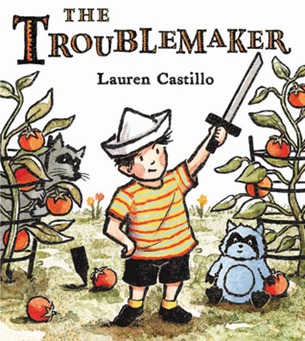
Told in the first person, this picture book is from the point of view of one bored little boy.  He and his stuffed raccoon decide to play pirates.  To do that you had to not only be sneaky but you also needed a prisoner, and his sister’s stuffed rabbit was quickly stolen and sent afloat in the lake.  The boy was scolded and the now damp bunny was returned to his angry sister.  The boy then spent time playing with his own toys, but soon his mother was asking if he’d taken the bunny again.  He hadn’t but no one believed him and then his stuffed animal went missing too!  It was a real mystery and now they had a real pirate on their hands.

Castillo takes a classic book of summer boredom and then picking on a sibling to a different and surprising place in this picture book.  Children who are paying attention will notice a furry face that appears on almost every page in the background, a lurking raccoon who seems to want to get involved or maybe is having his own dull afternoon and is looking for some fun.  This second little troublemaker adds a great amount of fun to the story.  Even better, having dealt with raccoons invading my house and stealing my son’s stuffed animals up into their attic den, this all rings completely true.

Castillo’s signature art style is on display here.  She manages to capture a timeless look on the page but also one that is modern and fresh.  The tinge of blue on the stuffed raccoon make sure that children will not mix up the real and stuffed animals.  The family’s home is well detailed, busy and filled with other natural touches.

A solid new title from Castillo that will work well for units or story times about pirates, siblings or raccoons.  Appropriate for ages 3-5.

Reviewed from library copy.

Review: Big Bug by Henry Cole

big bug

Big Bug by Henry Cole

Start with a close up of a ladybug in this picture book and then everything is put into perspective.  If you step back, the big bug on the first pages is not so big compared to the big leaf it is sitting on.  That leaf turns small when seen as just a part of a flower.  Then a big dog appears only to be dwarfed by the big cow on the next page.  This continues until the reader is looking at the big sky.  Then the book reverses and the perspective gets closer and tighter, returning in the end to that same dog now sleeping inside. 

This is a very simple book that is superbly done.  Cole plays nicely with perspective and with concepts.  The book can easily be used as a way to show the differences between big and small, but I think the real treat is showing children that perspective is important and understanding size is too.  With only a couple of words on each page, the book is imminently readable, especially by a child just starting to read on their own.

Cole’s art is clear and lovely.  The perspective changes are done vividly and the page where you linger with the big big sky for a moment is particularly lovely with its little farm and little tree.  It also serves as a very clear pivot point in the book thanks to the design of the page. 

Show this one to art teachers, preschool teachers, and kids who enjoy a huge insect.  Appropriate for ages 2-4.

Reviewed from copy received from Little Simon.

Review: Gravity by Jason Chin

gravity

Gravity by Jason Chin

In his latest book, Chin examines the theory of gravity and how it works on our planet and in the universe.  As with his previous books about redwoods and coral reefs, Chin takes a complicated subject and reduces it neatly to a child-appropriate level.  He also adds a touch of magic and whimsy.  The book begins with the book falling out of the sky and right in front of a boy on a beach, playing with his toy astronaut and rocket.  Then gravity goes away and his toys, bucket, shovel and banana head out into space.  From there, the effect of gravity on the earth is explained and eventually gravity returns and the objects fall back to earth.  But not exactly where you’d expect them to.

Told in very brief sentences, the book will work for even the youngest scientifically-inclined children to enjoy.  More information on gravity in a wordier format is provided at the end of the book.  Chin keeps the body of the book light-hearted and still scientific even as toys float right past the reader in the vastness of space. 

As with any book by Chin, his art is exceptional.  He manages on a still page to capture the effect of items floating in space, weightless and free from gravitational pull.  He also succeeds in conveying clearly when gravity is turned off and when it is returned, something not easily done in illustrations.  The beauty of what he captures is magnificent.  He shows the sun from space, the earth, and it is all vast and lovely.

Another winner of a title from Chin, get this into the hands of little ones who dream of science and space.  This is a very readable science book that would make a great addition for sharing aloud in a story time or unit.  Appropriate for ages 3-5.

Reviewed from copy received from Roaring Brook Press.

Review: The Midnight Library by Kazuno Kohara

midnight library

The Midnight Library by Kazuno Kohara

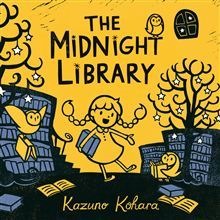
The Midnight Library only opens at night.  Then a little librarian and her three owl assistants help all sorts of animals find the right books.  The library was quiet and peaceful until a band of squirrels showed up looking for a place to practice.  Luckily, the library had an activity room where they could play music without disturbing anyone else.  It was quiet again until it started to rain, but it was raining inside the library.  It was Mrs. Wolf crying about something she read in a book.  The librarian and her assistants helped her finish the story and reach the happy ending.  Finally, it was time to close for the night and there was one very slow patron who would not leave, but the little librarian solved that situation happily too.  This is a clever and creative look at libraries and their services in a way that children will easily relate to.

Kohara is author of several other picture books all done in her signature style.  Here she cleverly takes a library and adds mystery by making it open at night.  The addition of animals as patrons also creates an interesting twist.  I also appreciated a library being depicted as a place that you can play music.  So often the focus is on the quiet and solitude, but this is one happening library!

Kohara uses the colors on the cover of the book throughout the story.  The deep blues and blacks are enlivened by the bright yellow-orange that forms most of the background.  Her use of printmaking techniques creates thick lines with an organic dappling effect.  These prints feel like woodblocks but have lines that swirl and curve unlike most block prints.

Clever, lively and great fun, this picture book is perfect for sleepy library fans.  Appropriate for ages 2-4.

Reviewed from library copy.

Review: The Good Ship Crocodile by J. Patrick Lewis

good ship crocodile

The Good Ship Crocodile by J. Patrick Lewis and Monique Felix

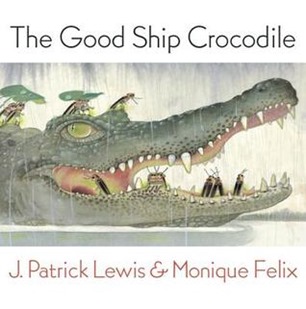
Snout was a crocodile who lived on a river.  During the rainy season, the water level would rise and other animals would get into trouble.  The fireflies could not fly in the falling rain, so they asked Snout to carry them to the other side of the river.  Across they went, riding on his back and even in his mouth.  Day after day, Snout carried animals across the river to safety.  Finally, when the sun came out again, Snout realized that he could no longer see his home because he had drifted far downstream.  Now it was Snout’s turn to ask the other animals for help returning to his home.

Lewis served as U.S. Children’s Poet Laureate from 2011-2013 and in this picture book, you can see his skill with words on every page.   Lewis creates an entire world here, including an unusually kind crocodile.  His words are so simple and uncomplicated, yet they create a sturdy structure for the story.  He doesn’t offer rationalizations for why this crocodile is so kind, but clearly shows that doing kindness for others will inspire them to do it for you when you need it most.

The illustrations in this book are breathtaking.  Felix creates a crocodile that looks wonderfully real, particularly in the very close up images.  As the crocodile takes different animals across the river, the text goes silent, allowing time for the reader to mentally make the journey too.  It also builds a great tension where readers will wonder if he will snap his jaws shut at any moment. 

Beautifully told and illustrated, this is a strong addition to any story time on crocodiles or kindness.  Appropriate for ages 3-5.

Reviewed from library copy.