Review: Maple by Lori Nichols

maple

Maple by Lori Nichols

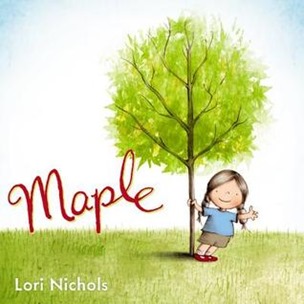
This is one amazing debut picture book.  Maple loved her name.  When she was a baby, her parents had planted a maple tree in their yard.  It was tiny just like her and as Maple grew so did the maple tree.  Her tree never minded if she was loud even though her parents did sometimes.  Maple loved to be outside with her tree.  She would sway along with it, pretend to be a tree and spend time gazing up into its branches and leaves.  When the tree lost its leaves in the fall, Maple gave it her coat to keep it warm.  Throughout the winter, the two played together.  Then in the spring, there were new surprises!  A new tree in the ground and a new baby in the family.  It is Maple who figures out exactly what to do to keep her new sister happy.

Clever and very satisfying, this book is an exceptional debut.  Nichols sets just the right tone with her prose.  From the very first page, you know that she understands children’s books and the way to structure and write them.  The story is clearly presented and the arc of the tale is nicely plotted and designed.  One knows that it is building towards something, but the book is willing to take the right amount of time to get there.  The book reads like a veteran author wrote it. 

The illustrations are also impressive.  They have a lovely softness to them that is very pleasing.  The colors are muted but very effective.  My favorite pages are when Maple looks up into the tree and you see her through the leaves.  It is all beautifully done.

Take it from someone who named one of her children after a tree and then planted one for him to grow up with, this book captures children, love for nature and new siblings with grace and style.  Appropriate for ages 3-5.

Reviewed from copy received from Nancy Paulsen Books.
Review: The Noisy Paint Box by Barb Rosenstock

noisy paint box

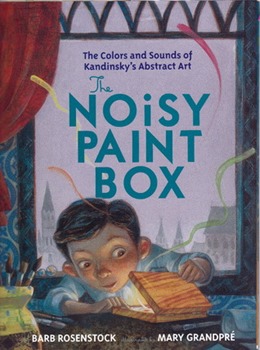
The Noisy Paint Box by Barb Rosenstock, illustrated by Mary GrandPre

Enter the amazing world of abstract art with this picture book biography of Kandinsky.  Vasya Kandinsky was raised to be a very proper young Russian boy.  Then his Auntie gave him a box of paints and he started to hear colors as sounds.  No one else could hear the sounds, but to Vasya they were a symphony that he could paint.  Vasya grew up and stopped painting.  He still heard the colors around him, but he was going to be a lawyer.  When he attended the opera one evening, Vasya saw the colors emerge from the music and was never quite the same again.  He became a painter and tried to meet everyone’s expectations, but to be happy he had to paint in his own way, an abstract one. 

Rosenstock’s biography is very successful, focusing on Kandinsky as a child and younger man.  She doesn’t speak down to children at all here, instead bringing them up to her level and demonstrating what abstract art is, showing the struggle of an artist trapped in the wrong life, and finally beautifully displaying what a life well-lived looks like.  She celebrates the transformation from lawyer to artist, from conventional to unique.  This book joyfully exposes how we are all different from one another and how those differences can be incredible if allowed to sing.

GrandPre’s art is glorious.  She shows what Kandinsky must have seen when hearing the opera and what he heard when the colors spoke to him.  The music of the paint box and the noises that emerged for him are shown in flourishes of sound, bringing Kandinsky’s synthethesia vividly to the page.  Her art is filled with motion when Kandinsky’s art is being expressed and then dims down to the staid and quiet when he is trying to conform.

Beautiful and choice, this picture book biography is one of the best.  Get this for elementary art classes, museum visits, and young artists.  Appropriate for ages 5-7.

Reviewed from copy received from Random House Children’s Books.

Review: Winston & George by John Miller

winston george

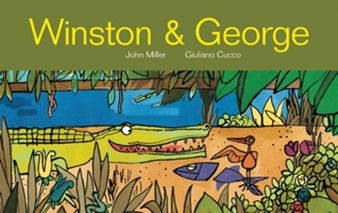
Winston & George by John Miller, illustrated by Giuliano Cucco

Released March 21, 2014.

Winston is a crocodile and George is a crocodile bird, the kind of bird that cleans a crocodile’s skin.  The two of them would fish together in the river with George calling out when he saw a fish and Winston diving into the water to catch it.  Then they would share the meal together on shore.  But George had the bad habit of playing pranks on all of the crocodiles as well as on Winston.  The other crocodiles tell Winston to just eat George to end the problem, but Winston can’t eat his friend.  Then George takes a prank too far and puts Winston’s life in danger.  He has to convince the other crocodiles and animals to help, but at what price?

Written and illustrated 50 years ago, this picture book is finally being published.  Unfortunately, the illustrator died in 2006, so he did not live to see this work finally come to the public.  Happily though, the book is fresh and vibrant with a wonderful vintage feel that makes it feel like an immediate classic.  Miller’s words are simple and drive the story forward at a fast pace.  The ending is immensely satisfying and sharing it aloud one can expect cheers of joy and relief.

Cucco’s illustrations are superb.  They have a wonderful grace of line combined with bright tropical colors that pop on the page.  The dramatic moments of the book are captured with plenty of motion and action.  Best of all, the humor of the text translates directly into humor of image. 

A humorous and dramatic look at an unusual friendship, one only wishes that Winston & George could go on more adventures together.  Appropriate for ages 4-6.

Reviewed from copy received from Enchanted Lion Books.

Review: Little Poems for Tiny Ears by Lin Oliver

little poems for tiny ears

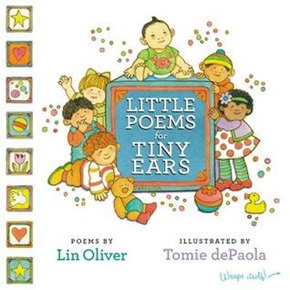
Little Poems for Tiny Ears by Lin Oliver, illustrated by Tomie dePaola

Celebrate the wonder of babyhood and toddlerhood with this collection of poems ideal for the youngest listeners.  These poems document the small moments of a child’s early years, seeing these little things as exactly what they are: the foundation of the future.  So each moment is given a gravity by the poems but they are also entirely playful and fun.  There are poems about body parts like noses and tongues, poems about peekaboo and high chairs, poems about naps, others about baths.  Each is short, clever and just right for sharing aloud.

DePaola has illustrated the poems with his signature style, depicting children of all colors and nationalities.  His illustrations embrace the gentleness of the entire book with their soft and bright colors and clear demonstrations of love.

Get this on the shelves right next to Mother Goose, because what you have here is a new classic set of poetry for the little ones.  Appropriate for ages 1-3.

Reviewed from library copy.

Review: Here Comes the Easter Cat by Deborah Underwood

Here-Comes-the-Easter-Cat

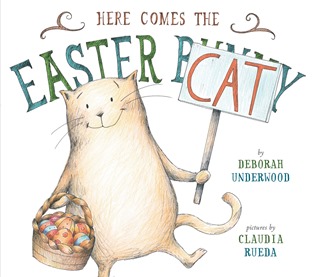
Here Comes the Easter Cat by Deborah Underwood, illustrated by Claudia Rueda

Easter books can be so filled with yellow fluffy chicks, bright Easter eggs, and soft bunnies that the become more than a bit stale.  Enter the Easter Cat, a character who offers exactly what was missing in Easter books: cats!  Cat wants to be able to do what the Easter Bunny does and deliver chocolate himself.  But he’s going to have to figure a lot of things out before he begins: what exactly will be deliver?  How will he travel?  What will he wear?  All of those decisions wear him out so he decides to take his eighth nap of the day, after all, he is a cat.  But then he learns that the Easter Bunny never naps at all.  Are all of his plans ruined?  Perhaps he just needs a little help from the famous Easter Bunny himself.

Underwood of The Quiet Book has created an uproariously funny book this time.  Her Cat character doesn’t speak at all, instead the reader quizzes Cat on what exactly he is doing.  Cat communicates through his expressions and holding up signs most of which have cartoon drawings on them outlining his plans.   The words in the book take on the tone of a parent, making it a real delight to read aloud.  The reader can go from cajoling to stern and back again.

Rueda’s illustrations carry much of the storytelling since Cat doesn’t speak.  She manages to convey his emotions very clearly on his face and in his stance.  Cat is a very enjoyable character with big plans that aren’t very well thought out.  This book on the other hand, has illustrations and words that work together flawlessly.

With the humor of Melanie Watt or Elephant and Piggie, this picture book is sure to find an eager Easter audience.  Ideal for perching in baskets, this book is good enough to share all year round.  Appropriate for ages 3-5.

Reviewed from copy received from Dial Books for Young Readers.

Review: Goose the Bear by Katja Gehrmann

goose the bear

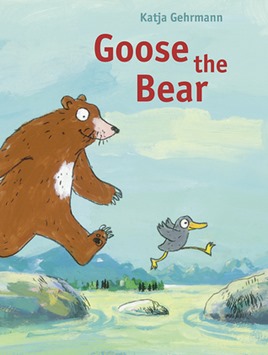
Goose the Bear by Katja Gehrmann

In a Canadian forest, Fox stole an almost-hatched goose egg, planning to eat roast goose very soon.  But he is so proud of himself that he forgets to watch where he’s going and runs right into Bear.  Bear picked up the egg from the ground after Fox ran off and wondered what it is.  Then the gosling hatched and called him “Mama!”  Bear tried to explain that they were not the same type of animal, but the gosling did not understand.  So Bear decided to show the little goose just how different they were.  Bear demonstrated how well bears climb trees, but the gosling could reach the top too.  Bear showed how fast bears can run, but the little goose ran just as quickly.  Finally, Bear jumped in the river and the little goose followed him in.  Then Bear got very worried.  Would the little creature survive the fall into the water?

Gehrmann has created a picture book that stands out from the many books about foxes chasing smaller animals.  Her addition of a bear as a main character adds a clever twist and throughout the book she continues to surprise the reader.  The writing has been done to create a read-aloud that will also keep young readers guessing about what is going to happen next.  With the theme of a tiny creature who can do just what a big bear can do, this book has strong kid appeal.

The premise of the book is quite unique and so is the artwork.  First published in Germany, the book has a European feel, particularly in the art.  It is humorous and bold with changing colors throughout.  Gehrmann’s depiction of the natural world around the characters is particularly rich and layered.

Fresh, vibrant and full of fun surprises, this book is an exceptional take on fox and goose (and bear) stories.  Appropriate for ages 4-6.

Reviewed from library copy.

Review: Time for Bed, Fred! by Yasmeen Ismail

time for bed fred

Time for Bed, Fred by Yasmeen Ismail

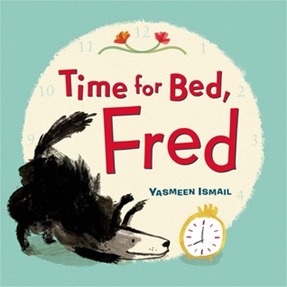
It’s time for Fred to go to bed, but this dog is not ready!  Instead of heading to bed, Fred dashes outside and tries to hide in the flower bed.  Then he hides in a tree until he falls out of it.  Fred then runs and lands in a huge mud puddle.  So then it’s bath time for Fred.  But just when he’s finally clean, he dashes outside once more!  Back inside, he hides in all sorts of places, even after he gets read a bedtime story.  Finally, Fred is moved to the right bed and falls asleep at last.

Fred is a dog that every toddler will relate to.  From his busyness as he dashes from place to place to his unwillingness to head to bed to the final collapse in exhaustion at the end of the day, Fred reacts exactly the way a young child does.  Ismail keeps the book moving quickly with her dialogue-only text that captures the reaction of the owner as Fred refuses to head to bed.  This makes the book great fun to read aloud as well.

Ismail’s art is reminiscent of Chris Raschka with her loose lines and free-flowing forms.  It is filled with action and movement as Fred runs through the garden on the loose.  The illustrations have a great ease and freedom to them that works particularly well with the storyline. 

An energetic and playful bedtime read, let’s hope your little puppies settled down at the end too!  Appropriate for ages 1-3.

Reviewed from library copy.

Review: Nest by Jorey Hurley

nest

Nest by Jorey Hurley

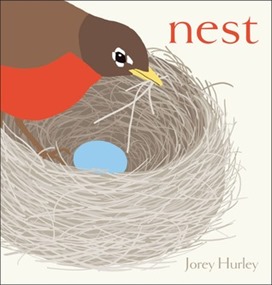
This simple and elegant picture book takes a look at a year in the life of a robin.  It begins with an egg in a nest and two proud parents.  By the next page, the egg has hatched into one very hungry baby bird.  As the tree flowers, the little bird is fed by its parents.  Then comes the first flight as a speckled robin chick.  There are berries on the tree to feast on and when autumn comes the green leaves have turned orange and yellow and started to fall.  The last of the berries are eaten while snow flies in the sky.  As spring returns, the young robin meets another young robin and they build their own nest together.  All of this is told in images since the text of the book is simple single words on each double-spread picture.  This is a beautiful and impressive book for the youngest children.

Hurley’s illustrations are strong and clear.  Done in PhotoShop, the illustrations have the feel of cut-paper collage in their simplicity.  They will project well to a group of children.  The storyline is far more than the words on the page, and children will want to discuss what is happening throughout the book. 

A wonderful pick for spring units, this book is a celebration of nature and seasons.  Appropriate for ages 1-3.

Reviewed from copy received from Simon & Schuster.

Review: Where’s Mommy by Beverly Donofrio

wheres mommy

Where’s Mommy? by Beverly Donofrio, illustrated by Barbara McClintock

Released March 11, 2014.

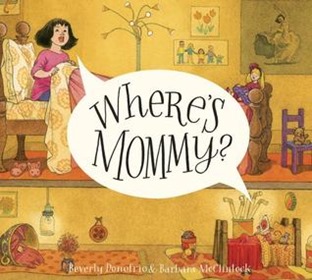
I am so pleased to see a follow-up story to Mary and the Mouse, The Mouse and Mary!  This new book focuses on the daughters of Mary and Mouse.  Maria is a little girl who has a mouse for a best friend named Mouse Mouse.  The two of them never reveal to anyone else that they know one another because otherwise the mice would either be driven off or have to move.  The two girls live parallel lives, getting ready for bed in the same way and both calling for their mothers at the same time.  But both mothers are nowhere to be found!  The search is on by both girl and mouse to figure out where their mothers have gone.  They both look all over their homes, check with their fathers, and ask their siblings.  Nothing.  Then they notice a light on in the shed and both head directly for it.  And if you read the first book, you will know exactly who they will find in the shed. 

Donofrio has written a clever parallel story that reveals the lives of two friends.  The upstairs downstairs aspect of the book has incredible appeal as does the wee details of mouse life.  There are little touches throughout the book that make the text charming and lovely.  Her pacing is also adept and keeps the entire book moving along and yet completely appropriate for bedtime reading. 

So much charm and style comes from the illustrations.  I particularly enjoy looking closely at the world of the mice created from borrowed items from the human home.  These little touches truly create a world under the floor that any reader would love to discover or live in themselves.  The illustrations are rich with color and details, worthy of lingering over when you aren’t quite ready for lights out.

Beautifully written and lovingly illustrated, this book is a suitable companion to the first.  They both stand alone fully on their own, but I’d think that anyone finding out there was another in the series would want to read them both, probably back to back.  Appropriate for ages 3-5.

Reviewed from ARC received from Schwartz & Wade.