Review: Max Makes a Cake by Michelle Edwards

max makes a cake

Max Makes a Cake by Michelle Edwards, illustrated by Charles Santoso

Max was growing up, he could dress himself, almost tie his shoes, and he knew the Four Questions for Passover in Hebrew and English.  It was his mother’s birthday and he wanted to make her a cake.  But when his little sister started to cry and Max’s dad took her for her nap.  Max waited and waited for his dad to come back to bake the cake, but his sister just kept waking up and crying.  So Max decided to make some frosting to help.  It turned out very nicely, a mix of jam and cream cheese.  Max knew that to bake a cake, he had to wait for his father.  But then he had a great idea, one perfect for Passover.

Edwards has written a story that organically incorporates Passover and its meaning.  She shows a warm and loving Jewish family with a father who takes expert care of his children.  Max’s clever solution to the cake is nicely foreshadowed in the book but is also a wonderful surprise solution that readers will not see coming.  It is also a pleasure to see a picture book about a child who solves a problem himself with creativity.

Santoso’s art conveys the same warmth as the text.  He uses humor throughout in his images, with a cheery note.  His depictions of Max are particularly well done as he solves the problem but not without a little mess.

Clever and creative, this is a welcome addition to public library’s Passover collections as well as a great choice for birthday story times.  Appropriate for ages 4-6.

Reviewed from digital copy received from Edelweiss and Random House.

Review: Gobble You Up! by Sunita

gobble you up


Gobble You Up! by Sunita, text by Gita Wolf

Based on a Rajasthani folktale, this picture book is a work of art.  Jackal’s best friend is Crane, but then one day he was too lazy to hunt for food.  Jackal challenged Crane to catch twelve fish all at once.  Crane managed to do the feat, and then Jackal quickly gobbled down all twelve fish.  Crane protested and then Jackal ate Crane too.  Tortoise witnessed this, so Jackal had to eat Tortoise as well.  Squirrel dared Jackal to eat him too, and Jackal managed.  One by one, more animals get eaten and Jackal’s belly stretches and stretches.  The elephant was more difficult to swallow, though Jackal managed.  Then Jackal got very thirsty from eating all of those animals one after another.  And you will just have to read the book to see how it all ends!

The first thing that you notice about this book is that it feels different in your hands.  It has a different weight, a different balance.  It smells different.  The pages have a texture to them and the ink has body on the page that your fingers can feel.  Inside, the story is told rapidly and with wonderful sounds and reactions.  This is a story that comes from an oral tradition and you can hear it as you read it aloud.  It flows and moves.  If you are a librarian who does storytelling, get your hands on this book.

Sunita’s art is the center of the book.  Called Mandna, this art form is practiced only by women and taught from mother to daughter.  It is used to decorate the mud walls of homes and done without brushes.  The art is beautiful, richly detailed and unique.  Make sure to read the information at the end of the book for more facts about the art and how the book was made.

Unique and lovely, this is a rich folktale from a region of India that will delight and amaze.  Appropriate for ages 4-8.

Reviewed from library copy.

Review: Junkyard by Mike Austin

junkyard

Junkyard by Mike Austin

Two huge robots are in a junkyard where there is garbage that goes on for miles.  Then the robots start munching, eating cards, buses, planes and more.  They devour trains, chains, tires, and bicycles.  They drink paste, goo and toxic waste.  Then the story changes and the robots clean up the few things that are left behind, just one little stack.  And it’s time for something new.  The robots dig holes in the ground and plant trees and flowers.  They build a playground and dig out a lake.  They have gardens and dirt piles.  And now what once was a junkyard is a place just for you!

Done in a romping rhyme, this picture book has the appeal of huge robots and destruction.  I must admit that I was completely disarmed by the change of tone in the book when the robots changed from destruction to creation.  It was a striking choice to make in the book and one that will increase its appeal.

Austin’s art is vibrant and colorful.  He uses deep colors that are rich and pop against the white background.  The robots are friendly even as they devour planes and buses.  With the rhyme, the entire book has a playful feel that makes it work well.

A celebration of robots, destruction and making something of nothing, this is a bright and fun joy of a book.  Appropriate for ages 3-5.

Reviewed from copy received from Beach Lane Books.

Review: Love Monster by Rachel Bright

love monster

Love Monster by Rachel Bright

Love Monster lives in a world filled with soft and cuddly pastel animals and everyone loves them.  But no one loves a red, googly-eyed monster who isn’t so cute.  So Love Monster decides to head out and see if he can find someone who will love him despite not being cuddly.  Love Monster searches and searches for someone like this.  He even thinks he’s found them, but then discovers that he has not.  He’s just about to give up, but learns some things are worth working hard to find.

Bright does an admirable job of creating a book that has a very large message without it consuming the story too much.  She uses a narrator voice that is strong and individual which helps keep the book from becoming to sweet as well.  Love Monster is a great character, primarily because he isn’t a complainer and refuses to just settle for a life alone.

Bright’s art is bight and large.  Love Monster pops against each pastel page with the pages getting darker colored as the story progresses.  Finally, night has fallen and the stars come out in a black sky and Love Monster pops there too.

Monsters and love, sounds like a great Valentine’s Day book for little monsters.  Appropriate for ages 3-5.

Reviewed from copy received from Farrar, Straus and Giroux.

Review: Brimsby’s Hats by Andrew Prahin

brimsbys hats

Brimsby’s Hats by Andrew Prahin

Brimsby was a hat maker and he had a quiet life.  He had a best friend and they had wonderful conversations together over a marvelous cup of tea.  But then his friend decided that he wanted to be a ship captain and left for the sea.  Brimsby’s life changed suddenly and he was all alone.  He set out on a walk when he was feeling particularly lonely and came upon a tree full of birds trying to remove snow from their nests and keep warm.  Brimsby thought they would make marvelous friends, but the birds were too busy working to talk with him.  Brimsby headed back home after dark all alone and sat in his dark home and thought.  Can a lonely hat maker figure out how to make new friends?

This story has such a complete feel to it.  Unlike other stories about friendship that can become trite, this one has nuance and balance.  Prahin creates a central character who is believable and understandable.  He also builds the book around a universal theme.  Then he takes a different approach to the solution of finding new friends that is completely surprising and satisfying.

His art is equally pleasing with its rich colors playing against pastels.  There is a lightness to the illustrations and also a great quirky feel to them that matches the story well.  He uses perspectives and dark and light to reveal just how lonely Brimsby becomes after his friend leaves.

A thoughtful and creative look at friendship that is entirely exceptional and perfect for a wintry day.  Appropriate for ages 4-6.

Reviewed from copy received from Simon & Schuster.

Review: A Book of Babies by Il Sung Na

book of babies

A Book of Babies by Il Sung Na

A duck takes readers on a tour of different sorts of animal babies.  The duck heads around the world, visiting baby lions, baby lizards, baby polar bears, and baby kangaroos among many others.   A trait of each baby is mentioned to distinguish them.  Baby zebras walk right away.  Fish are born with lots of brothers and sisters.  Seahorse fathers carry their babies in a pouch.  These small details add up to a kaleidoscope of different animals and offer lots of opportunities for parents to talk more about each animals as they share the book.

This author of The Book of Sleep always fills her books with rich illustrations.  Here her gentle poem carries the duck from one place to the next, but it is the illustrations that make this such a special gem.  Done in mixed media, they feature a variety of textured papers that become ice bergs, tree trunks and even the sky.  He manages to make colors that seem to emit light, glowing on the page. 

Perfect for toddler bedtimes, this book is radiant with baby animals.  Appropriate for ages 1-3.

Reviewed from copy received from Random House Children’s Books.

Review: Henri’s Scissors by Jeanette Winter

henris scissors

Henri’s Scissors by Jeanette Winter

When Henri-Emile Matisse was a young boy, he longed to make art the way his mother did. So he drew as much as he could and then painted after receiving paints as a gift.  But when he was on old man, he had to remain in bed or a wheelchair and didn’t have the energy or ability to paint.  As he recovered, Matisse started to draw and then picked up a pair of scissors and started cutting paper.  Matisse started a second phase of his art career with assistants who painted pages for him to cut from, dreams of the shapes to cut out, and surrounded by the bright colors of his art.  He created a garden that he could visit right from his bed. 

Winter starts with Matisse as a boy finding art and quickly moves the book to his paper cutting phase in the latter part of his life.  For a picture book biography, the text is very simple yet conveys his great attachment and gift for creating art.  It also speaks to the creative process and trying new things that fit with life’s limitations. 

Winter fills her book with bright colors both in Matisse’s art itself but also as the backgrounds to her images.  When Matisse is without art, the book becomes dark yet star-filled.  As he returns to creating pieces, the book lightens and blossoms visually.

A very successful picture book biography, this book will be welcome in elementary and preschool art classes.  Appropriate for ages 4-6.

Reviewed from copy received from Beach Lane Books.

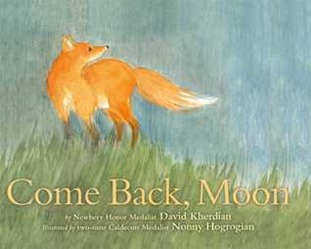
Review: Come Back, Moon by David Kherdian

come back moon

Come Back, Moon by David Kherdian, illustrated by Nonny Hogrogian

In this quiet book, Bear blames the moon for not being able to fall asleep.  So he pulls it out of the sky.  Fox notices that the moon is gone and so do Skunk, Opossum and Raccoon.  Crow asks Fox why he doesn’t know where the moon is, since he’s so clever.  So Fox takes them all to talk to Owl who is wise.  Owl knows where the moon is, since he saw Bear take it.  So they head off to retrieve the moon from Bear.  But how will they get it away from him?

This book has a wonderfully clear and simple story line that makes it ideal to use with toddlers.  It also has a deep quiet to it that will work for good bedtime or naptime reading.  Kherdian uses repetition throughout the story, having the different animals share ideas and echo back decisions. 

Hogrogian’s art also has that simple style.  She has wonderful images like the one on the cover that speak to the darkness and loss of the moon.  Her animals are realistically depicted and appear against white or tan backgrounds with few details. 

There is a place for quiet books for small children and this one has just enough activity to keep it moving too.  It would make a great board book.  Appropriate for ages 1-3.

Reviewed from copy received from Beach Lane Books.

Review: Wild by Emily Hughes

wild

Wild by Emily Hughes

When the baby girl was found in the woods by the animals, the entire woods took her in.  Bird taught her to talk.  Bear taught her to fish.  Fox taught her how to play.  Everything was good, until she met some people in the woods.  They took her home with them.  A famous psychiatrist took her in and tried to make her civilized.  They combed her hair, tried to teach her to speak, frowned at her table manners and didn’t appreciate the way she played.  Everything they did was wrong.  The girl was not happy at all.  But then one day, she found her wild once more. 

Told only in brief sentences, Hughes lets her art tell much of the story here.  And what a glorious story it is.  It’s the story of a child perfectly at home in the wild and with the animals.  She doesn’t long for society or civilization in any way.  She’s the opposite of many classic book characters like Curious George.  She rejects the rules and substitutes her own.

The art has a wonderful wild quality as well.  It is lush and filled with details.  The woods have a flowing green that is mesmerizing.  Once the humans enter the story, things become more angular and rigid.  The return to the woods is beautiful and completely satisfying. 

Hughes has tapped into what every child dreams of, living in the woods with the animals and thriving.  Everyone who reads this will want to be wild themselves.  Appropriate for ages 3-5.

Reviewed from library copy.