Review: King for a Day by Rukhsana Khan

king for a day

King for a Day by Rukhsana Khan, illustrated by Christiane Kromer

It is Basant in the city of Lahore, Pakistan and Malik has only made one kite to use in the kite battles over the city.  Malik is still sure of himself though, eager to show how fast his Falcon kite is.  Malik is especially interested in teaching the bully who lives next door a lesson for all of the times he’s said horrible things to Malik and his sister.  He also dreams of being the king of Basant, the best kite fighter in the city.  Malik spends his day freeing other kites by cutting their strings, and at the end of the day he has a pile of kites at his feet.  Then the neighborhood bully emerges again and tries to take a kite from a little girl, but Malik uses his new status as King to solve the problem.

Khan has captured a unique festival in Pakistan that is vivid, visual and offers children the ability to take on the city for a day.  Malik sits in a wheelchair throughout the book, but it is never mentioned in the text.  This quiet acceptance of a disability adds power to the idea that Basant is a holiday for everyone and that all abilities and ages can participate.  Khan has a nice touch with the kite battles, creating drama by sharing details but also making sure that the story is fast-paced and interesting.

Kromer’s illustrations are a beautiful mix of paper art and textiles.  Using textiles from the region brings in the deep colors and textures.  The paper arts capture the crispness of the kites in the sky and also the beauty of the people.  The mix of the two has a richness that suits the subject.

Celebrate Basant with this picture book that offers a glimpse of the Pakistani culture through the eyes of a young boy.  Appropriate for ages 4-6.

Reviewed from digital copy received from Edelweiss.

Review: Winter Is for Snow by Robert Neubecker

winter is for snow

Winter Is for Snow by Robert Neubecker

A brother and sister have very different reactions to the newly fallen snow outside.  The boy opens the curtains and quickly announces that “Winter is for snow!”  But his younger sister is not convinced.  The boy tries and tries to explain how wonderful winter can be, but she remains grumpy.  She does get on her coat, books, hat, mittens and more to head outside though, still protesting about how it is too cold outside and she’d rather watch TV.  Once the two reach the sledding hill, her resistance is starting to crumble and she puts her tongue out to catch some snowflakes.  Back home warm in front of the fire, it is now her turn to talk about how amazing winter and snow are. 

Written in clever rhymes, the book also has a wonderful rhythm to it that makes it great fun to read aloud.  The entire book is written in the dialogue of the two children as they go back and forth about winter.  The little boy has so many examples of why winter is incredible, including ones from the Arctic, sledding and skating, snowmen, and holidays.  It is a wonderful, jolly take on winter that we don’t see enough.

Neubecker’s illustrations are simple and large, perfect for sharing with a group.  The two children have bright orange hair, and more colors come in when the outdoors is shown.  I love that winter outside is more than blues and whites, it is filled with the colors of a community celebrating snow themselves.

This is a great book to share for a non-holiday winter story time with its rhyming text and exuberant love of snow.  Appropriate for ages 2-5.

Reviewed from library copy.

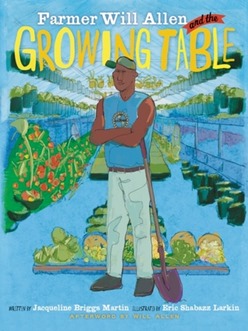
Review: Farmer Will Allen and the Growing Table by Jacqueline Briggs Martin

farmer will allen

Farmer Will Allen and the Growing Table by Jacqueline Briggs Martin, illustrated by Eric-Shabazz Larkin

Will Allen is a farmer who can see the potential where others can’t.  When he sees a vacant lot, he sees a farm with enough to feed everyone.  When he was a boy, he grew up helping care for a large garden that kept their family fed.  But Allen did not want to spend his life weeding and digging in the dirt, so he decided to become a basketball player, and he did.  But then living in Milwaukee, he saw empty greenhouses standing vacant and realized that he could feed people who had never eaten a fresh vegetable.  First though, he had to clear the land and then figure out how to improve his soil so that something could grow there.  That was the first time that the neighborhood kids helped out, bringing compost items to feed the worms.  Slowly and steadily, a community garden emerged and Will Allen taught others to be farmers too.  His Milwaukee farm now gets 20,000 visitors a year so that others can learn to grow gardens where there had only been concrete. 

I had seen the documentary, Fresh that includes Will Allen as part of the film about new thinking about food.  So I was eager to see a picture book about this inspiring figure.  It did not disappoint.  Martin captures the natural progression of Allen’s life from child eating from the garden to farmer giving other children that same experience and spreading the word about what is possible in an urban setting.  Martin’s tone throughout has a sense of celebration of Allen and his accomplishments.  She captures his own inherent enthusiasm on the page.

Larkin’s illustrations are striking.  Each could be a poster for farming and urban gardens on their own.  Combined into a book, they become a celebration of this large man with an even larger dream.  The colors are bright, the textures interesting and the image backgrounds evoke farming and nature.

This picture book biography is a visual feast that invites everyone to its community table.  Librarians and teachers in Wisconsin should be particularly interested in adding this to their collection, but it will hold interest in urban and farming areas across the country.  Appropriate for ages 6-9.

Reviewed from copy received from Readers to Eaters.

Review: Year of the Jungle by Suzanne Collins

year of the jungle

Year of the Jungle by Suzanne Collins, illustrated by James Proimos

Collins, author of The Hunger Games series, takes on a completely different writing challenge in this autobiographical picture book.  Suzy’s father is sent to fight in Vietnam when she is a little girl.  He will be gone for a year, but Suzy isn’t sure exactly how long a year is.  At first, her father sends lots of friendly postcards, but over time they change.  He even mixes up her birthday with her sister’s something he would never have done if he was home.  The the postcards stop altogether and Suzy catches a glimpse of the war on TV.  She starts to forget what her father looks like and is scared of many things.  Then suddenly, her father is home.  But he doesn’t look the same and doesn’t act quite the same either.

This book is so timely for children dealing with deployments in their own family.  Collins writes directly from her childhood persona, delving right into the fears that haunt children, the loss of control and the lack of contact.  It is her writing that makes this book work, her honesty about her emotions and the frankness with which she grapples with the challenges of having a parent fighting overseas.

Proimos’ illustrations are cartoony and rough.  The most successful are double-spreads that take on Suzy’s fears directly, placing them on a black landscape that is filled with tanks, animals, helicopters, and more.  They emanate danger and contrast directly with the more colorful other pages.

Though the book is about Vietnam, it has a universal message for children left behind worried about a deployed parent.  Timely and honest, this is a book that belongs in every public library.  Appropriate for ages 6-9.

Reviewed from copy received from Scholastic Press.

Review: Battle Bunny by Jon Scieszka and Mac Barnett

battle bunny

Battle Bunny by Jon Scieszka and Mac Barnett, illustrated by Matthew Myers

Gran Gran has given Alex a very saccharine sweet birthday book filled with bunnies as a gift.  But Alex is clearly not a fan of the original book since he takes his pencil and makes lots of changes so that it’s a book that he wants to read.  Birthday Bunny is turned into Battle Bunny, complete with helmet, utility belt and walkie talkie.  His goal is to unleash his evil plan on the forest and the world that only a boy named Alex can prevent.  Expect danger, cut-down trees, epic battles and much more as Alex tries to defeat the evil that is Battle Bunny!

Told and drawn in layers, this book is something very special. First you have the rather sickly sweet story underneath that celebrates Birthday Bunny’s birthday with lots of dancing and balloons.  It’s silly, friendly and pure sugar.  Over the top of that comes the brilliance of the writing of Scieszka and Barnett who manage by changing a few words in every sentence to make an entirely different story.  Most sentences just have a few words changed, but others towards the end are more edited to really let the story flow.  It works so well that one can forget the words underneath until you eye snags on one and you just have to read a bit of the silly story that has been edited. 

Myers’ art is equally successful.  He takes a dance scene and deftly turns it into an epic battle but one where you can still see the dancing underneath.  On some pages little comics are added in the white space so that more story can be told.  The cutesy nature of the underlying story is captured in his illustrations and one can feel the glee with which he reworked them just as a little boy would.

These three gifted book creators truly channeled their inner children to create this book.  It is funny, smart and immensely creative.  Appropriate for ages 4-7.

Reviewed from copy received from Simon & Schuster Books for Young Readers.

Review: Wild Berries by Julie Flett

wild-berries

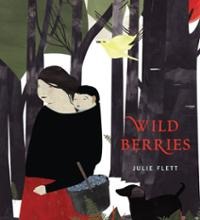
Wild Berries by Julie Flett

Clarence has gone berry picking with his grandmother since he was a baby.  Now he is big enough to carry his own bucket as they walk and sing.  The two of them pick the berries, Grandma looking for the sweet ones and Clarence for the bigger, sour ones that pop.  They pick the berries and eat the berries.  Then Clarence looks around the woods and sees different insects, spiders, and a fox.  It is time to go home, they say thank you and walk back home together.

This book weaves Cree into the story, separating the words out and providing pronunciation information at the end of the book.  Even these few Cree words evoke a different feeling, a new rhythm that is powerful.  Flett tells a very simple story here about going out to pick berries in the forest.  Yet it is a timeless story, one the embraces wildlife, the environment, and giving thanks for the bounty of nature. 

Flett’s art is a beautiful mix of cut paper collage, texture and painting.  She manages to show the depth of the woods without darkness.  She uses bright colors that pop on Grandma’s red skirt and the red sun in the sky.  The grass is drawn in individual blades and the tree bark varies from paper art to marker lines.  Put together, it is a rich and beautiful book.

Simple, powerful and honest, this picture book celebrates Cree and nature together.  Appropriate for ages 2-4.

Reviewed from library copy.

Review: How Big Were Dinosaurs? by Lita Judge

how big were dinosaurs

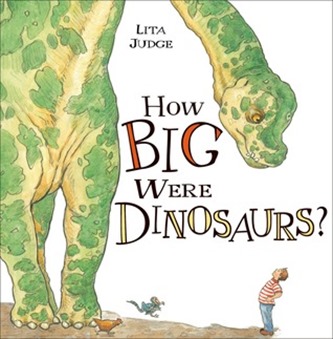
How Big Were Dinosaurs? by Lita Judge

Whenever you think of dinosaurs, they are like the one on the cover of the book.  Huge, green and either placid plant eaters or ferocious meat eaters.  This nonfiction picture book takes a look at dinosaurs that are quite different.  There is the microraptor who is the size of a chicken.  The long-named Leaellynasaura stood as tall as an emperor penguin and lived in that same climate.  Of course there were bigger dinosaurs too.  The akylosaurus stood as tall as an SUV.  There were dinosaurs with huge claws that ate plants, ones with armor and still others with odd parts of the body that no one understands yet. 

Judge carefully chooses her dinosaurs in this book.  Understanding that the littlest dinosaurs lack the vibrant punch of the huge ones, the book quickly changes to the more imposing creatures.  She shares just enough about each dinosaur to make the book readable.  In fact, this is one nonfiction picture book about dinosaurs that could be shared at a storytime or aloud in a unit.  Judge packs lots of fascinating facts into the book.  It ends with the science behind figuring out what dinosaurs used to look like and a fold-out page with all of the dinosaurs in the book shown next to each other with lots of numbers and facts.

Judge’s playful illustrations are great fun.  Throughout the book, she uses humans to show the scale of the dinosaurs as well as other animals.  The humans don’t just stand next to the dinosaurs, they interact and react to them.  I particularly enjoyed the image of the woman batting at a dinosaur with a broom.  It’s those little touches of humor that suit this book so well.

Readable, fun and filled with science, this book on dinosaurs will be a welcome addition to those crowded shelves.  Appropriate for ages 4-7.

Reviewed from copy received from Roaring Brook Press.

Review: Parrots Over Puerto Rico by Susan L. Roth

parrots over puerto rico

Parrots Over Puerto Rico by Susan L. Roth and Cindy Trumbore

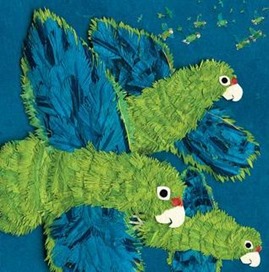
This exceptional nonfiction picture book tells the story of the Puerto Rican parrot.  It is a bird that has flown over Puerto Rico for millions of years but almost became extinct in the 1960s.  The book tells of the changes that came to Puerto Rico and its environment thanks to settlers, wars, hunting, and foreign invasive species.  Forests began to disappear too, so the parrots were limited to living in just one place.  By 1967, only 24 parrots lived in Puerto Rico.  With them almost extinct, people started trying to save the parrots.  The book tells the story of rescued parrots, storms and the dedicated scientists who figured out how to save this species from disappearing entirely.

Roth and Trumbore tell this story deftly.  They focus on what was almost lost, a sky crowded with these blue and green birds.  The book explores the history of Puerto Rico, tying it closely and innately into the story of the parrots themselves.  The entire book is fascinating and becomes even more compelling when the story turns to the rescue efforts.  Small victories such as saving a young parrot’s wings are celebrated, while the larger effort is also looked at in detail. 

Roth’s collages are exquisite.  She captures the beauty of the birds, as you can see from the cover image above, but also the beauty of Puerto Rico itself with all of its lush greens.  The book is beautifully designed as well.

A dazzling nonfiction book that will be welcome in classroom discussions and units about conservation and environment.  Appropriate for ages 7-9.

Reviewed from digital copy received from Lee & Low and Edelweiss.

Review: The Story of Fish & Snail by Deborah Freedman

story of fish and snail

The Story of Fish & Snail by Deborah Freedman

This is the story of Fish and Snail who were great friends.  Every day, Snail would wait for Fish to return with a new story.  This time, Fish returned with a great story, one so wonderful that Fish wanted to show Snail instead of tell about it.  But Snail doesn’t want to leave the book they are in.  Snail wants to stay right there and play kittens instead of pirates.  The two start to argue and finally Fish declares that it is THE END and leaves the book.  Snail was so sad.  This was not the way the story was meant to end.  So Snail leans farther outside of the page and sees Fish in a watery book below.  Will Snail leave his safe book and dare to tumble down to the other ocean below?  Will Fish return with more stories?

Freedman captures a story-within-a-story here with her setting of two characters living not just in one picture book but many.  It is the story of two opposite characters who still manage to be friends, most of the time.  There is the sedentary Snail who longs for the stories but not the real adventure.  Then there is the irrepressible Fish who jumps and leaps literally off of the page.  The pair make for a balanced friendship but also one with plenty of room for misunderstanding too.  Their conversation and fight are written strongly and honestly.

Freedman’s art is gorgeous.  Readers will recognize her as the author and illustrator of Blue Chicken.  She uses similar splash effects in her art here.  The blues are gorgeously green and filled with light.  When Fish swims the bubbles take on a stronger form as Freedman lets the watercolor dapple the page.  There is one beautiful image of Snail looking down to the other book that plays with perspective cleverly.

I’ve heard Caldecott rumblings for this one and with its playful yet artistic illustrations, I’d love to see that.  In the end though, it’s also a great story about friendship, books and being willing to take risks.  Appropriate for ages 3-5.

Reviewed from copy received from Viking.