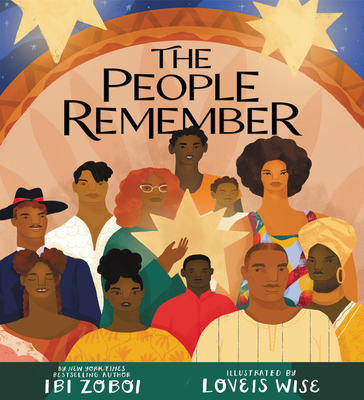
The People Remember by Ibi Zoboi

Cover image for The People Remember.

The People Remember by Ibi Zoboi, illustrated by Loveis Wise (9780062915641)

This nonfiction picture book explores African American history by connecting it to the seven principles of Kwanzaa. The book starts with Africa during a time of war when people disappeared or were sold. The history continues as they are taken into slavery, landing in places like South Carolina, Hispaniola and Brazil. Some escaped while those who could not escape found a common language and unity. People today remember the days of slavery, seeing that they have self-determination to change the nation. When slavery ended, the Great Migration came along with music on the streets and in churches, showing their collective work and responsibility. The history continues with examples of places that Black people created themselves and Black people who were successful, showing the principle of cooperative economics. Purpose came with voting rights, marches for civil rights, and the grief and hate of lynching. Creativity is shown again and again with music, dance, writing and more. The book ends with faith, a commitment not to forget and to carry forward with hope for change.

This Zoboi’s picture book debut. Her writing is exceptional, an ode to African Americans and their collective impact on the world. Using the Kwanzaa principles to guide the structure of the book works well, as the book naturally forms into seven sections. Zoboi uses a repeating structure of the various African tribes who were taken to America as slaves. In these sections and throughout, there is a call to Black pride, to seeing oneself as survivors and removing any shame from the narrative. Zoboi works to clearly draw the connection between history and today, showing the continuum that reaches backward and forward.

Wise’s illustrations are filled with lush colors, depicting connections between modern times and history. Their art is flat and graphic, almost poster like in its powerful simplicity. Each one could be framed and used to call out a movement or moment in history.

Powerful, unflinching and important. Appropriate for ages 6-9.

Reviewed from e-galley provided by Balzer + Bray.
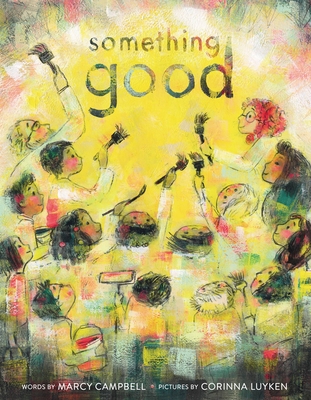
Something Good by Marcy Campbell

Cover image for Something Good.

Something Good by Marcy Campbell, illustrated by Corinna Luyken (9780759557420)

When a “bad-something” is found written on the wall in the girls’ restroom at school, the principal says that this won’t be tolerated. One girl and her friends sneak into the bathroom to see what the bad thing is. It’s fun at first, until they see what is written. The bad something is truly bad, leaving them all feeling horrible. No one knows who wrote it, so everyone is looking closely at one another for clues. Afterwards people were meaner to each other. So the school decided to give everyone ribbons to remind them who they are and then launched an art project to permanently cover the bad thing. Everyone worked together painting and creating until they had made something remarkable. Sharing poems afterwards, students became kinder to one another, reminded who they are and who they want to be.

Based on happenings in her children’s schools, this picture book shows the continued impact that hate speech can have on a school. Campbell shows the emotions of the various children clearly, making space for different reactions to what has been written and also showing how not knowing exactly what was said can also cause emotional and negative responses. The book is filled with empathy for the students and offers one of many solutions to bring the student body back around. Using art to express themselves allows for emotions to be shared and the community itself to step forward.

The art is done in gouache, colored pencil and ink. The art shows the mixed emotions of the students in the school, reddened and sharpened feelings of accusation, dark red and black of meanness, bright yellow of hope and change. The illustrations are a gorgeous mix of lightness of line with deep color that conveys the feelings.

A look at hate speech and how to confront its impact. Appropriate for ages 4-7.

Reviewed from e-galley provided by Little, Brown and Company.

Oscar’s Tower of Flowers by Lauren Tobia

Cover image for Oscar’s Tower of Flowers.

Oscar’s Tower of Flowers by Lauren Tobia (9781536217773)

This wordless picture book tells the story of Oscar and his love of plants and flowers. Oscar’s mother has left him with a relative and his favorite picture of him and his mother is full of flowers. At first, they grow just one little plant in a pot but soon after a visit to a garden store, Oscar has much more. He selects seeds to plant, potting soil and tools. Back in the apartment, they fill all sorts of containers with soil and seeds, placing them on the sunny windowsill. Then they all sprout! The apartment fills with plants, including the bathroom. It all gets a little too crowded, so Oscar gives the plants away to their neighbors. With his mother back, she and the reader can see the way that Oscar transformed not only one apartment but the entire neighborhood.

Tobia creates a warm and lovely story here filled with an adult empowering a child to follow his interest. Oscar communicates through his drawings of plants, showing his desire to grow something. The woman taking care of him, who may be an aunt or a rather young grandmother, dives in with him, getting him the tools and items he needs to truly grow plants. The solution of sharing his success with everyone is transformational for the entire apartment complex. The diverse urban setting changes from stark to vibrantly green and growing in the course of a few months, thanks to one little boy.

A wordless picture book about sharing, community and the impact a child can have. Appropriate for ages 2-4.

Reviewed from e-galley provided by Candlewick Press.

How to Find a Fox by Kate Gardner

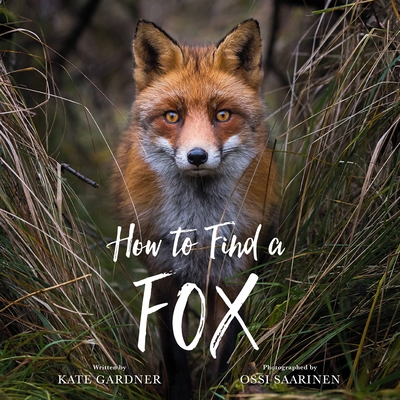
Cover image for How to Find a Fox.

How to Find a Fox by Kate Gardner, photographs by Ossi Saarinen (9780762471355)

This nonfiction picture book explores the world of the fox in beautiful photographs. The text is a mixture of a very simple storyline of finding a fox combined with detailed facts about foxes and their adaptability in a changing world. The book looks at when it is best to find a fox, such as time of day or season. It goes on to describe what a fox looks like and what to look for when finding their tracks. You can also listen for yips or other noises. But most importantly, you must try to be very quiet and hope that a fox might just find you!

The text of the book is well-written and full of interesting foxy facts. Children will want not only the simple story but to hear about the details of the fox’s life and how to find one themselves. The premise of the book alone is an invitation that is almost impossible to turn away from.

From the cover and through the entire book, the photographs are the focus. They marvelously capture the fox with clarity and a real feeling for their character. There are images where the fox is lit by the sun where you can almost sink your fingers into their fur. Other pages have the fox looking right at the reader with undeniable intelligence. Simply beautiful.

One of the most enticing and gorgeous animal books of the year. Appropriate for ages 3-6.

Reviewed from e-galley provided by Running Press Kids.

From the Tops of the Trees by Kao Kalia Yang

Cover image for From the Tops of the Trees.

From the Tops of the Trees by Kao Kalia Yang, illustrated by Rachel Wada (9781541581302)

A true story from the Hmong author’s childhood, this picture book brings readers to the Ban Vinai Refugee Camp in Thailand in 1985. Their days are filled with hunger and finding fruit that they can pretend are candy. The aunties in the camp talk about the war and their fears of returning to the old country or heading to a new country. Every week the families in the camp are given enough food for three days. It’s a practice meant to deter other Hmong refugees from entering the country. After Kao asks about the world beyond the camp, her father takes her to the tallest tree in camp, climbs with her to the highest branches, and gives her a view of the world beyond the camp.

Yang shows the view of the refugee camp from that of a small child living there. The day is filled with happy moments like riding one of the dogs and racing the chickens for rice balls. Yet there is no escaping that they are in a refugee camp. Yang shares this by having the adults talk about the war, showing the food disbursement, and having Kao explain that they can’t leave but others can enter. The climb into the branches is dramatic and inspiring, a look a freedom that could not be more moving and tangible.

Wada uses a mix of traditional media like graphite and watercolor with digital tools. She shows Yang’s small family, using more saturated colors to pull them out of the crowds and to keep the focus on the young Kao in the camps. The colors are sandy and subtle, becoming deeper as they reach the treetop to see the world around them.

Another gorgeous and skilled picture book from Yang that captures the experience of the Hmong refugee camps and Hmong Americans. Appropriate for ages 5-8.

Reviewed from e-galley provided by Carolrhoda Books.

Interrupting Chicken: Cookies for Breakfast by David Ezra Stein

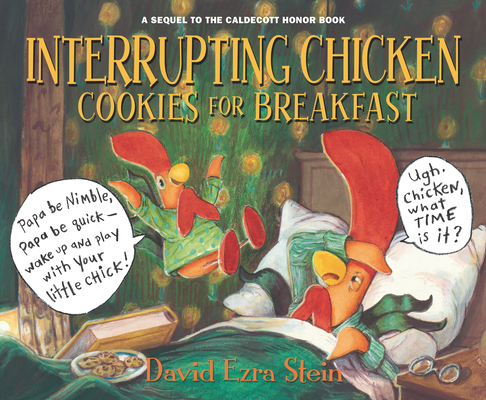
Cover image for Interrupting Chicken: Cookies for Breakfast.

Interrupting Chicken: Cookies for Breakfast by David Ezra Stein (9781536207781)

Little red chicken got up early on Saturday and brought his Papa breakfast in bed. Cookies for breakfast! But Papa doesn’t want either of them having cookies for breakfast and just wants to sleep a little longer. He agrees to read a book together though. Little red chicken picked out a book of nursery rhymes. There Was an Old Woman started out normally enough, but soon Little red chicken has turned it into a tale of shared cookies in a shoe. Jack and his candlestick and Hickory Dickory Dock all get changed too and now include cookies. Papa is starting to get a headache, so Little red chicken writes him a rhyme of his own which features cookies, of course. Now it is Papa’s turn to be hungry, and the two of them agree on a different treat for breakfast, cake! Pancakes.

This third book in the Interrupting Chicken series is another winner. In this book, Little red chicken interrupts regularly to continue to ask for cookies for breakfast. His sleepy and patient father goes along as best he can while also insisting that neither of them would have cookies for breakfast. The interruptions are great fun, transforming classic nursery rhymes into delicious humor. The relationship between the two characters is also a pleasure with their back and forth dialogue being just as joyous as the silly rhymes.

The art by Stein contrasts highly saturated and deeply colored images of the chickens with light pastel vintage nursery rhymes shown in a book. Those in turn get changed with some clever erasing and crayons that add yet another layer to the stories.

Another winner in a charming series. Appropriate for ages 3-5.

Reviewed from e-galley provided by Candlewick.

Everybody in the Red Brick Building by Anne Wynter

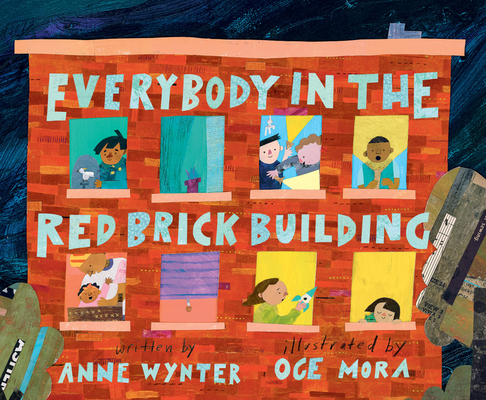
Cover image for Everybody in the Red Brick Building.

Everybody in the Red Brick Building by Anne Wynter, illustrated by Oge Mora (9780062865762)

Everybody in the red brick building was sleeping until Baby Izzie howled in her crib. That set off a chain reaction that got lots of people in the building awake. Rayhan tried to quietly check on his parrot, who shouted to Wake up! The boys sleeping outside got into a game of flashlight tag. Natalia set off her light-up rocket. And the noise kept growing with a car alarm too. Then quiet returned with the street sweeper going by, acorns plonking down, windchimes, and Izzie getting snuggles. Finally, everyone in the red brick building was asleep – again.

Wynter takes a classic children’s story structure and brings the noises to a full cacophony before returning the building steadily to quiet again. The book is a great mixture of wildness in the middle of the night and then quieting to fall asleep, making it a great book to get restless children to bed. The text is filled with repeating loud noises that children will enjoy joining in to help make them even louder. As the book quiets down, the sounds become soft and gentle while staying just as enjoyable as before.

Mora’s illustrations are done in colorful paper collage that show the diverse community that lives in the red brick building together. The colors take the deep blue of night to the orange warmth of indoors to teals, lavenders, and yellows. The colors are engaging, making each page turn a new room of its own. The illustrations are just as dynamic as the book, and that is certainly saying something!

A great read-aloud bedtime book. Appropriate for ages 2-4.

Reviewed from e-galley provided by Balzer +Bray.

Off-Limits by Helen Yoon

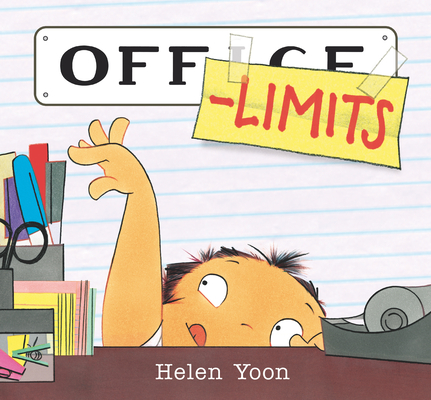
Cover image for Off-Limits.

Off-Limits by Helen Yoon (9781536207316)

Dad’s office is off limits for playing. But the temptation to enter is irresistible. Maybe if the little girl just looks around and doesn’t touch anything. Perhaps one piece of tape won’t hurt anything… Soon the lamp has a tape scarf and looks lovely. She then discovers the paper clips and binder clips which quickly form into necklaces, crowns and more. Post-It notes come next and soon the room is filled with paper chains, lines of notes, and that’s when she realizes that it’s gotten out of control. She sneaks out, trailing office supplies in her wake to hide in her room. But what does she find there?

Yoon has taken my own love of office supplies and turned it into a picture book that celebrates creativity and the joy of tape, post-its and binder clips. Readers will feel the barely suppressed need to play with the office supplies at first and then the relief of just giving in and doing it. Told in the voice of the little girl, the text is entirely her dialogue as she plays, rationalizing along the way what she is doing and then her horror at discovering how far she went.

The illustrations are a huge part of the delight of this picture book. The tape alone offers so much visual pleasure with it in her hair, dangling like earrings, and taping her mouth shut. Then come the clips and the sticky notes, and the entire book swirls with ideas until in one final amazing page, it all comes together into a stage-like finale. Add in the twist in the end and it is so much fun!

A dazzling look at office supplies that get out of control. Appropriate for ages 3-5.

Reviewed from e-galley provided by Candlewick.

Jazz for Lunch! by Jarrett Dapier

Cover image for Jazz for Lunch.

Jazz for Lunch! by Jarrett Dapier, illustrated by Eugenia Mello (9781534454088)

A boy heads with their Auntie Nina to a jazz club for lunch. The musicians play while the chefs in the kitchen cook, their sounds mixing together. But it’s so crowded that they can’t get to the front and can’t get any food either. It gets hot too, so the two head out and Auntie Nina has a new plan. The next day, the two of them set up in the kitchen. They listen to jazz on the stereo and start cooking together. There is cinnamon, peanuts, chicken, cheese, and much more, as they name the dishes after jazz icons. Soon it is the boy’s turn to have a drum solo played on the pots and pans. A knock comes on the door, and it’s all of the jazz musicians from the club. They share a great meal together. Now what’s for dinner?

This book cleverly demonstrates the improvisation of jazz music through having to change their plans for the day. That theme is also part of their cooking as their free-flowing style continues there with plenty of style. The text throughout the book has rhyme and rhythm. Dapier uses repetition of the phrase “Jazz for lunch!” throughout the book to great effect.

Mello’s illustrations are filled with bright colors of saffron, tomato, melon and blueberry. The illustrations swirl with movement, whether it is music moving through the air or ingredients dancing into the pan.

A delightful jazz riff on food. Appropriate for ages 3-6.

Reviewed from e-galley provided by Atheneum.