Review: My Father’s Arms Are a Boat by Stein Erik Lunde

my fathers arms are a boat

My Father’s Arms Are a Boat by Stein Erik Lunde, illustrated by Oyvind Torseter, translated by Kari Dickson

Published on February 5, 2013.

There are some picture books that you read the first few lines and you realize you are somewhere new and unknown.  This is that sort of book.  It is the story of a young boy who is unable to fall asleep.  His father is there, sitting in the living room by the fire.  The boy returns to his father and climbs onto his lap.  His father talks about cutting down a big spruce together the next day.  The boy asks about the red birds that they left bread for.  He worries about the fox stealing their bread too. His grandmother told him that the red birds are dead people and then the book turns and is about the loss of his mother and grief.  It is handled with such care and delicacy and the young boy is surrounded with such obvious love that it is achingly exquisite.

This book is not really about what I captured in the paragraph above.  It is about sorrow and grief, the sort of sorrow that can only be fleetingly captured in a silent flight of birds or a lone fox in the snow.  It is about the loss of a mother, but also about the days following when grief is all you can bear and think of.  This book reads like a beautiful ache, a heartbeat of grief where life must go on.  The writing is expressive and poetic, just like the title.

Torseter’s illustrations are also unusual and amazing.  Done in folded paper and collage, they have a 3-dimensional quality to them that invites in shadows.  Most of the images are black, white and grey, though the red birds and the orange fox are pops of color.  Beautiful and delicate, the slumps of the shoulders of the characters tell of the sad truth before the words do.  The winter setting too is cold and a bit wild, reflecting the mood of the story.

Stunning in its writing and illustration, this is a picture book that is noteworthy and memorable.  Appropriate for ages 6-8.

Reviewed from copy received from Enchanted Lion Books.

Review: The Other Side of Town by Jon Agee

other side of town

The Other Side of Town by Jon Agee

A New York taxi driver picks up a rather odd passenger who asks to be taken to Schmeeker Street on the other side of town.  They reach a dead end, but that is not the other side of town yet.  The man pulls out a remote control and the dead end opens into a tunnel, the Finkon Tunnel.  The tunnel leads to a maze of ramps that twist and turn, ending in spotholes.  The driver tries to avoid them, but accidentally drives into one of the large black holes from which they are dumped onto Schmeeker Street.  Suddenly everything is pink and green, just like the man.  Finally, they reach his destination but the cabbie is caught on the other side of town until he notices the remote control left in the back seat.  But yet another surprise is waiting for him when he gets home!

Agee plays with our expectations with a great sense of fun in this book.  Renaming landmarks into something very similar but yet strange and different was a great choice.  The tone is entirely one of silliness and laughter with just enough being different and zany to make it clear that the other side of town is unlike anywhere readers have ever been.  It is through this that Agee subtly demonstrates that there are paths to cultural acceptance for those who are different from us.

The color palette of the other side of town also plays a large role in the story.  Immediately readers will see the little man as unusual thanks to his pink plume and green bodysuit.  When the story moves to the other side of town, the cabbie suddenly pops in his pale blue against all of the pink and green.

Funny, silly and a treat, take a visit to the other side of the town!  Appropriate for ages 4-6.

Reviewed from copy received from Scholastic.

Review: Bunnies on Ice by Johanna Wright

bunnies on ice

Bunnies on Ice by Johanna Wright

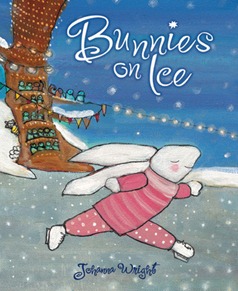
This icy read is just right for a very cold winter day, like we have been having here in Wisconsin.  One little bunny thinks that she is a champion ice-skater.  As a champion, she has to wait for conditions to be just right, even if it means waiting through spring, summer and fall!  When the waiting is finally over, she has to eat a big breakfast to prepare.  Clothing selection is also important, enough layers to be warm, but not too many.  Finally, it is time to skate her adoring fans.  She demonstrates her high level of skill, well, almost.  The day ends with hot chocolate, a warm bath and a cozy bed.  The perfect ending for a champion day.

Wright has created a cheery book about not only ice skating but the wonder of big dreams.  It is a delight to find a picture book with a young girl exhibiting such strong self-esteem with no hesitation.  Wright nicely weaves in the truth behind the little girl’s dreams.  This happens particularly when the actual skating begins and readers discover that she’s not really a champion ice skater. 

In her illustrations, Wright creates a cozy world.  There is the rabbit’s home inside a large tree that is filled with deep colors that evoke a warmth.  This contrasts nicely with the blues of the outdoors and the white of the snow.  The entire book exudes a cluttered friendliness and family-centered cheer.

Sparkling with ice and plenty of bravado, this picture book will inspire children to dream big themselves.  Appropriate for ages 3-5.

Reviewed from copy received from Roaring Brook Press.

Review: Frog Song by Brenda Z. Guiberson

frog song

Frog Song by Brenda Z. Guiberson, illustrated by Gennady Spirin

This is one breathtaking nonfiction book about frogs.  The book takes a look at various fascinating species from around the world, explaining what makes that species so special.  Delving deeper than skin deep, the strawberry poison dart frog from the cover is celebrated for the unique way she lays her eggs:  five at a time and then when the tadpoles emerge she carries each of them to their own pool of water up in the trees.  Each turn of the page brings another strange and amazing frog with its own unique approach to life.  This is a celebration of frogs that is sure to enthrall any young biologist.

Guiberson has carefully selected frogs that are incredible and unique.  Her writing is filled with frog noises, motion, and even the sounds that whipping a gooey mass of eggs into a ball of bubbles would make.  This adds a certain zing to the writing, making it great fun to read aloud.  You must have your ribbit on to pull this one off.

Spirin’s illustrations are simply amazing.  Filled with more all the great details you would get from a photograph, they are superbly realistic.  Turning the pages shows the breadth of frog life on our planet.  The vitality and also the fragility of these animals is highlighted in her art.

Beautiful, intriguing and great fun to read, this book is an impressive testament to the importance of frogs in our ecosystems.  Appropriate for ages 7-10.

Reviewed from copy received from Henry Holt and Company.

Review: Henry and the Cannons by Don Brown

henry and the cannons

Henry and the Cannons: An Extraordinary True Story of the American Revolution by Don Brown

The trend for great children’s historical biographies in picture book format continue this year.  This picture book tells the story of Henry Knox.   It is the winter of 1775 and the Americans need cannons to take back Boston from the British.  Knox takes the challenge of moving 59 cannons over 225 miles across Massachusetts in the dead of winter.  It took boats, oxen and plenty of determination and innovation to get those cannons across the state.  The journey and amazing achievement is told here in a way that will entice children to learn more stories about the American Revolution.

Brown’s writing is solid throughout the book.  He carefully sets the scene, clearly explaining how unbalanced the war was with Revolutionaries vs. the world’s best soldiers.  Add to that the power of cannons, and there was clearly no hope for victory.  After that the book turns more towards adventure and peril, making for a read that must be finished.  From the impossible mission to each and every mishap, readers will be rooting for Knox.

The illustrations serve to underline the stark winter and the heaviness of the cannons.  Men and oxen strain to move the 120,000 pounds of cannon.  Snow flies, the boats seem more like twigs next to the metal, and the crossing of an iced-over river brings drama and danger. 

Strong and noteworthy, this picture book nonfiction title has history and also plenty of action and adventure.  Appropriate for ages 7-10.

Reviewed from copy received from Roaring Brook Press.

Review: Building Our House by Jonathan Bean

building our house

Building Our House by Jonathan Bean

Told through the eyes of a young girl, this picture book chronicles her family’s move from the city to the country.  There in a bare field, they are going to build their own home.  The family works for a year and a half on their house, living in a very cozy trailer while they complete enough of the house to live in it.  Slowly the house takes shape from pegging out the corners to digging out the foundation to the incredible use of hand tools to work on the lumber for the frame.  Through it all, the entire family is involved in the process and what an amazing process it is!

There are plenty of lumber, rocks, trucks and construction in the book to keep children intrigued.  It is great to see a construction book where children are right in the middle of things, helping and getting fully engaged and dirty.  The story is based off of Bean’s own childhood when his own parents built their family home from the ground up.  It is told from his older sister’s perspective.  I think that is what really comes through in this story.  It is intensely personal but also wonderfully detailed so that children really get the feel of what it is to spend over a year building a home.

Bean’s writing and illustrations work beautifully together.  The illustrations are filled with small touches like the cats who join the family.  The seasons rush in and out, changing plans and creating a colorful background for the story.  This is a house that honors the site it is built on with all of the nature around it, the book does as well.

Get this into the hands of young construction enthusiasts definitely!  But it has appeal far beyond that since it is a story of family at its heart.  Appropriate for ages 5-7.

Reviewed from copy received from Farrar, Straus and Giroux.

Review: Sleep Like a Tiger by Mary Logue

sleep like a tiger

Sleep Like a Tiger by Mary Logue, illustrated by Pamela Zagarenski

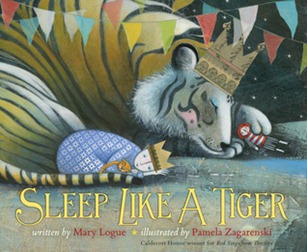
This is the story of a little girl who just wasn’t sleepy at bedtime.  Her parents agreed that she didn’t have to head right to bed, but she did have to put on her pajamas.  Then she had to wash her face, and that felt good.  She climbed into bed, because she loved the feeling of the sheets.  Then she asked about whether everything in the world sleeps.  Her parents explain that yes, like the dog being asleep on the couch where he shouldn’t be.  The book turns to explain about different animals and how they sleep from the upside down bats to floating whales to hibernating bears.  After talking, her parents let her stay awake in her bed.  The little girl begins to sleep like each of the animals, curling up like the dog, folding her arms like bat wings, finding the warmest spot like a cat.  Until finally, she is asleep like the strong tiger.

Oh what a bedtime story!  I had heard great things about this book and at first saw beautiful illustrations and a fairly normal story, but that changes and becomes something very special.  Once the little girl is in bed and talking about the animals, the language becomes more poetic and filled with imagery.  It is warm, cozy and infinitely inviting.

Zagarenski’s illustrations have a richness about them that enhances this bedtime tale.  Thanks to the golden crowns, they have an illuminated manuscript feel.  There is plenty of texture and pattern, but also a modern zing to the illustrations.  They are entirely winning.

This glorious bedtime story is a real treat to read aloud.  Get your own jammies on and cuddle up, I promise you will be dozing in no time, just like a tiger.  Appropriate for ages 3-5.

Reviewed from library copy.

Review: From the Good Mountain by James Rumford

from the good mountain

From the Good Mountain: How Gutenberg Changed the World by James Rumford

A mysterious object appeared in Germany in the 15th Century.  “It was made of rags and bones, soot and seeds. It wore a dark brown coat and was filled with gold.  It took lead and tin, strong oak, and a mountain to make it.”  To find out the answer to this clever riddle that appears on the first page of this book, readers will visit the 15th century and meet Johannes Gutenberg, who has invented a way to print books with movable type.  The riddle is not left at the first page, but is the center of the entire book.  Each piece of the printing press is explored from the very elements it is made from to the final culmination in a printed document.  Each page is also illustrated like an illuminated manuscript. 

Come visit the world of Gutenberg in this picture book biography that takes a very unique and intriguing approach to its subject matter.  This is much more a biography of the press itself than Gutenberg the man.  It is about the ingenuity and foresight it took to see such a construct in raw materials.  Readers are sure to learn much about the process of printing and what materials were used to create books.

Rumford’s art is just as wonderful as his writing.  The illuminated manuscript feel of the book is captured in its use of golds that seem to shine on the page like gold leaf.  He also uses the deep blues and other rich hues to create a feel of timeless beauty.

This is an intriguing read that will appeal to students who enjoy puzzles and riddles.  It is a book that unwraps and explains in a clever, engaging way.  Appropriate for ages 7-9.

Reviewed from library copy.

Review: This Moose Belongs to Me by Oliver Jeffers

this moose belongs to me

This Moose Belongs to Me by Oliver Jeffers

Wilfred’s moose arrived a while ago and Wilfred just knew that the moose was meant to be his.  He called the moose, Marcel.  Wilfred had some serious rules if Marcel was going to be his pet, but Marcel didn’t seem interested in following them.  Some though, Marcel was very good at.  He did not make noise while Wilfred was listening to his music.  He provided Wilfred shelter from the rain and he knocked high things down so that Wilfred could reach them.  Then there were the rules that Marcel didn’t follow.  He didn’t stay near home and soon Wilfred had learned to carry string along with them so they could find their way back home after long jaunts.  It was on one of those long walks that Wilfred discovered that there was someone else who thought that THEY owned the moose! 

Jeffers once again captures a concept with solidity and grace.  He manages to take the idea of owning an animal and get readers to ask themselves about what ownership really means.  The character of Wilfred has to do some adapting of his own, quickly changing his own rules and beliefs to be more moderate and open-ended.  It also helped to share food.

The art here combines grand backdrops of mountains and plains with one small round-headed boy and a moose, dragging bright blue string behind.  It’s a wonderful juxtaposition that will have readers understanding immediately that this moose is certainly not a pet that belongs to anyone.

Another delight from Jeffers, this book is about wilderness, the wild, and owning a pet.  Appropriate for ages 4-6.

Reviewed from library copy.