Review: Martin on the Moon by Martine Audet

martin on the moon

Martin on the Moon by Martine Audet, illustrated by Luc Melanson

Martin has just started school, but as he sits in class, his mind continues to wander.  His teacher reminds him of his cat due to her hair color.  Then he daydreams about the trip he and his mother took to the river and thinks about the water there.  He tries to pay attention, since it is the first day of school, but then his teacher reminds him of a seagull with the way she is moving her arms.  Martin remembers a time when he was out drawing and got to see a bolt of lightning in the sky.  When he shared that it looked like someone coloring outside the lines, his mother wanted to use the image in a poem. Martin then starts thinking about poems and kisses, until his teacher asks him who he’s blowing kisses to. 

Nominated for the Prix TD de littérature canadienne pour l’enfance et la jeunesse in its original French, this book works well translated into English.  The poetic language, the imagery and the creativity of young Martin all work together to create a beautiful unity.  This is a striking example of a picture book whose strength comes from its writing rather than its illustrations.  The writing is powerful, visual and uses imagery that children will easily relate to.  Tying in poetry itself to the story makes it all the more concrete.

Melanson’s illustrations have a soft texture and use a successful mix of vibrant and softer colors.  The illustrations don’t offer much detail, instead being more about color and texture than finer touches. 

Poetic and lovely, this picture book would work well in a unit on imagery or poetry.  I’d also get it into the hands of any young daydreamer.  Appropriate for ages 4-6.

Reviewed from library copy.
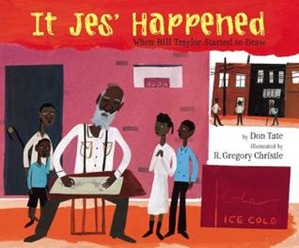
Review: It Jes’ Happened by Don Tate

it jes happened

It Jes’ Happened: When Bill Traylor Started to Draw by Don Tate, illustrated by R. Gregory Christie

This picture book is a beautiful tribute to a legendary folk artist.  Bill Traylor grew up a slave in Alabama.  Born in 1854, he worked in the fields as a child.  When the slaves were freed at the end of the Civil War, his family stayed on working as sharecroppers on the same land they worked as slaves.  As things happened to him throughout his life, from hunger to parties, Bill Traylor remembered it all.  When he finally left the farm and headed to the big city of Montgomery, it was those memories that he drew and painted.  At age 85, he started drawing and kept on.  He got attention for it too, eventually getting a gallery show in 1940.  Bill Traylor showed his life and his heart through his simple yet powerful art.

Tate does not shy away from truly embracing Traylor in this picture book.  The book has more words than many picture books, but they are necessary to truly recreate both the memories of Bill Traylor and the amazing transformation to artist that happened so late in his life.  The writing is solid and smooth, building a full life before your eyes.

Christie’s art hearkens back to that of Traylor’s in its rough simplicity.  It speaks to the deep colors and the power of plain paint and strong lines.  There is also a wonderful dynamic quality to the art that offers motion and storytelling.

A lovely look at the life of a folk artist, this book is a great example of a picture book biography.  Appropriate for ages 6-9.

Reviewed from library copy.

Review: Wumbers by Amy Krouse Rosenthal

wumbers

Wumbers by Amy Krouse Rosenthal, illustrated by Tom Lichtenheld

I love puzzle games and this book is like reading a puzzle game.  The concept is to mix numbers and words to form something entirely new.  The book cre8tes a gr8 way to interact with children, who will happily call out the answers.  My 11-year-old happily curled up with me and helped decipher the puzzles on each page.  The book is made up of a series of different situations rather than a flowing storyline, which makes the puzzles all the more enjoyable.  As the book progresses, the wumbers do get more difficult to figure out, resulting in plenty of groans of appreciation as we read the book.

This would make a 1derful writing exercise for students to a10mpt, since it’s a lot more difficult than it first appears.  It’s not a book to share with a large group, but rather one to cozily figure out together with one or two children.  Lichtenheld’s illustrations are great fun, adding context to the puzzles and a lightness too. 

Perfect for children who enjoy word puzzles or as a jumping off point for a fun writing exercise, this book is sure to el8 young readers.  Appropriate for ages 6-8.

Reviewed from copy received from Chronicle Books.

Review: All by Myself by Emile Jadoul

all by myself

All by Myself by Emile Jadoul

Leon is potty trained, but at night he still wants his parents to help him get to the bathroom.  So when he has to use the bathroom, he calls to his parents from his bed and waits for them to take him to the potty.  Then the next morning, his parents are exhausted.  So his mommy tells him that big boys go to the potty by themselves at night.  Leon decides to try it.  So that night when he has to use the potty, he climbs out of bed.  He considers calling his mother…but ends up going all by himself!  Then comes the clever bit at the end that I won’t spoil, but that makes the book all the more enjoyable to read.

Jadoul perfectly captures the later part of the pottying process, when there is still a little help to be given.  Told in very simple words, it is a quiet story of a loving family.  The writing level is just right for preschool children to enjoy.  The ending twist will have everyone giggling too.

The art in the book is done in black pencil and oil paints.  The rough darkness of all of the penguins plays nicely against the finer lines of the backgrounds in the story.  The addition of the little purple teddy bear emphasizes the youth of the main character and his need for security.

This book will nicely encourage almost-trained children to continue to do things on their own.  Appropriate for ages 2-4.

Reviewed from copy received from Eerdmans Books for Young Readers.

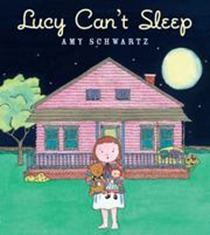
Review: Lucy Can’t Sleep by Amy Schwartz

lucy cant sleep

Lucy Can’t Sleep by Amy Schwartz

Lucy is in bed, but she just can’t fall asleep.  First, she tries counting sheep and other animals, but that doesn’t work.  So she climbs out of bed, puts on a sweater, stretches and wiggles.  Then she heads out of her room to try and find her doll and bear.  There they are in a chair downstairs.  Lucy then heads to the kitchen and rummages in the fridge for a snack.  She finds chocolate pudding and strawberry shortcake.  Everything is very quiet in her house.  Outside there is a squeaky door, a porch swing, and a radio playing.  Then Lucy’s dog appears and they head inside.  But Lucy isn’t quite ready for bed yet.

There is something old-fashioned and infinitely gentle about this book.  Lucy’s parents never awaken to find her out of bed, instead she putters around on her own with no fear of the dark, of the quiet or of being alone.  There is a great feeling of safety in this book with nothing startling or alarming in the least.  It is a welcome difference from many picture books.

Schwartz’s writing is done in stanzas with repetition and rhythm making it into a poem.  This makes it a great book for toddlers.  Her art is filled with small details of Lucy’s life and home.  It is all about warmth, familiarity and the small touches that mark a family’s life. 

Safe, sweet nighttime adventures will have young listeners enjoying Lucy and her escapades out of bed.  It will also make a nice addition to bedtime stories and story times.  Appropriate for ages 2-4.

Reviewed from copy received from Roaring Brook Press.

Review: The Scariest Thing of All by Debi Gliori

scariest thing of all

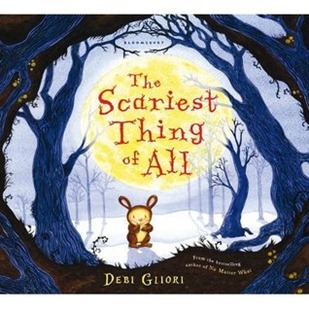
The Scariest Thing of All by Debi Gliori

This story of a very frightened young rabbit is uplifted by the marvelous illustrations.  Pip was a very little rabbit and had a huge list of things that he was scared of.  The list included rain because it reminded him of the sound a leggy wiggler makes in its web, bubbles in the water reminded him of a gobbler hiding at the bottom of the pond, and tree stumps were like the teeth of a giant wood troll.  He exhausted himself because he was so worried and frightened all the time.  He was so tired he fell fast asleep until dinnertime.  When he woke up, he heard a dreadful Raaar! Pip ran and ran, as far away from the sound as he could.  Finally, he stopped deep in the woods.  He saw a scary thing nearby, and heard the sound again.  Pip was going to have to be brave and smart to figure out what was making that horrible noise.

Gliori’s story of a small rabbit who is afraid of almost everything will resonate with children.  The ending has Pip becoming a much braver rabbit.  The book does conclude a bit too quickly and neatly.  Gliori spends much of her story developing the depths of fear and panic that Pip is living with.  All of that plays out very strongly, creating a firm foundation for the story. 

The art here really makes this picture book special.  It moves from the sunny warmth of Pip’s family and home to the dark blueness of a woods at night.  Throughout the woods scenes there is an incredible blue moon rising above him, giving a haunted feel to those pages that is marvelously chilling. 

This would make a great pick for a preschool Halloween story time because it has monsters and creepy things but won’t frighten.  Appropriate for ages 3-5.

Reviewed from library copy.

Review: Good News Bad News by Jeff Mack

good news bad news

Good News Bad News by Jeff Mack

So much depends on your point of view in this jaunty picture book that is written in a very limited vocabulary of just four words.  The book opens with the good news of a shared picnic.  Then the bad news of rain arrives.  Then the good news of the rabbit’s umbrella.  Bad news carries the rat off on the wind.  Filled with lots of energy and action, this picture book dashes along at a breakneck speed as readers look forward to the inevitable next twist in the tale. 

Mack manages to create a cohesive story with great pacing using just four words.  Reading like an animated short, the interchange of optimism and pessimism is sure to delight both sorts of personalities.  It gives us all a chance to laugh together as the poor rat is constantly disappointed and the rabbit doesn’t reach his breaking point until almost the end of the book.  By that point, the ups and downs of the story will have everyone ready to burst.

Good news!  The book is wonderful and is out now!  Good news!  It’s a great pick for new readers!  Good news!  No bad news at all.  Appropriate for ages 2-4.

Reviewed from copy received from Chronicle Books.

Check out the book trailer:

Review: Monet Paints a Day by Julie Danneberg

monet paints a day

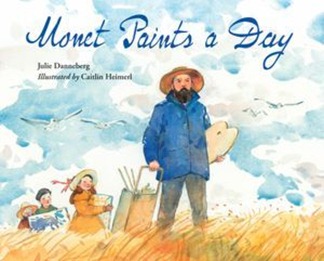
Monet Paints a Day by Julie Danneberg, illustrated by Caitlin Heimerl

Told in the first person by Monet, this book explores his painting process when he was on holiday in Etretat, France.  Children waited for him when he leaves his hotel, wanting to help carry his canvasses to the seaside.  When they reached the strip of sand at the bottom of the cliffs, the canvasses were placed against the cliff.  Monet was unique in painting right in the middle of the landscape rather than sketching and then finishing the painting in his studio.  Because of his unique approach, he had many canvasses in process at the same time.  On this day, he got so involved in painting that he didn’t realize how quickly the tide was coming in.  Everything was taken out by the sea, so he had to begin again on a new day.

Danneberg manages to tell two levels of story here.  There is the day that Monet is painting which is explored in exquisite detail.  Then in small boxes that are offset from the rest of the story, there is historical context offered about how Monet differs from other artists of his time and how he was creating an entirely new style of painting.  The Author’s Note at the end offers even more detail as well as a copy of Monet’s Waves at the Manneporte so that readers can see an example of Monet’s work.

Heimerl has the challenge of doing a picture book based on a famous artist.  In her illustrations she manages to create illustrations that both are their own style and yet pay homage to impressionism.  She achieves this with small touches, daubs of watercolor, here and there, lightening and brightening the illustrations.

A very successful picture book biography of Monet, this will be enjoyed by elementary art teachers and students.  Appropriate for ages 6-9.

Reviewed from copy received from Charlesbridge.

Review: What to Do If an Elephant Stands on Your Foot by Michelle Robinson

if an elephant stands

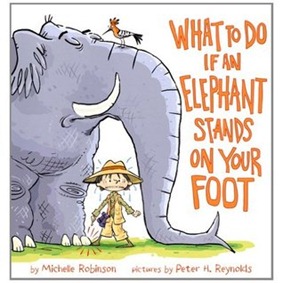
What to Do If an Elephant Stands on Your Foot by Michelle Robinson, illustrated by Peter H. Reynolds

You must stay calm, if an elephant stands on your foot.  The last thing you want to do is startle it…YEEEOOOWWW!  Now you probably want to run away from the elephant, but resist that and don’t run.  After all, running attracts tigers.  Oops.  OK, so now that you have the tiger’s attention you have to be silent.  No sudden noises, like a sneeze.  And so the romp in the jungle continues with the poor character steadily making worse and worse choices, including climbing up a tree and jumping into crocodile infested water.  Finally, thanks to the help of some friendly monkeys, you arrive home safe and sound.  All you need to do is apologize to the elephant, but remember, don’t startle him! 

I absolutely adored this wild ride of a book.  It reads aloud beautifully, though I’d practice a bit before using it with a group because the timing of the jokes is everything here.  Robinson’s writing has a great comedic feel, and the book design maximizes the humor with the page turns.  The pace is wild and almost run away, suiting the subject.  The book is one long running gag, which will delight young readers.

Reynolds’ art adds to the humor.  He manages to take sedate and even friendly animals and with one sneeze or jump turn them alarmingly grumpy.  This creates a zany energy in the art and the book as a whole.

This is a book to keep in your bag for when the kids get restless.  Pull it out with a grin and a flourish.  I’d also keep it in mind for an option when reading to older elementary children, since they will love the humor too.  Appropriate for ages 3-5.

Reviewed from copy received from Dial Books for Young Readers.