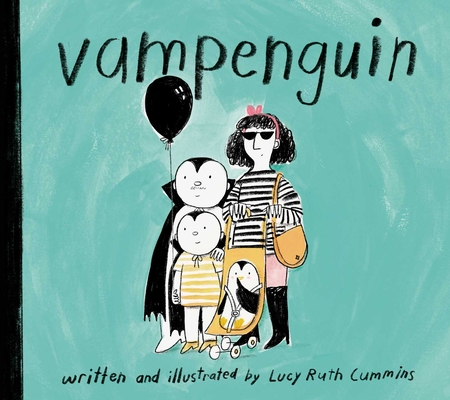
Vampenguin by Lucy Ruth Cummins

Cover image for Vampenguin.

Vampenguin by Lucy Ruth Cummins (9781534466982)

The Dracula family is heading to the zoo on Saturday. The first place they always visited at the zoo was the Penguin House. The youngest in the family, loved visiting all of the different sorts of penguins. And when he saw an opening, he made his way into the exhibit and a little penguin took his place in the stroller. The little Dracula was there when the penguins got fed, so he devoured the fish not sharing it very well. The family went on to walk the zoo and see all sorts of exhibits. Along the way, the penguin got to see the sights and eat lots of snow cones. Back in the penguin exhibit, it was time for a swim. Some rude children stopped by and little Dracula helped send them on their way. It was soon time for the child and penguin to switch places again. The family would never forget their visit to the zoo, and the penguins would never be the same either.

This wry picture book tells one story with the text while the illustrations show what is actually happening. With the stealthy and undiscovered switch between child and penguin, this style works very well and keeps the humor going through the entire book. Cummins’ writing has a subtle wink to reality all the while thoroughly enjoying throwing a vampire family into the everyday setting of a trip to the zoo.

The illustrations are a delight with all of their details that make the entire book work. From the fish left in the doorway to keep it ajar to the fluffy pink towels in the penguin exhibit, the details are charming. Then there is the truth of a visit to the zoo from the almost-empty exhibits where you can’t see much to the cost of the treats to dirty diapers.

This is a funny and smart picture book. Nothing fishy about it. Appropriate for ages 3-5.

Reviewed from copy provided by Atheneum.
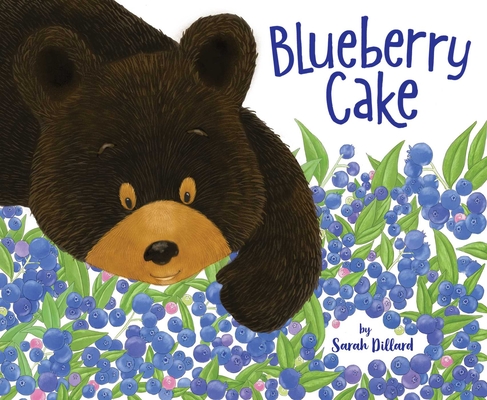
Blueberry Cake by Sarah Dillard

Cover image for Blueberry Cake.

Blueberry Cake by Sarah Dillard (9781534451346)

A little bear asks his mother for some blueberry cake one morning. She sends him off with a pail to pick blueberries. He walks through the woods until he reaches the huge patch of wild blueberries. He picks some and eats more. Distracted by a butterfly, he accidentally dumps out the few berries he has left. Almost back home, he stops to fill the pail with flowers from the meadow. But no blueberries, means no blueberry cake. So the next day, he tries again. This time he surprises his mother with a full pail of blueberries and she immediately makes him blueberry cake!

The little bear is a merry youngster, dashing through the woods, cartwheeling, and wearing the pail on his head. His enthusiasm for blueberry cake is contagious and mouthwatering. The text in the book is limited to only a few words with many of the panels in the book wordless. There is something marvelously charming about these domestic bears with their sunny yellow kitchen with polka dot wallpaper and checked curtains. Make sure to stay until the final page when the cake has been cut for a little giggle.

A summery sweet read. Appropriate for ages 1-3.

Reviewed from e-galley provided by Aladdin.

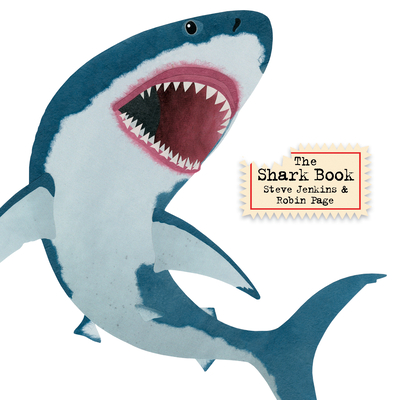
The Shark Book by Steve Jenkins and Robin Page

Cover image for The Shark Book.

The Shark Book by Steve Jenkins and Robin Page (9781328569493)

This gorgeous nonfiction picture book explores the diverse world of sharks that includes over 500 different species. The book defines what a shark is, exploring the various physical attributes that make sharks special including their rows of teeth, dorsal and other fins, and their countershading. The wide range of sizes that sharks come in is also featured. Size of shark is shown in comparison with a lone adult human swimmer, often dwarfed by the sharks around them. The book explores how sharks are born, what they eat, and then some of the more interesting species including hammerhead, great white, and whale sharks. Record holding sharks are shown and then shark attacks are discussed as well, while also stating the jeopardy that sharks are in themselves. This is a balanced, fascinating book that is sure to be popular.

From the Caldecott-Honor winning team, this nonfiction picture book features facts that have been chosen to draw readers into the subject. Readers may know something about one type of shark, but the huge diversity of sharks will likely surprise young readers who will find new sharks on every page. The writing is straight-forward and simple allowing the facts themselves to fascinate and awe.

As always, Jenkins’ illustrations are marvelous cut paper. He has a way of creating paper that creates watery ripples, dapples of light, or small waves across the sharks. The skilled use of humans as a way to show size is done at just the right moments in the book and not excessively.

Snap this one up! Appropriate for ages 4-7.

Reviewed from e-galley provided by Clarion Books.

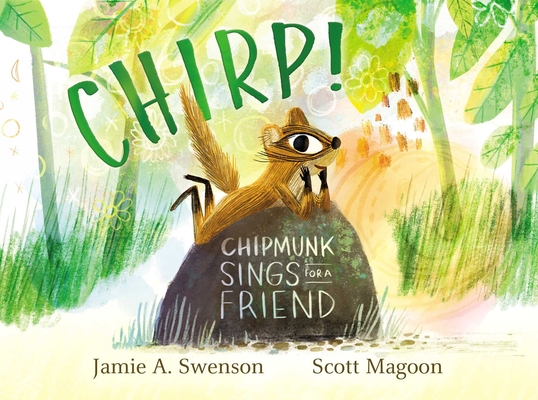
Chirp! by Jamie A. Swenson

Cover image for Chirp.

Chirp! by Jamie A. Swenson, illustrated by Scott Magoon (9781534470026)

Chipmunk spends her days chirping on top of her rock. Her songs can be happy, or bittersweet or very sad. Her rock was very good at listening, but didn’t sing along. So Chipmunk set out to find a new friend. She found a pinecone that she scooped up and brought back to where the rock was waiting. But the pinecone was also a listener and not a singer. So Chipmunk set off again. She found a log that she thought would make the perfect addition to her group of friends. The problem was, Chipmunk couldn’t move it. So she sat in the log and sang a sad song. Raccoon heard her singing and offered to help her move the log. But even with both of them trying, it wouldn’t budge. Chipmunk and Raccoon sang a bittersweet song together and Moose heard them. With Moose’s help they managed to pop the log free and it rolled right next to the pinecone and rock. Chipmunk still spends her days singing, now though Raccoon and Moose join in too.

A search for friendship makes for a poignant look at how it can be a struggle to find the right friends. At the same time, Chipmunk never gives up on her rather silent friends, framing it instead that they are good listeners. It’s a charming take on loneliness. The bridge of music to share emotions and find new friends weaves throughout the book and brings Raccoon and Moose into the story where they share their voices too. The ending is lovely and satisfying.

Magoon’s illustrations convey Chipmunk’s emotions with colors and movement. The pastels of happiness, the orange and dark moments of bittersweet feelings, and then the blackness of sadness that still has some light within it. The forest setting of the picture book is shown in lovely small details of ferns, grasses, leaves, rocks, dirt and light.

A book about finding friends who truly hear you. Appropriate for ages 3-5.

Reviewed from copy provided by Simon and Schuster.

Blue Floats Away by Travis Jonker

Cover image

Blue Floats Away by Travis Jonker, illustrated by Grant Snider (9781419744235)

Little Blue is an iceberg who lived with his parents near the North Pole. Then one day, he broke free and floated away. As he floated, Blue began to see new things like sharks in the water and sailboats. His new friends helped him chart a way to use the currents to get back home. But before he could return, something happened to Blue. He started to shrink until he disappeared entirely. Blue mixed with the ocean water and eventually evaporated and condensed into something new: a cloud. Once again, Blue made some new friends in the sky and they helped him head back home. Were his parents ever surprised to see what he had become!

Jonker writes a lovely and simple story here that is entirely engaging. It’s a clever look at both climate change and the water cycle without any sort of lecturing. The climate change piece is handled in a way that demonstrates changes but without being frightening, instead offering a sense that one can return home again successfully even after one has grown and changed after leaving home.

Snider’s illustrations are striking. They use deep colors for sky and sea, creating waves, bright days of tangerine and pink, and nights of purple and black. The cut paper format works particularly well, creating strong shapes that will work well for sharing aloud with a group.

A water cycle book that is a pleasure to drink in. Appropriate for ages 3-6.

Reviewed from copy provided by Abrams Books for Young Readers.

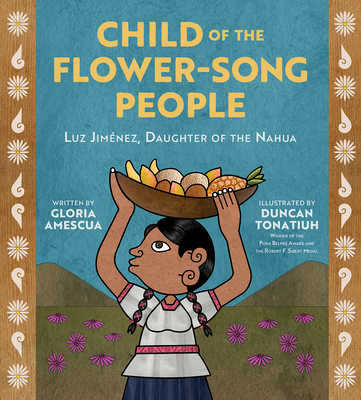
Child of the Flower-Song People by Gloria Amescua

Cover image for Child of the Flower-Song People.

Child of the Flower-Song People by Gloria Amescua, illustrated by Duncan Tonatiuh (9781419740206)

Luz Jiménez was a child of the flower-song people, the Aztecs. She had listened intently to the stories told by the elders about their sacred mountains and streams and also about how the Spaniards had taken their lands away. Luz learned how to do the traditional work of her people, grinding corn on a metate, twisting yarn with her toes, weaving on a loom. She learned about the plants around her and what herbs were medicine. Luz longed to go to school, but it was forbidden for native children. Then the law changed and required schooling in the ways of the Spanish. Luz was a good student and learned much, still keeping the traditional tales alive as she shared them with the other students. At age 13, Luz was forced to flee the Mexican Revolution and live in Mexico City. There Luz became a model for artists, sharing her traditions in paintings and photographs. She longed to be a teacher, but was denied that opportunity. Instead she taught in a different way, through modeling, sharing her tales, and being a living link to the Aztecs.

This beautiful picture book pays homage to Luz Jiménez, a humble woman who became the face of her people. Amescua’s lovely Author’s Note shows the detailed research that went into this biographical picture book. That research is evident in the lovely prose she uses to share Luz’s story with a new generation. Her writing uses metaphors and evocative phrases to really show the impact that Luz’s presence has had as well as her strong connection to her heritage.

Tonatiuh’s art is always exquisite. Done in his own unique style, his illustrations mix modern materials with a folkloric feel. They work particularly well for this subject.

A stellar biographical picture book of a true teacher and heroine. Appropriate for ages 7-10.

Reviewed from e-galley provided by Abrams Books for Young Readers.

Moon Pops by Heena Baek

Cover image for Moon Pops.

Moon Pops by Heena Baek, translated by Jieun Kiaer (9781771474290)

On a very, very hot night, everyone had their fans rattling and their air conditioning whirring. It was too hot to sleep even with a refrigerator door open. That’s when something started dripping. It was the moon melting. Granny ran out of her apartment with a bucket to catch the moon drops. She decided to make frozen moon pops out of the liquid moon. Then the power went out. It was dark everywhere, everywhere but Granny’s apartment that glowed. Granny handed out the glowing moon pops to everyone. They were icy and sweet and made the heat go away so that they could sleep. That’s when the two moon rabbits showed up and Granny had to figure out how to rebuild their moon home using the last drops of the moon.

This is the first book by Henna Baek that has been translated into English. She is an internationally acclaimed Korean children’s book author and illustrator and has won the Astrid Lindgren Memorial Award. This picture book puts a modern spin on a classic Korean folktale of rabbits that live on the moon. The entire book is marvelously crafted with a languid slowness of the heat at first and then the drama of the melting moon. The intelligence of Granny and her willingness to share and help make for an unusual folktale of community both nearby and far.

The illustrations are done in dioramas that are photographed. Baek lights them with glowing touches of the moon, lemony yellow lights that illuminate the darkness and provide comfort and connections. The paper figures are various animals who all live together in a crowded apartment building with their own interesting apartments to look into as well.

Intriguing, haunting and beautiful. Here’s hoping we see more translations of Baek’s work. Appropriate for ages 3-5.

Reviewed from e-galley provided by Owlkids.

Noah’s Seal by Layn Marlow

Cover image for Noah’s Seal.

Noah’s Seal by Layn Marlow (9781536218510)

Noah is waiting on the beach, wondering when he and Nana can take a sail out to see the seals. Nana needs to fix the boat before they go, so Noah must amuse himself on the beach instead. He looks out to see to check for seals, but they don’t like to come in to shore. So Noah digs in the sand while thinking of seals. Suddenly, he notices the pile of sand behind him looks a lot like the body of a seal. Noah steadily works to make the sand look even more like a seal, giving it shape, speckles, whiskers, and eyes and mouth. The two lie on the beach together until Nana calls him because a storm is coming. The two take shelter in the boat under a tarp, but the sand seal is washed away. Nana tells him that the boat is fixed and they can head out to see the seals tomorrow, and that is when Noah sees his seal alive and near the beach. Surely they must take the boat out right now!

A delightful mix of wishful fantasy and the beauty of a day spent on the beach making something, this picture book is a summery joy. The relationship between Nana and Noah is evident right from the beginning, full of warmth and support, but also offering Noah plenty of space to amuse himself. The text is just right, offering a clear view of the setting while moving ahead as quickly as an ocean breeze.

The illustrations are just the right mix of sunshine colored sand and teal sea wave. Noah and his grandmother are Black characters. Noah’s seal is depicted in a way that makes sense for a child to have designed and built it. It’s simple and effective.

Perfect reading for a summery day, whether on the beach or not. Appropriate for ages 3-5.

Reviewed from copy provided by Candlewick Press.

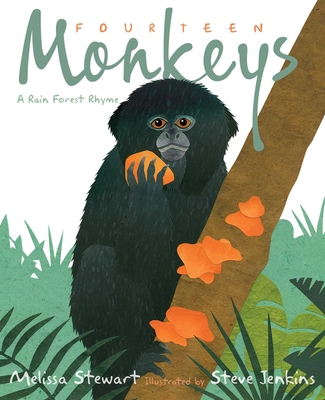
Fourteen Monkeys: A Rain Forest Rhyme by Melissa Stewart

Cover image for Fourteen Monkeys.

Fourteen Monkeys: A Rain Forest Rhyme by Melissa Stewart, illustrated by Steve Jenkins (9781534460393)

This picture book explores the fourteen species of monkey that all live together in Manu National Park in Peru. They all live in the rainforest together and survive successfully near one another thanks to their different diets, different heights for their habitats, and different body sizes. The day begins with the red howler monkeys who climb to the very tops of the trees to bellow. The spider monkeys live high up as well, searching for their favorite fruits. Down near the ground, sakis race and jump. Each monkey is shown with Jenkins’ detailed illustrations, their space in the rainforest documented, and their activities and diet explored. It’s a look at an entire community of monkeys all living happily as neighbors.

Stewart’s writing is clear and concise. She has a knack for sharing fascinating details about each monkey, such as how long the howlers rest each day (18 hours) and that capuchins will eat anything they can catch. The book offers layers of text, including basic text that could be shared aloud while the more detailed information is also there for those who want to explore it. Even more information is available at the end of the book along with additional resources.

As always, Jenkins’ illustrations done with paper art are phenomenal. He can make paper look furry, smooth, veined and fruity. He’s a master at the craft, creating animals that are realistic and artistic.

This book doesn’t monkey around, providing great information in a gorgeous format. Appropriate for ages 5-8.

Reviewed from copy provided by Beach Lane Books.