Review: The Family Tree by David McPhail

family tree

The Family Tree by David McPhail

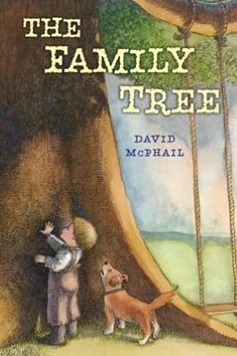
This is the story of a very special tree.  It was left standing when the rest of the space was cleared to build a house many years ago.  This tree would shelter the little house.  It witnessed many changes over the years as horse and wagon changed to cars.  There were births and deaths on the farm, until finally it was the great-great grandson of the original building of the home who lived there.  The tree still stood, strong and straight.  But then it was threatened as a new road was planned that would run right through it.  The grandson refused to let the tree be cut down, and wild animals join him to keep it from happening.  So the road plans must be changed and the tree continues to grow now by the large bend in the road.

There is something to be said about a picture book that decides to tell the story that feels right, the one that resounds in your bones, rather than the one that would happen in real life.  When I saw the bulldozers in the book, I braced myself for heartache, or for the story to turn into that of growing a new tree from an acorn that originated with this tree.  But instead McPhail told a story for tree lovers of all ages, who wish that there were bends in the big highways to keep huge old trees alive. 

McPhail’s writing is simple and straight-forward.  He tells the story with a great matter-of-fact tone that belies the wildlife appearing and the wonder of the tree standing.  His art is signature McPhail with its fine ink lines and watercolor softness.  It has both the clarity of the modern day and the softness of memories.

Get this into the hands of those who hug trees.  They are guaranteed to love it.  Appropriate for ages 3-5.

Reviewed from copy received from Henry Holt and Company.

Review: Lala Salama by Patricia MacLachlan

lala salama

Lala Salama by Patricia MacLachlan, illustrated by Elizabeth Zunon

This poetic lullaby transports readers to Tanzania and life by the lake, Tanganyika.  It is the story of a small family with a father who heads off to work on the lake in his boat.   The mother stays on the shore with her baby, washing the baby, carrying water, working the fields, and cooking food.  The animals of Tanzania are around them in all of their exotic beauty.  Then as the sun sets, the father returns spend time with his family and eventually sails off to the lake again.  The mother and baby sit on the shore, watching the night and the lights on the boats.  This picture book is beautifully foreign, tremendously tranquil, and has a lushness that is exquisite.

MacLachlan’s writing is pure poetry.  It has a great hushed quality to it throughout the entire story of the day.  She also deftly weaves in references to Tanzania, creating such a solid sense of place that this story could never be anywhere else in the world.  She references the colors of the sky, the roofs, and the lake.  She speaks of the hard work, and at the end of each stanza comes the refrain: “Lala salama.”  There is also a deep sense of love throughout the work, wrapping all of the poetry with motherly adoration.

Zunon’s illustrations carry the same lushness as the poetry.  Done in oil paint on watercolor paper, they have a deep color palette that becomes even more deep and dazzling as night falls.  It almost shines with light at times, then seems to drink the light from the room.  Beautiful.

A lush, poetic lullaby of a picture book, this makes a great diverse addition to bedtime reading.  Appropriate for ages 3-5.

Reviewed from library copy.

Review: The Giant Seed by Arthur Geisert

GiantSeed

The Giant Seed by Arthur Geisert

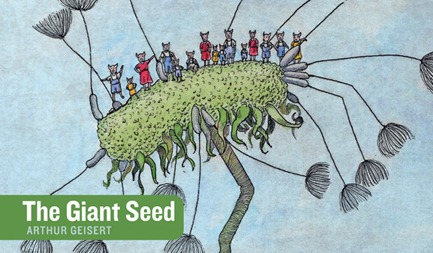
This follow-up to the charming Ice continues the story of the community of pigs.  One night, an enormous seed landed near the homes of the pigs.  The pigs immediately set to work planting it, watering it, and caring for it.  It grew into an enormous dandelion.  Just as the flowers were blooming, a volcano near their village started to erupt.  Hot ash fell onto their homes and the pigs were forced to flee.  They found the solution in the dandelion seeds, riding them to a new island filled with trees and fresh water. 

Geisert’s pig stories are told entirely through pictures.  The long, narrow format of the book allows for a series of panels, one picture on each page, or a lovely long image that takes up the entire spread.  Geisert uses all of these formats for his images.  His illustrations are done in etchings with fine lines and small details.  The mystery of the real size of the pigs continues with one wondering if they are either very tiny pigs or the dandelions are truly larger than trees. 

As readers face another disaster alongside the pigs, they will enjoy the whimsical solution and the impressive art.  Appropriate for ages 4-6.

Reviewed from copy received from Enchanted Lion Books.

Review: Traction Man and the Beach Odyssey by Mini Grey

traction man beach

Traction Man and the Beach Odyssey by Mini Grey

Traction Man and his faithful sidekick Scrubbing Brush are on the way to the beach.  There they explore the depths of the Rockpool to discover what creature live beneath the calm surface.  They are then called upon to guard the picnic from any intruders.  Unfortunately, Truffles the dog decided to bury Traction Man.  Happily Scrubbing Brush was there to dig him free.  But just as they are feeling safe, a wave comes and sweeps both of them out into the ocean.  When they resurface, they have been discovered by a girl who carries them to the Dollies’ Castle where there are garlands, sweet treats, and plenty of pink.  Truffles returns to save Traction Man from the castle, and Traction Man and the dolls head off on a shared adventure, to explore digging to the Center of the Earth.

This is the third Traction Man book, and I continue to delight in them.  Grey has exactly the right tone in the writing with Traction Man often speaking like a movie announcer and always in capital letters.   She incorporates plenty of humor into the book, but the reader is not laughing at the adventures or the play of the children.  Instead it is the inherent humor of action figures, their worlds, and that strong dialogue voice. 

Grey also uses small details throughout the book to really create a full world for Traction Man.  Garbage on the beach has brand names and logos, the text of the book is shown on graph paper with torn edges, action sequences are put into frames and read like comic books.  The end pages of the book are just as fun with details about Beach-Time Brenda, one of the dolls, at the front of the book and a comic featuring both Traction Man and Brenda at the end. 

A great summer read for Traction Man fans, this third book can stand happily on its own.  Appropriate for ages 4-6.

Reviewed from library copy.

Review: A Home For Bird by Philip C. Stead

home for bird

A Home for Bird by Philip C. Stead

Vernon, the toad, was out finding interesting things when he met Bird.  Bird wasn’t much for talking, not responding to anything that Vernon said, not even when he introduced Bird to his friends, Skunk and Porcupine.  Despite his silence (and his stiffness and button eyes) Vernon proceeded to show Bird around the river and forest.  But when Bird didn’t react even to watching clouds together, Vernon started to worry that Bird was depressed.  So Vernon and Bird set out to help Bird find his home.  They  looked at all sorts of homes, but none of them were right for Bird.  Then they came to a small blue house where they decided to stop for the night.  In the house was another small house, a cuckoo clock, up on the wall.  And that was where Bird and Vernon spent the night.  Until in the morning, Bird finally found his voice.

Stead writes and illustrates with a wonderful charm.  His writing is so solid that it is a joy to read aloud.  The story is carefully crafted and then playfully told, making for a book that is a pleasure to share.  Vernon is a character that children will relate easily and happily to.  Bird will immediately be recognized for the toy he is, but the story is less about that mistake by Vernon and more about the journey to find where Bird belongs.

The illustrations have a wonderful freedom to them, filled with swirls of color, that fill the air and cover the walls.  Stead draws the main characters with detailed fine lines, but their world is a more childlike, looser scrawl that reveals trees, flowers and dirt.   The way the detail plays against the less structured backgrounds adds to the cheer of the title.

Finding ones home, friendship and a grand quest fill this picture book to the brim and combine wonderfully with the charm of the illustrations.  Appropriate for ages 4-6.

Reviewed from copy received from Roaring Brook Press.

Review: Here Come the Girl Scouts by Shana Corey

HERE COME THE GIRL SCOUTS!

Here Come the Girl Scouts! by Shana Corey, illustrated by Hadley Hooper

Juliette Gordon Low, or Daisy as her friends called her, was nothing like the other girls growing up in the Victorian Era.  While girls were meant to be prim and proper, Daisy instead loved the outdoors and adventure.  Daisy traveled the world, but eventually wanted to be more useful.  Then she found out about the Boy Scouts and Girl Guides in the United Kingdom and realized that America needed something that would get the girls there out in nature and exploring.  So Daisy started what would become the Girl Scouts with just 18 girls in Savannah, Georgia in 1912.  She taught them the rules, designed uniforms, planned excursions, and had them outside, active and learning.  This book is about the impact one person with a purpose can have and also the incredible impact the Girl Scouts themselves have had in our society.

Corey looks at Victorian life very briefly and then jumps right in to celebrating the life of Daisy and her Girl Scouts.  The tone here is one of delight in a life well-lived.  Daisy is shown as a person unfettered by her time, but definitely not un-criticized by those around her.  Daisy rose above the scorn and derision that her program faced, continuing her commitment to everything the Girl Scouts stand for.

Hooper’s illustrations have a wonderful playful quality to them.  Done using printmaking techniques, the images have a hand-made quality that suits the subject matter well.  Woven into the images are phrases from the Scouts that immediately incorporate their attitude towards life and service.

An impressive picture book biography of an incredible woman, this book will inspire young readers to dream big and work hard to achieve those dreams.  Appropriate for ages 6-8.

Reviewed from library copy.

Review: The Conductor by Laetitia Devernay

conductor

The Conductor by Laetitia Devernay

This wordless picture book is tall and narrow, just like the trees featured within.  A man enters a forest of trees that are shaped like lollipops with long trunks and round tops.  He climbs to the very top of one tree and raises his hands.  Suddenly, birds start to appear, formed from the leaves of the trees.  They fly off leaving holes in the tree leaves shaped like them.  The leaf patterns are on their wings and they fly above the conductor in a variety of formations.  Until eventually they are gone, and all that are left are the blank trees.  The man climbs down and plants a seed that quickly grows into a tree.  As he is planting, the birds return to the trees, covering them once again in leaves.  The man leaves the forest just as he has found it, but with one more small trees.  It’s a beautiful look at the environment and the impact humans can have if they choose.

The art here is wonderfully done.  It has a limited palette of just yellow, green, black and white.  The juxtaposition of tree leaves and flying birds is spectacular visually and surprising at first.  It lifts the book to a more surreal place, a world where you are unsure what could possibly happen next.  The fine lined art, the scale of the book and the gentle theme all work well together, creating a memorable whole.

A surprising wordless picture book that is a work of art, this book would work well in art curriculum or as a quiet, beautiful book to share.  Appropriate for ages 3-5.

Reviewed from copy received from Chronicle Books.

Review: More by I. C. Springman

more

More by I. C. Springman, illustrated by Brian Lies

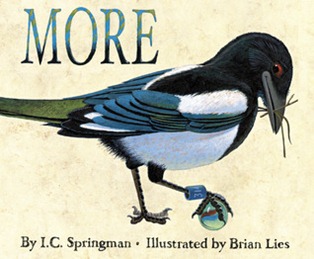
The book opens with a dejected magpie who has nothing at all.  Then a mouse gives him a marble that he takes to his nest.  Soon the marble is joined by a few other toys.  Then more and more, until there are so many things that the magpie has filled all sorts of nests in the tree with them.  Finally, the magpie adds one little penny to a nest and the branch cracks.  He has much too much now!  Everything tumbles to the ground, burying the poor magpie in his treasures.  The mice appear to dig him free and the pile becomes less and less as they work.  In the end, the magpie selects a few items to keep and lets the rest go, leaving with just enough.

This book is written in very spare language with only a few words per page.  They are all concept words, moving from nothing to everything to enough.  In between, there are terms like more, much, and less.  The dynamic illustrations really carry the story.  The magpie’s facial expressions range from greed to shock to satisfaction, all playing out nicely just in the shine of an eye and the curve of a bill.  Space is also played with in the images, speaking to the freedom of having just enough and the clutter of having too much.

This picture book deals directly with the idea of downsizing or having just enough toys and not too many, something that many children struggle with.  It is also a creative concept book that will work to teach those concepts through humor.  Appropriate for ages 2-4.

Reviewed from library copy.

Review: That’s Not a Daffodil by Elizabeth Honey

thats not a daffodil

That’s Not a Daffodil by Elizabeth Honey

When Tom’s neighbor gave him something that looked like an onion and said it was a daffodil, Tom was very skeptical.  Mr. Yilmaz told him to plant it to find out.  So they planted it in a large pot and Tom waited, and waited, and waited with nothing happening at all.  When Mr. Yilmaz asked how the daffodil was doing, Tom answered that it was not a daffodil, it was a desert.  So the two watered the pot.  Later, Mr. Yilmaz asked again and Tom said that the small green point sticking out of the dirt was a green beak, not a daffodil.  The beak slowly began to open.  Soon the daffodil looked more like a hand, hair, and even a rocket!  It even survived being toppled over by a dog.  Until finally, Tom gets to show Mr. Yilmaz exactly what that onion turned into.

Not only does this book perfectly capture the wonder of gardening with children with the impossibly long wait for results, but it also offers a beautiful zip of creativity along with it.  As Tom learns about patience with his daffodil, he also incorporates it into his playing.  The writing is simple and straight forward, yet has a sense of playfulness too.

Honey’s illustrations appear to be a mix of watercolor and pastels that have a homey warmth.  They also have a great texture that works well for the rough ground, dirt in the pot, and sweater knit.  At the same time, the watercolor smoothness plays against that. 

A sweet book about patience, gardening and creativity, this book would make a great addition to springtime story times.  Appropriate for ages 3-5.

Reviewed from library copy.