Review: Plant a Kiss by Amy Krouse Rosenthal

plant a kiss

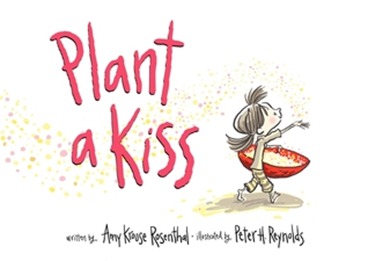
Plant a Kiss by Amy Krouse Rosenthal, illustrated by Peter H. Reynolds

Perfect for spring and Valentine’s Day, this book celebrates the way that love can grow.  A little girl plants a kiss in the ground using a shovel and watering can.  Then she gives it sun, water and attention.  For awhile she doubts if it is going to grow into anything, but then there is a sprout of glittery yellow and pink emerging from the ground.  Others gather around and she decides to share it, she hands out glowing yellow and pink wisps to everyone, even though others try to warn her that it is too rare and precious to share.  When she runs out, she heads back to her plant where she discovers that there is even more to give away!

When glitter is added to a book, it does a lot to create immediate appeal.  Unfortunately, many glitter-filled books don’t live up to that shimmery hype.  This one though is one that is designed to share, just like the kiss itself.  Rosenthal’s writing is light, airy and offers just a few words per page.  While her message of sharing love is clear, there is nothing preachy about the book, thanks to the cheery writing.

Reynolds’ art has that same light feel, including the wafting glittery clouds of kiss.  His young protagonist has a great quirky quality to her.  The glitter is incorporated into the story very successfully, adding to the book rather than distracting from it. 

The perfect snuggling book for the little one that you plant kisses on.  Appropriate for ages 3-5 and could be used as a gift for adults as well.

Reviewed from copy received from HarperCollins.

Review: Seed Magic by Jane Buchanan

seed magic

Seed Magic by Jane Buchanan, illustrated by Charlotte Riley-Webb

Rose and her brothers make fun of the old man who feeds the pigeons all day long from his wheelchair.  When Rose asks him why he likes pigeons so much, he tells her how beautiful they are.  But Rose can’t see it at all; she thinks that gardens are much more lovely than birds.  So Birdman gives her some seeds to put outside her window and grow a garden on her windowsill.  Rose knows that it won’t work, since there’s no dirt for them to grow in, but Birdman is insistent that they will grow a garden on her bare windowsill.  Her brothers make fun of her for even trying, but Rose starts to dream of the incredible flowers that could sprout there.  Then one day, something magical does happen, much to her surprise and delight.

Buchanan’s writing is poetic.  It has a strong rhythmic quality that beats to the heart of the urban setting perfectly.  She plays with imagery, describing the sunflower seeds as “black as tar, slick as oil” as Birdman share them with Rose.  This is a book that speaks to the power of making connections, rather than dismissing those around us.  It is also about beauty and seeing it in the most unlikely places.

The illustrations have a wonderful texture and thickness to them, the paint layered and deep.  Riley-Webb uses plenty of color to depict the urban park: greens, blues, and rich browns.  There is movement to her illustrations from the people, the birds and the gardens.  It is a fresh way to show a city, rather than the cold of concrete.

This book celebrates nature in an urban setting and the sharing of beauty.  Thanks to the rhythm of its writing, it’s a great read-aloud as well.  Appropriate for ages 4-7.

Reviewed from copy received from Peachtree Publishers.  

Review: Kate & Pippin by Martin Springett

kate and pippin

Kate & Pippin: An Unlikely Love Story by Martin Springett, illustrated by Isobel Springett

When Pippin, a fawn, is abandoned by her mother, photographer Isobel Springett found her crying for help.  She took Pippin home and placed her by Kate their old Great Dane.  The two immediately bonded:  Pippin thought she had found a new mother and Kate started to mother her even though she had never raised any puppies of her own.  Pippin learned to drink from a bottle and when she got bigger started to adventure outside.  One evening, Pippin disappeared into the forest and didn’t return for bedtime.  Kate was very concerned, but the next morning Pippin came back just in time for breakfast.  Pippin returned to the woods every night after that, returning to the farm almost every morning to eat and play.  As she grew into an adult deer, she still continued to return to visit Kate and play.  She even still comes into the house once in awhile for a visit. 

This is one of the most lovely picture books about a relationship with a wild animal that I have seen.  I especially appreciate that Pippin was allowed to continue to be a wild deer, returning to the forest and being allowed to create a relationship on her own terms.  It’s definitely refreshing to see.  Here the human and dog were able to rescue, aid but also step back and not absorb this little creature.  The relationship that emerges is breathtakingly touching, seeped in fragility yet incredibly strong.

A large part of the success here are the photographs of this tiny deer bonding with the enormous dog.  By the end of the book, the animals are the same size.  It is clear that both of them adore one another on a deep level, and one that is delightfully separate from the humans. 

This nonfiction picture book reads like fiction, making it a great pick for a touch of nonfiction in a story time.  It’s a story that children will relate to easily and naturally.  Appropriate for ages 4-7.

Reviewed from copy received from Henry Holt and Company.

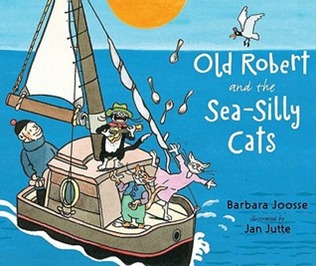
Review: Old Robert and the Sea-Silly Cats by Barbara Joosse

old robert

Old Robert and the Sea-Silly Cats by Barbara Joosse, illustrated by Jan Jutte

Old Robert sailed his ship at sea during the day and docked it at night because it was so dark.  At night, he prepared his dinner of toast in buttered milk and ran through his list of things that were all in their proper place, including clean socks, a clock, one dish and one spoon, and the moon.  He was all alone until one night when a dancing cat asked to come aboard.  Old Robert hesitated because there wasn’t much room aboard, but in the end he agreed.  So he made dinner of toast in buttered milk for both of them and when he went to bed, he noticed the moon was bigger.  Now his list included the cat in its hammock as he went to sleep.  On subsequent days, another two talking cats joined him on board, for dinner, and on his list.  And the moon got bigger still.  Finally, a cat that didn’t talk at all arrived and Old Robert let it on board too.  There was no room for a hammock, for Old Robert let it sleep on his chest.  Finally, the moon was full and Old Robert sailed off into the moonlit night with all of the cats. 

I expected quite a different book when I saw the cover.  I thought it was going to be silly, zany, and rather wild.  Instead, this book has a beautiful quietness to it, a thoughtfulness, and makes for a perfect bedtime read.  Joosse incorporates repetition so well here that it becomes a lullaby.  His listing of his belongings doesn’t change much, except for the size of the moon and the number of cats.  It speaks to the simplicity of his life, but also to how lonely he is.  This is shown rather than told, giving the book a lovely little ache that heads right for the heart.

Jutte’s illustrations too have a mix of silly and quiet.  They have a vintage feel, of old comic books that will make readers feel right at home.  They have great color with explosions of pinks, blues and yellows that pop and glow. 

A great read aloud, this would make a great bedtime pick but it is also a good one to turn into reader’s theater for children.  Appropriate for ages 3-5.

Reviewed from copy received from Philomel Books

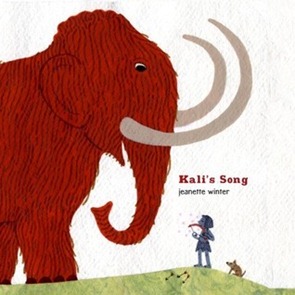
Review: Kali’s Song by Jeanette Winter

kalis song

Kali’s Song by Jeanette Winter

Kali’s mother painted amazing paintings of animals on their cave walls.  Soon Kali would be a man and so he started practicing with a bow and arrows.  But on his first session of practice, he discovered that he could do something else with the bow:  he could make music!  Soon he was making music instead of practicing his shooting at all.  When the day of the big hunt came, his bow was taut and his arrows sharp.  The men and boys approached the huge mammoths, that were far larger and more impressive than Kali had ever expected.  Kali forgot all about the hunt and just felt that he had to play the music he was hearing in his head.  As he played, the mammoths gathered closer around him and the other hunters laid down their bows.  Everyone realized that Kali must be a shaman to charm animals in this way.  Even as Kali grew much older, he continued to play music on his bow.

Winter has created such a remarkable story here.  It is a story without modern judgment about killing animals, which would be out of place in this book.  Yet Winter does not turn entirely away from modern sensibilities either with this book about a young shaman who does not kill, but instead charms.  It is a book that celebrates innate talents of people, relishes in inventiveness, and demonstrates a large heart for acceptance too.  Kali is not shunned for being different, but instead embraced for it. 

Winter’s illustrations are also very special.  Framed with torn edges, the illustrations are filled with the texture of papers that mimics that of cave walls.  The characters are roughly painted, just as his mother’s cave paintings are with additional fine details drawn on in ink.  The result is a book that is a winning combination of rough and fine. 

This picture book embraces differences, celebrates art and music, and does it all surrounded by stars and mammoths.  Appropriate for ages 4-6.

Reviewed from copy received from Schwartz & Wade Books.

Review: Bambino and Mr. Twain by P. I. Maltbie

bambino and mr twain

Bambino and Mr. Twain by P. I. Maltbie, illustrated by Daniel Miyares

In 1904, after losing his beloved wife, Mark Twain shut his door on the public life he had led.  Instead, he stayed indoors spending much of his time alone except for his daughter’s cat, Bambino.  The two of them grew closer as they played billiards together, shared ice cream for his birthday, and stayed together in a bed crowded with books and papers.  One day, after spotting a squirrel outside the window, Bambino leapt out and disappeared.  Twain put an ad in the paper and many people came with cats and kittens just to meet the famous author.  But none of the cats were Bambino.  Three days later, Bambino appeared on the doorstep as if nothing had happened.  Mark Twain took inspiration from his small companion, and started being part of public life again. 

This book explores the powerful relationship between people and animals.  It is also an exploration of grief and could be used with children in elementary school to discuss death and grief.  Maltbie includes many small touches about Twain, including those white suits, details about his wife, and traditions of their family.  Those little points create a much more human story, even though we are talking about one of the most famous authors ever. 

The black cat and the figure of Twain in his trademark white suit make for a great pairing visually as well.  Miyares’ illustrations are filled with great textures and colors, with the palette changing as the mood of Twain lifts.  The shadows are stronger when the grief is at its worst, but lightens and even brightens as the book continues. 

A personal look at a great figure of American literature, this book about Twain offers the depth of grief and the joy of connection with a pet.  Appropriate for ages 6-8.

Reviewed from copy received from Charlesbridge.

Review: Rosie Sprout’s Time to Shine by Allison Wortche

rose sprouts time to shine

Rosie Sprout’s Time to Shine by Allison Wortche, illustrated by Patrice Barton

Everyone thought that Violet was the best at everything.  She could run the fastest, sing the highest, and dress the fanciest.  But Rosie did not think that Violet was the best and was tired of hearing about Violet all the time.  When their teacher gave them an assignment to plant pea plants and care for them, Violet was sure that hers would be the best.  She decorated her pot with lots of sparkles.  Rosie’s plant was the first the pop up above the dirt, but Violet announced hers first.  So when Rosie came in early the next morning, she pushed soil over the top of Violet’s plant.  That day, they learned that Violet had chicken pox and would not be in for several days.  So Rosie started to care for both of their plants.  Rosie’s teacher told her that she was the best gardener she ever had in her class, as Rosie watered, rotated and sang to both plants. 

This book celebrates the quiet child, the one who is not the sparkliest or the loudest.  The book speaks to the need for all children to be praised and to be seen as being good at something.  Rosie definitely feels left out and jealous of Violet, and those feelings turn into action when she buries Violet’s plant.  But at the same time, that is the moment that the book turns around and Rosie starts to shine.  Happily, the jealous act is temporary and not the focus of the book.  Instead it is a much merrier book because of that.

The art work here has a wonderful softness to it that is very welcoming.  There is a freedom to the art as well that is very successful.  The lines are soft, the colors blend, and the effect is fresh.  The children in the classroom are multicultural, another small touch that makes the story all the more universal. 

A great book to share in the spring, when gardens start being planted, or when jealousies grow.  Appropriate for ages 4-6.

Reviewed from copy received from Random House Children’s Books.

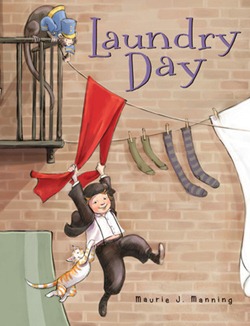
Review: Laundry Day by Maurie J. Manning

laundry day

Laundry Day by Maurie J. Manning

A young boy tries to sell shoe shines on the streets of New York City in a time before cars, when the streets are crowded with horses and carts.  Suddenly, a red cloth drifts down from above.  The boy looks up to see rows and rows of laundry drying above the street, so he starts to climb with the red cloth around his neck and his small cat following behind.  As he searches for the owner, he meets people from all over the world.  There is the Chinese woman who offers him a mooncake after he helps fold some laundry.  A Ukranian woman with a wailing baby suggests he check with the Italian organ grinder who lives above her.  A family of Polish little girls try to get him involved in their games.  When he finally finds the owner, he has traveled the world in just a few buildings, sharing in treats, hearing a few words of their language.  His high-wire antics add a little spice to the story and a wonderful play off of old films.  This is an old-fashioned treat of a picture book.

Manning adroitly wraps international content in a comfortable package.  The various cultures shown in tiny tastes here are done with a gentle hand and an eye to history.  There is a feeling of merriment throughout this book, with never a fear that the boy will injure himself or that he will find anyone unkind on his adventures.  

The illustrations too have a playful vintage quality about them.  There is a freshness mixed with a timeless feel.  The freshness comes from the cartoonish lines of the art and the comic-like panels used on some pages.  It’s an inventive mix of modern and timeless.

This picture book mixes vintage and new, international and American into one wonderful diverse story.  Appropriate for ages 3-5.

Reviewed from library copy.

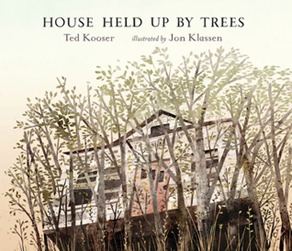
Review: House Held Up by Trees by Ted Kooser

house held up by trees

House Held Up by Trees by Ted Kooser, illustrated by Jon Klassen

This is the story of a family and a house.  When the house was new, it stood upon a newly planted lawn where the trees had been removed.  It was bare, not even a stump left behind.  On either side of the bare lot were trees of all sorts, the kind that spread seeds and scents.  Two children lived in the new house and often played in the trees at the edges, watching their father care for the lawn.  Their father mowed down all of the small tree seedlings before they could get started at all.  But the children grew up, the man moved away to be closer to them, and the house was left alone.  Alone except for the trees, which grew and took over the barren lawn, and eventually lifted the house high on their shoulders.

Kooser writes with amazing depth here, each sentence resonant with meaning and feeling.  While the book can be read more lightly, the joy here is in that dark deep that lies behind the lines.  The story plays with man vs. wilderness, the American obsession with lawns, children being pulled to the edges to find their own wild spaces, and the return to nature in the end.  The writing is beautiful because of that ever-present ache that is there, the tug of the trees, the dance of the seeds.

Klassen has illustrated this book with such delicacy that it shows he feels that same amazing pull.  He lets us peek at the house from the shelter of the woods, our eyes almost aching with the bareness in the sun.  He captures the tree seeds in flight from high above, allowing us to fly with them and plant ourselves too.  He plays with light, shadow and darkness, just as Kooser does. 

This book is poetry, without the stanzas.  It is a picture book that has depth, courage and looks deeply into our relationship with nature and with our families.  Beautiful.  Appropriate for ages 7-10.

Reviewed from library copy.