Book Review: No One But You by Douglas Wood

No One But You

No One But You by Douglas Wood, illustrated by P.J. Lynch

This radiant picture book speaks to each of us having individual experiences in the world.  Only you can feel things the way that you do.  Only you taste, hear, smell and see things in the way that you do.  No one else breathes with your breath.  No one else wishes on the same star in the same way.  And no one else feels the emotions you do or says I love you the way that you mean it. 

Wood’s writing reads like a poem, a verse that dances, expresses and moves.  He turns his lens onto different specific moments, emphasizing how we all experience things differently.  Using small moments of life, the book also quietly asks people to slow down and really experience what they are doing then.  Because no one else will feel it but you.

Lynch’s art is quiet and powerful.  His realistic paintings focus on diverse children doing day-to-day things.  The expressions they show are candid, real and vibrant.  His colors range from bright to dark, all of them filled with a special light that emanates from the children’s faces.

A gorgeous picture book, this is ideal for bedtime reading and is sure to make any child who hears it think about just how special they are.  Appropriate for ages 4-8.

Reviewed from copy received from Candlewick Press.
Book Review: The Great Big Book of Families by Mary Hoffman

great big book of families

The Great Big Book of Families by Mary Hoffman, illustrated by Ros Asquith

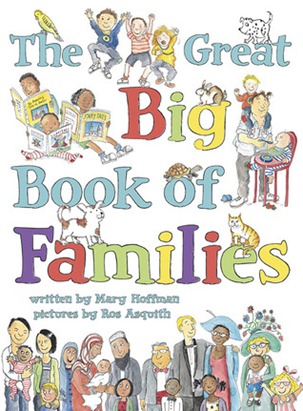
This book celebrates all of the different sorts of families there are.  It starts with a stereotypical family of blonde, white mom and dad, two kids (a boy and a girl), a dog and a cat.  They even come complete with the picket fence and apple tree.  Turn the page and you are in reality with families of different colors, single parents, grandparents, two mothers, two fathers, and adoptive families.  The book then moves on to family sizes, different homes, different ways to go to school, different ways parents work, the holidays families take, the food we eat, clothes, pets, hobbies, and much more.  The book ends by expressing a very important message that families change.  So what does your family look like today?

Another facet of this book is the celebration of families of different incomes and wealth.  Nothing is put down, just mentioned as different from one another.  Children may not notice the differences, but if you are a child struggling with poverty, it is good to see yourself represented here matter-of-factly and honestly.  Hoffman’s entire text is written in this straight forward way, she is inclusive, expansive and above everything non-judgmental. 

Asquith’s illustrations have a nice sense of humor that keeps the book from being too earnest.  They have a quirky feel, a silliness that makes the book a pleasure to read.

Every library needs a copy of this warm, welcoming book where all children will see parts of themselves represented.  Appropriate for ages 4-7.

Reviewed from copy received from Dial Books.

Book Review: Catch That Baby by Nancy Coffelt

catch that baby

Catch That Baby! by Nancy Coffelt, illustrated by Scott Nash

Starting from the title pages, Rudy’s mom has to catch him to get him into the bath.  But once the bath is over, the real chase begins as “Nudie Rudy” runs through the house.  Mom tries to catch him, but he runs into the living room.  His Mom and brother run after him, but he’s into the kitchen.  Now the dog, his father, and his sister join the chase.  But Rudy is off into the back of the house, filled with plants.  Now grandma and grandpa help look, because Rudy has disappeared.  What in the world could he be up to now?

Coffelt’s text ties this wild naked baby chase closely with The Gingerbread Man as more and more characters join in trying to catch Rudy.  The story telling is split between narrative and dialogue, shown in speech bubbles.  This keeps the pace of the story racing along with Rudy from page to page.

Nash’s art has bright colors and a comic book feel to its lines.  He uses objects and the dog to cleverly block any frontal nudity from view, instead showing chubby legs, flying feet, and a bare bottom. 

There is a real humor to the book, so much so that you can almost hear the giggle of this naked little racing boy.  The twist at the end is endearing and a natural part of the story.  A great pick for toddlers, this book is appropriate for ages 2-4.

Reviewed from copy received from Aladdin.

Book Review: The Mangrove Tree by Susan L. Roth

mangrove tree

The Mangrove Tree: Planting Trees to Feed Families by Susan L. Roth and Cindy Trumbore

This book tells the true story of Dr. Gordon Sato in picture book format.  The village of Hargigo in the African country of Eritrea was dry and the animals could not find enough to eat.  Dr. Sato had the idea of planting mangrove trees on the shore of the salty Red Sea.  The trees can survive the salt and would give women in the village a way to earn money close to home from planting the trees.  The trees also help by giving off oxygen too.  The goats and sheep ate the leaves from the trees and grew stronger, living longer and having healthier babies.  The mangrove trees also changed the habitat along the shore, creating hiding places for sea creatures that helped the fish grow larger and the fishermen improve their catch.  This is the story of Dr. Sato, who through science changed the lives of people not only in Hargigo, but around the world.

Trumbore has written a clever dual story here.  On one side of the page, a simple cumulative story is told of the mangrove trees by the sea.  On the other side, readers get much more detailed information about the science and impact of the planting of the trees.  Finally, at the end of the book, readers can see photographs of the actual villagers, the trees and Dr. Sato. 

Roth’s illustrations are eye-catching and inventive.  Using collage, she has created such texture, color, and natural feel.  Her illustrations have depth, showing the people at work, giving individual coats to the sheep and goats, and celebrating the bright colors the people wear.  It is a very rich illustration that celebrates the setting and the work that went into the project.

Highly recommended, this book is a beautiful mix of nonfiction and picture book that is ideal for elementary science about the environment.  It celebrates the impact that one man can have on the world, inspiring youth to think about what they can contribute too.  Appropriate for ages 5-8.

Reviewed from library copy.

Also reviewed by BookDragon.

Book Review: Where’s Walrus? by Stephen Savage

wheres walrus

Where’s Walrus? by Stephen Savage

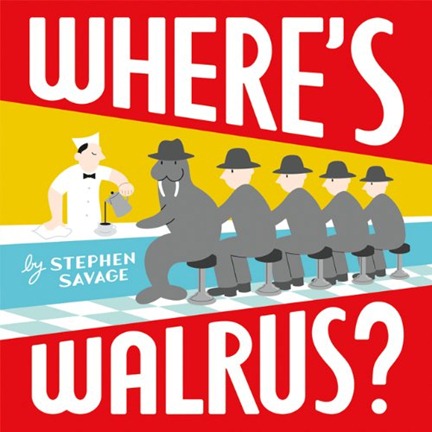
This wordless picture book has a great appeal for the youngest children and adults alike.  Walrus escapes from his small pool in the zoo, pursued closely by the zookeeper.  He hides in the most unlikely spots, posing as a mermaid in a fountain, seated at a diner counter, glamming up a window display, and much more.  Finally, he is cornered up on a diving board sporting a red swim cap.  What happens next is a satisfying close to this cheery picture book.

Savage has a tremendous sense of pacing in this book.  It moves ahead from one hiding place to the next, and then turns into a full story as the final pages turn past.  The story works well without words, helped by the skilled pacing and the ease of the storyline.

What really sets this book apart are the illustrations, done in bold shapes and bright colors.  They have a graphic quality to them and a modern edge.  While the book sounds like a Where’s Waldo type of book, it really isn’t thanks to the simplicity and style of the illustrations. 

This wordless dazzler of a picture book will impress old and young alike with its style and sense of fun.  Appropriate for ages 3-5.

Reviewed from copy received from Scholastic.

Also reviewed by

Book Review: Bone Dog by Eric Rohmann

bone dog

Bone Dog by Eric Rohmann

Right before his dog Ella died, she promised Gus that she would always be with him.  After she died, Gus didn’t feel like doing anything, not even leaving the house, but he did.  He didn’t feel like trick-or-treating, but he put on his skeleton costume and headed out anyway.  But when Gus started to head back home after his bag was full, he passed through a graveyard where it got dark and windy and creepy.  In moments, Gus was surrounded by skeletons, real ones.  At first the skeletons thought he was a real skeleton too, but when they found out that he was a boy, they threatened to steal his guts.  Just before anything happened, Ella showed up as a skeleton dog.  But what in the world can a small boy and a small skeleton dog do to stop a crowd of skeletons? 

If that paragraph above read like a rather strange storyline, then I wrote it correctly.  This is not a “normal” picture book.  It has a wonderfully shivery, scary part to it combined with the loss of a beloved pet, and then a great funny twist at the end.  It is not a disjointed book at all, but rather one that is unexpected which makes for a fun read. 

Rohmann’s art is done in his signature style.  The thick black lines mix successfully with the deep and subtle colors.  What grabs the eye is Rohmann’s layout of the pages, where whitespace is used as more than space for the words to appear.  The style stays consistent throughout the book, but the perspective is intriguing and adds much to the book.

A strange and superb choice for Halloween reading, this book should be shared throughout the year too as a celebration of intriguing, unique picture books.  Appropriate for ages 4-7.

Reviewed from copy received from Roaring Brook Press.

Book Review: Emma Dilemma by Kristine O’Connell George

emma dilemma

Emma Dilemma: Big Sister Poems by Kristine O’Connell George, illustrated by Nancy Carpenter

Told from the point of view of the older sister, these poems show the intricacies of relationships between sisters.  Emma can be a very embarrassing little sister, especially at ball games where she is the one dressed in a feather boa and cheering loudly using Jessica’s name.  Emma copies everything Jessica does, but her hand also fits perfectly in Jessica’s when they hold hands.  Jessica is often the only one who understands what Emma is saying.  Emma can be naughty, stealing shoes, scaring people, filling Jessica’s room with loops of yarn.  But there are also the moments when the sisters connect over pet rocks, picture books, and jokes.  The climax of the story comes when Emma tries to reach Jessica and one of her friends when they are in a treehouse.  Emma falls and breaks her arm, and there is no doubt these sisters adore one another.

George captures the ins and outs of siblings with a skilled eye.  The book shows the complexity of the relationship, both the good and the bad, often right alongside each other.  Neither sister is the good or bad one, they are simply themselves.  The book’s tone is just right as well, never too dramatic or over the top.  Instead these are moments from what feel like real days, captured in poetry.  The touches of humor add to the appeal of the book as well.

Carpenter’s illustrations exude a warmth that works so well here.  Done in pen and ink and digital media, they retain their hand-drawn style with the bright washes of digital ink.  Each illustration is a picture of the lives of the characters, they reveal the emotions going on in that moment with a great clarity.

Highly recommended, this is a book of poems that any child with siblings will see themselves in and enjoy.  Appropriate for ages 6-8.

Reviewed from library copy.

Also reviewed by Young Readers.

Book Review: Fairly Fairy Tales by Esme Raji Codell

fairly fairy tales

Fairly Fairy Tales by Esme Raji Codell, illustrated by Elisa Chavarri

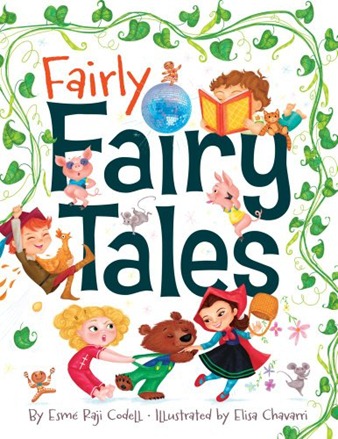
A child does not want to go to bed even after a kiss and some water.  So begins this quick and charming look at the elements of fairy tales.  Three elements of a classic story are given along with a fourth element that does not belong.  But then, maybe, it actually does!  Turn the page and that outside element has been combined with the story to create a wild mashup twist.  The stories include The Three Little Pigs with solar panels added, Little Red Riding Hood with shampoo, Jack and the Beanstalk with spaghetti, Cinderella with a disco ball, Hansel and Gretel with a piñata, and Goldilocks with a TV.  It’s a fun surprise for children familiar with the classic stories to see them mixed with the modern world.

Codell’s writing here is very simple, offering the elements of the stories and then the surprise.  Each real element is followed with a “yes” and the surprise element with a “nooooo” that then turns into a “well, maybe.”  This pattern is followed throughout the book which works well.  It leaves the emphasis of the book on the twist and the illustrations.

Chavarri’s illustrations were done digitally and have that smooth digital feel to them.  They are colorful and very funny.  The elements of the story are done on a white background but when the page is turned to combine them, the illustration fills the page with color and action.  It makes a nice visual contrast between old story and new.

If you are looking for a fractured fairy tale feel with fewer words and that is more accessible for younger children, this is a great pick.  Appropriate for ages 4-6, especially for those familiar with the stories.

Reviewed from copy received from Aladdin.

Also reviewed by:

Book Review: The Bravest Woman in America by Marissa Moss

bravest woman in america

The Bravest Woman in America by Marissa Moss, illustrated by Andrea U’Ren

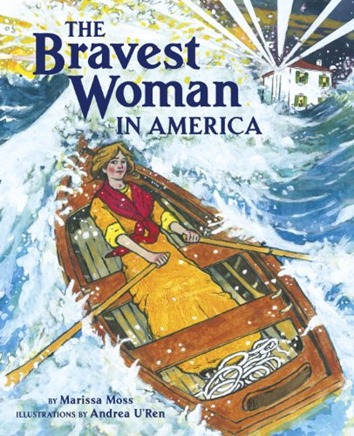
Ida Lewis loved the sea, from the crash of the waves to the bite of the ocean air.  When her father got a job as a lighthouse keeper, she was thrilled.  He had to cross back and forth twice a day to check the light, and he took Ida with him, teaching her how to row.  He also taught her to care for the lamp and how to rescue people without capsizing herself.  When Ida turned 15, her family moved out to live next to the lighthouse.  Ida dreamed of becoming the keeper herself one day.  That day came early when her father got ill and could no longer care for the lighthouse.  So Ida helped more and more.  Though she had never rescued anyone, she rowed out to save some boys in a sailboat that capsized.  It took all of her determination and strength to save them, but she did.

This book works on so many levels.  It is a true story about a real hero who defied what society expected of her and became what she dreamed of.  Additionally, it is the story of a girl who was strong, brave and amazing.  A girl who relied on her own strength and wits to save others rather than to be rescued herself.  Beautiful. 

Moss writes the story with drama and action, yet is never heavy handed.  She builds up to the accident nicely, showing it happen and then building to the climax of the rescue.  This is an rescue story that will have readers cheering.

U’Ren’s art is done in watercolor, ink and acrylic.  The colors are deep and lovely, from the changing colors of the sky to the blues and greens of the water that change with the storm.  Ida Lewis is always shown as a young lady, never masculinized at all.  It adds to the charm and drama of the story.

Highly recommended, this is a great book choice for women’s history units or for any child to learn that girls are heroes too.  Appropriate for ages 5-8.

Reviewed from copy received from Tricycle Press.