Book Review: Fortune Cookies by Albert Bitterman

fortunecookies

Fortune Cookies by Albert Bitterman, illustrations by Chris Raschka

One day, a young girl gets a package in the mail that contains seven fortune cookies.  She opens one cookie each day.  The fortunes are done as pull tabs in the book, nicely mimicking the pleasure of cracking open a cookie and the surprise of the fortune.  Each fortune moves the story forward a bit.  The first talks about losing something you don’t need, and she loses her tooth.  The next about money being like the wind, and she finds a dollar under her pillow and buys a kite.  The next fortune is more vague, about finding the good with the bad.  Here the girl loses her kite, but finds a cat and takes her home.  As the days pass, more fortunes are read, the cat is lost and later found in the fort the girl has built.  But one last surprise awaits that makes for a very satisfying fortune indeed.

Librarians will be very pleased with the tabs here, because they will stand up nicely to public use.  There are only seven of them and they are sturdy and move easily back and forth.  Equally pleasing is that the tabs make sense here.  They are not an afterthought of the story, but an integral pleasure of the book and fortune cookies themselves.  The story is intriguing with its mix of fortunes, straight-forward action, and then the satisfying resolution.  It makes for a book that is great fun to read, because one is never sure what will happen next, though you have been given a clue in the fortune.

Raschka’s art adds another dimension here.  His splashing watercolors are very pleasing on the white background.  Combining this free-feeling art with the dimension of the tabs creates a book that is not only unusual in its artistry but a joy to explore and read.

A fortunate pick for any reader, this book is appropriate for ages 3-5.

Reviewed from copy received from Beach Lane Books.

Also reviewed by:

Book Review: Loon Baby by Molly Beth Griffin

loonbaby

Loon Baby by Molly Beth Griffin, illustrated by Anne Hunter

Loon Baby lives happily with his mother in the northern woods.  His mother dives under the water for Baby’s dinner but he is too little to follow her underwater.  Loon Baby waited, floating and paddling.  At first he is sure that his mother will return just as she always had.  But she stays away and he begins to wonder if something has happened to her.  He tries to dive down into the water, but keeps bobbing back to the surface.  After diving so many times, Loon Baby can’t remember where home is anymore.  Everything looks the same to him on the banks of the pond.  Loon Baby has had enough and wails a cry that wavers and sinks.  His mother pops up by his side, his dinner in her mouth.  In his happiness, Loon Baby dives deep into the water, discovering that he can indeed dive just like his mother.

Griffin tells this story in prose that reads like poetry.  It is spare, simple and ideal for young children.  The story speaks to the panic a lost child can feel when their mother disappears, gently guiding children to the parallels between Loon Baby and themselves. 

Hunter’s illustrations are a lovely mix of watercolors and lines that crosshatch and offer details.  The green and blue colors evoke the northern woods.  Pulling back to a larger view, they emphasize the lone Loon Baby as he seeks his mother. 

A lovely book for preschoolers about being lost and being found again.  Appropriate for ages 3-5.

Reviewed from library copy.

Also reviewed by Katie’s (Little Ones) Learning Lounge.

Book Review: Dorje’s Stripes by Anshumani Ruddra

dorjesstripes

Dorje’s Stripes by Anshumani Ruddra, illustrated by Gwangjo and Jung-a Park

In a small Buddhist temple in the Himalayas, the monks have an unusual visitor, a Royal Bengal tiger named Dorje.  Dorje is very unusual himself, because his coat has no stripes.  In the two years since he arrived at the monastery, they disappeared one by one.  One evening, the youngest monk noticed that Dorje had one stripe again!  One of the monks tells the story of when he entered Dorje’s dreams and saw that as Dorje lost each stripe, a tiger had died.  Now there was a new tiger in the wilderness, a female tiger, who seemed to have taken a liking to Dorje.  Soon perhaps, his coat will fill again with stripes.

Inspired by the tragic loss of tigers in India, this story vividly tells of the loss in a way that children will easily relate to.  The story is quietly told through Dorje himself and the voices of the monks.  It is a story that speaks gently about horrors beyond children’s comprehension, making them tangible and understandable. 

Ruddra’s tone is one of respect and awe for this creature.  He takes his time to tell the story to its fullest, offering inspiration along the way.  The illustrations are glowing with bright colors that capture the coat of Dorje and the world of the monastery.  The watercolors have been allowed to bleed a bit, creating auras around things.  At other times, the painting is tight and controlled.  The two play against each other, showing the wild next to the tame.

This is a lovely and inspiring book about threatened species.  It captures the plight, the loss and the recovery in one beautiful story.  Appropriate for ages 5-7.

Reviewed from copy received from Kane Miller EDC Publishing.

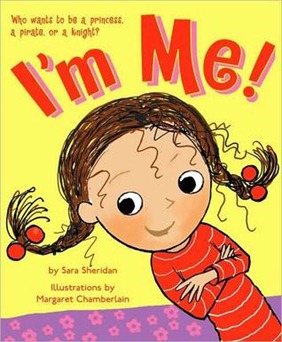
Book Review: I’m Me! by Sara Sheridan

im-me

I’m Me! by Sara Sheridan, illustrations by Margaret Chamberlain

When Imogen visits her Aunt Sara, she asks immediately to play pretend.  Aunt Sara offers to pretend that Imogen is a monkey on the beach.  Or perhaps a beautiful princess with a gown and a crown.  Or a witch’s cat with magic wands.  Or a pirate’s parrot searching for buried treasure.  Or a dragon-taming knight.  Or an astronaut.  But Imogen wants to be only one things today, herself!  So she and her Auntie Sara head to the park, play on the swings, eat ice cream, and then curl up on the couch together to share some stories.

Sheridan has created a book with a romping rhythm that keeps it moving quickly and merrily along.  The options that are given for different themes to play together are clever, silly and invitingly fun.  The book speaks to every child’s dream, an adult who is eager to play not only with them, but to play exactly what the child wants to play.

Chamberlain’s illustrations are done first in pen and ink on paper and then loaded into the computer to add color and texture.  This gives a pleasing combination of hand-drawn lines and deep computer colors.  The bright, bold colors and jaunty textures add zest to the title.

An invitation to play and imagine, this book is appropriate for ages 3-5.

Reviewed from copy received from Scholastic.

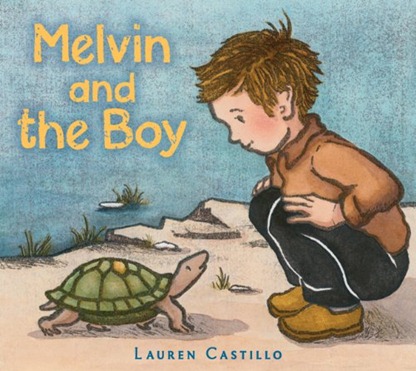
Book Review: Melvin and the Boy by Lauren Castillo

melvinboy

Melvin and the Boy by Lauren Castillo

Released July 5, 2011.

A young boy wants a pet very badly, but his parents always say no.  A dog is too big, a monkey too much work, a parrot too noisy.  One day, he sees a turtle at the park who is looking at him and follows him.  So the boy asks if he can keep it as a pet.  His parents agree, and the boy names the turtle Melvin.  But back home, Melvin won’t play.  He won’t eat.  Walking the turtle doesn’t work either.  The only time Melvin comes out of his shell is when he takes a bath.  The boy can see that Melvin is not happy in their house.  So they return him to the pond, where the boy will be sure to visit him often.

This is the first book that Castillo has both written and illustrated.  Her writing is pitch perfect here, offering just enough detail and with the right phrasing and tone.  It really feels as if a child was speaking in first person without becoming distracting.  I particularly enjoy the fact that the boy himself realizes the turtle is unhappy.  His parents follow his lead with the turtle rather than them leading him to a decision.

As always, Castillo’s art is very successful.  Her art emphasizes the urban setting of the book, playing the greens against the concrete colors nicely.  Her use of thick lines and soft colors makes for a book that is welcoming and warm.

A great addition to any story time on pets or turtles, this is also a wonderful read to start discussions about pets and keeping them safe and happy.  Appropriate for ages 3-6.

Reviewed from copy received from Henry Holt and Company.

Book Review: I Spy with My Little Eye by Edward Gibbs

ispylittleeye

I Spy with My Little Eye by Edward Gibbs

Children adore books with holes to peek through.  In this book, the frog’s eye on the cover is actually a hole that carries through the book, with the background changing as the page is turned.  The entire book is an I-Spy game where a clue is given and then you can see just a bit of the next page.  My favorite aspect is that as you turn the page, you see the next creature’s eye looking at you.  The book incorporates game play, colors, and logic with great results. 

Gibbs has a real sense of style with this book.  His illustrations are big and bold, the animals bursting off of the pages with the bright colors and the large size.  While the illustrations are large, the lines stay delicate and filled with swirls. 

This is one book that will fly off of library shelves as soon as children spy it with their little eyes.  Appropriate for ages 3-5.

Reviewed from library copy.

Also reviewed by Everyday Reading.

Book Review: If Rocks Could Sing by Leslie McGuirk

ifrockscouldsing

If Rocks Could Sing: a Discovered Alphabet by Leslie McGuirk

This is such an intriguing premise for an alphabet book!  Each alphabet along with the items that the letter stands for are shown in rocks.  The rocks were found along a Florida shore and not changed to look this way.  It is a book based on finding treasures others overlook and seeing possibilities.  The book has a simple layout, allowing the rocks to be the feature here.  It begins with A is for Addition with rocks standing in for 1, 8, = and 9.  B is for Bird with a very unique bird-shaped rock posed in a nest.  C is for couch potato, because who could ever not use this perfectly potato-like rock!  The book is a whimsical tribute to beachcombing.

It is such a simple concept that it has to be done right.  While a couple of the rocks do seem more like blobs than the object they are meant to be, others are startlingly close.  Look at the T is for Toast page, and you can almost see the whole-wheat grain in the toast slice.  The book is a delight just to page through and discover.

It is a book that will have you looking for much more than pretty seashells on your next visit to the beach!  Appropriate for ages 2-4.

Reviewed from copy received from Random House Children’s Books.

Also reviewed by Journey of a Bookseller.

Check out the trailer:

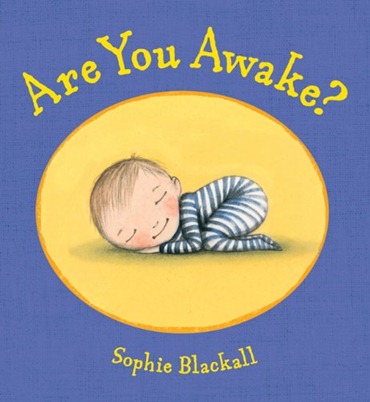
Book Review: Are You Awake? by Sophie Blackall

areyouawake

Are You Awake? by Sophie Blackall

Edward wakes up in the middle of the night and can’t sleep.  Luckily, his mother is right there though she is sleeping.  But Edward has so many questions to ask, that he can’t help but ask them right then and there.  The recurring question is “Why is it still nighttime?”  His mother has many answers for that question:  the alarm clock hasn’t rung yet, the sun hasn’t risen yet.  But Edward continues to ask a series of spiraling, looping questions that are endearing, charming and yes, enough to keep even the more tired mother awake.  As the book progresses, the two of them start talking about yellow things, and as Edward’s mother lists more and more things that are yellow, he begins to drowse, just as the room fills with the yellow light of the sun.

The conversations between mother and child in this book are so natural that all families will have some version of this story in their personal histories.  The lines of text are done in two different fonts, one for each character, so their voices are easily read aloud, but no extra words are needed.  Thanks to this, the book has a flow and ease to it that is just as charming as the conversation happening between mother and son.

Blackall’s illustrations play with the dim nighttime room, using just subtle touches of color in the otherwise black and white illustrations.  Readers with sharp eyes will notice the subtle changes as the night progresses, from a deep darkness, to blue tinged, to pinks, and finally to the bold yellow of the sunny day. 

Filled with gentle humor, clever writing and illustrations that convey the loving relationship, this book is a small gem ideal for bedtime reading snuggling under the covers.  Appropriate for ages 3-5.

Reviewed from copy received from Henry Holt.

Book Review: Bring on the Birds by Susan Stockdale

bringonthebirds

Bring on the Birds by Susan Stockdale

This is a bright and bold picture book about birds.  Written in simple, rhyming text, the book is a celebration of the diversity of birds around the world.  It shows birds of different sizes, colors and habitats.   Some are active, others sitting, and still others hang upside down.  There is a section at the end of the book that has more information on each bird as well as a list of nonfiction titles about birds for children to explore. 

The text here is so simple that it glides past.  The rhythm and rhyme is gentle and unifies the book.  The illustrations are the glory of the book offering simple backgrounds that the birds shine against.  Even in their simplicity, the illustrations manage to convey the birds’ habitat and size. 

Definitely not for the birds, this is a very successful nonfiction picture book for young readers.  Appropriate for ages 2-4.

Reviewed from copy received from Peachtree Publishers.

Also reviewed by: