Book Review: Cloudette by Tom Lichtenheld

cloudette

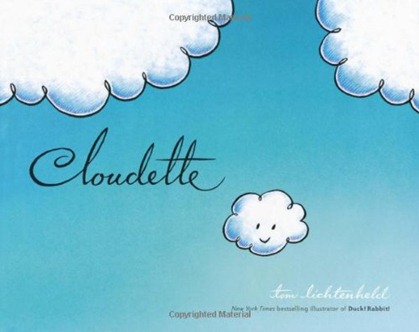
Cloudette by Tom Lichtenheld

Cloudette is the smallest of clouds.  Usually it was just fine to be the littlest.  She was called by cute nicknames, she had little friends, she was great at hiding, and she even slept in a special spot on the moon.  But sometimes, she felt left out because she was so small.  She couldn’t do the important work that the big clouds did, like storm fronts and rainbows.  She wanted to do something big herself, but all of her big ideas didn’t work out.  One day, she was blown by a storm to a new area where she had never been before.  There she found a lone frog sitting in a dried up pond.  Cloudette knew she could help, but only if she tried very, very hard.  By helping in one place, she realized that there was  a lot one small cloud could do in the world.

Lichtenheld’s text is a pleasure to read aloud.  He has included all sorts of aside comments from the clouds, Cloudette herself, and animals too.  They give the book more flavor and a stronger tone.  The small making a large impact and doing something big is an idea that is featured in a lot of children’s books. Children relate to being the smallest, being envious of what bigger people can do, and feeling powerless themselves. Cloudette is certain to speak directly to the fact that small contributions can add up to something big.

The artwork here is bright, simple and entertaining.  While some pages have a paneled look, many of them are single or double-page spreads.  Lichtenheld nicely contrasts background colors to create a book that is colorful and that will work well with a group.

Cloudette will have you cheering for her and is sure to easily create small fans.  Appropriate for ages 3-5.

Reviewed from copy received from Henry Holt & Co.

Also reviewed by:

Watch the book trailer:

Book Review: Me…Jane by Patrick McDonnell

mejane

Me…Jane by Patrick McDonnell

Jane is a girl who loves to be outside watching the animals.  She takes her toy chimpanzee Jubilee with her on all of her adventures.  They watch the squirrels, birds and spiders.  They figure out where eggs come from.  They go together up into her favorite tree to dream about being Tarzan in Africa.  Jane dreamed about a life where she could study animals, learn about them, and watch them up close.  And that’s exactly what she grew up to do as Jane Goodall, chimpanzee expert and animal activist.

McDonnell writes with a restraint that is beautiful.  He has pared down Goodall’s childhood into a few seminal moments that speak to the adult she became.  Delightfully readable, the book has only a few lines of text per page, making it very accessible for young readers.  Yet it works as a biography because those few lines carry a weight with them.

The art in the book, also by McDonnell, combines old-fashioned stamps of chickens, squirrels, clocks and more with paintings that have a whimsical warmth about them.  This gives the book a feeling that it is about the past without being specific.  The color palette works especially well here with its yellows, greens, blues and browns.

The final pages of the book have information on Goodall’s life as well as a message from Jane herself to the readers.  It’s an ideal way to end a biographical picture book written for an age that is too young for bibliographies.

A playful, winning biographical picture book that celebrates the childhood of the incredible Jane Goodall.  Appropriate for ages 4-6.

Reviewed from library copy.

Also reviewed by:

Book Review: Clink by Kelly DiPucchio

clink

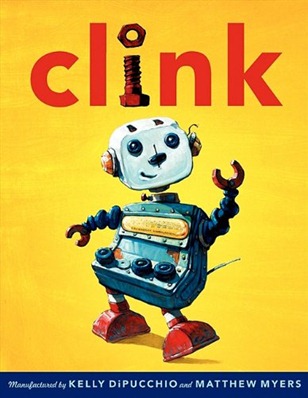
Clink by Kelly DiPucchio, illustrated by Matthew Myers

Clink used to be a new robot, but now he is dusty and squeaky.  Even his ability to make toast and play music doesn’t attract the children anymore.  Instead they want newer robots with retractable arms or the ability to bake cookies.  When Clink tried to be like the newer robots, it never worked well.  Finally Clink just gave up and hid himself away.  A long time later, a boy came to the shop and wasn’t interested in any of the new robots.  As the boy left the store, he played a song on a harmonica.  When Clink heard the music, he came to life.  He began to sing and then to dance.  But just as he caught the boy’s attention, a spring popped free and hit the boy right in the face.  Had Clink lost his chance to finally find a home?

DiPucchio has created a world where robots are cool but only if they are new.  Her writing is long enough to really describe a full world.  The book reads aloud easily and has a great built-in appeal with the charm of Clink himself on the cover and the robot theme. 

Myers helps visually build the world that DiPucchio describes so well.  His depictions of the new robots are just as whimsical as Clink himself.  I especially enjoy the hair-cutting robot that moves around on a broom and the cookie-baking robot that wheels around on a rolling pin.  Myers uses bright colors and deep colors together.  He manages to make the robots feel physical and real.

A good pick for any young robot lover, who might enjoy designing their own robot on paper and giving it some interesting capabilities too.  Appropriate for ages 4-7.

Reviewed from library copy.

Book Review: All the Way to America by Dan Yaccarino

allthewaytoamerica

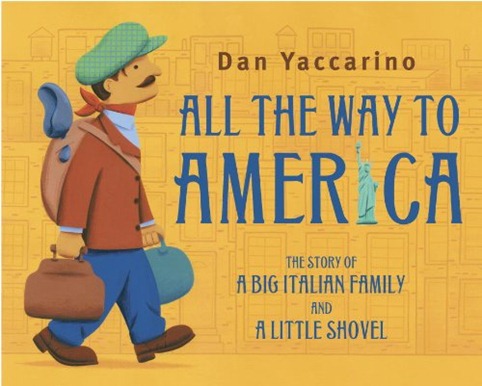
All the Way to America: The Story of a Big Italian Family and a Little Shovel by Dan Yaccarino

Yaccarino tells the story of several generations of his Italian family in this picture book.  The book starts with his great-grandfather who grew up in a farm in Sorrento, Italy.  He headed for America in search of new opportunities, leaving his parents behind.  His father gave him a little shovel, reminding him to work hard, but remember to enjoy life.  His mother told him to never forget his family.  As time goes on, Michael and his descendants used the small shovel in a variety of ways.  Michael used it at his first job in America to scoop flour and sugar.  When he opened his own pushcart, he used it to measure dried fruits and nuts.  His son Dan used the little shovel in his market.  His son Mike used it to pour salt on the icy sidewalks in front of his barbershop.  And now Dan, the author of the book, worked hard himself and uses the shovel to on their terrace to grow fruits and vegetables.

I love the use of the symbol of the shovel to tie the different generations together.  Additionally, the ways that the shovel is used by different people add an interesting piece to everyone’s story.  Yaccarino has created a vibrant picture book from his heritage that is warm, friendly and intriguing.  His writing contains just enough detail to be interesting and to evoke a specific time, but not too much for the young audience.

Yaccarino’s illustrations have a wonderful graphic nature to them that is fresh, modern yet evokes the past clearly.  Watching the features of the family change from one generation to the next is a treat.  The illustrations are filled with color to the edges of the page, making for a bright, complete world.

A great pick to use with youngsters learning about their family tree, this book would also make a good place to start off family conversations.  Appropriate for ages 5-8.

Reviewed from copy received from Random House Children’s Books.

Also reviewed by Jen Robinson’s Book Page.

You can also take a look at the book trailer:

Book Review: No Sleep for the Sheep! by Karen Beaumont

nosleepforthesheep

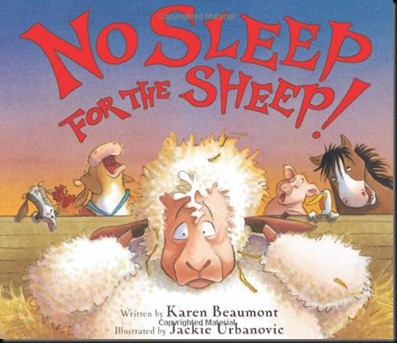
No Sleep for the Sheep! by Karen Beaumont, illustrated by Jackie Urbanovic

A very silly read-aloud that follows in the tradition of funny bedtime stories set on farms.  Here, the sheep is very tired and wants nothing more than to go to sleep.  But one by one, he is bothered by animals.  First a duck, then a goat, a pig, a cow, and even a horse.  And no one leaves for their own bed, but instead joins the sheep where he sleeps.  And in the end, just when the sheep finally is able to fall asleep, there is one last noisy animal to wake him up.  This time with a COCK-A-DOODLE-DOO!

Beaumont has created a text that reads aloud beautifully.  It has a rollicking rhythm and a pattern that repeats again and again.  This makes it ideal for toddlers and young preschoolers, who will enjoy the repetition.  The humor of the text is delightfully simple, made from the silliness of animal noises and interruptions. 

Urbanovic’s art adds a jolly tone to the book.  The fuzzy and increasingly manic sheep, the rotund pink pig, and the mounds of sleeping animals add to the fun.  The facial expressions of the animals are funny all on their own as well.

Add this to any farm story time or any bedtime story times you do.  It will be enjoyed by small children with big senses of humor looking to avoid going to bed.  Appropriate for ages 2-4.

Reviewed from library copy.

Book Review: Queen of the Falls by Chris Van Allsburg

queenofthefalls

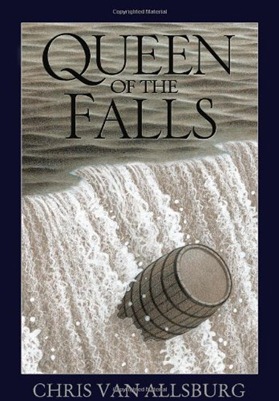
Queen of the Falls by Chris Van Allsburg

What does a daredevil look like?  What traits must they embody?  Take the first person who ever went over Niagara Falls in a barrel.  Who do you think that person might be?  I’ll bet you didn’t think of a retired charm school teacher named Annie Edson Taylor.  She decided to try for fame and fortune through her stunt.  So she had a custom-made barrel designed and created, riding it over the falls in 1901.  This picture book follows her through her decision, preparations, over the falls, and then how her chance at fame turned out.  It is a book that explores fame, courage, and stereotypes.

Van Allsburg’s writing is rich, offering more text than is usually found in a picture book.  His picture books tend to have more text and be aimed at an older audience than general picture books, so this is exactly in the vein of his previous work.  The writing offers readers a glimpse into Annie’s though process as she changed from teacher to daredevil.  So much of the story would have been lost without the writing to carry it.

Of course any Van Allsburg book is about the illustrations.  He captures moments of inspiration, times of disappointment and anger, and also what a person’s face would look like as they go over Niagara Falls.  There is a beauty to this feisty woman who would not stop because of derision from those around her.  Van Allsburg reveals her as a real heroine in his book, creating incredible moments of tension in his art.

Highly recommended, this book celebrates a vibrant, risk-taking woman who deserves to be much better known than she currently is.  Appropriate for ages 6-9.

Reviewed from library copy.

Book Review: Perfect Square by Michael Hall

perfectsquare

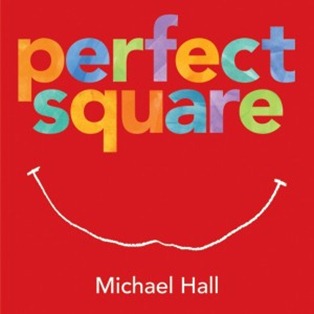
Perfect Square by Michael Hall

One perfect square is transformed again and again into something surprising and new.  On Monday, the square had holes poked in it and was cut into pieces, so it became a fountain.  On Tuesday, the square was torn into scraps, so it became a garden.  Shredded strips became a park.  Shattered shards became a bridge.  Ribbons with curves became a river.  Wrinkles and crumples became a mountain.  Until finally, the square was just a square again and had to find a way to change within its four sides.  The result?  Triumphant!

This very simple premise offers small children a glimpse at art and inspiration.  It celebrates creativity, creating something new from something ripped, crumpled or sliced.  Hall sets the perfect tone with his brief text, allowing the images to do most of the work in the book.  My favorite part of the text is that the square is the one reinventing itself rather than an outside force doing the creativity.  It changes the dynamic of the book entirely.

I can see so many art project emerging from this book.  Get it into the hands of elementary art teachers in your school district!  If you enjoy crafts with your preschool story times, share some squares of paper in a variety of colors, offer scissors, hole punches, markers and more.  You just wait to see what those children create!  Appropriate for ages 3-6.

Reviewed from library copy.

Also reviewed by Fuse #8 and There’s a Book.

Book Review: 999 Tadpoles by Ken Kimura

999tadpoles

999 Tadpoles by Ken Kimura, illustrated by Yasunari Murakami

Released May 1, 2011.

999 tadpoles are born in a small pond but when they turn into frogs, they completely run out of room to even breathe!  So mother and father frog decide they must find a new home to live in.  All of the 999 tadpoles follow their father across a big field.  He warns them about the dangers of snakes, just a moment before the little frogs come dragging a sleepy snake up to him.  They escape that danger, but don’t notice the hawk circling above them.  Down comes the hawk and grabs the father frog in his talons.  But when he flies up into the sky again, it is not just the father frog that comes along for the ride, but all of the frog family.  It’s a much heavier load than the hawk can manage, but what will happen if the frogs are dropped?

Kimura has written a book is a friendly, conversational style that is a pleasure to read aloud.  The voices of the little frogs and their parents are clear and individual.  Get ready to speak in more than one froggy voice for this book!  Kimura has also built plenty of action into his story which has adventure and dangers that will keep children’s attention.

Murakami’s illustrations create a very unique feel to the book.  Using white space to great effect, the polished yet simple illustrations have a graphic appeal to them.  With so many of the illustrations being shown from the overhead perspective, the humor of the number of little frogs is never lost. 

A book about tadpoles and frogs that focuses on fun, family, and humor.  Appropriate for ages 4-6.

Reviewed from copy received from NorthSouth Books.

Also reviewed by Kids Book Review.

Book Review: Clancy & Millie and the Very Fine House by Libby Gleeson

clancymillie

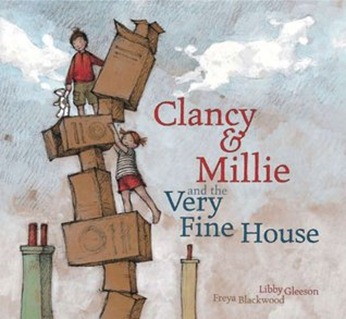
Clancy & Millie and the Very Fine House by Libby Gleeson, illustrated by Freya Blackwood

When Clancy and his family move to a new house, everyone is delighted, except Clancy.  Clancy think everything about the new house is too big.  He fondly remembers his old room, the old fireplace, the old house.  Clancy heads outside to play and discovers the huge pile of cardboard boxes left from the move.  He starts to play in them and then hears someone’s voice.  It’s Millie, a new neighbor.  The two play together with the boxes, finally building a house out of them, a very fine house.

Gleeson has captured the uncertainty of a move.  She never descends into melodrama here, instead speaking directly to Clancy’s feelings and reactions to the new home.  Children who have experienced a move, even one they enjoyed, will recognize the emotions here.  Gleeson’s use of the moving boxes as a way to deal with the move and make a new friend is very clever.  They change from a symbol of what Clancy moved away from into a symbol of what he moved to. 

Blackwood’s illustrations show the move from Clancy’s point of view.  The rooms of the new house loom, gray and empty around him.  The images from his memories are brighter and cozier, clearly contrasting with the new home.  The tower of boxes seems taller than the houses when Clancy heads outside.  The potential is there is the gravity-defying stack. 

This is a great book about moving, making new friends, and the power of imagination to create new connections and memories.  Appropriate for ages 4-6.

Reviewed from library copy.