Snow Rabbit, Spring Rabbit: A Book of Changing Seasons

snowrabbit

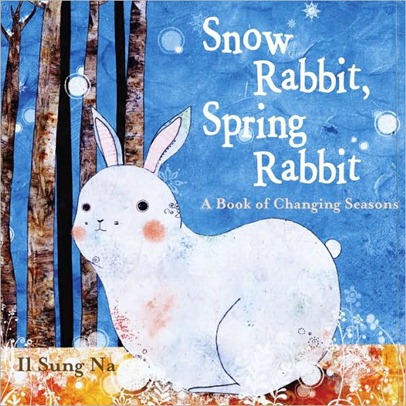
Snow Rabbit, Spring Rabbit: A Book of Changing Seasons by Il Sung Na

The author of A Book of Sleep returns with another book filled with striking illustrations.  When winter comes, all of the animals know it.  Some fly to warmer places, others take a long sleep, some swim to warmer waters, and others grow a thicker coat.  The white rabbit leads readers through so many different types of animals and how they deal with the winter season.  Then spring comes and all of the animals know it’s a new season.  That includes our friend the rabbit who looks very different now!

Il Sung Na has created a book that celebrates changing seasons with a sense of joy and fun.  Readers will see migration, hibernation, and much more in this book.  The text remains simple and straight-forward, keeping the concepts to a preschool level nicely. 

The real impact is made by Il Sung Na’s incredible illustrations that are lush, vivid and at the same time laced with a real delicacy of line and pattern.  Created using handmade textures combined with digitally generated layers, this is a sort of illustration that is stylized, modern and still welcoming and friendly.

Highly recommended, this book is a beautiful exploration of changing seasons, ideal for welcoming spring.  Appropriate for ages 2-4.

Reviewed from copy received from Random House Children’s Books.

Also reviewed by:
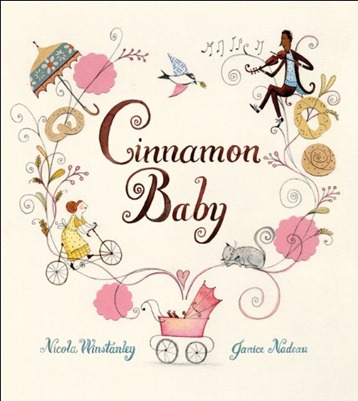
Cinnamon Baby

cinnamonbaby

Cinnamon Baby by Nicola Winstanley, illustrated by Janice Nadeau

Miriam was a baker who had her own little bakery where she made wonderful breads.  She always saved the cinnamon bread for last because it was her favorite.  As she made the bread, she sang the songs of her childhood, weaving them with the scent of cinnamon in the air.  Then one day a young man named Sebastian bought some cinnamon bread and continued to by a loaf every day for a year.  Finally, he proposed to Miriam and she said yes.  Soon a baby was on the way, but when the baby arrived it cried and cried and cried.  Nothing would settle the baby down until Miriam got a sudden idea  and headed for the bakery with her family.  She made every kind of bread with the cinnamon bread saved for last.  And what do you think happened when her voice mixed with the cinnamon and sugar in the air?

This modern magical story is simply delicious.  Winstanley’s writing is gentle and strolling, building towards the story and throughout until it is neatly tied together by the end.  There is a sense of ease, of simplicity and of love throughout the entire book that is very comforting and warm. 

Nadeau’s illustrations have a modern feel to them with their bright mix of yellows and pinks against browns and grays.  At the same time, they feel timeless with the people riding bicycles, pushing prams, and the motif of curling wrought iron. 

This sweet story has the spice of cinnamon to keep it interesting and the warmth of bread baking to keep it filling.  Appropriate for ages 4-6.

Reviewed from copy received from Kids Can Press.

The Tree House: Wordless and Wonderful

treehouse

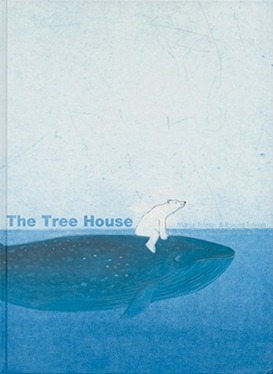
The Tree House by Marije Tolman and Ronald Tolman

This is a wordless picture book by a father/daughter team who have created a magical immersive experience.  A polar bear swims towards a tree house that stands alone in the water.  Later, a brown bear arrives in a boat.  The two bears stay together in the tree house, reading books as the sea below turns pink with a flock of flamingos.  As the flamingos pass, more animals arrive, including a rhino who bashes the trunk of the tree, two pandas, some owls, a hippo, and a peacock.  Another bear arrives via balloon and takes the peacock away.  The other animals head off, leaving the two original bears together in the tree house.

My synopsis doesn’t capture the beauty of this picture book at all, as is often the case with wordless picture books, the story is so much more about the pictures than anything that can be summarized in words.  The illustrations are simple and beautiful.  The tree house itself is unchanging, printed in exactly the same way from page to page.  It offers a consistency while the world changes around it.  The level of the water rises and falls, the sky changes colors, the seasons move.  The tree house stands, staying constant through it all, even as it supports so many animals.

There is a lovely gentle mood throughout the book.  A sense of playfulness and unexpectedness fills the story as well.  The surprise of the suddenly pink page when the flamingos arrive is visually arresting and very effective.  The colors are deep, from a blue that is almost black and perfect captures late evening to a canary yellow that sings. 

This is a book of wonder, a beautiful place to spend some moments with someone in a tree house out in the water.  Appropriate for ages 3-5.

Reviewed from copy received from Lemniscaat.

Also reviewed by:

Mirror: A Reflection of All of Us

mirror

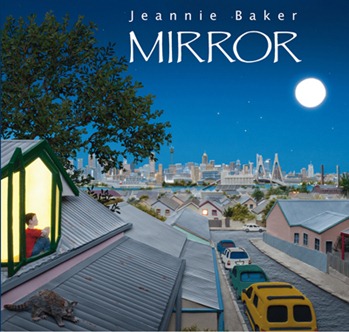
Mirror by Jeannie Baker

This book tells two stories at the same time from two distinctly different cultures.  Each story focuses on a family and a day in their lives.   One story is set in Sydney, Australia where a boy lives with his family and baby sibling.  They drive a minivan to the hardware store to get more materials to renovate their home.  The other story features a family in Morocco.  Here too a boy lives with his family and his little sibling.  They travel to the market by donkey to sell a rug, some sheep and some chickens.  That same rug is the one picked out by the Australian family at a rug store to have in their home.  The entire book is a celebration of the interconnected nature of our lives no matter what nation we live in.

The book can be read in several ways, either both stories at the same time, or each one completely separately.  It opens with the Australian story with an English introduction on the left which is read from left to right.   The Moroccan story is on the left with an introduction in Arabic.  The entire Moroccan section is read right to left just like Arabic.  Each story has its own separate pages bound together with a shared spine and cover, which I see as very symbolic of the entire book concept.

After the introductions, the bulk of the book is wordless.  Through Baker’s incredibly delicate and detailed collage illustrations, readers will discover the universal nature of the two cultures and also their differences.  Baker shows different foods, different pets, different transportation, different lands but the stories are so similar, the families so alike, that the focus is never on the differences but on the similarities.

This is a masterpiece of a picture book.  While not appropriate for a story time, it is a book that should be shared for its celebration of diversity, multiculturalism, and humanity.

Reviewed from library copy.

To get a better sense of the structure of the book, take a look at the video below:

Also reviewed by:

The Junkyard Wonders: Timely and Timeless

junkyard

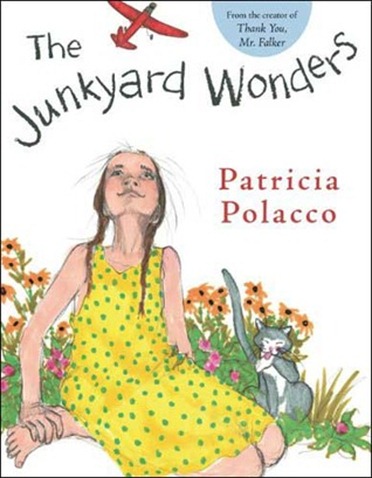
The Junkyard Wonders by Patricia Polacco

Polacco tells another very personal story of an amazing teacher in this book.  Trisha thinks she has a fresh start when she moves to live with her grandparents and father.  She expects that she will no longer be in a special needs class anymore, but in her new school she is once again in a special class.  At this school, the class is known as The Junkyard.  Happily though, it has an incredible teacher in Mrs. Peterson.  Mrs. Peterson begins the school year talking about what genius is, and continues to lead the class forward by inspiring them every day.  She allows them to create their dreams, to realize that a junkyard is place of opportunity, and to achieve and grow.  When tragedy strikes the class, they persevere on with their efforts as a tribute. 

Polacco’s books are always heartfelt and vibrantly real.  Here readers see that differences are not disadvantages and friends are not always the most likely but can be the longest lasting.  The arc of the story takes readers through a wide range of emotions, from the dismay and shame of the special class to the achievements they realize to the loss they experience together.  Her tributes to teachers and the difference the great ones make in children’s lives could not be more timely and more timeless.

As always, Polacco’s illustrations are bright and evocative.  Obviously based on real people, the characters in the book are consistently portrayed and entirely unique from one another. 

Highly recommended for all children, whether in special classes or not.  I guarantee they will all long to be part of a Junkyard class by the end of the book.  This would make a great book for elementary classrooms discussing diversity and differences.   Appropriate for ages 6-9.

Reviewed from copy received from Philomel Books.

Also reviewed by:

My Wild Sister and Me

51i0qtO7VmL

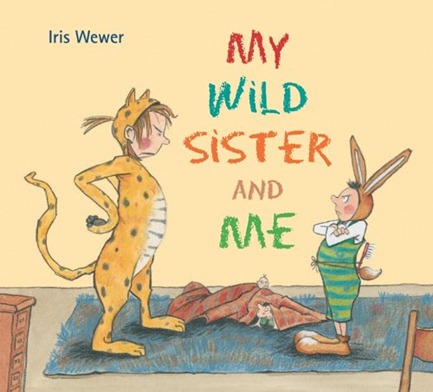
My Wild Sister and Me by Iris Wewer

Told from the point of view of a younger brother, this book is about the thrill of having a big sister who not only plays with you, but pretends to be different animals!  She is sometimes a giraffe, aloof and ignoring him.  So he is forced to be a skunk and sulk about it.  Other times, she is a bear and he can be a bear along with her.  Still other times, they are the happiest animals of all, bunnies!  They play Catch-the-Bunny, much to their mutual delight.  But when his sister’s friend comes and asks her to play with her, she leaves without a second thought.  Leaving one very sad bunny behind.  But this bunny is also clever and knows just how to tease his sister into another round of Catch-the-Bunny when she returns.

Wewer captures the sibling dynamic so well here.  From the pull of other friends for the older sibling, to the sense of abandonment for the younger, and finally the joy of playing together.  She has also nicely captured the naughtiness of children, their energy and their vivid imaginations.  It is a book that really feels just as wild and loose as its title implies.

Wewer’s art adds to the dynamic feel of the title.  My particular favorite page features the children dashing around the entire margin of the page dressed as bunnies.  The illustrations of the children plainly show their emotions, from the anger when his sister returns to the blank innocence in case he gets caught taking her toothbrush.  Priceless!

If you have children who are wild, silly and occasionally turn into animals on you, this is the book for them!  Appropriate for ages 4-6.

Reviewed from copy received from NorthSouth.

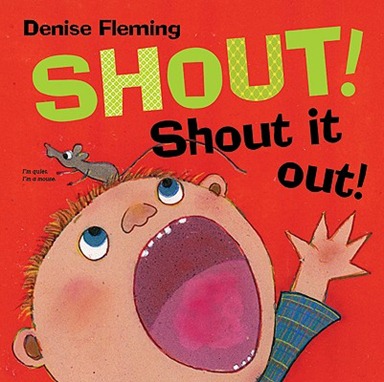
Shout! Shout It Out!

Shout-Shout-It-Out

Shout! Shout It Out! by Denise Fleming

Released March 29, 2011.

If you are looking for a book that will help with the wiggles and energy of a toddler or preschool class, this is the book for you!

Fleming takes a fast-paced rhythm that chants for children to shout out the answers if they know them.  Then she runs through numbers, the alphabet, colors, animals and vehicles.  A little mouse makes aside comments throughout the book as well.  The illustrations are classic Fleming with  bright colors, large format, and a very active feel.

Fleming does her art in pulp painting, which gives the colors an unusual depth and a great texture.  The entire book is just as inviting and invigorating as the cover.  While the text is primarily calling for children to shout out the answers they know and then the different names of things, it shows a great restraint that really makes the book work well.

This is sure to be a hit in libraries and preschools.  I’d have it on hand for any rowdy toddler story time.  Appropriate for ages 2-4.

Reviewed from copy received from Henry Holt.

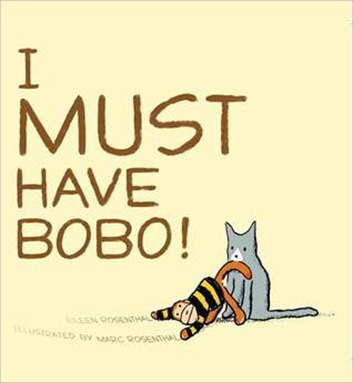
I Must Have Bobo!: Silliness to Share

imusthavebobo

I Must Have Bobo! by Eileen Rosenthal, illustrated by Marc Rosenthal

When Willy wakes up, he can’t find his beloved sock monkey, Bobo.  Willy needs Bobo to get through his day.  But Earl the cat likes Bobo too.  Willy takes Bobo away from Earl and heads off to breakfast.  But whenever Willy is distracted or busy, Earl sneaks in and grabs Bobo, carrying him off.  Willy searches high and low for Bobo, finally realizing that it must be either pirates or Earl who has taken the toy.  The book ends with a cuddle between the three of them, curled up and happy together.  Or are they?

This book is silly and great fun. The ending has a gentle twist to it, that will delight young listeners.  It will work well with a group, since it has plenty of emotion to portray, lots of laughs, and a sharing theme that children can relate to easily.  The illustrations work well with the simple text.  They have a great warmth to them, thanks to the creamy background and the rough edges.  Additionally, the book has a timeless appeal, but remains modern as well.

Recommended for cat or toy story times, this book is a pleasure to read and share.  Appropriate for ages 3-6.

Reviewed from copy received from Atheneum Books for Young Readers.

Also reviewed by

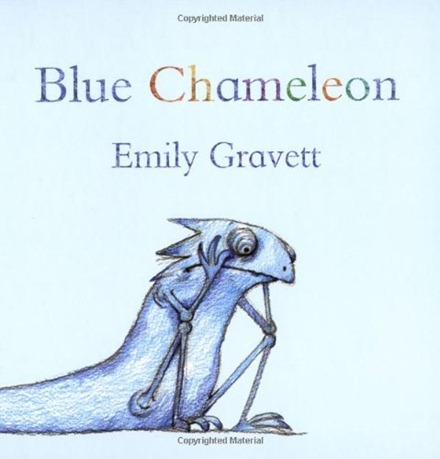
Blue Chameleon: Colorful Companionship

bluechameleon

Blue Chameleon by Emily Gravett

Gravett’s latest is a charmingly simple picture book that showcases her illustrations.  The featured character in the book is a chameleon who is feeling blue because he is lonely.  So he sets off to find a friend.  As he meets different objects and animals, his color changes to mimic theirs.  He turns yellow like the banana.  He turns pink like the cockatoo.  He even turns spotty like a ball and striped like a sock.  But he just can’t find a friend.  As he mopes gray on a rock and then disappears white against the page, he finally finds a friend who is just as colorful as he is.

Gravett has created a book about colors where the colors are a vital part of the story being told, making it very different than some picture books about colors that don’t read nearly as naturally.  Adding to the appeal is the emotive chameleon himself and his attempts at making friends.  Children will get the humor of the situation, love the moment he begins to show patterns, and also will relate to making friends.

Gravett’s illustrations and text work well together.  The bulk of the text is just the color and the object the chameleon is interacting with.  The chameleon also makes friendly comments to the potential friends, adding a welcome touch of more humor to the title.  The illustrations are bright, large and will work equally well with groups or reading to one child.

Highly recommended for any library’s colorful shelves, this book will be enjoyed by any preschooler or toddler.  Appropriate for ages 2-4.

Reviewed from copy received from Simon & Schuster.

Also reviewed by: