Ribbit Rabbit: Great Rhyming Fun

ribbitrabbit

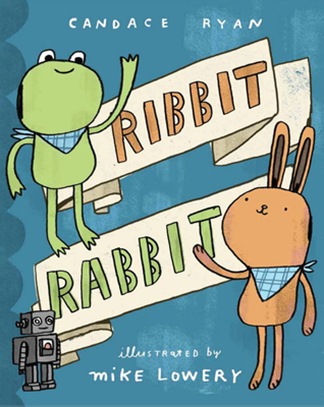
Ribbit Rabbit by Candace Ryan, illustrated by Mike Lowery

Frog and Bunny are the best of friend.  They swim together.  Fight monsters together.  Even share peanut butter sandwiches.  But sometimes something happens and they stop getting along.  Like when they find a robot with a key.  One of them ends up with the robot, the other with the key.  And they don’t want to share.  After a bit of alone time though, they come together ready to share and have fun once again.

Ryan’s text is such fun to read aloud.  It trips, gallops, dashes and dances on the tongue.  The rhythm of the book is a delight and the silly rhymes add joy to the book.  It is impossible to read it without grinning. 

Lowery’s illustrations have a wonderful modern, fresh feel to them.  Done in pencil, screen printing and print gocco, they are finished digitally.  They have a simplicity that works well here.  The soft colors have an intriguing pop to them and the texture from the screen printing adds to the appeal.

Highly recommended, this is a top choice for toddler and preschool story times.  Appropriate for ages 2-4.

Reviewed from ARC received from Bloomsbury.

Also reviewed by The Bookbag and Young Readers.
Little White Rabbit: Masterful Simplicity

littlewhiterabbit

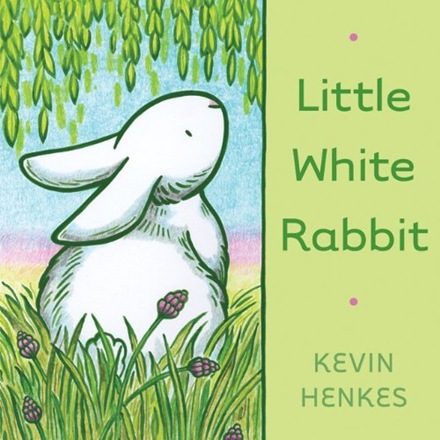
Little White Rabbit by Kevin Henkes

Little White Rabbit set off filled with imagination.  As he hopped through the grass, he wondered what it would be like to be green.  When he went by the fir trees, he wondered what being tall was like.  When he hopped over the rock, he wondered about how it would feel not to be able to move.  When he saw the butterflies, he imagined being able to fly.  But when he saw the cat, he got too scared to imagine anymore.  He hurried back to his family and didn’t stop wondering and imagining.

Henkes is a master of the picture book format.  The simple words here carry the story beautifully, giving just enough detail to keep the book moving.  The focus on wondering and imagining is one that will have young minds wondering along with the book, exactly what I love to see in any picture book. 

The illustrations, done in colored pencil and acrylic paint, are also simple.  They are nice and large, which will work well with a group of preschoolers.  The simplicity speaks to the skill of Henkes as an illustrator.   The double-page spreads of the imaginings of Little White Rabbit offer lots of exploration, moments of quiet, and space for young children to have their own daydreams too.

Simplicity by a master of the genre, this book will be adored by Henkes’ many fans and will find new fans too.  Appropriate for ages 3-5.

Reviewed from library copy.

Also reviewed by Brimful Curiosities.

Check out the video about the making of this book:

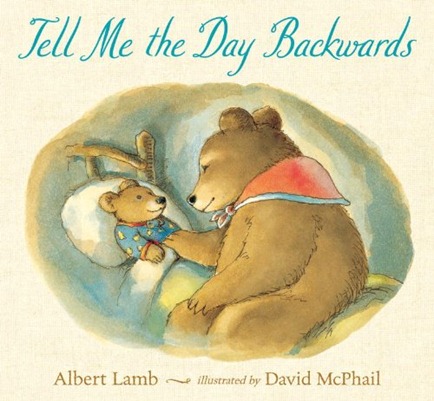
Tell Me the Day Backwards: A Bedtime Charmer

tellmebackwards

Tell Me the Day Backwards by Albert Lamb, illustrated by David McPhail

Released March 22, 2011

Timmy Bear and Mama play a game before he goes to sleep.  They tell each other their day backwards.  The story they tell one another is filled with special moments together like watching the sunset and having a picnic.  Then there are moments of fear, and told backwards they make it even more of an event.  The story builds nicely as readers discover exactly what led to Timmy Bear jumping from a high rock into the river.  The story ends as it began, with Timmy Bear in bed and Mama at his side, creating a beautiful circle of a story. 

Lamb’s writing here has such a gentle feel, it is perfect for a bedtime story.  The adventure portion in the middle keeps this from being too soft and gentle, adding a great story arc to the book that is sure to have young readers listening intently.  The exchanges between Mama and Timmy in the book have a touch of humor and a great deal of love. 

McPhail’s art captures the story with his usual style.  His illustrations are soft watercolors that work for both the active portions of the book and the slower parts.  He manages to capture so much emotion, action and movement in only a few lines.  The illustrations are simple and lovely.

This book belongs in every library and will make a wonderful gift book for toddlers who just may have similar adventures in a given day.  After reading the book it is impossible not to want to tell your day backwards, so if sharing with a group, you may have to have an activity of writing or drawing their day backwards.  Appropriate for ages 2-4.

Reviewed from ARC received from Candlewick.

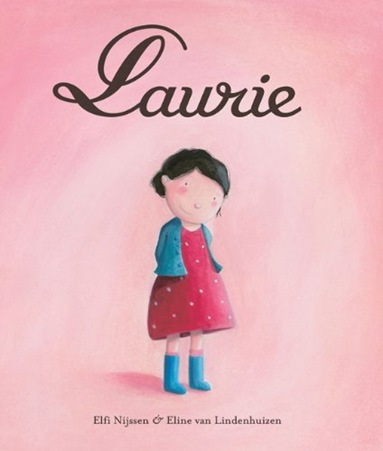
Laurie: A Picture Book About Hearing Loss

41ZwG5oVdZL

Laurie by Elfi Nijssen & Eline van Lindenhuizen

Originally published in Belgium and Holland, this tremendously sweet book takes a straight-forward approach to the story of Laurie, a girl with hearing loss.  Laurie has trouble hearing other children, so she usually plays alone.  The others tease her about being deaf and refuse to play with a girl who can’t understand them.  Laurie’s dog doesn’t mind that she’s different from the others.  Finally one day, Laurie and her mother go to the ear doctor.  He discovers she needs hearing aids, or “hearing computers” as Laurie calls them.  Now Laurie can hear cars coming, plays happily with others, and pays better attention in class.  Sometimes though, she still likes the quiet and turns her hearing aids off just to return to the silence. 

Nijssen’s writes as an author who has experienced hearing loss herself.  This makes the emotions and struggle of Laurie very real.  The book doesn’t shy away from conflicted feelings and one of the nicest parts is when Laurie decides to turn her hearing aids off or down once in a while.  It makes for a lovely moment that shows that being different was not the problem, being misunderstood was.

Lindenhuizen’s art is simple and friendly, depicting Laurie separated from the other children at first and later connected with others.  She uses space on the pages very successfully, emphasizing the spirit of the text visually.

A great pick for units on differences and diversity, this book is friendly and straight forward.  Appropriate for ages 4-6.

Reviewed from library copy.

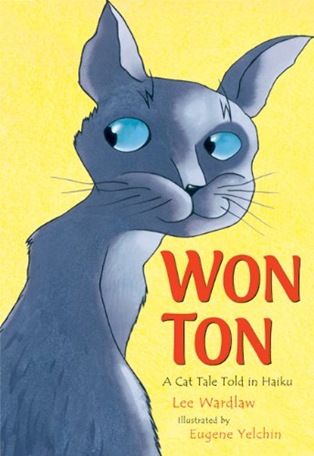
Won Ton: A Cat Tale Told in Haiku

wonton

Won Ton: A Cat Tale Told in Haiku by Lee Wardlaw, illustrated by Eugene Yelchin

This picture book is told in a series of haiku poems.  The poems form the only text in the book, charmingly telling the tale of Won Ton, a cat saved from the animal shelter by a boy and his family.  Once rescued, Won Ton demonstrates that he is pure cat.  His aloof yet cozy manner is captured to perfection here in the poems.  The book is in turns touching, beautiful, wistful and very funny.

Wardlaw’s haiku read as if they were effortlessly written.  In a few words and syllables, he captures the life of a cat and the humor of life.  It is a book that celebrates poetry, making it approachable and understandable for children.  At the same time, he speaks to the power and connection in animal adoption. 

Yelchin has illustrated the book with a playful flair.  The graphite and gouache illustrations are bright and large, making them well suited to sharing with a group.  Anyone with a cat in their lives will recognize the poses, the reactions and the attitude that Won Ton displays.

A perfect book to share in a poetry unit, this book is appropriate for ages 5-8.

Reviewed from copy received from Henry Holt and Company.

Also reviewed by Fuse #8 and Wild Geese Guides.

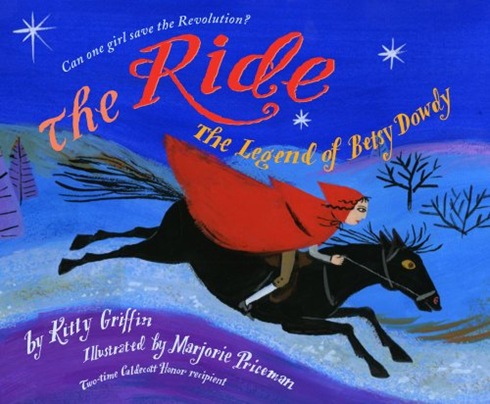
The Ride: The Legend of Betsy Dowdy

51cp3FCfmKL

The Ride: The Legend of Betsy Dowdy by Kitty Griffin, illustrated by Marjorie Priceman

The story of Betsy Dowdy has been part of an oral tradition for over 200 years.  While she may not have existed, this is a wonderful American story of bravery and determination.  Betsy was 16 years old in 1775 when the news came of the redcoats marching to Great Bridge to take ponies and supplies.  There was no hope that anyone could make it to General Skinner’s militia fifty miles away in time to bring aid.  But Betsy could not help in other ways.  She couldn’t fight.  But she could ride.  So despite the danger and the dark, she set off riding her trusty pony, Bess.  The ride was not easy.  They had to swim across a channel in December, and that was the start of the ride.  Betsy had to endure packs of dogs, ice cold temperature, and falling from Bess several times.  But in the end, she got to the general in time.  The day was saved thanks to one brave girl and her tireless pony.

Betsy Dowdy is a girl version of Paul Revere.  Griffin writes with great historical details, that bring the time period to life.  But it is Betsy herself who is the focus of this book.  Wonderfully, Betsy’s fear is allowed to show and her desperation and fatigue.  She is a very human heroine and because of that she is all the more impressive. 

Priceman’s illustrations are filled with deep colors from the purple of the frightening forest to the deep blue of the river.  Done in gouache and ink, the illustrations are wonderfully dramatic, conveying motion forward in a variety of ways.  One of my favorite images is Betsy riding into the dawn of the new day, the colors changing as she moves through the setting.  One feels the sudden surge of hope that light brought.

A powerful story of girl power that should be used in American Revolution units with elementary children.  Girls will enjoy a story that includes more action than sewing or rolling bandages.  Appropriate for ages 4-7.

Reviewed from copy received from Atheneum.

Also reviewed by The Fourth Musketeer and Kiss the Book.

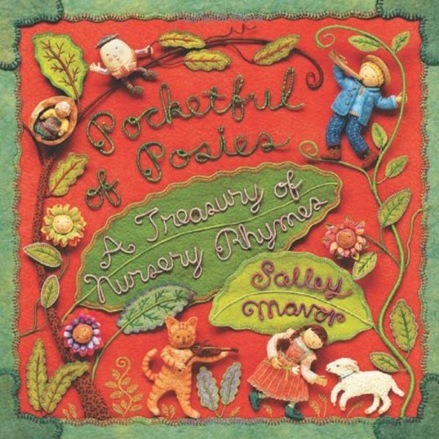
Pocketful of Posies: A Treasury of Nursery Rhymes

6175eO6wypL

Pocketful of Posies: A Treasure of Nursery Rhymes by Salley Mavor

This book contains classic nursery rhymes like “Baa Baa Black Sheep” and “Mary Had a Little Lamb.”  The text is unchanged from the classic style, making this book a reassuring one to share with children.   The surprise and wonder of the book is its illustrations.  Done in fabrics and threads, the illustrations have a great dimensionality to them, lifting off of the page.  There is also an almost irresistible urge to try to feel the fabric’s softness on some pages.  If you look closely, you will find other objects in the illustrations as well:  small shells, acorn caps, pine cones. 

The bright colors make the book immediately appealing.  The softness of the illustrations, created by the fabric, continue to add to the appeal.  This becomes more than a book of nursery rhymes and turns into a book that can be pored over time and again.  It is a refreshing and interesting style that is timeless and lovely.

Highly recommended, this would make a gorgeous baby gift.  Stand it up in the library facing out, and it won’t take long for someone to whisk it away to check out.  Appropriate for ages 1-3.

Reviewed from library copy.

Also reviewed by: Young Readers.

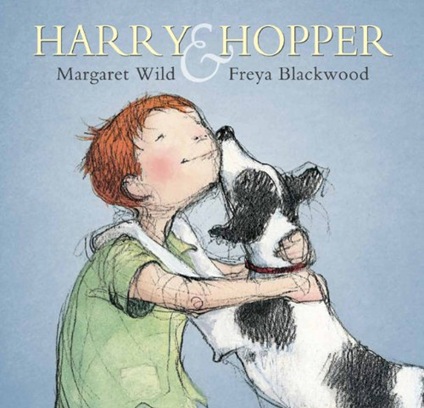
Harry & Hopper

51DqYCgE7UL

Harry & Hopper by Margaret Wild and Freya Blackwood

Harry got Hopper when he was a jumpy puppy.  He taught him to sit, stay and play ball.  The two of them were inseparable.  Hopper even slept with Harry, moving from the bottom of the bed to the top over the course of the night.   But then Harry came home from school and Hopper wasn’t there.  His father broke the news of the accident gently to Harry, explaining that Hopper had died.  Harry couldn’t sleep in the bed he shared with Hopper, so he started sleeping on the couch instead.  At school, Harry couldn’t tell anyone about what had happened.  That night, Harry was awoken from sleeping on the couch by a dog leaping by the window.  It was Hopper!  The two of them spent the night together playing.  The same thing happened night after night, but Hopper was getting less solid and less warm.  Eventually, Harry had to say goodbye to Hopper.

This book should come with a box of tissues.  Sniffle.  Wild depicts the bond between boy and dog with a clarity that makes it very tangible and real.  The loss comes quickly and without prelude, jarring the reader.  As Harry moves through his grief, the return of Hopper brings that process into a similarly tangible state.  The slow disappearance of Hopper over the nights, depicts the acceptance of loss.  Harry’s grief never comes to full resolution, something that is particularly beautiful about this book and its writing. 

This book won the Kate Greenaway medal for its illustrations, and rightly so!  Blackwood’s illustrations are done in laser print on watercolor paper with watercolor, gouache and charcoal.  They have a charm to them that is emphasized by the use of lines to slow motion.  Additionally, the shadows that appear with the grief add to the darker feeling of that section of the book.  Through it all, there is a warm light in the darkness, often provided by Harry and Hopper themselves. 

A beautiful book of loss and grief, this book deserves a spot in libraries where it is sure to find an audience.  Perhaps offer a Kleenex as a bookmark upon check out.  Appropriate for ages 4-6.

Reviewed from copy provided by Feiwel and Friends.

Check out a gallery of the illustration on the Guardian website.

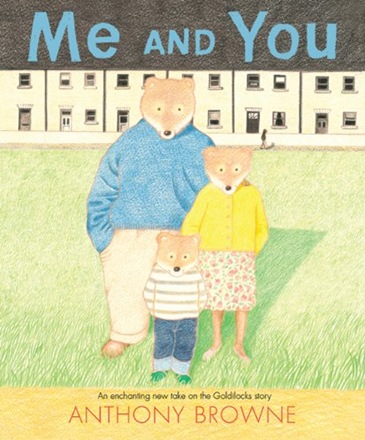
Me and You: A Glorious Goldilocks

518fiHZWXbL

Me and You by Anthony Browne

This is a version of Goldilocks that is sure to make readers think.  The story of Goldilocks is told opposite that of the Bear family.  Goldilocks comes from a rough part of town, complete with broken windows and graffiti.  After chasing a balloon that gets away, she finds herself in front of the Bears’ home.  It’s a pretty yellow home, obviously comfortably middle class.  The Bears have headed out for a walk in the neighboring park, chatting about work, the home and the car.  When they return, they find that their house has been disturbed.  From here the story continues in the traditional way.  Goldilocks flees the house, finding her way home to the arms of her mother.  This is a Goldilocks tale that will have readers thinking.

Browne has created a book that emphasizes the differences between Goldilocks and the Bears.  The Goldilocks story is told in wordless format with a very realistic feel and muted colors.  In many of the images the only bright color is Goldilocks’ hair.  Contrasted with that are the images of the Bears.  Shown in pastels done in a much softer line, the images are comfortable and bright.  But readers’ eyes are sure to wander back to the darker side of the page and Goldilocks.

Is Goldilocks the villain that has been portrayed in the past?  Is she a greedy little girl who wants the items of some poor bears?  Not here.  Here Goldilocks may be homeless, is definitely in need of warmth, and is lost.  This book turns the tale on its head, creating a heroine out of a lost girl and questioning the motives of the comfortable bears.

This is an important look at a fairy tale that asks modern questions.  I’d recommend using it with other versions of the same story and saving this one for last.  It is certainly a book that will have young listeners talking.  Appropriate for ages 4-6.

Reviewed from copy received from Farrar Straus & Giroux.