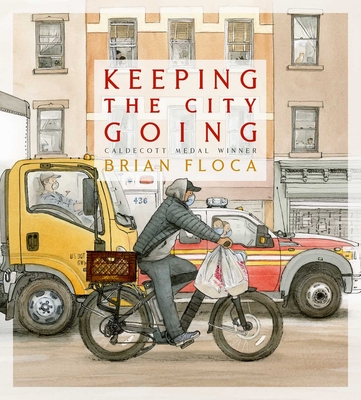
Keeping the City Going by Brian Floca

Keeping the City Going by Brian Floca (9781534493773)

This picture book by Caldecott Award winner Floca explores the Covid-19 pandemic. Through New York City streets, the book shows how most people were forced to stay indoors and watch the streets go quiet. But the streets never emptied entirely, since there were people working at essential jobs. People were still out and about using all sorts of vehicles. There were people delivering mail and packages, people heading to work in hospitals, others making food deliveries on their bicycles, still others picking up trash, and police and fire protecting everyone. Then every night, the windows opened and people shouted and banged their appreciation for these people who kept on working through the danger and the emptiness to keep everyone safe, fed and looked after.

The text in the book is simple, explaining what happened to cause the streets to empty as people took refuge in their homes to stay safe. The book shows vehicles of all sorts but also shows lovely moments of connection, of toys being delivered or taxis stopping to get someone with lots of grocery bags.

Floca tells us in his Author’s Note that he created these images during the pandemic’s height in New York City. As the streets emptied, he found solace in drawing the vehicles that continued to move through the city. He then took those images and made them into this book, which explains the aching melancholy of some of the images as they show the empty streets and the vast change to a normally bustling city.

A beautiful yearning look at New York City in 2020 with plenty of interesting vehicles to explore. Appropriate for ages 3-5.

Reviewed from copy provided by Atheneum.

Amira’s Picture Day by Reem Faruqi

Cover image

Amira’s Picture Day by Reem Faruqi, illustrated by Fahmida Azim (9780823440191)

It is Eid tomorrow, and Amira is thrilled. She gets her hands decorated by mehndi designs that she has to let dry from green to a rich brown. They also get to miss school tomorrow! Amira is happily helping her family make goody bags for the children at the masjid, when she sees the notice about tomorrow also being Picture Day at school. The class was going to be photographed all together and now Amira would miss it. The next morning, Amira got ready for Eid but still longed to wear the dress she had picked out for Picture Day. Once they were at the masjid, Amira was swept up in the celebration of Eid with lots of food, hugs and sharing of goody bags. But when the celebration ended, she once again thought about Picture Day. On their way home, Amira had a big idea that involved the leftover goody bags and maybe going to Picture Day after all.

Faruqi shows the push and pull of being Muslim in a country like the United States where children must miss school to celebrate holidays like Eid. When Eid which is based on the lunar calendar, falls on an important day at school, it can be very difficult for children. That’s what happens with Amira in the story and her navigation of it shows the tension between loving her family and her faith but also wanting to be part of her school community too. The book shows various parts of Eid without minimizing Amira’s wishing to be at school too.

Azim’s illustrations are bright and colorful. She shows the diversity in both the Muslim community as well as at Amira’s school. She creates great facial expressions as Amira navigates having to go to Eid and potentially miss out on Picture Day. Readers will clearly understand her happiness, wistfulness and pleasure at being able to find a solution.

A strong addition for school and public libraries that celebrates the diversity of children in our communities. Appropriate for ages 4-7.

Reviewed from copy provided by Holiday House.

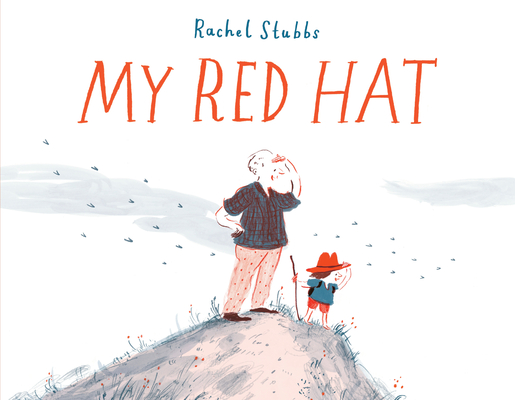
My Red Hat by Rachel Stubbs

Cover image

My Red Hat by Rachel Stubbs (9781536212716)

A grandfather gives his red hat to his granddaughter. He explains the amazing things that the hat is capable of. It can make you stand out in a crowd or blend right in. It can keep you warm and dry or keep you cool in the sun. It can be used for serious and silly reasons. Wearing the hat, you can go anywhere you like: low, high or on real adventures, until you are ready to come back home again. It is your hat.

Stubbs takes a very simple and familiar event, the gifting of a hat into a level of wonder and dreams in this picture book. Using very simple language, she has created a book that reads aloud brilliantly. The pace manages to be both fast and rather dreamy, revealing new opportunities that the hat provides at each turn of the page. It is the relationship between grandparent and grandchild here that is beautifully portrayed while never being overtly discussed in the text.

The illustrations are done in a limited color palette with teal, red and pink the primary colors. On each page, the red pops out, focusing on the hat itself. The illustrations have enough details to linger over, particularly the crowd scenes that fill double-page spreads.

A warm look at the role of grandparents to inspire discovery and self-esteem. Appropriate for ages 2-4.

Reviewed from e-galley provided by Walker Books.

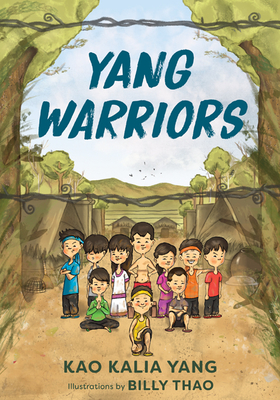
Yang Warriors by Kao Kalia Yang

Cover image.

Yang Warriors by Kao Kalia Yang, illustrated by Billy Thao (9781517907983)

In the Ban Vinai refugee camp, there is a group of young warriors who train together. They run drills, balance rocks on their heads, meditate and wield branches as sacred swords. They are led by Master Me, a ten-year-old who teaches them. One day, Master Me meditated and decided that the warriors must leave camp and forage for greens. But no Hmong person was allowed to leave the camp without permission. People had been beaten for doing it and some had even disappeared. But Master Me was set on carrying out the mission. The narrator of the story is a young girl whose older sister was in the warrior group. She was 7 years old, scared but determined to carry out the mission. That day, the warriors stealthily left camp and returned carrying morning glory greens. Many were injured on the mission, but that day they became more than children playing at being warriors and became true heroes to everyone in the camp.

Yang tells the story of life in a Hmong refugee camp through the eyes of her childhood self. The hardships, violence and rules of being in such a camp are foundational to the overall story, though not the direct focus. The tale really is about the power of children to be heroes for their families, the determination and courage to take action in the face of injustice, and the way that real life heroes are so much more important than those with capes.

The illustrations by Thao are unique and interesting. He makes each of the children recognizable even though they move as a group of warriors. He uses interesting frames throughout the images, showing the children through doorways or from the fire itself as danger increases. The illustrations are stirring and also show just how young these children were.

A tale of child heroes in a Hmong refugee camp that is worth cheering for. Appropriate for ages 4-7.

Reviewed from copy provided by University of Minnesota Press.

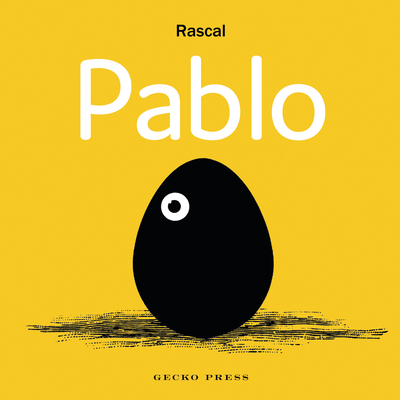
Pablo by Rascal

Cover image.

Pablo by Rascal (9781776573240)

Highly stylized, this picture book focuses on Pablo, a baby bird who is ready to leave the egg. But Pablo is going to do it in his own unique way. After a breakfast of croissant and hot chocolate, he gathers his strength. He is too big for his egg now, so he must break out. First, he creates one hole, just the right size for his eye. He looks all around and then creates a second eye hole so he can really see out. He pecks two holes, one on each side of the shell so that he can hear what is happening around him. Then one hole for his beak so he can smell soil and flowers. The sixth and seventh holes are for his legs so he can wander. Then holes eight and nine are just right for his wings to come out. Pablo is entirely free of the shell, but he saves a piece just in case.

Visually arresting, this Belgian picture book features a pure black egg on a white background. Subtle shading and clouds move past, but the focus and each page center around Pablo himself as he steadily frees himself from the egg shell. The book steadily counts the number of holes that Pablo makes and is marvelously absurd has he continues far longer than most readers might think, staying in the shell and creating holes.

The art is simple and very funny. Perhaps most delightful is the final reveal of Pablo freed from the black egg, looking nothing like what one might have expected.

For the toddler, preschooler or parent who appreciates a bit of the surreal. Appropriate for ages 2-4.

Reviewed from copy provided by Gecko Press.

Spin a Scarf of Sunshine by Dawn Casey

Cover image.

Spin a Scarf of Sunshine by Dawn Casey, illustrated by Stila Lim (9781782506584)

On her family’s small farm full of sheep, bees and chickens, Nari had a lamb of her own. All year, the lamb grew and got more wool. In spring, it was time to shear the sheep and Nari’s sheep was sheared too. Nari washed the wool, carded it, and spun it into yarn. She gathered marigolds from the garden and they dyed the yarn sunshine yellow. Nari knitted the yarn into a scarf just in time to wear it in the winter. Eventually, her scarf got tattered and worn, so Nari put it in the compost bin where the worms would break it down into rich earth. She returned the compost to the ground to help the green grass grow, just in time to feed a new lamb.

Casey’s picture book focuses on the beauty of a quiet cottage life full of farming and animals. She shows how clothing is created from sheep to wool to yarn to cloth in a way that shows how long it takes and how much dedication as well. The book celebrates the cycle of farm goods from animal to item and back to the soil. It also celebrates traditional crafting and a slow, full life in touch with the seasons. Her writing is simple and also offers the sounds of that activity or season.

This is Lim’s first picture book. She shows the beauty of cottage life and the countryside. Her watercolors fill the pages with rich outdoor colors, from early spring green grass to the bounty of autumn to snowball fights in winter. Each season is celebrated for its colors, its feel and its beauty.

A good beginning look at how clothing is made and what a sustainable life looks like. Appropriate for ages 2-4.

Reviewed from copy provided by Floris Books.

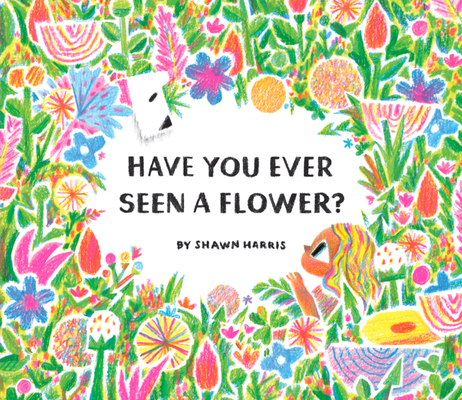
Have You Ever Seen a Flower? by Shawn Harris

Cover image.

Have You Ever Seen a Flower? by Shawn Harris (9781452182704)

Award-winning illustrator Harris makes his authorial debut in this bright and flowery picture book. A little girl is the only colorful spot in her drab, gray city. She travels by car out to the hills that are covered with flowers, the same hues as her streaming hair. With her dog at her side, she asks the reader if they have ever seen a flower. Have they crawled deep in the clover to find one? Have they breathed deeply and figured out exactly what they are smelling? Have they found a flower so deep that they shouted into it and listened for an echo? The question then shifts to whether the reader has ever been a flower? With their torso as their stem, rooted in the ground, growing to the sun? Try it and see!

Harris brings young readers directly into his story with his string of questions that ask them to use all of their senses to experience nature around us, in particular flowers. He draws deep connections between flowers and children while also inviting in creativity and imagination. His wording reads aloud brilliantly, playing with near rhymes and repeating structures.

The illustrations are stunning. Done in colored pencil, the colors are neon bright while still having real depth. Harris evokes the flowering hills of California, filling them with a variety of plants and also having pages of the same plant repeating in patterns. He shifts perspective beautifully, moving from close ups of plants and the little girl to broad landscapes of color.

Perfect for spring, this is one to pluck from the shelves and share. Appropriate for ages 2-5.

Reviewed from copy provided by Chronicle Books.

The 2021 Anna Dewdney Read Together Award Winner

The Anna Dewdney Read Together Award is given annually to a picture book “that is both a superb read aloud and also sparks compassion, empathy, and connection.” The award includes a list of honor books that are listed below the winning title:

WINNER

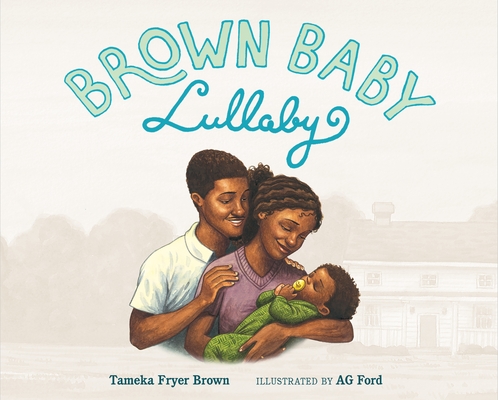
Brown Baby Lullaby by Tameka Fryer Brown, illustrated by AG Ford

HONOR BOOKS

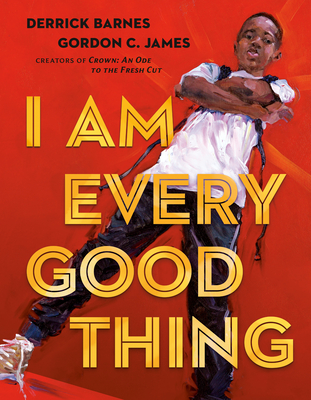
I Am Every Good Thing by Derrick Barnes, illustrated by Gordon C. James

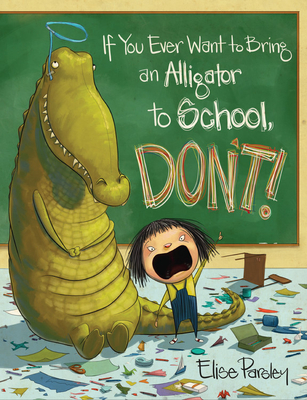
If You Ever Want to Bring an Alligator to School, Don’t! by Elise Parsley

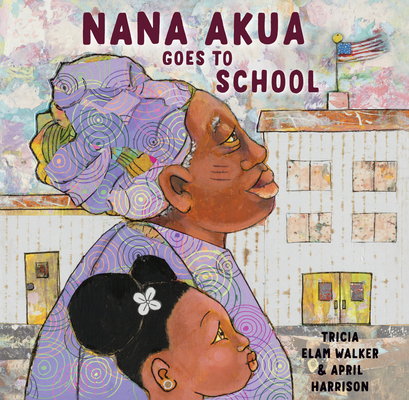
Nana Akua Goes to School by Tricia Elam Walker, illustrated by April Harrison

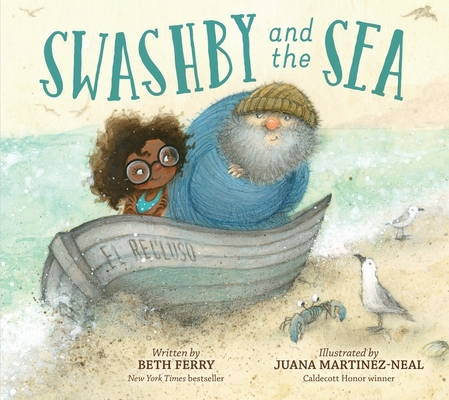
Swashby and the Sea by Beth Ferry, illustrated by Juana Martinez-Neal

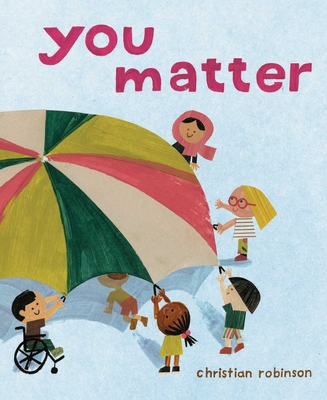
You Matter by Christian Robinson

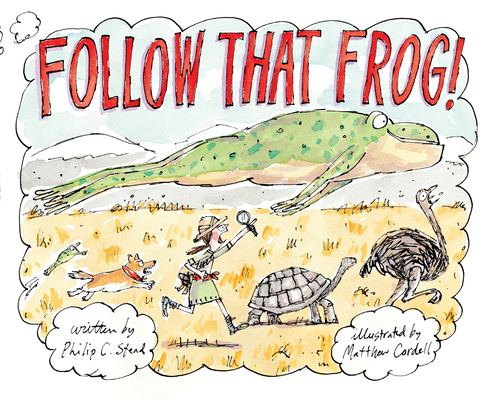
Follow That Frog! by Philip C. Stead

Cover image.

Follow That Frog! by Philip C. Stead, illustrated by Matthew Cordell (9780823444267)

The great combination of Stead and Cordell return with another energetic and funny picture book collaboration. In a house full of chickens, there is a knock on the door. Sadie rushes to wake up Aunt Josephine. But Aunt Josephine is much more interested in sharing a tale of her time in Peru cataloging amphibians for Admiral Rodriguez who recently experienced a tragic banana accident. His son was flirting with Josephine when suddenly he was swallowed by a giant frog. Josephine gave chase, trying to catalog the fast-moving frog and rather disinterested in the fate of the Admiral’s son. The frog fled around the world, through deserts aboard an ostrich, into the waters of the Panama Canal, onto the back of a whale, all to lose sight of the frog forever. But who could be at the door?

Stead’s text is marvelous, moving from the rather wordy but fascinating Aunt Josephine into her story which is fast paced and frenetic. The journey around the world is great fun, dashing along behind the huge frog. There is so much to enjoy here, including Josephine’s ignoring of the Admiral’s son in all of this, her interest in nature and the world, and the story-within-a-story structure. The ending is also a delight sure to satisfy readers.

Cordell’s illustrations fit perfectly with Stead’s writing. His merry illustrations add to the wild storyline with their large fonts. His truly huge frog is interesting as are the chickens peppered around the place. Throughout there is a sense of giggles rising to the surface.

A grand escapade of a picture book. Appropriate for ages 4-6.

Reviewed from copy provided by Neal Porter Books.