Jump at the Sun: The True Life of Unstoppable Storycatcher Zora Neale Hurston by Alicia D. Williams

Cover image

Jump at the Sun: The True Life of Unstoppable Storycatcher Zora Neale Hurston by Alicia D. Williams, illustrated by Jacqueline Alcántara (9781534419131)

As a little girl growing up in Eatonville, Zora loved to listen to stories. She listened to stories of Brer Rabbit and Brer Fox at the general store. Zora told her own stories too, to anyone who would listen. But her father didn’t approve of her storytelling, since he considered it telling lies. Her mother though, didn’t want her children growing up to till the land, so she encourage Zora to “jump at de sun.” When Zora’s mother died, she was sent to the Florida Baptist Academy boarding school. Zora loved the books there, but soon her school fees were not paid and she had to leave. She didn’t stay long with her family, quickly moving out and finding work though she kept getting fired or quitting. She only loved the times when she could spin stories. Zora decided to return to high school and graduate, so she lied about her age of 26, claiming she was 16. After graduating, she headed to Howard University and decided to become an author, writing her stories of Eatonville. So she moved to New York and eventually sent out some of her stories to a magazine contest. Zora made another leap after she got attention from winning the contest and got a scholarship to another college where she was assigned to collect Negro folklore, something she had been doing since she was a child!

Williams writes Hurston’s biography with such energy and appreciation. She takes the statement Hurston’s mother made and turns it not only into the title of the book but also into a sentiment woven throughout the entire story, showing the connection between Hurston’s success, her talent and her willingness to make leaps of faith to new opportunities. There is bravery and resilience on these pages, shining in the sunlight as Hurston takes risks in the most inspiring ways.

The illustrations are marvelously colorful, filling the pages with Eatonville, various colleges and the dynamic feel of New York City. All of the pages are full-page art, taking the color right to the edge of the page, glowing with streaming sunlight, peach, green, blue and reds.

A shining leap of a picture book biography that suits its subject perfectly. Appropriate for ages 6-9.

Reviewed from copy provided by Atheneum.
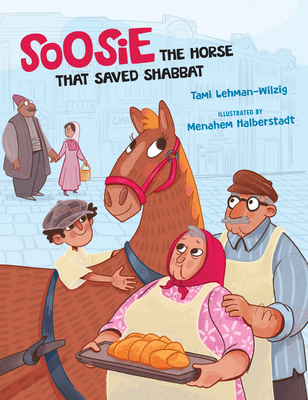
Soosie the Horse That Saved Shabbat by Tami Lehman-Wilzig

Cover image

Soosie the Horse That Saved Shabbat by Tami Lehman-Wilzig, illustrated by Menahem Halberstadt (9780998852775)

Long ago, when Jerusalem was still a small town, there was a bakery. The bakery specialized in challah, and made enough for the entire community. Jacob was the bakery’s delivery boy who drove the cart that was pulled by Soosie, the owners’ horse. The two traveled in the early morning along the cobblestone streets of Jerusalem, delivering challah. As each family paid, the coins dropped into the metal bank with a clink-clang. They did the same route, day after day, month after month. But then one day, Jacob was too sick to make the deliveries. Jacob was certain that Soosie, the horse, could make the deliveries all on her own. So they put a note on the cart and sent her on her way. Soosie stopped at each place, accepted the money in the bank, and walked on. Back at the bakery, they worried about whether Soosie could do it all on her own. Three hours passed, and finally Soosie was home again with an empty wagon and a bank full of coins.

Inspired by the history of Angel Bakery in Jerusalem, the author created a gentle folktale about dependability, challah and Shabbat. The author explains the details of Shabbat in her author notes, including the importance of animal rights as a part of Shabbat. Her writing pays homage to folklore capturing the same repeating elements as Jacob and Soosie make their regular rounds. She also uses plenty of sounds in her writing, emphasizing them and inviting participation.

The illustrations are light-hearted and merry. From the bustling bakery to the stable next door to the many people of Jerusalem they interact with. The entire book has the same quiet humor and good-natured belief in one another.

Paying homage to folklore and Jerusalem, this Jewish picture book is full of the warmth of bread and community. Appropriate for ages 3-5.

Reviewed from ARC provided by Kalaniot Books.

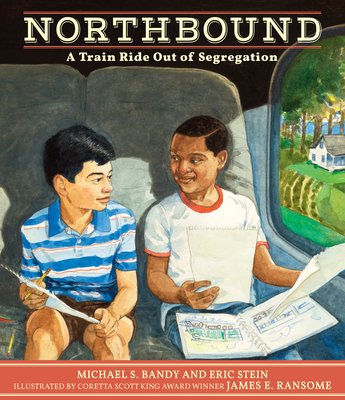
Northbound by Michael S. Bandy and Eric Stein

Cover image for Northbound

Northbound by Michael S. Bandy and Eric Stein, illustrated by James E. Ransome (9780763696504)

Michael has always stopped work to watch the trains go by the farm he lives on with his grandparents in Alabama. Then one day he gets his dream and takes a train trip north with his grandmother to Ohio to visit cousins. Though Michael has caught sight of a boy his age on the train, he isn’t allowed to go into the car where the boy is riding, because it’s closed to Black people. As the train leaves Atlanta, the “Whites Only” sign on the door is taken down and now Michael is allowed to enter the car. The two boys quickly start to play together and explore the train. They discover they have all sorts of things in common. But when the train reaches Chattanooga, Tennessee, Michael has to return to his own car and the sign goes up again. Luckily, his new friend knows it is fair and shares a final drawing of all people riding in the same train car together.

In a book that starts with the wonder of trains and the joy of a train ride, this picture book shows the impact of arbitrary race laws throughout the United States in the early 1960s. While consistent racism in Alabama is an everyday occurrence for Michael, it is the on-again, off-again rules that will catch readers’ attention as well as that of the train passengers. It clearly demonstrates the differences in the way racism impacts lives in different parts of our country, speaking clearly to today’s issues as well as that of our past.

The art by Ransome is a grand mix of train travel with tunnels, bridges and cities together with a diverse group of passengers and staff on the train. There is a sense of frustration and limits in the illustrations with the closed doors and signs that is replaced with a joyous freedom as the two boys explore the train together.

A critical look at our shared civil rights history and a call for us to do better. Appropriate for ages 6-9.

Reviewed from e-galley provided by Candlewick

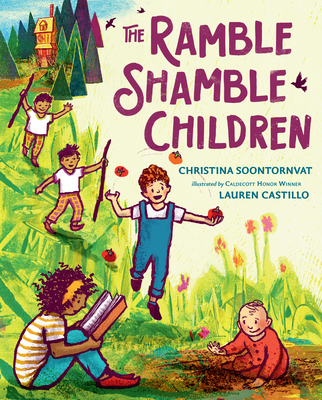
The Ramble Shamble Children by Christina Soontornvat

Cover image

The Ramble Shamble Children by Christina Soontornvat, illustrated by Lauren Castillo (9780399176326)

From two award-winning artists comes this picture book about children who are definitely not the traditional family. Merra, Locky, Roozie, Finn and Jory all live together in their “ramble shamble house.” They have chickens in the yard, a nice big mud puddle that Jory loves to play in, and a bountiful vegetable garden. Their lives are merry and busy with working in the garden together. Then one day, they discover a picture of a beautiful pristine house that is far more proper than theirs. So they set out to make their rustic house into something closer to the lovely model home. Out go the carrots to make way for rose bushes. The mud puddle is covered up. The chickens get an ornate home of their own. They even make their own chandelier. Things may be proper, but they aren’t quite right the next day. The hens refuse to use their new house, the chandelier is carried off by crows, but worst of all, Jory has disappeared. They find him in a new patch of mud, helping them all realize that they may just need to accept they are a ramble shamble family.

As the proud owner of a wild natural garden outside my front door and a house covered in vines that please me immensely, I firmly embrace being ramble shamble. With this picture book, Soontornvat proves that she can write almost anything from children’s fiction to nonfiction to picture books. Her tone here is cozy and warm, embracing the way the children live from the very first page. The hard work the children do, their closeness and care for one another, and their desire to have a proper home all speak to the importance of having a family around one.

Castillo’s illustrations show the children arriving together at the house and then show how they live together. The children are diverse and range in ages from little Jory who is close to a toddler to Merra who is an older child. The illustrations show their connection to one another, how they all help out, and the beauty of their ramshackle life they have built together.

A charmer of a picture book sure to warm the heart and ease the need for a proper life. Appropriate for ages 3-5.

Reviewed from copy provided by Nancy Paulsen Books.

Vy’s Special Gift by Ha-Giang Trinh

Vy’s Special Gift by Ha-Giang Trinh, illustrated by Evi Shelvia

Vy rushes in the morning to reach the line to get rice. She is running late, but still gets a spot. Set in Vietnam during Covid, she wears and mask and stands in line on the marked spot to be socially distanced from others. The line is very long and everyone is tired. Ahead of her in line is a woman with a baby and a small boy. Vy sings to the baby, a lullaby to get him to settle. She reads the little boy a poem of rice and rain. Then the two of them draw a picture together that they give to an older woman in line. Vy lets the woman go ahead of her in line, but when Vy reaches the end, there is no more rice. But the small kindnesses she performed in line come back to her in rice for her family.

Trinh tells this story with a real grace. She shows the poverty and need with frankness while also showing how small acts of kindness in the midst of a pandemic can make all the difference in people’s lives. The story has a genuine quality to it, the acts of kindness are thoughtful and realistic as is the final sharing of rice amongst everyone who was impacted by Vy’s kindness. The text is written in a mix of narration and speech bubbles, combined with poetry and song lyrics.

Shelvin’s illustrations embrace the mixtures of texts, highlighting the song and poem with freshly bright colors of bright pinks, yellows and blues. The majority of the book is done in a subtle color palette with golds, pale blue and gray.

A quiet and lovely look at the pandemic and everyday kindness in a crisis. Appropriate for ages 4-6.

Reviewed from e-galley provided by the author.

The Tree in Me by Corinna Luyken

Cover image

The Tree in Me by Corinna Luyken (9780593112595)

There is a tree in all of us, as this picture book so gorgeously demonstrates. It’s a tree that is apple-orange-pear-almond-plum delicious. It’s a tree of shade and sun. All parts and stages of the tree are there, from the sapling through to the trunk and the crown. It’s a tree full of creatures, like bees, squirrels and birds. The tree brings wind and rain and dirt with it. Rivers flow and the sky arches overhead. The tree bends thanks to its deep roots. It reaches to the sun. And thanks to knowing there’s a tree in me, I know there’s a tree in you too.

This picture book is written in simple poetic text that swirls on the page, inviting readers to look deeply at their own tree inside of them. The inward connection with nature itself and with our own nature within is beautifully captured here, showing that we are part of nature at a deep level. Children who are learning meditation will enjoy this new visualization of their connection with others too.

The illustrations are a huge part of this book. Done in what would seem wild colors of neon pinks and oranges, the connection to nature turns these colors into sunbeams, light in the trees, and the glow of merry playful cheeks. Paired with the black ink used in the images for leaves, trunks, weeds and grass, the colors invite us into an interior world of brightness.

A nature connection inward and outward. Appropriate for ages 3-5.

Reviewed from copy provided by Dial Books.

There Is a Rainbow by Theresa Trinder

Cover image

There Is a Rainbow by Theresa Trinder, illustrated by Grant Snider (9781797211664)

This picture book captures the experience of the Covid pandemic as we are all stuck in a place in between for months. It is a place where school is on the other side of the computer screen, where windows separate us from neighbors. But it is also a bright place, full of praise for the heroes who kept us going, phone calls with grandparents. It is a place of light, of sunsets, of time spent outdoors together. It is a place of loss, sadness and comfort. It is a storm that promises a rainbow tomorrow.

Told in simple poetic phrases, this picture book takes a frank look at the changes the pandemic brought us. While it could have stayed focused on the distance, instead it turns it around and shows the new ways we connected with others, with nature and with the promise of the future. This picture book sets just the right tone of respect for those who were lost, seriousness about the nature of the pandemic, and joy that it may pass and bring us somewhere beautiful.

Snider’s illustrations are done in bright colored pencil. The characters are whimsically drawn, while the urban landscape glows on the page. The book offers rainbows of color long before the literal one arrives at the end of the book.

Timely and quietly full of joy. Appropriate for ages 3-5.

Reviewed from copy provided by Chronicle Books.

Time for Kenny by Brian Pinkney

Cover image

Time for Kenny by Brian Pinkney (9780060735289)

Told in four short chapters, this picture book shows readers a day in the life of a small boy named Kenny. Kenny must first get dressed. He tries on all sorts of other people’s clothes, like his dad’s shirt, his mother’s shoes, and his grandfather’s hat. Then he is finally dressed and ready to go. In the next story, Kenny doesn’t like the vacuum cleaner. After all, it eats all of the food he drops. Could it eat his stuffed animal? Could it eat Kenny?! The third story shows Kenny’s sister teaching him to play soccer. At first, Kenny tries a lot, but misses. Then he starts to get the hang of not using his hands and even makes a goal. The last story is about how Kenny isn’t tired at all when it’s his bedtime, or is he?

Told in simple language, these stories show the universal experiences of toddlers and younger children. From creative clothing choices to learning new skills to having to go to bed, each of these is wonderfully accessible. The book also shows a loving Black multigenerational family, depicted with Pinkney’s signature illustrations that are full of bright colors, swirls of motion and a great use of white space.

A charming picture book that reflects a day in a toddler’s life with warmth. Appropriate for ages 1-3.

Reviewed from e-galley provided by Greenwillow Books.

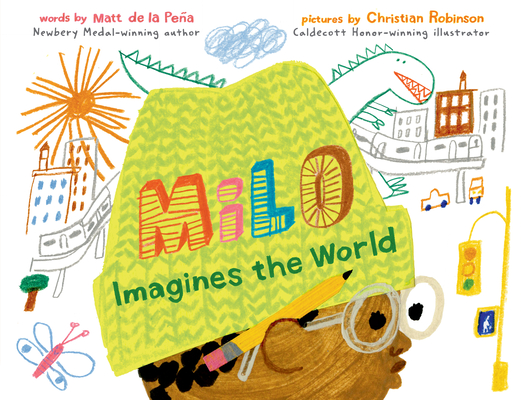
Milo Imagines the World by Matt de la Peña

Cover image

Milo Imagines the World by Matt de la Peña, illustrated by Christian Robinson (9780399549083)

The award-winning team that brought us Last Stop on Market Street have returned with another picture book together. This picture book is also about traveling on public transportation with Milo and his sister traveling on the subway together. Milo passes the time on the long ride by looking at the people around him on the subway. He imagines what their life is like and then draws it in in his book. Looking at a man with a crossword puzzle, Milo imagines him in an apartment with lots of pets. When a little boy in a suit comes on the train, Milo imagines that the boy is a prince who lives in a castle. A woman in a wedding dress, Milo pictures as soaring up in a hot air balloon after her wedding ceremony. When a group of dancers whirl aboard the train, Milo imagines that they are not welcome in stores or in fancy neighborhoods. When they reach their destination, Milo and his sister head into the prison, where he sees the boy in the suit in line too. Milo rethinks his image of the boy and all of the others he drew on his trip.

This is one of those marvels of a picture book that is told in a straight forward way and also manages to insist that readers think again, assess themselves. It is done without lecture or shaming, an exploration of assumptions made from people’s appearances and then how wrong they can be. Milo himself is a great protagonist for this, creative and thoughtful. He shows how race and economic status factors into stereotypes and how different the truth can actually be.

Robinson creates a diverse urban setting for Milo to experience, filled with people of all races. His cut paper images are full of characters of all ages and different cultures. Readers will find themselves thinking about the others on the train just as Milo does, making their own assumptions.

Another gem of a picture book from two masterful artists. Appropriate for ages 5-7.

Reviewed from copy provided by G.P. Putnam’s Sons Books for Young Readers.